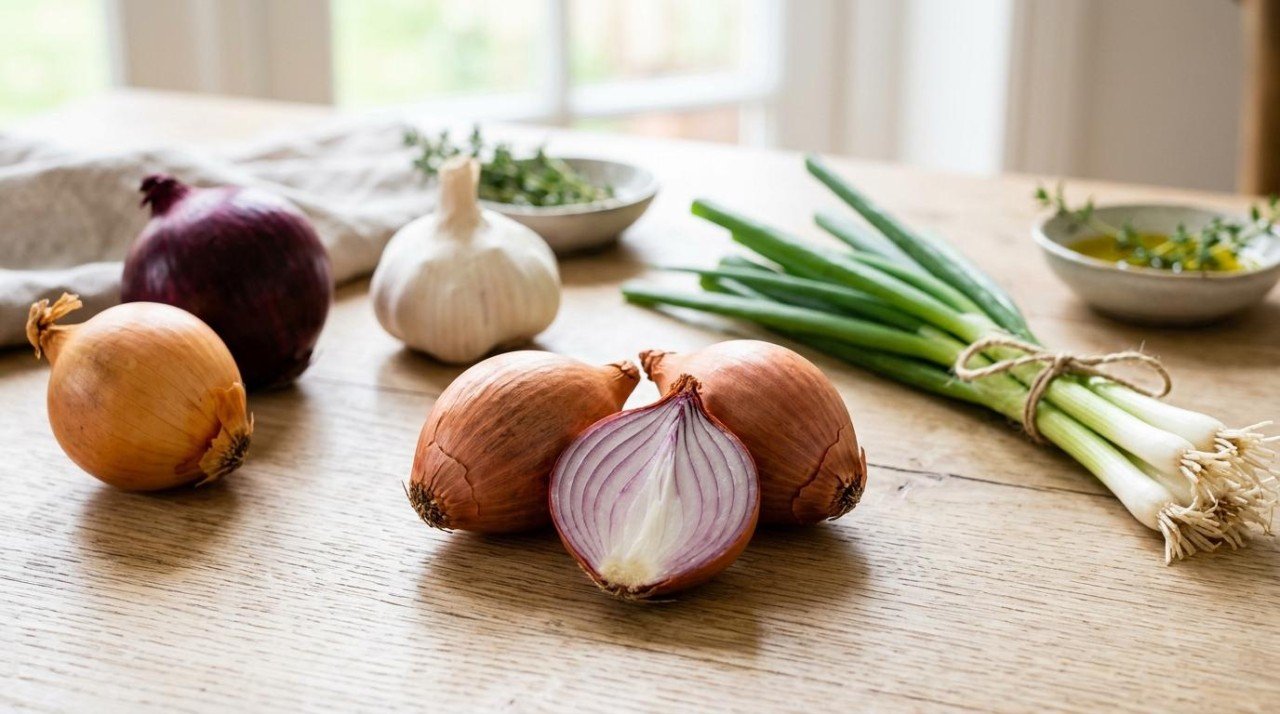
The recipe says "2 shallots, finely minced," and what is actually on the counter is a bag of yellow onions, a head of garlic, and a bunch of scallions going soft in the door of the fridge. The pan is already hot.
The good news is that shallots are one of the easier ingredients to rebuild, because what they do is not exotic. A shallot is a mild, faintly sweet allium with a soft garlicky edge — roughly what you would get if an onion and a clove of garlic met in the middle. Most kitchens already have the parts.
The mistake that genuinely ruins dinner is swapping by the unit. A medium shallot weighs about an ounce. A medium onion weighs five to eight. Drop one onion in for one shallot and you have not substituted, you have quadrupled your aromatics. So every swap below is measured, and sorted by what the shallot was going to do: melt into a sauteed base, sit raw in a vinaigrette, or fry into crisp golden threads on top.
The Quick List
- Yellow onion + a pinch of garlic — the closest all-purpose stand-in, cooked or raw
- Scallion whites — mild and quick; ideal for fast dishes and dressings
- Leeks — the sweetest, gentlest option for a slow-cooked base
- Red onion — for raw work: vinaigrettes, mignonette, salads, quick pickles
- Sweet onion — raw with no bite to tame
- Store-bought crispy fried onions — the shortcut for a fried shallot topping
- Onion powder + garlic powder — flavor without texture, for rubs and dressings
- Dried minced onion — rehydrates into something with actual bite
- Chives — raw finishing only, added off the heat
- Garlic on its own — a different dish, but often a good one
- Pearl onions or cipollini — when the recipe roasts or braises shallots whole
First, How Much Is One Shallot?
This is the number everything else hangs on, and shallots vary wildly in size. America's Test Kitchen weighed them out: a small shallot is about 1/2 ounce (14 g) and yields 1 tablespoon minced, a medium is about 1 ounce (28 g) and yields 3 tablespoons minced, and a large is about 1 1/2 ounces (42 g) and yields 4 tablespoons minced.
So treat "1 shallot" as 3 tablespoons minced and work from there. Two rules cover almost every swap:
- Cooked: match the volume 1:1. Three tablespoons of minced shallot becomes three tablespoons of finely chopped onion, leek, or scallion white.
- Raw: start with half the volume of onion and taste up. Raw onion is sharper and more sulfurous than raw shallot, and it is the one place a straight volume swap will bully the dish.
One more wrinkle: some shallots split into two or three lobes under the skin, like garlic cloves. Recipes almost always mean the whole bulb, so if you are unsure, go by weight or by the tablespoon rather than by the count.
Match the Substitute to the Job
- Sauteed base (pan sauces, soups, risotto, braises) — yellow onion + garlic, leeks, scallion whites
- Raw (vinaigrettes, mignonette, salads, quick pickles) — red onion, sweet onion, soaked yellow onion, chives
- Crispy fried topping — store-bought fried onions, or thinly sliced onion fried yourself
- Roasted or braised whole — pearl onions, cipollini, or onion wedges
Yellow Onion + a Pinch of Garlic
- Swap: 1 medium shallot → 3 tablespoons finely chopped yellow onion + 1/8 teaspoon garlic powder (or a quarter of a small clove, minced). Raw: start with 1 1/2 tablespoons of onion.
- Best for: Sauteed bases, pan sauces, braises, stir-fries, meatballs, stuffings
- Skip it for: Raw dishes, unless you halve it or tame it (see the next section)
This is the swap that covers the most ground, and the garlic is what makes it work. Onion alone lands slightly flat and one-note where a shallot would have had a little perfume; an eighth of a teaspoon of garlic powder puts the missing note back without turning the dish into garlic bread. McCormick's own conversion is 1/8 teaspoon of garlic powder per medium clove, which is exactly the quiet amount you want here.
Expect the pan to behave a little differently. Per USDA data, shallots are about 79.8% water with 7.9 g of sugar per 100 g, while onions are 89.1% water with 4.2 g of sugar (FoodData Central). Practically, that means onion has more water to cook off and less sugar to brown, so give it two or three extra minutes over medium heat before you move on. White onion works the same way with a sharper, cleaner edge — good in Mexican-style dishes, a bit brash in a delicate cream sauce.
The 15-Minute Fix for Raw Onion
If the shallot was going raw — into a vinaigrette, a mignonette, a potato salad, a scatter over tacos — the problem is not quantity, it is the harshness. There is a tested fix. Cook's Illustrated compared soaking sliced raw onion in water, milk, vinegar, and a baking soda solution, and found that a soak of 1 tablespoon baking soda per cup of water for 15 minutes worked best, beating even plain water. Vinegar stripped the burn but replaced it with sourness; milk worked but left the onion tasting washed out.
The chemistry is the interesting part: rather than just leaching compounds away, the alkaline baking soda neutralizes sulfenic acid, the precursor to the harsh-tasting thiosulfinates, so they never form. Rinse the onion thoroughly afterward or you will taste the baking soda. Fifteen minutes and a colander is the difference between raw onion that behaves like a shallot and raw onion that takes over the salad.
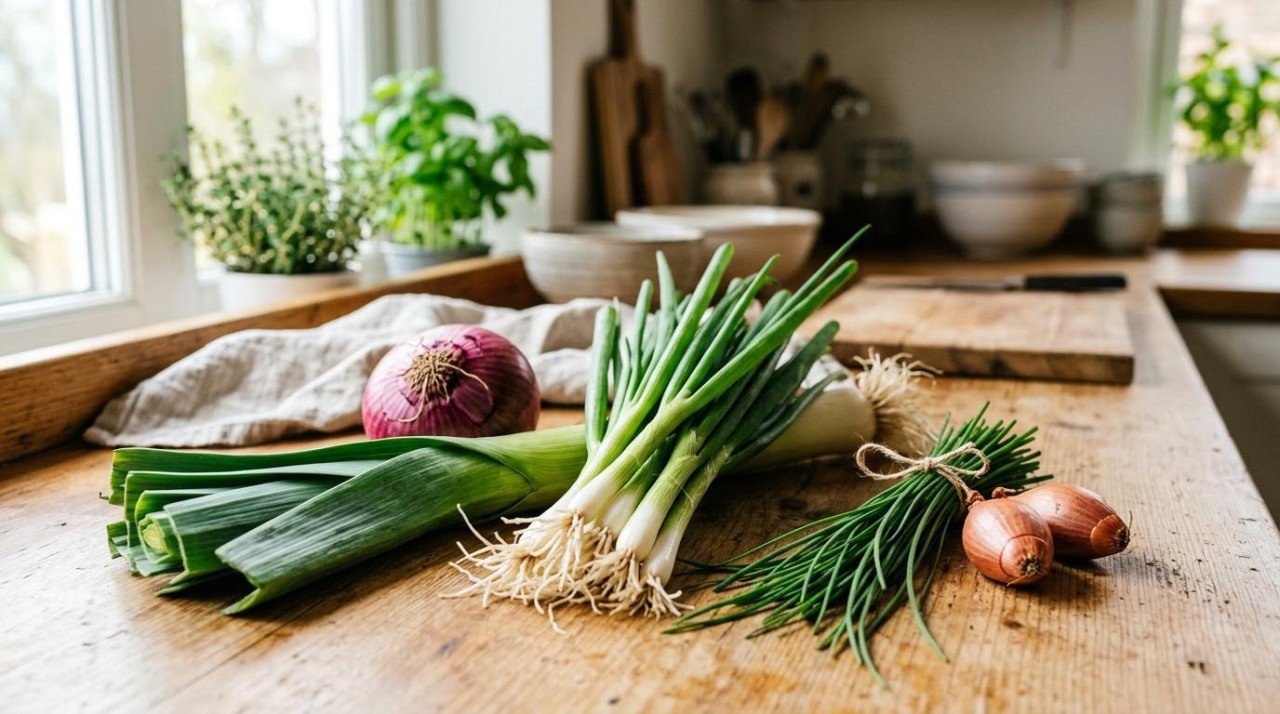
Scallion Whites (Green Onions)
- Swap: 1 medium shallot → 3 tablespoons thinly sliced scallion whites and light green parts (roughly 4 to 6 scallions)
- Best for: Stir-fries, eggs, fried rice, dressings, pan sauces, anything that cooks fast
- Skip it for: Long braises and deep caramelizing — there is no bulk here to melt down
Scallion whites are the most underrated shallot substitute, because they are already mild and sweet in the way a shallot is mild and sweet. They need no taming raw and they soften in a hot pan in about ninety seconds, which is roughly what minced shallot does too.
Save the dark green tops for finishing. They go slimy and dull with more than a minute of heat, but scattered over the dish at the end they add back a fresh oniony lift that a cooked substitute cannot.
Leeks
- Swap: 1 medium shallot → 3 tablespoons chopped leek, white and light green parts only (about a third of a large leek)
- Best for: Soups, cream sauces, risotto, braises, quiche, anything with a slow base
- Skip it for: Raw dishes — leeks stay fibrous and grassy without heat
In a slow-cooked base, leeks may actually be the better ingredient. They melt into something silky and sweet with none of the sharpness, which is why classic French cooking reaches for leeks and shallots for the same kinds of jobs.
The one step you cannot skip: leeks grow in sandy soil and trap grit between their layers. Slice them first, then swish the pieces in a bowl of cold water and lift them out with your hands, leaving the sand at the bottom. Running a whole leek under the tap does nothing.
Red Onion
- Swap: 1 medium shallot → 1 1/2 tablespoons minced red onion raw, or 3 tablespoons cooked
- Best for: Vinaigrettes, mignonette, salads, salsas, quick pickles, grain bowls
- Skip it for: Pale cream sauces (the pigment bleeds gray-purple) and long cooking, where the color goes drab
Red onion is the natural pick when the shallot was going to stay raw and visible, and it is the standard swap in a mignonette for oysters. It is sharper than a shallot, so halve it and, if you have the time, give it the baking soda soak above or a ten-minute bath in the vinegar or lemon juice the recipe already calls for. Acid does its own gentle taming.
It is also the best candidate for quick pickling. Sliced thin and covered with warm vinegar for twenty minutes, red onion turns bright pink, softens, and lands very close to the pickled shallots that show up on top of everything these days.
Sweet Onion (Vidalia, Walla Walla, Maui)
- Swap: 1 medium shallot → 3 tablespoons chopped sweet onion, raw or cooked, no halving needed
- Best for: Raw salads, sandwiches, salsas, dressings, and anywhere you want zero bite
- Skip it for: Dishes that need real savory depth — sweet onions are low in the sulfur compounds that give a base its backbone
Sweet onions are mild for a specific reason: they are lower in sulfur and higher in water than standard cooking onions, and sulfur compounds are what produce the pungent bite. That makes them the only onion you can swap straight across into a raw dish without any tricks.
The trade is depth. In a long-simmered stew or a pan sauce that needs to taste like something, a sweet onion can read watery and a little flat. Raw, though, it is the easiest substitute in this list.
Store-Bought Crispy Fried Onions
- Swap: 1:1 by volume for crispy fried shallots
- Best for: Toppings — rice and noodle bowls, soups, green beans, salads, congee, anywhere fried shallots were scattered on at the end
- Skip it for: Any recipe where the shallot gets cooked into the dish; these will just dissolve
Fried shallots and fried onions are the same idea executed on different alliums, and in the crunchy-topping role the swap is nearly invisible. The canned French-fried onions sold for green bean casserole work, and the tubs of crispy fried onion or shallot in the Asian grocery aisle are better and usually cheaper by weight.
Frying your own is worth it if you have ten minutes. Slice an onion or a few scallion whites as thin as you can manage, add them to about a quarter inch of neutral oil in a cold skillet, and bring it up to a steady medium sizzle, stirring often. Pull them out when they are pale gold, not brown — they keep cooking on the paper towel, and a shade too far is bitter. Salt them the moment they come out, and save the oniony oil for the dressing.
Onion Powder + Garlic Powder
- Swap: 1 medium shallot → 1/2 teaspoon onion powder + 1/8 teaspoon garlic powder (start here and taste up)
- Best for: Dry rubs, dressings, burgers and meatballs, sauces where you do not want visible pieces
- Skip it for: Raw dishes, where it tastes dusty, and anything where the shallot was providing texture or body
Powder is a real substitute, not a desperation move — it disperses evenly in a way that minced fresh allium never does, which is why it beats fresh in a burger patty or a shaken vinaigrette. The catch is the dose. McCormick puts 1 tablespoon of onion powder at one medium onion, and since a shallot is a fraction of an onion, you are working in half-teaspoons. People who think they hate onion powder have almost always used four times too much.
Add it early enough to hydrate in whatever liquid is around, and keep it out of a dry, ripping-hot pan on its own, where it scorches in seconds.
Dried Minced Onion
- Swap: 1 medium shallot → 2 teaspoons dried minced onion rehydrated in 1 tablespoon warm water for 10 minutes, plus a pinch of garlic powder
- Best for: Meatballs, meatloaf, burgers, dips, stuffings — anywhere a little texture matters
- Skip it for: Anything raw and crisp, and dishes where the allium is meant to be a visible ingredient
This is the overlooked middle ground between fresh and powder. Once rehydrated, dried minced onion gives back enough physical presence to work in a meatball or a dip, where powder just vanishes into the background. Do not skip the soak: dropped in dry, the flakes pull moisture out of whatever they land in and stay unpleasantly chewy.
Chives
- Swap: 1 medium shallot (raw) → 2 to 3 tablespoons snipped chives, added off the heat
- Best for: Garnishes, potato salad, egg salad, dips, compound butter, sour cream toppings
- Skip it for: Anything cooked — chives lose their flavor almost immediately in a hot pan
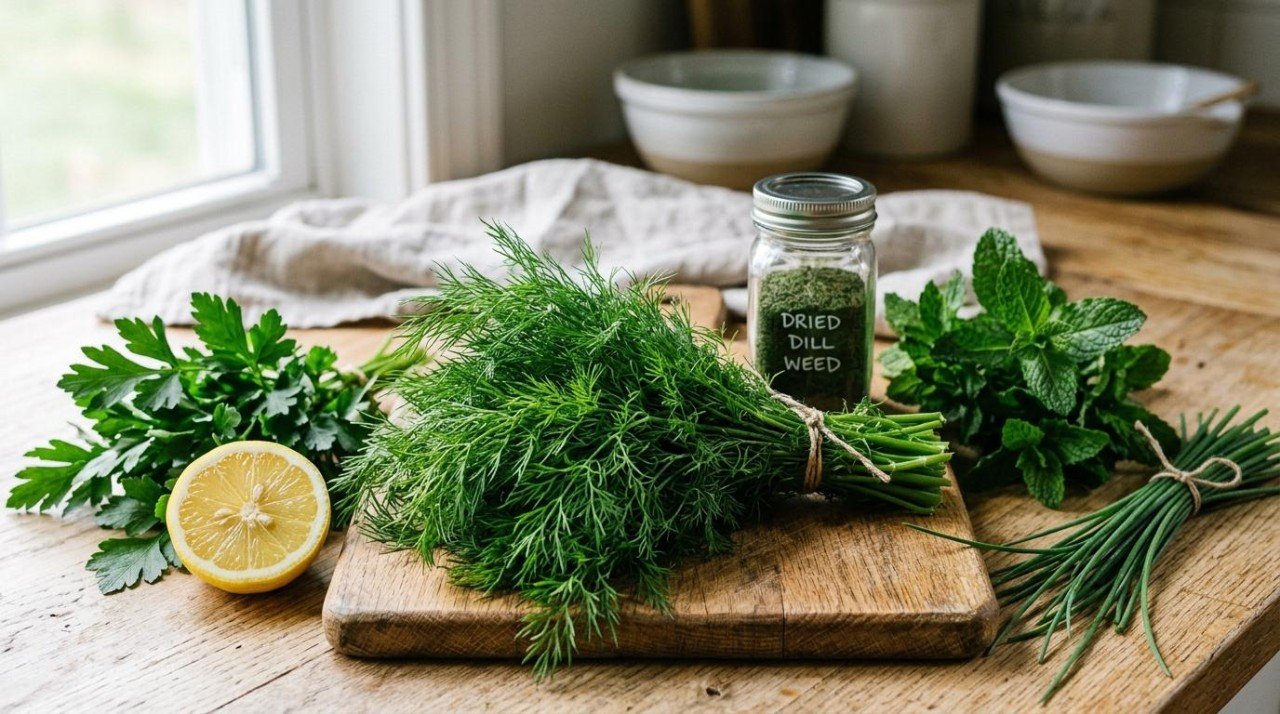
Chives are the mildest allium in the kitchen and the right answer when the shallot was raw and decorative rather than structural. They cannot carry a dish, but sprinkled over a soup or folded into a dip they cover the job convincingly.
Garlic on Its Own
- Swap: 1 medium shallot → 1 medium clove, minced (roughly 1 teaspoon)
- Best for: Pan sauces, sauteed greens, pasta, beans, marinades
- Skip it for: Raw vinaigrettes, where it is harsh, and any dish with "shallot" in its name
Straight garlic is not really a substitute — it is a decision to make a slightly different dish. Where a shallot would have given you a sweet, mellow background, garlic gives you a sharper, more assertive one. In a pan sauce or a pot of greens, most people would happily eat the result and never ask what happened. If you have both onion and garlic, the combination at the top of this list is closer. Our fresh garlic substitutes guide has the full conversion chart if the garlic is what you are short on.
Pearl Onions or Cipollini
- Swap: Weight for weight — about 1 ounce per medium shallot. Use pearl onions whole, cipollini halved
- Best for: Recipes that roast, braise, or glaze shallots whole — sheet-pan dinners, coq au vin, pot roast
- Skip it for: Minced applications, where peeling that many tiny onions is a punishment
When a recipe calls for whole shallots rather than minced ones, this is a completely different substitution problem, and the small sweet onions solve it best. Cipollini are the closest match: flat, sugary, and prone to the same glossy caramelization. Frozen peeled pearl onions are a genuinely good shortcut and skip the worst of the work. If neither is available, cut a regular onion into wedges through the root end so the layers hold together.
The Nutrition Angle, Honestly
Shallots are the more nutrient-dense allium, and it is not close. Per 100 g, USDA data puts shallots at 3.2 g of fiber, 334 mg of potassium, and 1.2 mg of iron against an onion's 1.7 g, 146 mg, and 0.21 mg — and Cornell researchers testing shallots against ten common onion varieties found shallots had six times the phenolic content of the lowest variety they measured, along with the highest antioxidant activity of the group.
Here is the honest part: you are substituting about an ounce. Three tablespoons of shallot versus three tablespoons of onion is a difference of roughly 0.4 g of fiber and 50 mg of potassium in the entire dish. Real, but not worth a trip to the store, and certainly not worth feeling bad about.
The gain that is actually worth chasing is variety. Onion, shallot, leek, scallion, and chive are five different plants, and if you are tracking plant diversity for gut health, using two of them in a dish counts for more than doubling up on one. A base of leek plus a little garlic is more interesting nutritionally than a base of onion alone, and it costs nothing extra. Our post on why 30 plants a week matters covers the research behind that, and the onion substitutes guide takes the same question from the other direction.
Take the Guesswork Out of Eating Well
Eat Well Planner helps you organize your favorite recipes, plan balanced meals, and automatically generate shopping lists — all in one place. Whether you're tracking macros, managing dietary restrictions, or just trying to stop asking "what's for dinner?", we've got you covered.
Our AI-powered tools can adapt any recipe to your dietary needs, help you discover new meals you'll love, and even log your nutrition effortlessly. It's meal planning made simple.
Start Organizing Your Meals — FreeIf You Are Avoiding Shallots for FODMAP Reasons
If the reason you are looking for a substitute is IBS rather than an empty vegetable drawer, most of this list will not help you: shallots are high in fructans, and so are onions, leeks, and garlic. Swapping one for another changes nothing.
What does work comes down to one piece of chemistry. Monash University, who developed the low FODMAP diet, notes that fructans are water soluble but not fat soluble. That gives you a short, reliable toolkit:
- Shallot- or onion-infused oil — the flavor crosses into the oil, the fructans stay behind. Use it as the cooking fat or in the dressing.
- Green tops only — the dark green parts of scallions and leeks. Stop cutting where the color turns pale; the white and light green portions are the high-FODMAP part.
- Chives — Monash names them directly as an onion replacement.
- Asafoetida (hing) — a pinch bloomed in hot oil covers a surprising amount of the allium role. Most brands are cut with wheat flour, so check the label if you are also gluten-free.
And one myth worth killing: Monash is explicit that simmering a whole onion or shallot in a soup and fishing it out before serving does not work — the fructans have already leached into the liquid. In an oil-based dish like a stir-fry they do not leach out, which is the same reason infused oil is fine.
What Not to Use
- One onion for one shallot. The single most common way these swaps go wrong. It is three to four times too much aromatic, and it will flatten everything else in the pan.
- Raw yellow onion at full volume. In a vinaigrette or a mignonette, that is not a substitution, it is a takeover. Halve it, soak it, or use red or sweet onion instead.
- Onion salt without doing the math. It is mostly salt. If you use it, cut the recipe's salt by roughly three quarters of the volume you added.
- Onion powder where the shallot provided body. In a dish built on a cup of soft, sweet aromatics, powder gives you flavor and leaves the texture thin.
- Red onion in a pale sauce. The anthocyanins bleed, and a beurre blanc the color of dishwater is a hard sell.
- Fried onions from a can where shallots get sauteed. They are cooked, oiled, and salted already. They will not soften into a base; they will dissolve into greasy specks.
Not Sure Which One Fits Your Recipe?
This is the limit of any substitution guide: it can tell you what shallots generally do, but not what they are doing in your recipe. A shallot in a beurre blanc, a shallot in a lentil braise, and a shallot fried for a salad topping are three different ingredients wearing the same name.
That is the gap Eat Well Planner fills. Import the recipe you are cooking — from any website, an Instagram reel, or a YouTube video — and the AI recipe chat can answer with your actual ingredient list in front of it: "I am making this and I have no shallots, only red onion and garlic — what should I do?" If you are avoiding alliums entirely, Recipe Variations can rewrite the whole recipe with the swaps already worked in, rather than leaving you to adapt it line by line.
And if the substitution is a chance to make the dish a little better rather than just survivable, the Recipe Playground lets you change an ingredient and watch the nutrition score move before you commit. It is free to use, and it is a lot faster than standing in the kitchen doing math with a hot pan.