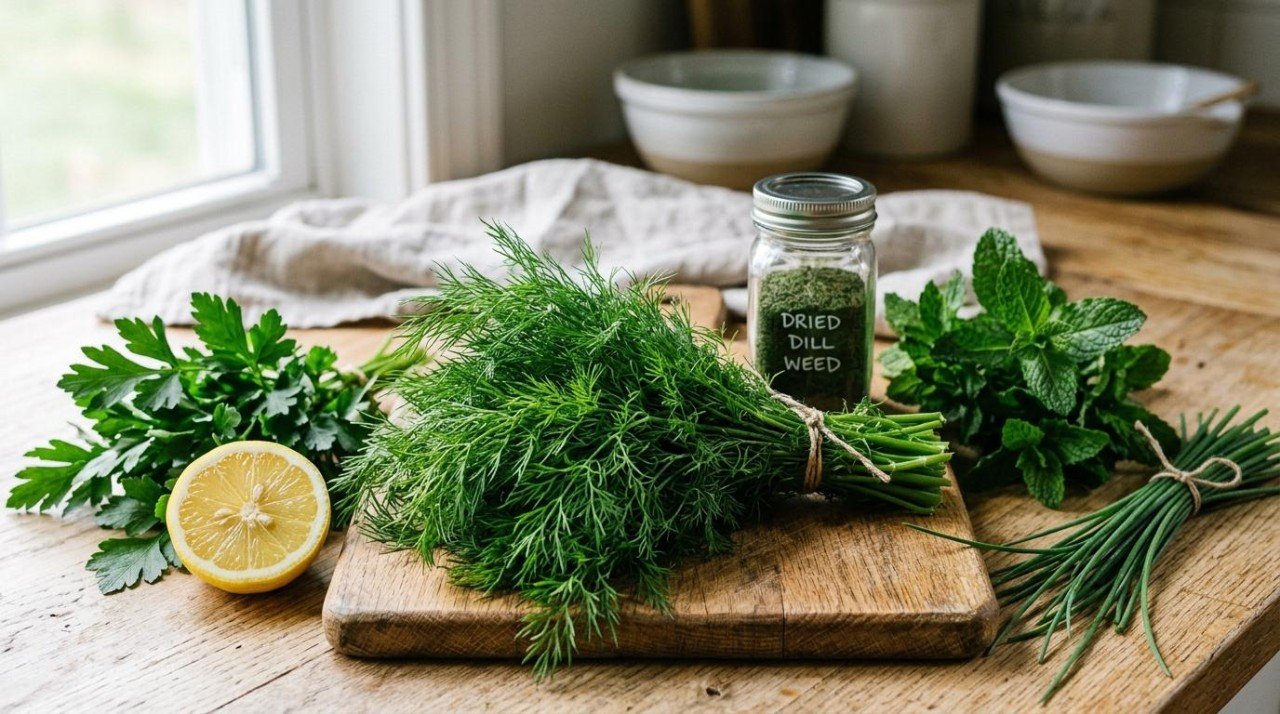
The salmon is in the oven, the yogurt sauce is half stirred, and the dill you bought last Tuesday is a green sludge in the bottom of the crisper drawer. Dill does that. It is one of the most perishable herbs in the store and one of the most specific in flavor, which is an annoying combination.
The good news is that dill is doing a narrower job than it seems. It brings a fresh, grassy, faintly anise-scented lift and a feathery green texture that reads as delicate rather than leafy. Match those two things and you are most of the way there. The complication is that dill turns up in three very different contexts — finished on fish and folded into yogurt, boiled into pickle brine, and stirred through potato and egg salads — and the right substitute is not the same in all three.
Here is what actually works, with the ratios, starting with the one distinction that most substitution charts get backwards.
The Quick List
- Fennel fronds — the closest match on looks, texture, and flavor; a straight 1:1
- Dried dill weed — the pantry answer, at one third the amount, for anything cooked or creamy
- Fresh tarragon — closest on the anise note; use half, and only where that reads well
- Chervil — delicate and faintly licorice; brilliant in eggs and cream sauces
- Flat-leaf parsley + lemon zest — for green color and freshness when the dill was decoration
- Dill seed — the correct swap for pickles and long-simmered dishes, and wrong as a garnish
- Fresh mint — the traditional other herb in tzatziki; use half
- Chives or scallion tops — for potato salad, egg salad, and sour cream dips
- Celery leaves — free, already in your fridge, and good in anything creamy or brothy
- Caraway seed — pickles, cabbage, and potatoes only, in a very small amount
First: Dill Weed and Dill Seed Are Not the Same Thing
This is worth thirty seconds because it decides half the choices below. The feathery green herb and the little brown seeds come from the same plant, but they do not taste alike, and the chemistry explains exactly why.
The leafy herb is dominated by alpha-phellandrene — around 46% of the essential oil at the leafy stage — which is the fresh, green, slightly citrusy smell you get when you chop a bunch. Carvone is barely present. Once the plant flowers and sets seed, that flips: dill seed oil is roughly 46% carvone and 44% limonene. Carvone is also the compound that makes up about 68% of caraway seed oil.
So dill seed does not taste like a concentrated version of fresh dill. It tastes like a cousin of caraway — warm, faintly bitter, rye-bread adjacent. That is exactly right in a jar of pickles and exactly wrong sprinkled over poached salmon. Keep that in mind when a chart tells you to just use the seeds.
Fennel Fronds
- Swap: 2 tablespoons chopped fresh dill → 2 tablespoons chopped fennel fronds (1:1)
- Best for: Salmon and white fish, tzatziki and yogurt sauces, cucumber salads, potato salad, roasted vegetables
- Skip it for: Pickling brine, where you want the seed flavor, not soft fronds
If you have a fennel bulb in the fridge, the answer is already in your kitchen. The wispy green fronds on top are an herb in their own right, and most people throw away the best free substitute for dill they will ever find. They look nearly identical chopped, they have the same delicate feathery texture, and they carry a soft sweet anise note that sits very close to where dill lives.
Use the tender fronds and the thin stems, not the woody stalks. Add them at the end, off the heat, the same way you would use dill. They lean a little sweeter and a little more licorice-forward, so if your dish is already sweet-ish — carrots, beets, peas — start with three quarters of the amount and taste up. On salmon, honestly, most people will not notice the substitution at all.
Dried Dill Weed
- Swap: 2 tablespoons chopped fresh dill → 2 teaspoons dried dill weed (the standard 3:1 fresh-to-dried rule)
- Best for: Creamy dips, ranch dressing, tuna and egg salad, soups, dill bread, marinades
- Skip it for: Garnish and anything raw where you want visible green fronds — dried dill looks like dust and tastes flat when it has not had time to rehydrate
Dried dill is the pantry fallback, and it is better than dried parsley or dried cilantro because dill's flavor is more robust than either. Do not expect the same herb, though. Drying strips the fresh green top notes and leaves something hayer and more one-dimensionally anisey.
The single technique that makes it work: give it liquid and time. Stir it into the sour cream, yogurt, mayonnaise, or vinaigrette and let it sit at least 10 to 15 minutes — 30 is better — before you taste and adjust. Dried dill thrown into a bowl at the last second tastes like nothing; the same amount left to bloom in a dip tastes like dill. In a hot soup or braise, add it early enough to soften rather than at the end.
Fresh Tarragon
- Swap: 2 tablespoons chopped fresh dill → 1 tablespoon chopped fresh tarragon (or 1 teaspoon dried)
- Best for: Fish, chicken salad, egg dishes, cream sauces, buttery vegetables, remoulade and tartar-style sauces
- Skip it for: Pickles, borscht, and anything Eastern European or Scandinavian where dill is the defining flavor
Tarragon is the closest match to the anise side of dill, and where it works it works beautifully — a chicken salad or a salmon with tarragon instead of dill is not a compromise, it is a recognized French version of the same dish. It also holds up slightly better than dill in a warm sauce.
The catch is volume. Tarragon is noticeably more assertive and its licorice note is much more pronounced, so half the quantity is the right starting point and you can always add more. Where it goes wrong is in dishes whose identity is dill — a cucumber-dill salad made with tarragon just tastes like a tarragon salad, and a pickle made with tarragon tastes like a mistake.
Chervil
- Swap: 2 tablespoons chopped fresh dill → 2 to 3 tablespoons chopped chervil
- Best for: Omelets and scrambled eggs, delicate cream and butter sauces, green salads, poached fish, spring vegetables
- Skip it for: Anything cooked more than a minute or two, and anything that needs to punch through strong flavors
Chervil is dill's quiet French relative — lacy leaves, gentle parsley flavor with a faint anise whisper underneath. It is one of the classic fines herbes alongside parsley, chives, and tarragon, which tells you where it belongs: eggs, butter, cream, and delicate fish.
Because it is so mild you can use it at equal volume or slightly more without overshooting. The two practical drawbacks are that it is genuinely hard to find in most American supermarkets, and that it collapses under heat — add it at the very end or at the table. If you already keep it around, it is also the top pick in our fresh parsley substitutes guide, so a bunch does double duty.
Flat-Leaf Parsley + Lemon Zest
- Swap: 2 tablespoons chopped fresh dill → 2 tablespoons chopped flat-leaf parsley + 1/2 teaspoon finely grated lemon zest
- Best for: Potato salad, egg salad, grain and bean salads, roasted vegetables, anywhere dill was mostly green confetti
- Skip it for: Tzatziki, gravlax, dill pickles, or anything where dill is the named flavor of the dish
Parsley alone is not a dill substitute — it is the right color and the wrong flavor. But dill's job in a lot of recipes is simply to make the plate look alive and taste fresh, and parsley does that job perfectly well. The lemon zest is what fills the gap: it supplies the high, perfumed brightness that parsley lacks, which is the part your palate actually registers as "dill was here."
Use flat-leaf (Italian) parsley if you have the choice, add the zest off the heat, and grate it finely so you get the oils without chewy strips of peel. If your recipe already has lemon in it — most dill recipes do — you can often just use parsley straight and add an extra squeeze at the end.
Dill Seed
- Swap (cooked dishes): 2 tablespoons chopped fresh dill → 1/2 teaspoon dill seed, lightly crushed, added early in cooking
- Swap (pickling): 3 heads of fresh dill per quart jar → about 1 tablespoon dill seed, or 2 tablespoons dried dill weed
- Best for: Pickles, cabbage and slaws, potato dishes, breads, long-simmered soups and braises
- Skip it for: Garnish, raw yogurt sauces, gravlax, anything delicate and uncooked
For pickling, dill seed is not a downgrade — it is arguably the more reliable ingredient, and the standard recipes treat the two as interchangeable. The National Center for Home Food Preservation's quick fresh-pack dill pickles calls for 1 1/2 heads of fresh dill per pint jar and gives 1 1/2 teaspoons of dill seed per pint as the equivalent, which works out to roughly three heads or one tablespoon of seed per quart.
One safety note while you are in there: seasonings are the flexible part of a canning recipe. Dill, garlic, mustard seed, and peppercorns can be adjusted to taste, but the vinegar-to-water ratio and the processing time are what keep the jars safe, and those are not adjustable. Change the herbs, not the brine.
In a cooked dish, crush the seeds lightly to wake them up and add them early so the flavor has time to spread. Expect a warmer, more caraway-like result than fresh dill would give — good in a cabbage soup or a potato bake, out of place in a cold cucumber salad.
Fresh Mint
- Swap: 2 tablespoons chopped fresh dill → 1 tablespoon chopped fresh mint
- Best for: Tzatziki, cucumber and yogurt salads, grain salads, peas, lamb, cold soups
- Skip it for: Anything simmered — mint turns dull and faintly medicinal with heat — and cream sauces
This is the one substitution on the list with genuine tradition behind it. Greek tzatziki is made with dill, with mint, or with both depending on the cook and the region, so swapping to mint is not adapting a recipe — it is making a different authentic version of it. The same is true for cucumber-yogurt salads across the eastern Mediterranean and the Middle East.
Use about half as much as the dill called for. Mint takes over quickly, and a tzatziki that tastes of toothpaste is worse than one with no herb at all. Chop it just before it goes in; cut mint darkens and dulls within an hour.
Chives or Scallion Tops
- Swap: 2 tablespoons chopped fresh dill → 2 tablespoons finely sliced chives or green scallion tops
- Best for: Potato salad, egg salad, sour cream and yogurt dips, smoked salmon plates, baked potatoes, cold soups
- Skip it for: Pickles, and dishes where an onion note would clash with the other flavors
Chives do not taste like dill at all, and it does not matter, because in a creamy salad the herb's job is to cut richness with something fresh and green. A gentle onion note does that as well as an anise one — arguably better in a mayonnaise-heavy potato salad, where dill can get lost anyway.
Slice them thin and add them at the end; chives lose their delicate flavor almost instantly in heat. Scallion tops are the more assertive stand-in of the two, so if you are using those, start with a little less. This is also the best option when you need the herb to hold its color on a plate of smoked salmon or a bowl of cold beet soup.
Celery Leaves
- Swap: 2 tablespoons chopped fresh dill → 2 tablespoons chopped tender inner celery leaves + a squeeze of lemon
- Best for: Potato and egg salads, tuna salad, chicken salad, brothy soups, bean dishes
- Skip it for: Dishes where the herb is the headline — this one is a background player
The pale, tender leaves in the middle of a celery heart are an herb, not trimmings, and almost everybody bins them. They are grassy and savory with a light peppery bite, and with a squeeze of lemon they cover dill's role in anything creamy or brothy for free.
Stick to the inner leaves and skip the dark, tough outer ones. This is the swap that shines in an egg salad sandwich and disappoints on a fillet of salmon, where there is nothing to hide behind.
Caraway Seed
- Swap: 2 tablespoons chopped fresh dill → 1/4 teaspoon caraway seed, lightly crushed
- Best for: Pickles, sauerkraut and braised cabbage, potato dishes, rye and dill breads, beet soups
- Skip it for: Fish, yogurt sauces, and any fresh raw application
This is the sideways swap that makes sense once you know the chemistry above. Since dill seed is close to half carvone and caraway seed is around two thirds carvone, a small amount of caraway lands in genuinely similar territory to dill seed — which is why it works in exactly the same dishes and nowhere else.
Use a very light hand. Caraway is more pungent than dill seed and much more recognizable, and a quarter teaspoon crushed into a pot of cabbage or a jar of pickles is plenty. Half a teaspoon and your dinner will taste like rye bread.
Which One for Which Dish
Dill's uses split sharply, and this is where most substitution advice falls down:
- Fish, tzatziki, and yogurt sauces (raw, delicate, herb-forward): fennel fronds first, then tarragon at half quantity, then mint for anything cucumber-and-yogurt. You need soft green texture and last-second timing. Dill seed and caraway are wrong here.
- Pickling (long soak, hot brine): dill seed at about 1 tablespoon per quart, dried dill weed at 2 tablespoons per quart, or caraway in a pinch. Fresh leafy substitutes go slimy and contribute almost nothing after a week in vinegar.
- Potato salad, egg salad, and creamy dips (rich, cold, forgiving): almost anything works — chives, celery leaves, parsley with lemon zest, dried dill given time to bloom. This is the category where you should stop worrying and just use what is in the fridge.
- Soups, braises, and breads (cooked long): dried dill weed added early, or dill seed. Fresh herbs of any kind cook away to nothing over an hour.
The Healthier Angle
Let us be honest about the nutrition here: none of these swaps will change your health. Dill is nutrient-dense in the way herbs always are on paper and irrelevant in the amounts anyone eats. A whole cup of fresh dill sprigs comes to about 4 calories and 7.6 mg of vitamin C — under 10% of a day's worth — and you are probably using two tablespoons.
Two things about herbs genuinely do matter, though. The first is salt. In the SPICE trial, adults who went through a 20-week behavioral program built around cooking with spices and herbs cut their sodium by about 957 mg a day compared with a self-directed group — a real difference, though it was a small study of 40 people. Reaching for an herb instead of the salt cellar is the most useful thing on this page.
The second is variety. Herbs count toward the "30 different plants a week" target that keeps showing up in gut microbiome research, and being forced off dill for a week is a free entry on that list. Fennel fronds, chervil, and celery leaves are three plants most people never eat at all.
If you want a swap that actually upgrades the dish rather than just replacing an herb, the one to make is the base, not the leaf: a dill or fennel dressing built on plain Greek yogurt instead of sour cream or mayonnaise keeps the tang, adds real protein, and cuts most of the saturated fat. That is a bigger change to a potato salad than any herb decision.
And if you are not sure how a swap lands in the specific thing you are cooking, that is exactly what Eat Well Planner's AI recipe chat is for — it reads your actual recipe and tells you whether tarragon will work in that dish, rather than in the abstract. Its Recipe Playground goes a step further: change the yogurt for the sour cream and watch the nutrition score move before you commit.
Take the Guesswork Out of Eating Well
Eat Well Planner helps you organize your favorite recipes, plan balanced meals, and automatically generate shopping lists — all in one place. Whether you're tracking macros, managing dietary restrictions, or just trying to stop asking "what's for dinner?", we've got you covered.
Our AI-powered tools can adapt any recipe to your dietary needs, help you discover new meals you'll love, and even log your nutrition effortlessly. It's meal planning made simple.
Start Organizing Your Meals — FreeWhat Not to Use
- Dill pickle brine as a flavoring shortcut. It shows up on lists, and it does taste of dill — along with a large amount of vinegar and salt. Splashing it into a yogurt sauce breaks the sauce and blows past the seasoning. Fine for a marinade, wrong as an herb replacement.
- Dill seed in anything raw and delicate. The most common mistake on this page. Seeds are a caraway-adjacent spice, not concentrated fresh dill, and they will make your tzatziki taste like rye bread.
- Fennel seed instead of fennel fronds. The fronds are soft and green; the seeds are a sweet, strong licorice spice. They are not interchangeable, and a recipe calling for a tablespoon of fronds will be ruined by a tablespoon of seed.
- Oregano, thyme, or rosemary. They appear on plenty of substitution lists because they are herbs and they are in your cupboard. They are resinous, woody, and Mediterranean, and they fight everything dill is usually paired with. Rosemary on gravlax is a genuinely bad evening.
- Cilantro, unless you mean it. The feathery look fools people. It has the texture but a completely different citrus-soapy aroma, and it will make a dish taste Mexican or Southeast Asian rather than Nordic. It does work on fish tacos and in yogurt sauces, which is why it turns up on our cilantro substitutes list in reverse — just use it knowingly.
- Doubling the parsley to compensate. More parsley gives you more parsley. The missing piece is the aromatic top note — add lemon zest or a pinch of fennel seed, not another handful of green.
Never Buy a Bunch You Waste Again
Dill is the herb most likely to rot before you use half of it, and drying it at home is a poor trade. Freezing is the better move: Penn State Extension names dill among the herbs that keep their flavor better frozen than dried, and says to use frozen herbs in the same proportion as fresh. The one caveat is texture — frozen herbs go limp when thawed, so they belong in soups, sauces, dips, and dressings rather than scattered over a finished plate.
Chop the whole bunch the day you buy it, pack it into an ice cube tray with a little water or olive oil, and freeze. Next time the recipe calls for dill, you drop in a cube.
The Short Version
If you have a fennel bulb, use the fronds and stop reading. If you have dried dill, use one third the amount and give it 15 minutes in the yogurt before you judge it. If it is fish or chicken, tarragon at half quantity. If it is pickles, dill seed at a tablespoon per quart. If it is potato or egg salad, chives or parsley with lemon zest, and nobody will ask.
Whichever version you land on, it is worth keeping. Eat Well Planner lets you import any recipe from a URL, video, or photo, adapt it to what you actually have, and save the fixed version — so the next time the dill has gone to sludge, the decision is already made.