The recipe says "garnish with sliced green onions," or worse, "cook the scallion whites until soft," and the bunch in your crisper drawer has turned into a bag of slime. It happens faster than it should. Scallions are one of the few aromatics with a genuinely short shelf life, and they are almost always the last ingredient you check.
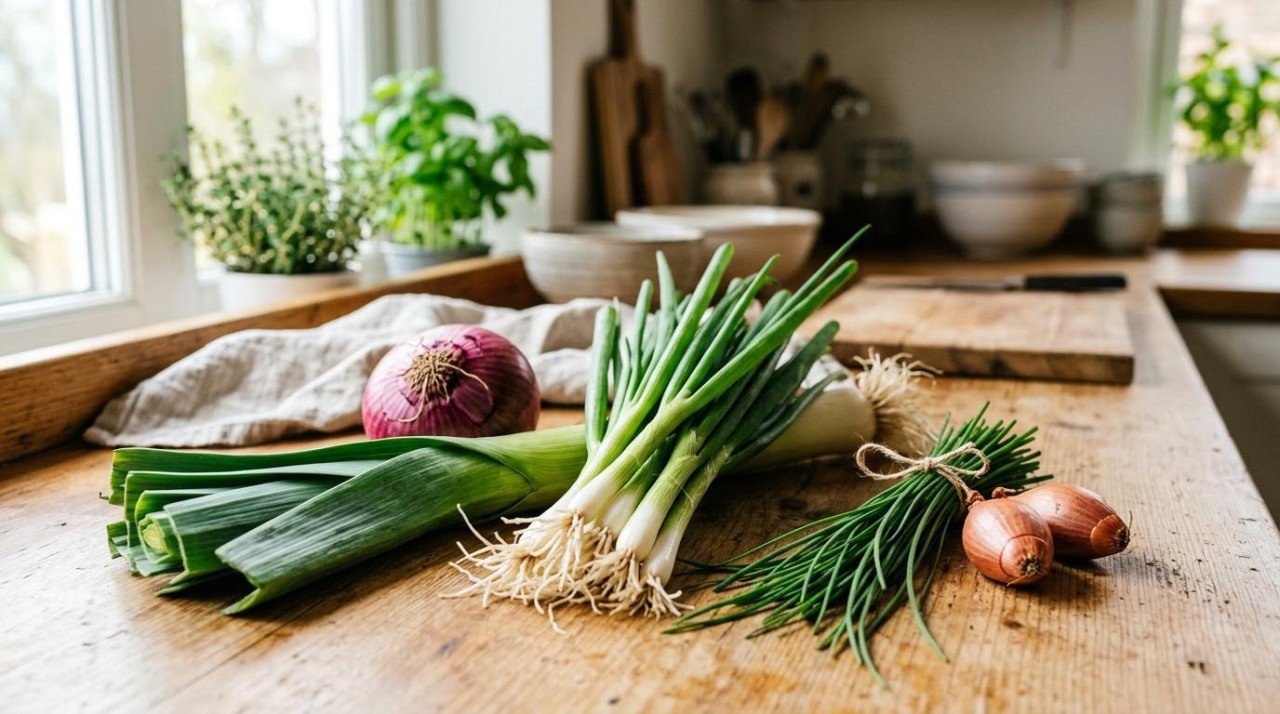
Here is the thing that makes this swap easier than it looks: a scallion is really two ingredients sold as one. The white and pale green base is a mild onion that wants heat. The dark green tops are a fresh herb that wants none. Milk Street puts it simply — the white end is more pungent and benefits from cooking, while the greens are grassier and peppery and work best as a garnish.
Once you know which of those two jobs your recipe needs, the substitute picks itself. Below are ten that work, with real ratios, plus the ones that quietly ruin the dish.
The Quick List
- Chives — the best swap for raw greens and garnish; no cooking
- Leeks — the best swap for the whites in anything cooked
- Shallots — most versatile all-rounder; cooked dishes, dressings, and potato salad
- Yellow, white, or red onion — always in the house; use about half as much
- Garlic chives (gow choy) — made for stir-fries, dumplings, and noodles
- Spring onions — the bulbing kind; one replaces two or three scallions
- Ramps — a spring-only upgrade with far more punch
- Freeze-dried or dried chives — the pantry backup that actually works
- Parsley or cilantro — fresh green finish when flavor matters less than color
- Fennel fronds — allium-free garnish for anyone avoiding onion
The Measurement That Makes All of This Work
Scallions are sold by the bunch, and recipes are written by the bunch, which is why substituting them goes sideways. A standard bunch is 6 to 8 medium stalks weighing about 3.8 ounces, yielding roughly 1 cup sliced, and a single medium stalk gives you about 2 tablespoons chopped.
Every ratio below is anchored to those two numbers. Before you substitute anything, work out whether the recipe wants about 1 cup of mild allium (a bunch) or a couple of tablespoons of green confetti (a stalk or two). It changes which swap you reach for.
Chives
- Swap: 1 medium scallion → 2 to 3 tablespoons finely chopped chives
- Best for: Garnish, baked potatoes, sour cream dips, eggs, potato and egg salad, anything sprinkled on at the end
- Skip it for: Cooking. Chives lose their flavor within a minute of heat and go drab
- Health notes: Nutritionally a wash — chives carry about 213 mcg of vitamin K per 100 g, essentially the same as scallions
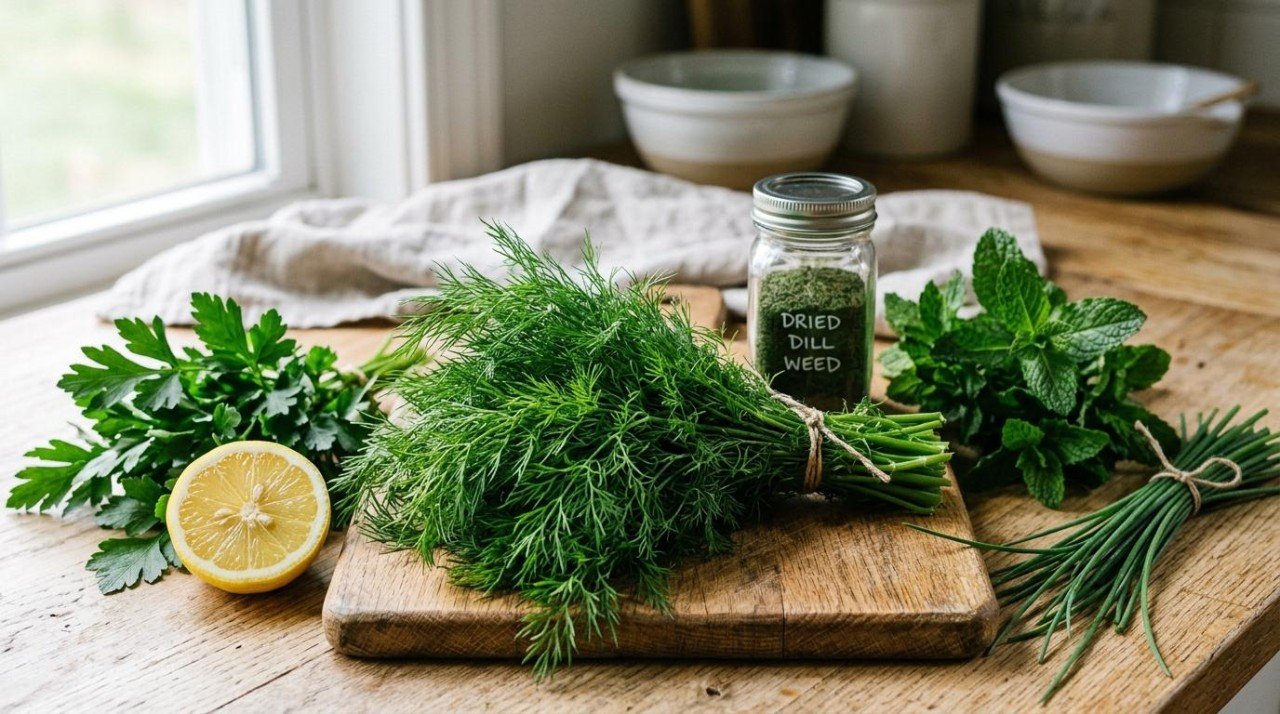
For the green half of the scallion's job, chives are as close as you get. They are the same mild, grassy onion note in a thinner package, and they look right — the flecks of green on a soup or a loaded potato read the same way. The ratio matters because chives are more delicate, which is why the standard guidance is 2 to 3 tablespoons of chopped chives per medium scallion rather than a straight one-for-one.
Two limits. Chives cannot replace the white part, because there is no white part — they have no bulb and no body, so they contribute nothing to a stir-fry base. And a full bunch of scallions worth of chives is a lot of chives, which gets expensive fast if you are buying the little plastic clamshells. Use them where they show.
Leeks
- Swap: 1 bunch scallions (whites and light greens) → 1 small leek, white and light green parts only, thinly sliced, about 1 cup
- Best for: Stir-fry and soup bases, braises, fried rice, anything where the whites go in the pan first
- Skip it for: Raw garnish. Leeks stay fibrous and grassy without heat
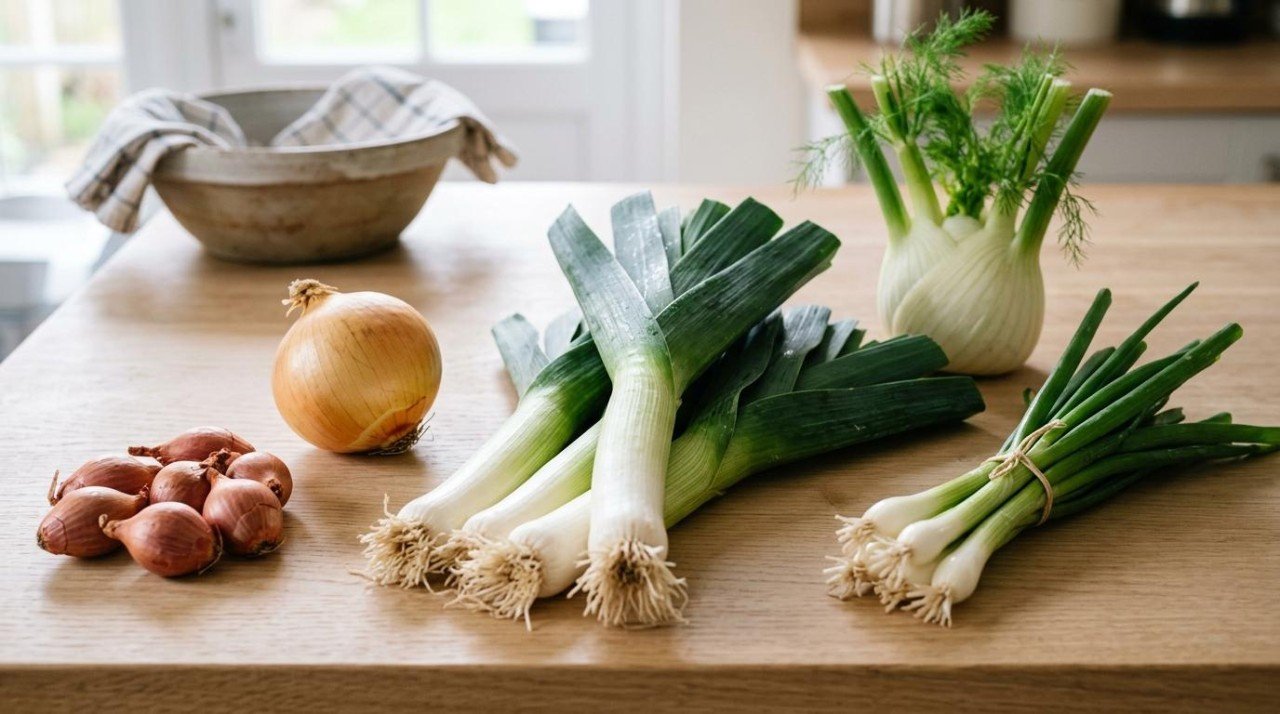
A leek is essentially a scallion white that kept growing, which makes it the most natural stand-in for the cooked half of the job. It softens into the same sweet, mild allium background, just more of it. If a recipe has you soften scallion whites in oil before anything else goes in, sliced leek does that job better than the original did.
One non-negotiable technique note: leeks grow in sandy soil and trap grit between their layers. Slice first, then swish the slices in a bowl of cold water and lift them out, leaving the sand at the bottom. Rinsing a whole leek under the tap does nothing. Save the tough dark green tops for stock — they never get tender enough to eat.
Shallots
- Swap: 1 medium scallion → 2 to 3 tablespoons thinly sliced or minced shallot (1 bunch → about 2 medium shallots)
- Best for: Cooked dishes, vinaigrettes, potato salad, egg salad, anywhere the onion flavor should stay refined
- Skip it for: The green garnish. You get the flavor but none of the color
Shallots are the most versatile answer on this list because they work raw and cooked, which almost nothing else here does. Minced raw into a dressing, a shallot gives you onion flavor without the sulfurous slap of raw yellow onion — the same reason scallions work raw in the first place. Cooked, they melt down sweet and lightly garlicky. The 2 to 3 tablespoons per medium scallion ratio holds in both directions.
They brown faster than onion because they hold less water and more sugar, so drop the heat a notch when sauteing. And if the recipe leaned on scallions for that scattered-green look, finish the plate with a little parsley or chive. Our full guide to shallot substitutes covers the reverse problem if you are out of those too.
Yellow, White, or Red Onion
- Swap: 1 cup sliced scallions → about 1/2 cup finely chopped onion when cooked; start at 1/3 cup if it is going in raw
- Best for: Cooked bases, soups, chili, fried rice, meatballs, anywhere the allium disappears into the dish
- Skip it for: Delicate raw dishes and garnish, unless you tame it first
This is the swap most people already have, and it works as long as you respect the strength difference. A scallion is mild enough to eat by the handful; a yellow onion is not. Cut it finer than you normally would, and use about half the volume the recipe asked for in scallions.
For anything raw — a salsa, a bean salad, a cucumber dish — red onion is the one to reach for, and a cold-water soak fixes the harshness. Slice it thin, cover with cold water for 10 minutes, then drain and pat dry. It comes out sweet and crisp rather than aggressive. If the whole dish hinges on the onion, the substitutes for onion guide goes deeper on which onion does what.
Garlic Chives (Chinese Chives, Gow Choy)
- Swap: 1:1 by volume for scallion greens; scale back to about three-quarters in a delicate dish
- Best for: Stir-fries, dumpling and potsticker fillings, noodles, scallion-pancake-style breads
- Skip it for: Anything where you do not want garlic. This is not a subtle ingredient
If your scallions were headed into an Asian dish, garlic chives are less a substitute than a sideways upgrade. The Woks of Life describes them as having a strong garlicky fragrance with meaty, flat leaves — flatter and wider than regular chives, and sturdy enough to behave like a vegetable rather than a garnish.
That sturdiness is the point. Unlike ordinary chives, garlic chives hold up to a hot wok for a minute or two without collapsing, so they can replace both halves of the scallion in a stir-fry. Look for them at Asian grocers, usually sold in a long flat bundle.
Spring Onions (The Bulbing Kind)
- Swap: 1 spring onion → 2 to 3 scallions. Use the bulb like a small onion and the tops like scallion greens
- Best for: Grilling, roasting, cooked bases; the tops work raw
- Skip it for: Recipes that want true scallion mildness in raw quantity
Confusingly, "spring onion" means a scallion in British recipes and a distinct vegetable at most American farmers markets: a young onion pulled early, with a round white bulb an inch or two across and green tops still attached. That bulb is a real onion, so it is stronger and sweeter than a scallion white and gives you far more of it.
Treat the two ends separately, exactly as you would a scallion, and just use fewer of them. Halved and grilled until charred, the bulbs are also better than scallions ever were.
Ramps (Wild Leeks)
- Swap: 1 bunch scallions → about 4 to 5 ramps. Cook the bulbs like scallion whites; use the leaves like the greens
- Best for: A short spring window — pastas, eggs, compound butters, anything you want to taste loudly of allium
- Skip it for: Any other season, and any dish where a background note was the goal
Ramps are the most flavorful thing on this list and the least available. Penn State Extension notes that their leaves appear from April to May, and that the plants are slow-growing enough to need 5 to 7 years before they flower — which is why populations are vulnerable to overharvesting. Buy them at a market rather than stripping a patch, and lean on the leaves, since those regrow with the plant.
Flavor-wise, expect something between garlic and onion with the volume turned up. Where a scallion is a supporting note, ramps become the dish.
Freeze-Dried or Dried Chives
- Swap: Freeze-dried chives, 1 tablespoon for 1 tablespoon fresh. Air-dried chives, use the standard 3:1 herb ratio — 1 teaspoon dried per 1 tablespoon fresh
- Best for: Dips, dressings, sour cream, compound butter, seasoning blends, soup finished off the heat
- Skip it for: Anywhere the crunch or the fresh look is the point
Dried alliums are usually a disappointment, but chives are the exception, particularly freeze-dried ones — they rehydrate almost instantly in anything with moisture. Stir them into sour cream or a dressing five minutes before serving and they come back convincingly.
What they cannot do is texture. There is no snap, and scattered dry over a finished plate they look like green dust. Give them liquid and a few minutes and they earn their place.
Parsley or Cilantro
- Swap: 1:1 by volume for scallion greens as a garnish, plus 1 to 2 teaspoons minced shallot per bunch if you need actual onion flavor
- Best for: Tacos, grain bowls, soups, curries, roasted vegetables — dishes already carrying plenty of flavor
- Skip it for: Dishes where the scallion was the flavor, like scallion oil or a simple noodle bowl
Sometimes the scallions were doing a visual job more than a culinary one: a scatter of fresh green over something brown. Flat-leaf parsley handles that with a clean, peppery bite, and cilantro does it in anything Mexican, Thai, Vietnamese, or Indian. Neither one tastes like onion, so if the dish is otherwise plain, pair the herb with a spoonful of minced shallot or a small pinch of onion powder.
If you are out of those as well, the parsley substitutes and cilantro substitutes guides cover the next tier down.
Fennel Fronds
- Swap: 1:1 by volume for scallion greens as a garnish
- Best for: Fish, roasted vegetables, potato dishes, salads; useful for anyone avoiding alliums
- Skip it for: Anything where an anise note would clash, and anywhere the onion flavor is load-bearing
The wispy tops on a fennel bulb are a free herb most people throw away, and they give you the same fine green scatter with a soft anise note instead of onion. For anyone cooking without alliums — a low-FODMAP stretch, or a household member who cannot tolerate onion — this is the substitute that solves the garnish problem without cheating.
The Substitute You Already Threw Away
If you have used the tops off a bunch and kept the root ends, you have a supply of scallion greens about a week away. Stand the root ends, roots down, in an inch of water on a windowsill and change the water daily. New shoots appear in three to five days, with usable stalks after about a week, and a healthy base can be regrown two to four times before it gives up.
It is the rare kitchen hack that genuinely earns its counter space, and it is why plenty of cooks stop buying scallions weekly altogether.
What These Swaps Do to the Nutrition
Scallions punch above their weight for something used a tablespoon at a time. Per 100 g raw — which is roughly one whole bunch — they deliver 207 mcg of vitamin K, 18.8 mg of vitamin C, 64 mcg of folate, and 2.6 g of fiber for 32 calories. Spread a bunch across a dish for four and each person picks up roughly 50 mcg of vitamin K, which is a real share of a day's worth from something you thought of as a garnish.
The honest summary of the swaps: chives land in almost exactly the same place, leeks and shallots and onion are all alliums with a broadly similar profile, and parsley and fennel fronds trade the allium compounds for their own. Nothing here is a downgrade worth worrying about. The one small win is variety — if you are tracking plant diversity, swapping in a different allium or a fresh herb counts as a distinct plant rather than a repeat, which is exactly how the 30-plants-a-week target is meant to be hit.
Where a guide like this runs out of usefulness is the point where you need to know how a swap plays in your recipe. That is what the AI recipe chat in Eat Well Planner is for — it has your actual recipe in front of it, so "I am out of scallions and I am making this dumpling filling, what should I use?" gets an answer that accounts for the other ingredients, the cooking method, and how much you actually need. If the swap is a bigger one, the Recipe Playground lets you make the change and watch the nutrition score move before you commit to it.
Take the Guesswork Out of Eating Well
Eat Well Planner helps you organize your favorite recipes, plan balanced meals, and automatically generate shopping lists — all in one place. Whether you're tracking macros, managing dietary restrictions, or just trying to stop asking "what's for dinner?", we've got you covered.
Our AI-powered tools can adapt any recipe to your dietary needs, help you discover new meals you'll love, and even log your nutrition effortlessly. It's meal planning made simple.
Start Organizing Your Meals — FreeWhat Not to Use
- Onion powder alone, for garnish. It covers the flavor and none of the freshness or texture. Fine stirred into a sauce, useless sprinkled on top
- The dark green tops of leeks, raw. They stay tough and grassy no matter how thin you slice them. Stock only
- Chives in a long-cooked dish. Ten minutes of simmering leaves you with olive-colored threads and no flavor. Add them off the heat or not at all
- Raw yellow onion, one-for-one. Too much, too sharp. Halve the volume and soak it, or use red onion instead
- Garlic scapes, for a mild dish. Seasonal, delicious, and much more garlicky than a scallion — a great ingredient, a poor stand-in when you wanted subtlety
The Short Version
Ask which half of the scallion your recipe needs. If it is the greens going on at the end, use chives — or parsley, cilantro, or fennel fronds when the color matters more than the flavor. If it is the whites going into a hot pan, use leeks or shallots, or half as much regular onion. If it is both and the dish is a stir-fry, garlic chives cover the whole job at once.
If you would rather have swaps like these worked out against your own recipes than against a general chart, Eat Well Planner is free to use — import a recipe from any site, ask the chat what to do about the missing ingredient, and let Recipe Variations rewrite the whole thing when a substitution needs to ripple through the rest of the method.