You are halfway into a vegan mac and cheese, or standing over a bowl of popcorn with the shaker in hand, and the nutritional yeast tub is empty. Nothing else in a normal pantry is a savory, cheesy, dairy-free flake, which is why this one feels harder than it is.
It gets easier once you separate the three jobs nutritional yeast does: savory umami depth, a nutty, faintly cheesy flavor, and - in fortified brands - a real dose of B vitamins including B12. Every substitute below covers one or two. None covers all three, so the right pick depends on which job you needed.
Here is what works, sorted by what you are making, with exact ratios - plus an honest note near the end for anyone counting on the B12.
The Quick List
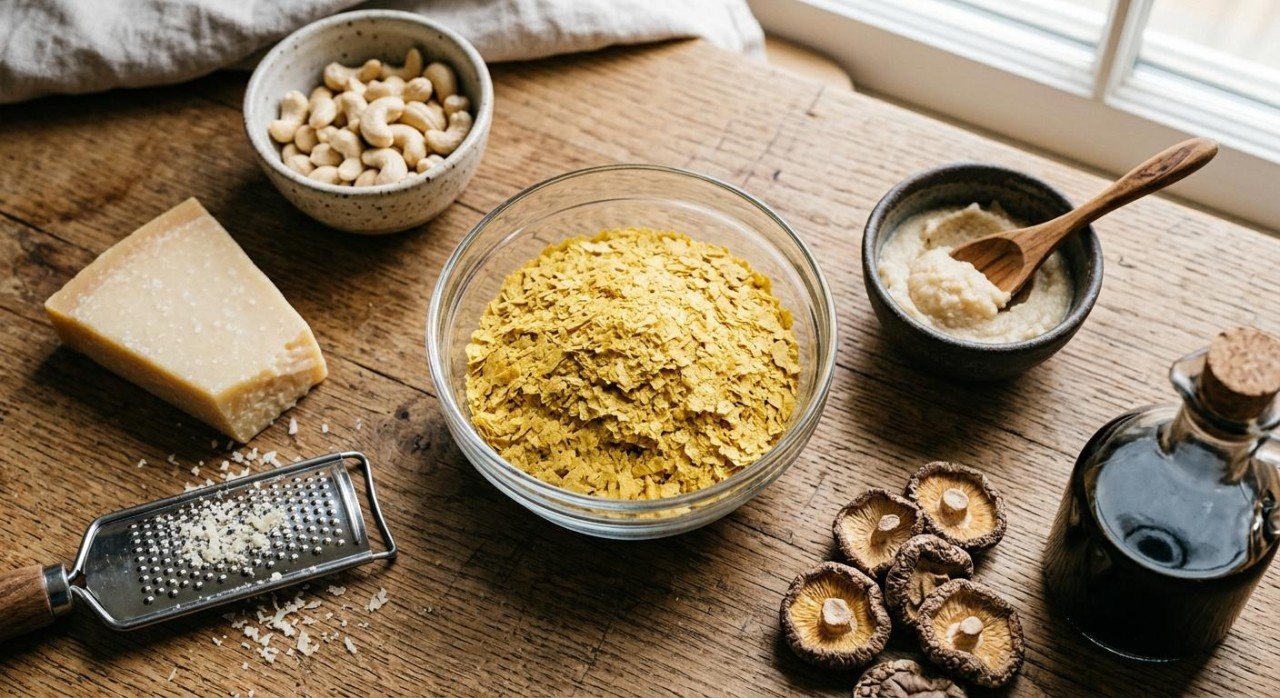
- White miso paste — the best flavor stand-in for anything wet; use one third the amount
- Raw cashews, blended — the body and richness of a vegan cheese sauce
- Finely grated parmesan — by far the closest cheesy hit, if the dish need not be vegan
- Store-bought vegan parmesan — a straight 1:1 that works in sauces and on top
- Cashew or sunflower seed "parm" — the homemade sprinkle for popcorn and pasta
- Dried mushroom powder — huge savory depth, earthy rather than cheesy
- Soy sauce or tamari — pure umami for soups, gravies, and dressings
- Yeast extract (Marmite or Vegemite) — the most concentrated option, and the only one that also carries B12
- Debittered brewer's yeast — the closest relative, but noticeably more bitter
- Vegetable bouillon powder — already in your pantry, and salty enough to need care
For Vegan Cheese Sauces, Mac and Cheese, and Queso
The hardest use to replace, because there is no cheese to fall back on. Stop looking for one swap and combine two: something for body, something for savory tang.
Raw Cashews (Blended)
- Swap: 1/4 cup nutritional yeast → 1/3 cup raw cashews blended into the sauce, plus 1 teaspoon lemon juice and 1/4 teaspoon salt
- Best for: Mac and cheese, queso, alfredo-style sauces, creamy soups
- Skip it for: Anything you sprinkle, anything nut-free, thin sauces you do not want thickened
- Health notes: An ounce of cashews brings about 4 g of protein, 74 mg of magnesium (20% DV), and 0.65 mg of copper (70% DV) - but also 190 calories, where nutritional yeast is nearly fat-free
Soak the cashews in boiling water for 30 minutes (or cold water for four hours), drain, then blend with the sauce liquid for longer than feels necessary, or it stays faintly gritty. Cashews supply richness and cling, not sharpness - that is the lemon and salt's job. Add miso, mustard, or a splash of sauerkraut brine and it starts reading as cheese.
White Miso Paste
- Swap: 1 tablespoon nutritional yeast → 1 teaspoon white (shiro) miso, whisked in off the heat. For 1/4 cup, start with 1 tablespoon and taste up
- Best for: Cheese sauces, gravies, soups, dressings, mashed potatoes, marinades
- Skip it for: Dry toppings, and dishes where you are watching sodium closely
- Health notes: Roughly 600 to 700 mg of sodium per tablespoon, so cut the recipe's salt to match
Fermented soybean paste lives in the same savory register nutritional yeast occupies, making it the best pure flavor substitute here. Whisk it in at the very end off the heat - simmering dulls its aroma, and a hard boil kills the live cultures in unpasteurized miso. Use white or shiro, the mildest; red and dark misos take over the dish.
Store-Bought Vegan Parmesan
- Swap: 1:1 by volume
- Best for: Sauces, baked pasta, popcorn, roasted vegetables
- Skip it for: Anything that needs to melt into strands; these soften but do not stretch
These are usually cashews or almonds ground with salt and garlic - exactly the profile you want, already made. Check the label first: many brands list nutritional yeast among the ingredients, which is fine if you simply ran out and useless if you are avoiding it for an allergy or a low-yeast diet.
Finely Grated Parmesan or Pecorino
- Swap: 1 tablespoon nutritional yeast → 1 tablespoon finely grated parmesan, with the recipe's added salt cut by about a quarter
- Best for: Pasta, risotto, popcorn, cream sauces, soups, roasted vegetables
- Skip it for: Vegan and dairy-free cooking, which is why most people own nutritional yeast in the first place
- Health notes: Adds calcium and protein, but also sodium and saturated fat that nutritional yeast does not carry
If the dish need not be vegan, nothing else is close. Parmigiano-Reggiano aged 24 months carries about 1,680 mg of free glutamate per 100 g, rising to around 2,220 mg at 48 months - among the highest of any food, and precisely the flavor nutritional yeast is imitating. Grate it on a microplane so it disperses instead of clumping; pecorino is sharper and saltier, so use less. Out of that too? Our parmesan substitutes guide covers the rest, and the cheddar guide is the one if a melting cheese sauce was the real goal.
For Popcorn, Pasta, and Anything You Sprinkle
Dry uses rule out everything wet - miso, soy sauce, and yeast extract are all out. You need a powder or coarse crumb that carries salt and sticks to a buttered surface.
Cashew or Sunflower Seed "Parm"
- Swap: 1 tablespoon nutritional yeast → 1 tablespoon of the blend below
- Make it: Pulse 1 cup raw cashews or sunflower seeds with 1 teaspoon salt and 1 teaspoon garlic powder to coarse sand. Stop before it turns to nut butter
- Best for: Popcorn, pasta, roasted vegetables, salads, avocado toast, garlic bread
- Skip it for: Smooth sauces - it stays grainy no matter how long you stir
- Health notes: Sunflower seeds are one of the best food sources of vitamin E, and the sunflower version is nut-free and much cheaper
This is the answer if popcorn is what sent you here: ninety seconds of work, two weeks in a jar in the fridge, and arguably better than the original, because it carries fat - which is what makes seasoning stick and taste rich. Toasting the nuts or seeds first roughly doubles the payoff.
Dried Mushroom Powder
- Swap: 1 tablespoon nutritional yeast → 2 teaspoons dried mushroom powder (grind dried porcini or shiitake in a spice grinder)
- Best for: Popcorn, pasta, risotto, gravy, soups, stews, burger and lentil-loaf seasoning
- Skip it for: Anything where you wanted a cheesy tang - this is deep and earthy, not sharp
- Health notes: The only heavy hitter here that adds essentially no sodium, and it counts as another plant in your week
Drying transforms a mushroom. Fresh shiitake carries around 70 mg of glutamate per 100 g, dried shiitake about 1,060 mg, plus roughly 150 mg of guanylate. That second compound is why a spoonful makes soup taste like it simmered an hour longer: when glutamate meets a 5'-ribonucleotide like guanylate, the two do not simply add up - in humans the response to the combination is about eight times larger than to glutamate alone. Start with less than you think; it browns pale dishes and keeps developing as it sits.
Debittered Brewer's Yeast
- Swap: 1 tablespoon nutritional yeast → 1 tablespoon debittered brewer's yeast, but add half first and taste
- Best for: Popcorn, savory sprinkles, hearty soups and stews, smoothies
- Skip it for: Delicate cream sauces, dressings, anything you cannot taste and adjust
- Health notes: Similar B-vitamin profile, but usually not fortified with B12 - check, do not assume
Same species, different upbringing: brewer's yeast is grown on a brewing medium rather than cultivated purely as food, and picks up a bitter edge from hop compounds. Debittered versions keep an earthy, wet-grain quality, so use it where strong flavors are already talking - chili, mushroom soup, heavily buttered popcorn. In a subtle sauce it reads as off rather than cheesy.
For Umami Stirred Into Soups, Sauces, and Dressings
If you were adding nutritional yeast a spoonful at a time to make food taste more savory rather than more cheesy, these are the most direct swaps. All are salty, so add the substitute first and salt at the end.
Soy Sauce or Tamari
- Swap: 1 tablespoon nutritional yeast → 2 teaspoons soy sauce. Tamari for gluten-free, or 1 tablespoon coconut aminos, which is milder, sweeter, and much lower in sodium
- Best for: Soups, stews, gravies, marinades, stir-fries, vinaigrettes, tomato sauce
- Skip it for: Dry seasoning, pale sauces it would tint brown, dishes that needed a cheesy note
- Health notes: Around 900 mg of sodium per tablespoon; reduced-sodium versions cut that by roughly a third
The fastest fix in the house for a dish that tastes flat. In small amounts it disappears into a tomato sauce or gravy without announcing itself - half a teaspoon in a pot of vegetable soup does real work. It cannot do the nutty half of the job, so pair it with something from the sprinkle section if you needed both. Out of that as well? The soy sauce substitutes guide has the full set.
Yeast Extract (Marmite or Vegemite)
- Swap: 1 tablespoon nutritional yeast → 1/2 teaspoon yeast extract, dissolved in a spoonful of hot liquid first
- Best for: Soups, stews, braises, gravies, tomato sauce, mushroom dishes, savory pies
- Skip it for: Anything pale or delicate, salads, dressings, dry sprinkling
- Health notes: Usually fortified - a 5 g serving of Marmite supplies about 25% of a day's B12 - making this the only swap that also replaces the fortification. Formulas differ by country, so check your jar
Yeast extract is essentially nutritional yeast concentrated into a paste - the same yeast cells, broken down to release their savory compounds. That makes it the most potent option here and the easiest to overdo: half a teaspoon in a pot of stew is transformative, a full teaspoon and the dish tastes like Marmite. Dissolve it in hot liquid first, or it sits in a stubborn dark clump at the bottom of the pan.
Vegetable Bouillon Powder
- Swap: 1 tablespoon nutritional yeast → 1 teaspoon bouillon powder or paste (or a quarter of a crumbled cube), with the recipe's salt cut back
- Best for: Soups, gravies, mashed potatoes, rice and grain cooking, pan sauces
- Skip it for: Dry toppings, and anything already seasoned to the edge
- Health notes: Frequently 500 mg or more of sodium per teaspoon, and many brands lean on flavorings rather than actual vegetables
The swap most people already own, and perfectly good in anything brothy. Its limit is that it adds nothing to a dish already built on stock - at that point you are only adding salt. There, reach for mushroom powder or miso instead.
The Swaps That Add Something Back
Worth saying plainly: nutritional yeast is a genuinely nutrient-dense ingredient, and most of the list above is a flavor swap rather than a nutrition swap - several options are far saltier than what they replace. Dried mushroom powder is the exception worth seeking out, since it delivers serious depth with essentially no sodium and counts as another plant in your week, if you are working toward the 30-plants-a-week target microbiome research points to for gut health.
Beyond that, the right answer depends on your dish. A tablespoon of miso in a four-serving soup is nothing; the same tablespoon in a salad dressing is most of the salt in the bowl. In Eat Well Planner, you can ask the AI recipe chat about the recipe you are actually cooking - it has your full ingredient list in front of it and can say which swap fits and at what amount. To see the consequences before committing, the Recipe Playground lets you swap an ingredient and watch the nutrition score and sodium move in real time.
Take the Guesswork Out of Eating Well
Eat Well Planner helps you organize your favorite recipes, plan balanced meals, and automatically generate shopping lists — all in one place. Whether you're tracking macros, managing dietary restrictions, or just trying to stop asking "what's for dinner?", we've got you covered.
Our AI-powered tools can adapt any recipe to your dietary needs, help you discover new meals you'll love, and even log your nutrition effortlessly. It's meal planning made simple.
Start Organizing Your Meals — FreeIf You Were Relying on the B12
Yeast does not make vitamin B12 - only certain bacteria do. When a tub lists a huge B12 number, that vitamin was manufactured separately and added to the flakes, which is why unfortified brands on the same shelf contain essentially none. Adults need 2.4 mcg a day, and Harvard's Nutrition Source lists fortified nutritional yeast alongside fortified cereals and enriched plant milks as a standard way for vegans and vegetarians to cover it.
Of everything in this guide, only fortified yeast extract carries B12. Cashews, sunflower seeds, miso, mushrooms, soy sauce, bouillon, and brewer's yeast contribute essentially none - and neither do the plant foods often claimed to, which the Vegan Society addresses bluntly, advising readers to be suspicious of any claim that this vitamin can be derived from plants. If the tub was your B12 vehicle rather than your popcorn seasoning, swap the flavor with anything above and cover the B12 separately with a supplement or another fortified food. It is a supplement question, not a substitution question.
What Not to Use
- Active dry or instant yeast. The most common mistake, and it fails completely. Baker's yeast is alive and bred to make bread rise, not to taste like anything - raw it is bready and bitter, and in warm liquid it foams rather than dissolving into savoriness. No ratio makes this work.
- Yeast from the bottom of a beer bottle. Same problem, plus real bitterness.
- Any chart telling you to use miso or Marmite 1:1. A tablespoon of nutritional yeast has almost no sodium - single-digit milligrams. A tablespoon of miso has upward of 600, and yeast extract far more. Spoon for spoon does not make a dish savory; it makes it inedible.
- Flour or cornstarch "for bulk." Some lists suggest these to replace the volume in a sauce. They replace texture and contribute nothing to flavor, which was the entire point.
The Short Version
Vegan cheese sauce: blended cashews for body plus a teaspoon of white miso for savor. Popcorn or pasta: blitz cashews or sunflower seeds with salt and garlic powder, or grate parmesan finely if dairy is fine. Soup or gravy: mushroom powder, soy sauce, or half a teaspoon of yeast extract. And if it was the B12 you needed, that is a supplement, not a swap.
And if you are adapting a whole dish rather than one line - making something dairy-free, say - Eat Well Planner's Recipe Variations feature will rewrite the entire recipe with the swaps already worked in, so you are not translating it in your head at the stove.