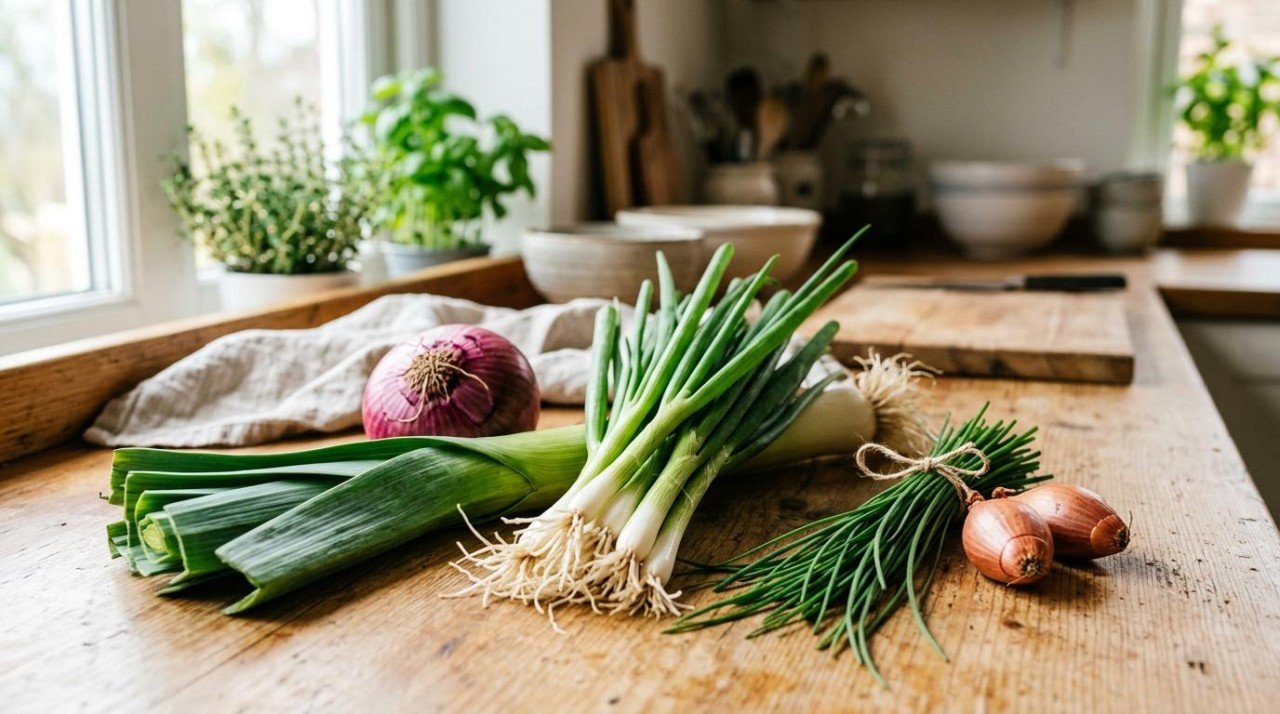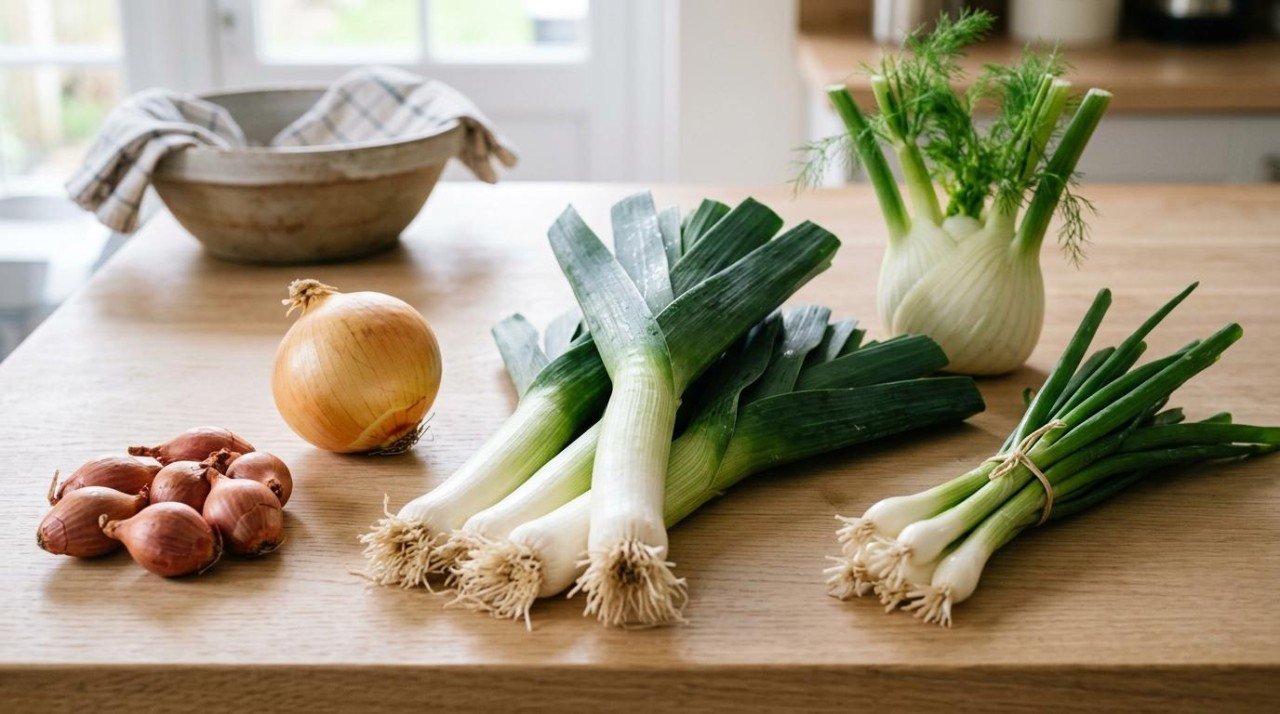
The recipe is potato leek soup, and the potatoes are peeled, the stock is warm, and the crisper drawer holds exactly zero leeks. There is a bag of yellow onions, a couple of shallots, and some scallions. Can you still make it?
Yes, but not by swapping one for one and hoping. A leek does something specific: it gives a mellow, gently sweet onion flavor with almost no bite, and with slow cooking it collapses into soft, silky ribbons. A regular onion has more sulfur punch and holds its shape longer, so a straight swap tends to make a leek dish taste louder and more ordinary than it should.
The fix is to choose the substitute by what the leeks were doing in the recipe, and to soften the stronger alliums so they behave like leeks. Every swap below has a measured ratio, sorted by job: the base of a soup, the main vegetable in a braise or gratin, a quick sauteed start to a quiche or risotto, or a crispy topping.
The Quick List
- Yellow onion + a shallot — the closest all-purpose stand-in for a cooked base
- Sweet onion — the best single swap for potato leek soup and vichyssoise
- Yellow onion, sweated low and slow — what most kitchens actually have, and it works with the right technique
- Shallots — mild and refined, great in small amounts and cream sauces
- Scallions — the closest flavor match, best in quick cooking
- Fennel (with a little onion) — restores the soft, silky body in braises and gratins
- Spring onions or green garlic — the seasonal near-twins of leeks
- Ramps — a spring treat, much stronger, used at half the volume
- Celery + onion — a soup and stock base when you need bulk and a green note
- Crispy fried shallots or onions — for a fried leek garnish
First, How Much Is One Leek?
Leeks vary a lot in size, and recipes are rarely precise about it. As a working rule, a medium leek gives about 1 cup chopped once you trim off the root and the dark green tops, and a large supermarket leek gives closer to 1 1/2 to 2 cups. If the recipe says "2 leeks," call it 2 to 3 cups chopped and measure your substitute against that.
Two rules then cover almost every swap:
- Cooked base: use about 3/4 cup of onion for every 1 cup of leek, because onion is stronger. Milder alliums (sweet onion, scallions, shallots) can go in closer to 1:1.
- Cook it gently: sweat the substitute over medium-low heat with a lid on and a pinch of salt until it is soft and translucent, not browned. Leeks rarely get caramelized in classic recipes, and browning an onion pushes it even further from leek flavor.
Before you write leeks off entirely, check what is left of the last bunch. America's Test Kitchen notes that the dark green tops are tough and suitable only for making stock, but the tender pale part runs higher inside the leek than the outside color suggests. Their trick of cutting the tops off on a diagonal, layer by layer, recovers roughly 15 percent more usable leek. If you have one small leek, that plus a little onion may be all you need.
Match the Substitute to the Job
- Soup base (potato leek, vichyssoise, chicken soup) — sweet onion, yellow onion + shallot, celery + onion
- Leeks as the vegetable (braised leeks, gratins, tarts) — fennel, spring onions, green garlic, scallions halved lengthwise
- Quick sauteed base (quiche, frittata, risotto, pasta, stuffing) — yellow onion + shallot, shallots, scallions
- Crispy topping — fried shallots or onions
Yellow Onion + a Shallot
- Swap: 1 cup chopped leek → 1/2 cup finely chopped yellow onion + 1/4 cup minced shallot (about 1 large shallot)
- Best for: Soup bases, quiche, risotto, pasta sauces, stuffing, braises
- Skip it for: Dishes where leeks are the vegetable you see on the plate, like braised leeks
This is the closest thing to leek flavor that most kitchens can put together. The onion brings bulk and savory depth; the shallot brings a softer, more delicate sweetness that pulls the whole thing closer to a leek's mellow profile. The combined volume is slightly less than the leek you are replacing, which is intentional, since both are stronger.
Chop the onion finer than you think you need to. Leeks melt into thin, soft layers, and a fine dice cooked gently ends up much closer to that texture than big chunks of onion. Our shallot substitutes guide has the shallot sizing chart if you are working out how many you need.
Sweet Onion (Vidalia, Walla Walla, Maui)
- Swap: 1 cup chopped leek → 1 cup chopped sweet onion
- Best for: Potato leek soup, vichyssoise, creamy soups, quiche, and any dish where leeks are a gentle background
- Skip it for: Long-cooked stews that need savory backbone, where sweet onion can taste flat and a little watery
Sweet onions are mild because they are low in the sulfur compounds that give a regular onion its bite, which makes them the one onion you can swap straight across into a leek recipe. In a blended soup, where texture disappears anyway, a sweet onion cooked gently in butter or olive oil is very hard to tell apart from leeks.
For potato leek soup specifically, this is the swap to reach for. If you also have scallions, stir a handful of thinly sliced green tops into the finished soup for the fresh green note that leeks would have given.
Yellow Onion, Sweated Low and Slow
- Swap: 1 cup chopped leek → 3/4 cup finely chopped yellow onion, cooked covered over medium-low heat for 10 to 12 minutes
- Best for: Any cooked base when it is the only allium in the house
- Skip it for: Delicate cream sauces and dishes where leek is the star, unless you accept a stronger onion flavor
Plain yellow onion is the most common substitute and the one most likely to disappoint, but almost always because of technique rather than the onion itself. Cooked hot and fast, it browns and turns assertive. Cooked slowly with a lid and a pinch of salt, it softens, releases its water, and becomes much sweeter and milder. That gentler version is the one you want.
Use a little less than the leek amount and cut it fine. If the dish still tastes too oniony at the end, a spoonful of cream, a squeeze of lemon, or a few extra minutes of simmering will round it off. White onion works the same way but is sharper; save it for brothy dishes rather than creamy ones. For the full rundown on onion swaps and how they behave, see the onion substitutes guide.
Shallots
- Swap: 1 cup chopped leek → 3/4 to 1 cup minced shallot (about 4 to 5 medium shallots)
- Best for: Cream and wine sauces, risotto, gratins, egg dishes, any recipe using a single leek
- Skip it for: Recipes that call for several leeks, where you would need a whole bag of shallots
On flavor alone, shallots are the closest of the bulb alliums to leeks: mild, a little sweet, with a soft garlicky edge. The catch is quantity. A medium shallot gives about 3 tablespoons minced, so replacing a cup of leek takes roughly five of them. That is fine for a sauce or a single-leek risotto and impractical for a big pot of soup, which is why the onion-plus-shallot combination above usually makes more sense.
Shallots are also denser and contain less water than onions, so they soften faster. Keep the heat gentle and stir often; a shallot goes from golden to bitter quickly.
Scallions (Green Onions)
- Swap: 1 cup chopped leek → 1 cup thinly sliced scallions, white and light green parts
- Best for: Quick sautes, frittatas, fried rice, pasta, dumpling fillings, and as a fresh finish on leek soups
- Skip it for: Long braises — scallions do not have the bulk to melt into a silky base
Scallions and leeks share the same long, layered structure and a similar fresh, grassy sweetness, so on flavor they are a very good match. The difference is substance. Leeks are thick and fleshy; scallions are thin and cook in about a minute, so they cannot carry a dish that depends on a long-cooked base.
Where they shine is speed. For a leek frittata, a weeknight pasta, or a leek and mushroom saute, scallions go in near the end and land very close to the original. For whole braised or grilled leeks, use thick scallions or halved spring onions and cut the cooking time in half. The green onion substitutes guide covers the reverse swap if scallions are what you are missing.
Fennel (with a Little Onion)
- Swap: 1 cup chopped leek → 1/2 cup thinly sliced fennel bulb + 1/2 cup thinly sliced yellow or sweet onion
- Best for: Braises, gratins, roasted vegetable dishes, fish stews, and tarts where leeks provide body
- Skip it for: Dishes where you do not want any anise flavor, and as the only substitute in a classic potato leek soup
Fennel does something onion cannot: it braises into the same soft, layered, slightly sweet texture as leeks. Raw fennel tastes clearly of anise, but long cooking mellows that a lot, and in a gratin or a braise with cream, white wine, or stock, it reads as gentle and sweet rather than licorice-y. Pairing it with onion supplies the allium flavor that fennel lacks.
Slice it thin, against the grain, and give it the same time the leeks would have had. Fennel is also a nutritional upgrade: per 100 g, USDA data puts raw fennel bulb at 3.1 g of fiber against 1.8 g for leeks and 1.7 g for onion. Save the fronds and scatter them on top at the end.
Spring Onions or Green Garlic
- Swap: 1 cup chopped leek → 1 cup chopped spring onions (bulbs and light green stalks), or 3/4 cup chopped green garlic
- Best for: Whole braised or grilled leek dishes, soups, risotto, tarts, spring vegetable dishes
- Skip it for: Dishes that should stay very mild, if you are using green garlic
Spring onions (young onions harvested before the bulb fully forms, larger than scallions) and green garlic (young garlic harvested before it forms cloves) both show up at farmers markets and some grocery stores in spring. Both have the same tender stalks and mild flavor that make leeks useful, and they can be trimmed, halved, and braised or grilled whole just like leeks.
Green garlic is noticeably more garlicky than leeks, which is why it gets a slightly smaller ratio. Spring onions are milder and swap almost exactly. If you see either at the market, they are worth trying in any leek recipe, not just as an emergency substitute.
Ramps
- Swap: 1 cup chopped leek → 1/2 cup chopped ramps (bulbs and leaves), plus 1/2 cup sweet onion for bulk if needed
- Best for: Spring pasta, eggs, risotto, pesto, a simple saute
- Skip it for: Big pots of soup — they are too strong and too precious to use by the cupful
Ramps are sometimes called wild leeks, but their flavor is much more intense: a strong garlic-and-onion punch that dominates a dish if you use them like cultivated leeks. Use half the volume and treat them as the featured flavor rather than a background base. The leaves wilt in seconds, so add them at the very end.
Buy ramps only from sellers who harvest responsibly. United Plant Savers placed ramps on its "To-Watch" list, noting they take more than seven years to reach maturity and that an overharvested patch can need 20-plus years to recover. Great Smoky Mountains National Park banned collecting them in 2002. The group recommends taking a single leaf per plant and leaving the bulb in the ground, so if you are buying, choose leaves only when you can, and do not forage in places where it is prohibited.
Celery + Onion
- Swap: 1 cup chopped leek → 1/2 cup chopped onion + 1/4 cup finely chopped celery
- Best for: Chicken soup, vegetable soups, stocks, stews, stuffing
- Skip it for: Creamy blended soups where celery's stringiness or color would show, and braised leek dishes
Leeks add both allium flavor and a fresh, vegetal green note, and celery helps put that green note back when onion alone would taste one-dimensional. In a brothy soup or homemade stock, this mix gives a full, rounded base that most people would never identify as a substitution. If you are making stock, check our chicken broth substitutes guide too.
Keep the celery to a supporting role. At equal amounts it starts to taste like celery soup, which is a different dish.
Crispy Fried Shallots or Onions
- Swap: 1:1 by volume for crispy fried leeks
- Best for: Garnishing soups, salads, steak, roasted vegetables, mashed potatoes
- Skip it for: Anything where the leek is cooked into the dish — these will just go soggy
Crispy fried leeks are a common restaurant garnish, and fried shallots or onions do exactly the same job: a crunchy, sweet, savory topping. The tubs of crispy fried shallots sold in Asian groceries are excellent, and canned French-fried onions work too.
To fry your own, slice shallots or an onion very thinly, start them in about a quarter inch of neutral oil in a cold pan, and bring them up to a steady medium sizzle, stirring often. Pull them out when they turn pale gold — they keep cooking on the paper towel — and salt them right away.
Leeks vs. Onions: The Nutrition Angle, Honestly
Leeks are often described as sweeter than onions, but the sugar numbers do not back that up. Per 100 g raw, USDA data lists leeks at 3.9 g of sugar and onions at 4.2 g. What makes leeks taste sweeter is what they lack: less of the sharp sulfur bite that dominates an onion. That is useful for cooking, because it means the fix is gentler cooking and milder alliums, not adding sugar.
Where leeks really differ is in their green tissue. Per 100 g, leeks have about 47 µg of vitamin K and 64 µg of folate, against an onion's 0.4 µg and 19 µg — that comes from the pale green leaves an onion bulb does not have. Leeks also carry more vitamin C (12 mg vs. 7.4 mg) and roughly the same fiber (1.8 g vs. 1.7 g).
So if keeping that nutritional edge matters to you, pick substitutes with green parts. Scallions, tops included, have even more: USDA lists 207 µg of vitamin K, 64 µg of folate, and 2.6 g of fiber per 100 g. Fennel brings 62.8 µg of vitamin K and the most fiber of the group. A base of onion plus a handful of sliced scallions or some fennel is nutritionally closer to leeks than onion alone, and it tastes closer too.
There is also a plant-diversity bonus. Leek, onion, shallot, scallion, and fennel are all different plants, and if you track plant variety for gut health, a base using two of them counts for more than a base using one. Our post on why 30 plants a week matters explains the research behind that idea.
Take the Guesswork Out of Eating Well
Eat Well Planner helps you organize your favorite recipes, plan balanced meals, and automatically generate shopping lists — all in one place. Whether you're tracking macros, managing dietary restrictions, or just trying to stop asking "what's for dinner?", we've got you covered.
Our AI-powered tools can adapt any recipe to your dietary needs, help you discover new meals you'll love, and even log your nutrition effortlessly. It's meal planning made simple.
Start Organizing Your Meals — FreeIf You Are Avoiding Leeks for FODMAP Reasons
If you are looking for a leek substitute because of IBS, most of the alliums above will not help: onions, shallots, garlic, and the white part of leeks are all high in fructans. Swapping one for another changes nothing.
The useful exception is the leek itself. Monash University, who developed the low FODMAP diet, has tested the green leaves of leeks separately from the bulb, and the leaves are low FODMAP in a moderate serving, while the pale bulb is high. Check the Monash app for the current serving size, since it has been revised over time. Beyond that, the reliable options are:
- Leek or scallion green tops — slice the dark green parts thinly and cook them longer than you would the white part, since they are tougher.
- Garlic- or onion-infused oil — Monash explains that fructans are water soluble but not fat soluble, so the flavor moves into the oil while the fructans stay behind.
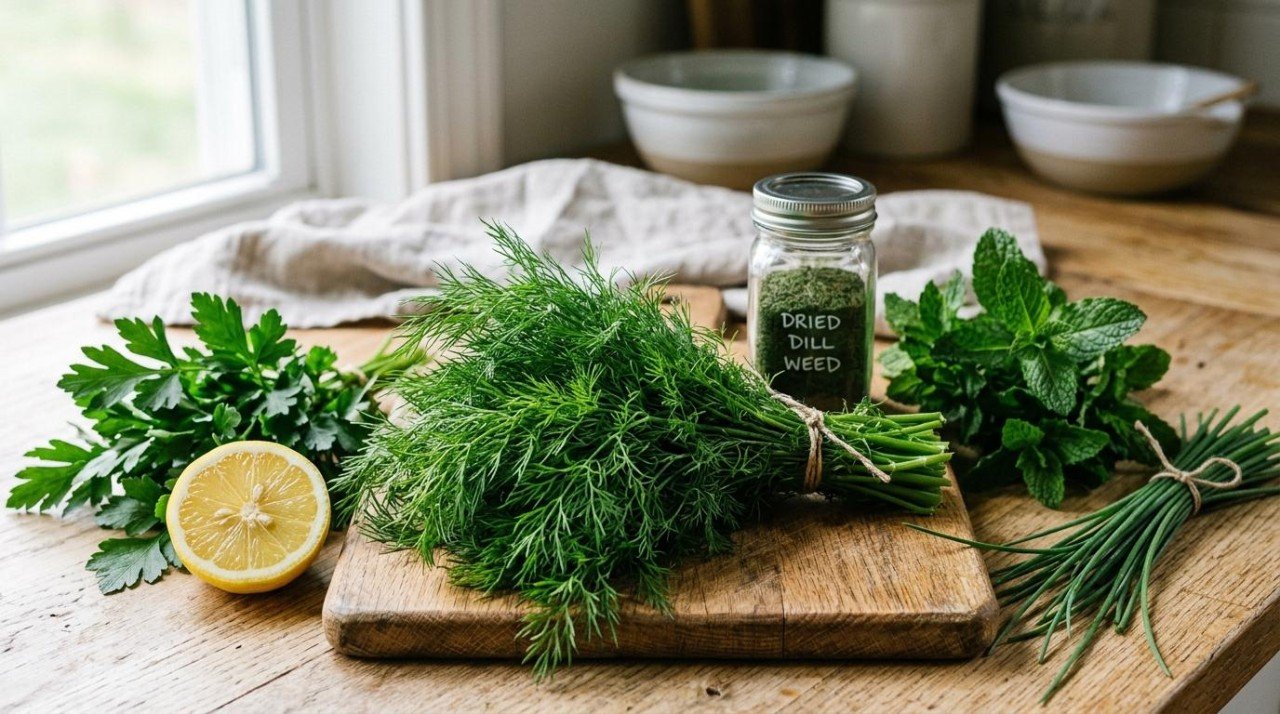
- Chives — Monash names chives and the green parts of spring onion as onion replacements.
- Asafoetida — a small pinch bloomed in hot oil adds an onion-like savory note. Many brands contain wheat flour, so check the label if you also avoid gluten.
One thing that does not work: cooking a whole leek or onion in soup and fishing it out before serving. Monash is clear that the fructans have already leached into the liquid by then.
What Not to Use
- A full volume of yellow onion cooked hot. Browned onion at a 1:1 ratio turns a delicate leek soup into onion soup. Use less and cook it gently.
- Red onion in a pale soup or sauce. Its pigment bleeds into a gray-purple color, and it is sharper than leeks anyway.
- Onion powder as a stand-in for a leek base. It can add a bit of flavor, but leeks provide body and texture. In a soup built on two cups of soft leeks, powder leaves it thin.
- Ramps by the cupful. They are far stronger than leeks and, in many areas, overharvested.
- Raw garlic as the main substitute. Garlic is a supporting flavor. It cannot replace the sweetness or volume of leeks, and a lot of it will overwhelm the dish. If garlic is what you are short on, the fresh garlic substitutes guide has the conversions.
- Dark green leek tops cooked as if they were the white part. They stay tough and stringy. Use them in stock, or slice them very thin and cook them much longer.
Not Sure Which One Fits Your Recipe?
A general guide can only go so far. Leeks in a blended potato soup, leeks braised whole with butter and thyme, and leeks folded into a quiche are three different jobs, and the best substitute depends on which one you are cooking and what else is in the dish.
That is where Eat Well Planner helps. Import the recipe you are making from any website, Instagram reel, or YouTube video, and the AI recipe chat can answer with the full recipe in front of it: "I have no leeks, just yellow onions, a fennel bulb, and scallions — what should I do?" If you are avoiding alliums for FODMAP reasons, Recipe Variations can rewrite the whole recipe with low FODMAP swaps already worked in.
And if you want the substitution to make the dish a little more nourishing — adding fennel for fiber or scallion greens for vitamin K — the Recipe Playground lets you change an ingredient and see the nutrition score update before you commit. It is free to use, and much quicker than guessing over a hot pan.