You are standing over a mixing bowl with a biscuit recipe that calls for two cups of self-rising flour, and the only bag in the pantry says all-purpose. Good news: this is the most exactly solvable substitution in baking, because self-rising flour is not really a special flour. It is ordinary flour that somebody already stirred baking powder and salt into.
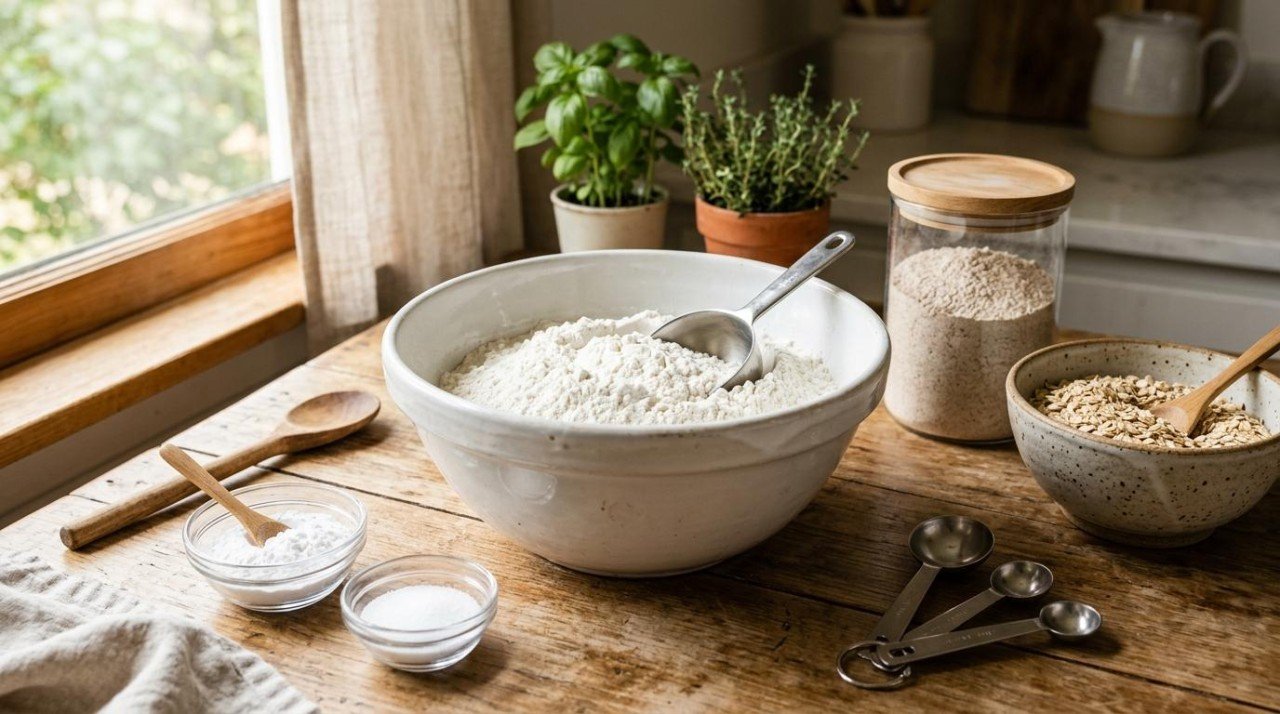
So you are not approximating anything. The standard formula is 1 cup all-purpose flour, 1 1/2 teaspoons baking powder, and 1/4 teaspoon fine salt. Whisk, use as directed, done.
The wrinkles come up when you are also out of baking powder, when you are making tender Southern-style biscuits that want a softer flour than all-purpose, or when you would like to work some whole grain in while you are at it. Everything below is ordered from the swap you will almost certainly use to the ones for narrower situations.
The Quick List
- All-purpose flour + baking powder + salt — the exact DIY; works anywhere self-rising flour does
- All-purpose flour + cornstarch + leavening — closest match for tender, Southern-style biscuits
- Bread flour + baking powder + salt — fine in a pinch; chewier, needs a splash more liquid
- Baking soda + cream of tartar — when you are out of baking powder too; bake immediately
- Baking soda + buttermilk — best when the recipe already calls for buttermilk
- Gluten-free 1:1 blend + baking powder + salt — the reliable gluten-free version
- Whole wheat or white whole wheat + leavening — the fiber upgrade; best at half
- Oat flour + leavening — partial swap that adds beta-glucan and a soft crumb
1. All-Purpose Flour + Baking Powder + Salt
- Swap: 1 cup self-rising flour → 1 cup (120 g) all-purpose flour + 1 1/2 teaspoons baking powder + 1/4 teaspoon fine salt
- Best for: Everything — biscuits, pancakes, waffles, muffins, scones, quick breads, cobbler topping, dumplings
- Skip it for: Nothing, as long as you whisk it properly
- Health notes: You control the salt, which a store-bought bag does not let you do
The only thing that usually goes wrong here is bad mixing. Baking powder is fine and dense, flour is light and clumpy, so a lazy stir leaves pockets of concentrated leavening that taste faintly bitter and make biscuits rise crooked. Whisk a full 20 to 30 seconds, or sieve it once.
Two checks before you commit. That your baking powder is still alive — half a teaspoon in hot water should fizz enthusiastically, or the batch will be a brick. And that the recipe does not also call for baking powder and salt on their own lines; some do add a little baking soda for browning, and that soda should stay in. A jar of this keeps about six months airtight. Label it, because it looks identical to plain flour and is an unpleasant surprise in a pie crust.
2. All-Purpose Flour + Cornstarch + Leavening
- Swap: 1 cup self-rising flour → 14 tablespoons all-purpose flour + 2 tablespoons cornstarch + 1 1/2 teaspoons baking powder + 1/4 teaspoon fine salt, sifted twice
- Best for: Southern-style biscuits, shortcake, pancakes, tender cakes, cobbler
- Skip it for: Anything needing structure — a heavy quick bread loaded with fruit or nuts will slump
Here is the detail most substitution charts skip: commercial self-rising flour is often not milled from the same wheat as your all-purpose. White Lily, the brand behind a lot of heirloom biscuit recipes, is made from 100 percent soft winter wheat, which is lower in protein than standard all-purpose. Less protein means less gluten, which means a cakier crumb. Straight all-purpose gets you a perfectly good biscuit that is a little sturdier and more bread-like than the recipe author intended.
Swapping 2 tablespoons of the flour for cornstarch closes most of that gap, because the starch dilutes the protein. It is the same trick used to fake cake flour, which sits at roughly 7 to 9 percent protein against all-purpose flour's 10 to 12 percent. Sift twice — cornstarch clumps worse than flour, and lumps show up as chalky white streaks.
3. Bread Flour + Baking Powder + Salt
- Swap: 1 cup self-rising flour → 1 cup bread flour + 1 1/2 teaspoons baking powder + 1/4 teaspoon fine salt, plus up to 1 tablespoon extra liquid
- Best for: Drop biscuits, dumplings, cobbler topping, savory quick breads
- Skip it for: Delicate cakes, shortcake, and the flakiest cut biscuits
Bread flour points in the opposite direction from what self-rising flour wants, but it works. Its higher protein absorbs more water, so the dough feels tight and dry at your recipe's liquid amounts — add more a tablespoon at a time — and it builds gluten fast, so handle it as little as possible or the dough turns rubbery. Expect more chew: under sausage gravy nobody notices, in a strawberry shortcake they will. Our guide to all-purpose flour substitutes goes deeper on the wheat-flour trade-offs.
4. Baking Soda + Cream of Tartar
- Swap: 1 cup self-rising flour → 1 cup all-purpose flour + 3/4 teaspoon cream of tartar + a scant 1/2 teaspoon (3/8 teaspoon) baking soda + 1/4 teaspoon fine salt
- Best for: Pancakes, waffles, biscuits, quick breads that go straight into the pan or oven
- Skip it for: Batters that rest, doughs you chill, anything mixed ahead
This is the swap for the worse version of the problem: no self-rising flour and no baking powder. Baking powder is only baking soda plus a powdered acid, and cream of tartar is that acid. The conversion is 1/2 teaspoon cream of tartar plus 1/4 teaspoon baking soda per teaspoon of baking powder, so a cup's worth needs one and a half times that.
The catch is timing. Commercial baking powder is double-acting, saving some gas for oven heat; your homemade version is single-acting and spends everything in the first few minutes. Mix it in last and get the pan straight into the oven. Pancakes are ideal; a muffin batter that waits for the oven to preheat comes out noticeably flatter. If cream of tartar is what you are short on, our cream of tartar guide covers the acids that stand in for it.
5. Baking Soda + Buttermilk
- Swap: 1 cup self-rising flour → 1 cup all-purpose flour + 1/4 teaspoon baking soda + 1/4 teaspoon fine salt, with at least 1/2 cup buttermilk per cup of flour as the recipe's liquid
- Best for: Buttermilk biscuits, pancakes, cornbread, Irish soda bread, waffles
- Skip it for: Recipes whose liquid is water or plain milk, or where you cannot change the liquid
Baking soda needs an acid to do anything, and buttermilk is one. If your recipe already calls for buttermilk — many recipes that want self-rising flour do — you can leave the baking powder out entirely and let the soda react with it. This is less a workaround than how Southern biscuits were made before packaged self-rising flour existed.
It changes the dish, mostly for the better: baking soda raises the dough's pH, which speeds browning and gives crisper edges. Sally's Baking Addiction's buttermilk biscuit recipe uses both leaveners on purpose for that reason — the powder lifts, the soda browns and heads off the bitter aftertaste baking powder alone can leave. If you have some baking powder but not enough, that hybrid is the best of both. If buttermilk is the missing piece, our buttermilk substitutes guide has the milk-plus-acid fix.
6. Gluten-Free 1:1 Blend + Baking Powder + Salt
- Swap: 1 cup self-rising flour → 1 cup gluten-free measure-for-measure blend + 1 1/2 teaspoons baking powder + 1/4 teaspoon fine salt, plus 1/4 teaspoon xanthan gum only if the blend lacks it
- Best for: Pancakes, muffins, drop biscuits, cobbler topping
- Skip it for: Single flours — rice, almond, or coconut flour alone will not work here
The leavening ratio does not change when you go gluten-free; only the flour does. Use a blend sold as 1:1, measure-for-measure, or cup-for-cup, since those swap directly for wheat flour by volume. Most already include xanthan gum, so read the label before adding more — doubling up gives a gummy, heavy crumb. Gluten-free doughs also benefit from a 10 to 15 minute rest so the starches hydrate, which works against a single-acting leavener — one place where real double-acting baking powder beats the cream of tartar version above.
The Healthier Upgrades
Self-rising flour is refined white flour by definition, so if you are mixing your own anyway, this is a free chance to make the swap better than the bag you would have bought.
Whole Wheat or White Whole Wheat Flour
- Swap: 1 cup self-rising flour → 1/2 cup whole wheat flour + 1/2 cup all-purpose flour + 1 1/2 teaspoons baking powder + 1/4 teaspoon fine salt, plus about 2 teaspoons extra liquid
- Best for: Muffins, pancakes, waffles, drop biscuits, savory quick breads
- Skip it for: Light layer cakes and the flakiest cut biscuits
- Health notes: Whole wheat flour has 10.7 g of fiber per 100 g against 2.7 g for white flour, plus more protein
Half-and-half is the honest recommendation, not a full swap. Whole wheat flour still contains the bran, which drinks up more water and whose sharp edges physically cut gluten strands — that is why an all-whole-wheat biscuit comes out dense and squat. At 50 percent you get close to four times the fiber in that half of the mix while keeping a texture people will eat. White whole wheat is the same grain in a paler variety: identical fiber, milder flavor.
Oat Flour
- Swap: 1 cup self-rising flour → 3/4 cup all-purpose flour + 1/3 cup oat flour + 1 1/2 teaspoons baking powder + 1/4 teaspoon fine salt
- Best for: Pancakes, waffles, muffins
- Skip it for: Full 1:1 swaps, and anything that has to hold a tall, layered structure
- Health notes: Adds beta-glucan, the soluble fiber oats are known for
No need to buy it — blend rolled oats until powdery. Oat flour has no gluten of its own, so keep it to about a quarter of the flour and let the wheat do the structural work. The payoff is a soft, faintly sweet crumb that suits pancakes and muffins well.
One more advantage to mixing your own: you decide how much salt goes in. Store-bought self-rising flour carries about 1,193 mg of sodium per 100 g — roughly 1,491 mg in a cup — against essentially none in plain all-purpose. Salt plays no part in the leavening reaction, so halving that 1/4 teaspoon, or skipping it with salted butter, trims a few hundred milligrams per cup without touching the rise.
Take the Guesswork Out of Eating Well
Eat Well Planner helps you organize your favorite recipes, plan balanced meals, and automatically generate shopping lists — all in one place. Whether you're tracking macros, managing dietary restrictions, or just trying to stop asking "what's for dinner?", we've got you covered.
Our AI-powered tools can adapt any recipe to your dietary needs, help you discover new meals you'll love, and even log your nutrition effortlessly. It's meal planning made simple.
Start Organizing Your Meals — FreeThe Reverse Problem: Self-Rising Flour When the Recipe Wants All-Purpose
This comes up just as often, usually because a bag got bought by mistake. Use the self-rising flour 1:1, then remove 1 1/2 teaspoons of baking powder and 1/4 teaspoon of salt from the recipe for every cup of flour. If the recipe also calls for baking soda, leave it in — it is there to brown the bake and react with an acid, which the baking powder in the flour does not do.
The exception is yeast bread. Self-rising flour brings chemical leavening and salt on a schedule that has nothing to do with a yeast dough's rise. Use plain flour for anything with yeast in it.
What Not to Use
- Plain all-purpose flour on its own. The most common version of this mistake. Without the leavening you get flat, dense biscuits — the recipe is relying on that 1 1/2 teaspoons of baking powder per cup and has no other lift built in.
- Baking soda by itself. Not a drop-in for baking powder. It needs an acid in the recipe to produce gas; without one it leaves a soapy, metallic taste.
- Self-rising cornmeal mix. Sounds close, is not — it is mostly cornmeal, so you get cornbread texture whether you wanted it or not.
- Pancake or biscuit mix, measured 1:1. Mixes like Bisquick already contain fat and more salt. If it is truly all you have, cut the recipe's butter or shortening by about a third, hold back the added salt, and expect a different result.
- Almond or coconut flour, 1:1. Neither is a wheat flour substitute at equal volume. Coconut flour absorbs several times its weight in liquid and needs extra eggs to hold together at all.
- Baking powder past its date. Not a substitution problem exactly, but it is why most homemade self-rising flour fails. Test it in hot water first.
Which One Fits Your Recipe
For nearly everyone reading this it is the first swap: 1 cup all-purpose flour, 1 1/2 teaspoons baking powder, 1/4 teaspoon fine salt, whisked properly. Reach for the cornstarch version if you are chasing a specific tender biscuit, cream of tartar if your baking powder went missing too, and buttermilk if the recipe was already pointing that way.
What a blog post cannot do is look at your recipe. That is where Eat Well Planner helps: import the recipe you are making and the AI recipe chat will tell you which of these swaps fits that particular dough, with the ingredient list and method in front of it. Ask it to rewrite the recipe gluten-free or dairy-free and Recipe Variations hands back the whole thing with the substitutions worked in. And to see whether the whole wheat version is worth it before committing, the Recipe Playground lets you make the swap and watch the nutrition score move, with a per-edit delta showing what the change bought you.