The recipe is grain-free, the bowl is out, and the almond flour bag is either empty or sitting on the other side of a nut allergy. Almond flour is a strange ingredient to replace, because it is not really a flour at all. It is ground nuts: about half fat, a fifth protein, and almost no starch. That is where its moist, tender, nutty crumb comes from, and it is why a cup of regular flour will not simply slot in.
The good news is that most of the best substitutes are other ground nuts and seeds, which behave almost the same way. The bad news is that the substitute everyone reaches for first, coconut flour, behaves completely differently, and a 1:1 swap is the single most common way an almond flour recipe gets ruined. More on that below.
The right pick depends on what you are making: a gluten-free cake or cookie, a crunchy coating for chicken, or macarons, where the grind has to be fine enough to pass through a sieve. The guide is organized around those three jobs.
The Quick List
- Almond meal — same nut, coarser grind; a 1:1 swap for everything except macarons
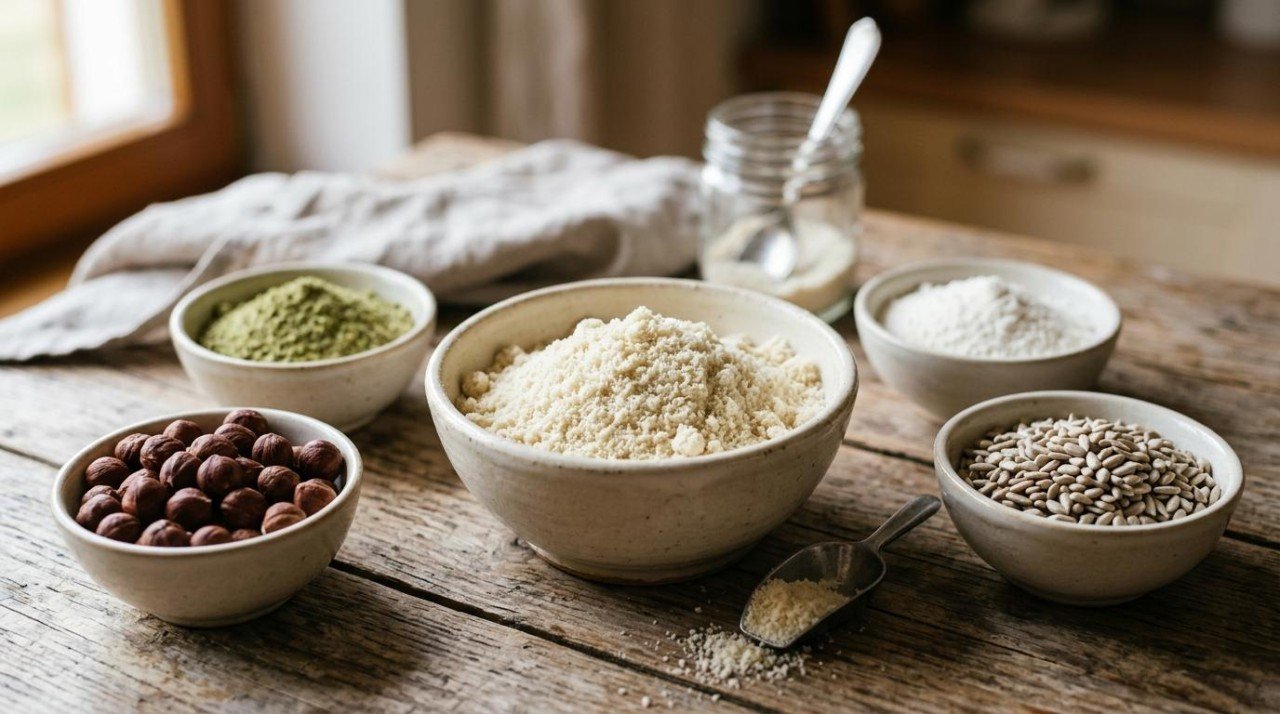
- Other nut flours (hazelnut, pecan, cashew, macadamia) — the most faithful swap, 1:1 by weight
- Sunflower seed flour — the best nut-free option, 1:1, with one color quirk to manage
- Pumpkin seed flour — nut-free, 1:1, and the protein and mineral upgrade
- Oat flour — 1:1 by weight in muffins and quick breads; lighter, drier, and fiber-rich
- Coconut flour — works, but only at about 1/4 the amount, with extra eggs and liquid
- All-purpose flour — fine when gluten is not the reason you are using almond flour
- Crushed pork rinds + Parmesan — the low-carb breading that actually crisps
- Panko or bread crumbs — the crunchiest coating if grain-free is not the goal
- Ground flaxseed — a partial swap in baking and a solid breading base
Substitutes for Gluten-Free Baking
In cookies, cakes, muffins, and quick breads, almond flour is doing three jobs at once: adding fat (moisture and tenderness), adding protein (some structure), and adding bulk without gluten. The closer a substitute is to that profile, the less you have to change. A note on measuring: King Arthur's ingredient chart puts a cup of almond flour at 96 g, against 120 g for all-purpose flour and 128 g for coconut flour, so the same cup holds very different amounts of each. If you own a scale, swap by weight.
1. Almond Meal
- Swap: 1 cup almond flour → 1 cup almond meal (or match the grams)
- Best for: Muffins, quick breads, rustic cakes, crumbles, crusts, cookies with a bit of texture
- Skip it for: Macarons and delicate, pale cakes
If you have a bag labeled almond meal, you mostly have your answer. The difference is the skins: almond flour is made from skinless, blanched almonds ground almost to a powder, while almond meal usually keeps the skins and is ground coarser, with brown specks throughout. Healthline's verdict is that the two are interchangeable in most recipes, but that the finer flour works better in delicate bakes, where coarse meal can weigh the batter down.
In practice, expect a slightly denser, darker, more rustic result with a little more chew. That is an improvement in a blueberry muffin or a fruit crumble and a liability in a pale vanilla cake. Labels are not always consistent, so check the bag: some products sold as almond meal are made from blanched almonds and are nearly identical to flour.
2. Other Nut Flours (Hazelnut, Pecan, Cashew, Macadamia)
- Swap: 1 cup almond flour (96 g) → 96 g hazelnut, pecan, cashew, or macadamia flour
- Best for: Cookies, brownies, tart crusts, coffee cakes, anything chocolate or spiced
- Skip it for: Full replacement in macarons (see the macaron section)
Other nuts have roughly the same fat-protein-no-starch makeup as almonds, so they are the closest structural match there is. What changes is flavor and fineness. Hazelnut flour is sweeter and more assertive, which is a gift in anything with chocolate or coffee. Pecan flour tastes buttery and toasty and bakes up a touch more oily. Cashew and macadamia are the mildest and richest, the best picks when you do not want the nut flavor to announce itself.
Most of these are ground a bit coarser than superfine almond flour, and they do not weigh the same per cup: King Arthur lists hazelnut flour at 89 g a cup and pecan meal at 80 g, so weighing keeps you honest. Can't find them in the store? Pulse whole nuts with the recipe's sugar in a food processor in short bursts, then sift; the sugar keeps them from turning into nut butter. Blanched hazelnuts give the cleanest result, since the papery skins taste bitter.
3. Sunflower Seed Flour (Nut-Free)
- Swap: 1 cup almond flour → 1 cup sunflower seed flour
- Best for: Nut-free cookies, muffins, pancakes, brownies, crackers, school-safe baking
- Skip it for: Recipes leavened only with baking soda, unless you are fine with green
- Health notes: More vitamin E, magnesium, and selenium than almonds, gram for gram
This is the go-to answer when almond flour is off the table because of a nut allergy. Sunflower seeds have nearly the same macronutrient profile as almonds — per 100 g, about 21 g of protein and 51 g of fat, against roughly 21 g and 53 g for blanched almonds — so the texture comes out remarkably close. The flavor is earthier and a little more savory, which disappears under chocolate, cinnamon, or banana. You can buy it, or grind raw, unsalted hulled seeds yourself (short pulses, then sift).
The quirk is color. Sunflower seeds are rich in chlorogenic acid, which reacts with amino acids to form green pigments under alkaline conditions. In baked goods, that means a cookie that looks normal coming out of the oven and turns green inside as it cools. It is completely harmless, and the cause is baking soda. In one study of sunflower butter cookie dough, the baking soda version reached pH 9.18 against 7.14 with baking powder and greened noticeably more, and adding acid prevented the greening. So: where the recipe allows, swap the baking soda for baking powder (roughly 3 teaspoons powder per 1 teaspoon soda), or keep the soda and add an acid such as a teaspoon or two of lemon juice. Recipes that already contain buttermilk, yogurt, or brown sugar usually behave better on their own.
4. Pumpkin Seed Flour (Nut-Free)
- Swap: 1 cup almond flour → 1 cup pumpkin seed flour
- Best for: Savory crackers, muffins, quick breads, brownies, pancakes
- Skip it for: Anything that should look pale or golden; the crumb comes out olive green
- Health notes: About 30 g protein per 100 g, plus a large dose of magnesium, iron, and zinc
Pumpkin seed flour (ground pepitas) is the other strong nut-free option, and nutritionally it is the most interesting one here. Per 100 g, dried pumpkin seed kernels carry about 30 g of protein, 592 mg of magnesium, 8.8 mg of iron, and 7.8 mg of zinc. Blanched almonds, by comparison, come in around 21 g of protein and 268 mg of magnesium. Both are excellent; pumpkin seeds just push the mineral numbers further.
The green here is not a chemical reaction; pepitas are simply green, so the bake will be too. In chocolate brownies or herby crackers, nobody notices. The flavor is grassy and savory, so it shines in savory baking and needs bold partners (cocoa, spice, maple) in sweet. Toast the seeds lightly before grinding for a rounder, nuttier taste, and cool them completely first, or they will clump into paste.
5. Oat Flour
- Swap: 1 cup almond flour (96 g) → 96 g oat flour (about 1 cup), plus 1 tablespoon melted butter or oil if the batter looks dry
- Best for: Muffins, banana bread, pancakes, snack cakes, soft cookies
- Skip it for: Grain-free or keto recipes, crisp almond-flour crackers, and macarons
- Health notes: Far less fat and fewer calories, plus beta-glucan, the soluble fiber oats are known for
Oat flour is the swap most people can make right now, because it is just rolled oats blitzed in a blender until powdery. By volume it lines up almost perfectly — King Arthur puts a cup at 92 g, against 96 g for almond flour — but the composition does not. Oat flour has about 9 g of fat per 100 g where almond flour has over 50, and it is mostly starch. The result is a lighter, softer, slightly drier bake that tastes more like a classic muffin and less like a rich almond cake.
Make up for the missing fat with a tablespoon of melted butter or oil per cup if the batter looks stiff, and let it rest for 10 minutes so the oats can hydrate. Two cautions. Oat flour is not grain-free, so it does not work for paleo or keto. And oats are only gluten-free when the package says so; standard oats are often cross-contaminated with wheat, so buy certified gluten-free oats if anyone at the table has celiac disease.
6. Coconut Flour (Read This Before You Try It)
- Swap: 1 cup almond flour → 1/4 cup coconut flour + 1 extra egg + more liquid as needed
- Best for: Grain-free muffins, pancakes, and quick breads, once you have adjusted the recipe
- Skip it for: Cookies, crusts, macarons, breading, and any recipe you cannot afford to rework
Coconut flour is grain-free, nut-free (coconut is not a tree nut for most people with nut allergies, though check with your allergist), and it lives in a lot of the same pantries as almond flour, so it is the obvious grab. It is also the swap most likely to fail. Coconut flour is not a 1:1 substitute for almond flour. Not even close. It is mostly fiber, and it soaks up liquid like a sponge. Used cup for cup, you get a batter as stiff as wet sand and a bake that is dry, dense, and crumbly.
The usual starting point, per Dummies' paleo baking guide, is to replace 1 cup of almond flour with 1/4 cup (1 ounce) of coconut flour, add one extra egg for every 1/4 cup of coconut flour on top of the eggs the recipe already uses, and be prepared to add more liquid — possibly as much as double — a little at a time. Weight shows why: that 1/4 cup is about 32 g of coconut flour standing in for 96 g of almond flour. After mixing, let the batter sit for 5 minutes; it will thicken as the coconut flour drinks, and only then can you judge whether it needs more liquid. Expect a lighter, more cake-like texture and a faint coconut sweetness. If your recipe has almond flour as the only flour, consider finding a recipe written for coconut flour instead; it will almost always beat a conversion.
7. All-Purpose Flour (When Gluten Is Not the Issue)
- Swap: 1 cup almond flour (96 g) → 96 g all-purpose flour (about 3/4 cup plus 1 tablespoon)
- Best for: Recipes where almond flour is only part of the flour, like a cake or cookie that mixes the two
- Skip it for: Gluten-free, grain-free, or keto baking, and recipes built entirely on almond flour
Plenty of people use almond flour for flavor and tenderness rather than for any dietary reason, and if that is you, wheat flour is a perfectly good substitute. Match it by weight, not by cup: a cup of all-purpose weighs about a quarter more than a cup of almond flour, so a straight cup-for-cup swap makes the bake drier and tougher.
This works best when the almond flour is a supporting ingredient. King Arthur's test kitchen found that swapping 25 percent of the flour for almond flour made bakes more tender and moist, browned them more, and lowered their rise — so going the other way, back to all wheat, gives you a slightly taller, drier, less rich result. Recipes that use only almond flour are a different story: they are balanced for all that fat and protein, and switching to wheat changes the dough completely. For those, a nut or seed flour from above is the better call. If you are avoiding gluten because you suspect it bothers you, our look at whether gluten is bad for you without celiac disease is worth a read.
Substitutes for Breading and Coating
Almond flour is a popular low-carb coating for chicken cutlets, fish, and zucchini fries because it browns well and does not get soggy. For a coating, the job is simple: something dry, finely crumbled, and willing to stick to an egg wash. The bar for a substitute is much lower than in baking.
8. Crushed Pork Rinds + Parmesan
- Swap: 1 cup almond flour → 1 cup finely crushed pork rinds + 1/2 cup grated Parmesan, plus seasoning
- Best for: Keto chicken tenders, chicken Parmesan, pork cutlets, fried fish
- Skip it for: Vegetarian dishes, or when you are watching sodium
This is the low-carb crowd's favorite coating, and with good reason: it gets genuinely crisp. A typical mix is 1 cup crushed pork rinds, 1/2 cup grated Parmesan, and a little garlic powder, onion powder, and Italian seasoning. Crush the rinds to a fine crumb in a food processor or a zip-top bag with a rolling pin; large shards fall off and do not brown evenly.
Pat the meat dry, dip it in beaten egg, press it into the crumbs, and bake on a rack or air-fry so air can reach the bottom. Both pork rinds and Parmesan are salty, so leave the salt out of the seasoning and taste before adding more.
9. Panko or Bread Crumbs
- Swap: 1 cup almond flour → 1 cup panko or fine dry bread crumbs
- Best for: Cutlets, baked fish, meatballs, casserole toppings, crispy vegetables
- Skip it for: Gluten-free or low-carb meals (unless you use gluten-free panko)
If almond flour was just the coating you had on hand, panko is an upgrade in crunch. Its large, airy flakes stay crisp longer than any ground nut, and they brown beautifully with a light spray of oil. Fine dry bread crumbs give a tighter, more even crust. For meatballs and meatloaf, where almond flour is working as a binder, swap 1:1 and expect a slightly lighter texture. Our bread crumbs substitution guide has more options if you are out of those too.
10. Ground Flaxseed
- Swap: Breading: 1 cup almond flour → 1 cup golden flaxseed meal. Baking: replace up to 1/4 of the almond flour, plus 1 to 2 tablespoons extra liquid per 1/4 cup flax
- Best for: Coating chicken or fish, crackers, and a partial swap in muffins and quick breads
- Skip it for: Full replacement in cakes or cookies — it turns them gummy
- Health notes: About 27 g of fiber per 100 g, and the richest common plant source of omega-3 ALA
Golden flaxseed meal makes a mild, nutty coating that browns well, and it is nut-free, grain-free, and low-carb. Mix it 50/50 with Parmesan or pork rinds for a crisper crust. In baking, flax behaves very differently from almond flour: it forms a gel with water, which is why it works as an egg substitute (one of the options in our guide to replacing eggs in baking). That makes it a great partner but a poor stand-in, so cap it at a quarter of the flour.
Nutritionally, though, it earns its spot. Ground flaxseed has about 27 g of fiber and 23 g of ALA omega-3 per 100 g, nearly three times almond flour's fiber. Buy it pre-ground or grind it yourself (whole flaxseeds pass through mostly undigested), and store it in the fridge or freezer, since those omega-3 fats go rancid quickly.
Substitutes for Macarons
Macarons are the one place where almond flour is genuinely hard to replace. The shells are made from almond flour, powdered sugar, and meringue, and the nut flour has to be ground fine enough to sift. Anything coarse or oily cracks the shells, kills the smooth tops, or leaves hollows. Coconut flour, oat flour, and almond meal all fail here. These are the options that work.
- Make your own blanched almond flour. If the problem is just an empty bag and you have blanched or slivered almonds, grind them with the powdered sugar from the recipe in short pulses, then sift and regrind the coarse bits. Stop as soon as it looks like powder; over-processing turns it oily, and oily almond flour is the classic cause of blotchy, cracked macaron shells.
- Sunflower seed flour (nut-free). The most tested nut-free route. Pies and Tacos' nut-free recipe uses 105 g sunflower seed flour with 105 g powdered sugar, the same weights a standard almond recipe uses, and notes that sunflower flour is not as fine as almond flour, so sifting matters even more. Because macarons are leavened by meringue rather than baking soda, the greening problem mostly does not come up.
- Hazelnut or pistachio flour, partly. Swap only part of the almond flour. When Pies and Tacos replaced all of it with hazelnut flour, the macarons came out with a huge gap between the feet and the top; swapping 1/3 worked. Sift the hazelnut flour before measuring, since roughly half of a coarse store-bought flour can be left in the sieve.
How the Nutrition Compares
Almond flour is already one of the more nutritious flours you can buy, so this is less about upgrading and more about knowing what each swap trades. Per 100 g, blanched almonds bring about 590 calories, 21 g of protein, 10 g of fiber, and 24 mg of vitamin E — the full Daily Value of vitamin E in about two-thirds of a cup.
- For more protein and minerals: pumpkin seed flour, with roughly 30 g of protein per 100 g and more than double the magnesium.
- For more fiber: ground flaxseed in a partial swap, at nearly three times almond flour's fiber, plus omega-3.
- For fewer calories and less fat: oat flour, at about 400 calories per 100 g, with beta-glucan fiber in the bargain. It is a lighter bake, not a richer one.
- For more vitamin E without nuts: sunflower seed flour, which carries about 35 mg per 100 g.
There is one more quiet benefit to rotating your flours. Each different nut and seed counts as its own plant, and if you are working toward the 30 plants a week that gut-health research keeps pointing to, swapping pumpkin seeds or hazelnuts into a recipe you already make is about the easiest point you will ever score.
Take the Guesswork Out of Eating Well
Eat Well Planner helps you organize your favorite recipes, plan balanced meals, and automatically generate shopping lists — all in one place. Whether you're tracking macros, managing dietary restrictions, or just trying to stop asking "what's for dinner?", we've got you covered.
Our AI-powered tools can adapt any recipe to your dietary needs, help you discover new meals you'll love, and even log your nutrition effortlessly. It's meal planning made simple.
Start Organizing Your Meals — FreeWhat Not to Use
- Coconut flour, cup for cup. Worth saying twice: it needs about a quarter of the amount plus extra eggs and liquid. A straight swap gives you a dry, crumbly brick.
- Gluten-free all-purpose blends in an all-almond-flour recipe. These blends are mostly rice flour and starches, with almost none of almond flour's fat. In a recipe that relies on almond flour alone, they bake up dry and gritty. They are fine where almond flour was only a small part of the flour.
- Cornstarch, tapioca, or arrowroot alone. Pure starch with no fat or protein. In baking, you get a gummy, pale result; as a coating, it gives a thin, crackly shell, not a crumb.
- Wet almond pulp left over from homemade almond milk. It is waterlogged and has given much of its fat to the milk. Dry it thoroughly in a low oven and grind it, and it works in crumbles and muffins, but it is not a drop-in replacement for almond flour, and it is never fine enough for macarons.
- Almond meal in macarons. The skins and coarser grind produce speckled, lumpy shells that rarely form clean feet.
- Peanut flour as a 1:1 swap. Most peanut flour on the shelf is partially defatted, which makes it much drier and higher in protein than almond flour, and it tastes strongly of peanuts. Use it as a partial swap at most.
Which One Fits Your Recipe
For most gluten-free baking, reach for another nut flour or almond meal and swap it 1:1. For a nut-free kitchen, sunflower seed flour is the closest match (switch to baking powder or add a squeeze of lemon to keep it from turning green), with pumpkin seed flour as the protein-rich alternative. For breading, pork rinds and Parmesan if you are low-carb, panko if you are not. And if all you have is coconut flour, use a quarter of the amount and add an egg, or find a recipe written for it.
The tricky part is that almond flour does a different job in every recipe — sometimes it is the whole structure, sometimes just a bit of richness — and a general guide cannot see which one you are holding. Eat Well Planner can. Import the recipe and ask the AI recipe chat something like "I'm out of almond flour and my son has a nut allergy — what should I use here?" and it answers with the full ingredient list and method in front of it, including whether the baking soda needs to change. If you want the whole recipe rewritten nut-free or gluten-free, Recipe Variations hands it back with every swap already worked in. And the Recipe Playground lets you try pumpkin seed or oat flour in place of almond and watch the nutrition score move, so you know exactly what you are trading before the bowl comes out.