The cake is cooling, the butter is soft, and the frosting recipe calls for three cups of powdered sugar. The bag in the cupboard holds about four tablespoons and a hard lump. Good news: this is one of the easiest kitchen gaps to close, because powdered sugar is not really its own ingredient. It is regular sugar, ground very fine, with a pinch of starch mixed in.
That second part matters more than people think. Powdered sugar (also called confectioners' sugar or icing sugar) has the smallest crystals of any white sugar, and it carries up to about 3 percent cornstarch to absorb moisture. Ground that fine, sugar grabs humidity from the air and its crystals glue themselves together. The starch is an anti-caking agent, not a thickener, and it is also why the homemade version below lasts for weeks instead of turning into a brick overnight.
The right substitute depends on what the powdered sugar was doing. In frosting and glazes, it has to dissolve without a trace of grit. On top of a brownie, it just has to look pretty. In whipped cream, it sweetens and helps the cream hold its shape. And in a few cookie recipes, it is baked right into the dough. The list below tells you which swap fits which job.
The Quick List
- Homemade powdered sugar (granulated + cornstarch) — the real answer for frosting, glazes, and dusting
- Homemade without the starch — fine when you are using every bit of it right away
- Homemade with arrowroot, tapioca, or potato starch — the corn-free version
- Superfine (caster) sugar — whipped cream, meringues, cold drinks
- Granulated sugar in a cooked frosting — Swiss meringue buttercream or ermine frosting, no powdered sugar needed
- Granulated sugar, measured by weight — cookies, shortbread, and whipped cream in a pinch
- Maple syrup or honey — whipped cream, cream cheese frosting, and pourable glazes
- Blended coconut sugar or maple sugar — a caramel-toned powdered sugar for spice and chocolate cakes
- Sugar-free powdered sweeteners — for low-sugar frosting, with a few honest caveats
- Cocoa powder or cinnamon — dusting, when sweetness is not the point
- Freeze-dried fruit powder — dusting and flavoring frosting, so you can use less sugar
1. Homemade Powdered Sugar (Granulated + Cornstarch)
- Swap: Blend 1 cup granulated sugar + 1 tablespoon cornstarch on high until powdery; it makes about 1 3/4 cups. Measure the result 1:1 for powdered sugar
- Best for: American buttercream, cream cheese frosting, glazes, royal icing, dusting, whipped cream — everything
- Skip it for: Nothing, really, as long as you blend it until it is truly fine
This is the substitute to reach for first, because it is not really a substitute. It is the same two ingredients the factory uses, in roughly the same proportion. One tablespoon of cornstarch weighs about 7 grams, so it comes out to around 3 percent of the finished blend, right in line with store-bought. Put both in a dry blender, put the lid on, and run it on high for 30 seconds to a couple of minutes depending on how strong your machine is. A small coffee or spice grinder works beautifully for half-cup batches. Then let the cloud settle for a minute before you open the lid, or it ends up on your counter and your shirt.
Test it by rubbing a pinch between your fingers. If you feel any crunch, blend longer. Homemade powdered sugar is a touch coarser than the factory kind no matter what, so sift it before it goes into frosting. Then measure after blending, not before: granulated sugar weighs about 198 grams per cup and powdered sugar about 113, which is why 1 cup of crystals turns into nearly 2 cups of powder. If your recipe gives grams, just weigh and the volume change does not matter.
2. Homemade Powdered Sugar Without Cornstarch
- Swap: Blend granulated sugar alone until powdery, then measure 1:1 for powdered sugar
- Best for: A glaze or a dusting you are about to use, or anyone avoiding corn
- Skip it for: Making ahead — it clumps fast — and whipped cream you want to hold for hours
Plain blended sugar works perfectly well for the next 20 minutes. Its weakness is storage: without starch to absorb moisture, the powder starts lumping as soon as it sits out, and in a humid kitchen it can set solid in a jar. So blend only what the recipe needs, sift it, and use it right away.
The other thing you give up is a little body. That small amount of starch is part of why a powdered sugar glaze sets to an opaque, matte finish. A starch-free glaze tends to dry slightly more translucent and a bit stickier. It still tastes exactly the same.
3. Homemade With Arrowroot, Tapioca, or Potato Starch
- Swap: Blend 1 cup granulated sugar + 1 tablespoon arrowroot, tapioca starch, or potato starch; use 1:1 for powdered sugar
- Best for: Corn-free and grain-free baking; storing a batch for later
- Skip it for: Nothing in particular — this behaves the same as the cornstarch version
Any fine, neutral starch can do the anti-caking job. Organic powdered sugars already take this route: Wholesome's is organic cane sugar with organic tapioca starch instead of cornstarch. So if corn is off the table in your house, this is not a compromise at all.
Use the same tablespoon per cup. Arrowroot and tapioca are both very fine and blend in without a trace, and no one will taste the difference in a frosting.
4. Superfine (Caster) Sugar
- Swap: In whipped cream, meringue, and drinks, use superfine sugar to taste, about 1 to 2 tablespoons per cup of heavy cream; in frosting, blend it first as in #1
- Best for: Whipped cream, French meringue, cocktails, iced tea, fruit macerating
- Skip it for: American buttercream and glazes straight from the bag — it is finer than granulated, but still crystals
Superfine sugar sits between granulated and powdered. Its crystals are small enough to dissolve almost instantly in cold liquid, but it carries no starch, so it does not have that faintly chalky edge that some people taste in powdered sugar. That makes it a lovely choice for whipped cream and anything else where powdered sugar is just there to dissolve fast.
If you have no superfine sugar either, you can make it: pulse granulated sugar in a food processor or blender for 15 to 30 seconds, stopping well before it turns to dust. Also note that whipped cream made with any non-powdered sugar tends to soften sooner, which is covered under #6.
5. Granulated Sugar in a Cooked Frosting
- Swap: Instead of a powdered sugar buttercream, make Swiss meringue buttercream (granulated sugar and egg whites heated to 161°F, whipped, then beaten into butter) or ermine frosting (granulated sugar and flour cooked in milk, cooled, then beaten into butter)
- Best for: Layer cakes, cupcakes, piping — and anyone who finds American buttercream too sweet
- Skip it for: A rushed weeknight. Both take 30 to 45 minutes including cooling
Here is the reframe that rescues a lot of birthdays: if the powdered sugar was for frosting, you do not have to substitute the sugar. You can switch to a frosting that was never built on powdered sugar in the first place. Both of these dissolve granulated sugar with heat, so there is no grit, and both come out silkier and noticeably less sweet than the classic butter-and-powdered-sugar kind. King Arthur's Swiss buttercream uses 1 1/4 cups granulated sugar, 3 egg whites, and 1 pound of butter: whisk the sugar and whites over simmering water to 161°F, whip until cooled and stiff, then add the butter a few tablespoons at a time. If it looks broken halfway through, keep beating. It comes back.
Ermine frosting is the old-fashioned red velvet frosting and the egg-free route. A typical version cooks 3/4 cup granulated sugar and 1/4 cup flour in 1 cup of milk (or milk and half-and-half) until thick like pudding, cools it completely under plastic wrap, then beats it spoonful by spoonful into 1 cup of soft butter. The flour paste must be at room temperature before it meets the butter, or you get soup. Both frostings pipe well and hold up better in the fridge than at a warm outdoor party.
6. Granulated Sugar, Measured by Weight
- Swap: 1 cup powdered sugar → about 1/2 cup + 1 tablespoon granulated sugar (same weight, roughly 113 g); add 1 teaspoon cornstarch if the recipe is a shortbread or tender cookie
- Best for: Cookies, shortbread, crumb crusts, and other baked doughs; whipped cream in a pinch
- Skip it for: Uncooked frosting, glazes, royal icing, dusting — you will feel every crystal
When powdered sugar is baked into a dough, it does not need to dissolve on your tongue, so plain granulated sugar can take over. The trap is volume. Powdered sugar is so fluffy that a cup of it weighs barely more than half as much as a cup of granulated, so a straight cup-for-cup swap nearly doubles the sugar and makes the dough spread and turn sticky. Match the weight instead: 1/2 cup plus 1 tablespoon of granulated is very close to 1 cup of powdered.
Expect a slightly different cookie. Powdered sugar gives shortbread and some butter cookies their sandy, melt-away texture, partly thanks to that bit of starch. Granulated makes them a little crisper with more spread, and a teaspoon of cornstarch per cup of swapped sugar gets you partway back. In whipped cream, granulated works if you add it at the start so it has time to dissolve, but be ready to serve it sooner: cream sweetened with granulated sugar tends to deflate after 2 to 3 hours, while powdered sugar can keep it fluffy for about 12. For more stability without the starch, beat in a tablespoon or two of mascarpone or cream cheese.
7. Maple Syrup or Honey
- Swap: Whipped cream: 1 to 2 tablespoons maple syrup or honey per cup of heavy cream. Cream cheese frosting: 8 ounces cream cheese + 4 tablespoons butter + 3 to 4 tablespoons maple syrup or honey. Glaze: see below
- Best for: Whipped cream, spreadable cream cheese frosting, drizzles for loaves and scones
- Skip it for: Stiff piped decorations, royal icing, and dusting
Liquid sweeteners dissolve instantly, which solves the grit problem completely. The trade-off is structure: powdered sugar is a dry bulk ingredient that thickens a frosting, and syrup is the opposite. So instead of trying to swap 1:1 into a recipe that uses 3 cups of powdered sugar, flip to a frosting where the sweetener is a seasoning. Maple whipped cream holds peaks fine if you drizzle the syrup in once the cream is already thickening. Maple or honey cream cheese frosting is softer than the classic version, perfect for spreading on carrot cake or cinnamon rolls, not for piping roses. Chill it for 30 minutes and it firms up nicely.
For a glaze, warm 1/4 cup honey or maple syrup with 1 tablespoon butter and brush or drizzle it over a warm loaf or scones. It soaks in and stays glossy rather than setting into a white crust. A lemon loaf has its own classic route too: heat equal parts granulated sugar and lemon juice until the sugar dissolves (about 1/3 cup of each for a standard loaf), then spoon it over the cake while both are warm.
8. Blended Coconut Sugar or Maple Sugar
- Swap: Blend 1 cup coconut sugar or maple sugar + 1 tablespoon cornstarch or arrowroot until powdery; use 1:1 for powdered sugar
- Best for: Frosting for spice cake, carrot cake, chocolate, banana, or pumpkin bakes; dusting dark desserts
- Skip it for: Anything that has to be white — a wedding cake, royal icing cookies, snowy dusting
Coconut sugar and maple sugar grind into powder exactly like white sugar, and they bring a tan color and a toasty, caramel flavor along with them. In a maple-pecan or chocolate frosting, that is an upgrade, not a compromise. Both are a little denser than granulated per cup (about 154 to 156 grams), but after blending you measure the powder 1:1, so it does not change the math.
An honest note on the health angle, since coconut sugar is often sold as the "better" sugar. It does carry trace minerals, but you would need to eat an awful lot of frosting to get a meaningful amount, and your body handles it as sugar. Choose it for the flavor. The genuinely healthier move with frosting is in the upgrades section below.
9. Sugar-Free Powdered Sweeteners
- Swap: Powdered erythritol blends (such as Swerve Confectioners) measure cup-for-cup like powdered sugar; for powdered allulose, check the bag — it is less sweet than sugar, and many brands suggest a little more of it
- Best for: Low-sugar buttercream and cream cheese frosting, dusting, whipped cream
- Skip it for: Royal icing that needs to dry rock-hard; frosting that will sit for days
For people managing blood sugar, powdered sweeteners are the most direct swap here. Swerve's blend of erythritol and oligosaccharides measures cup-for-cup like sugar and does not raise blood sugar or insulin in the studies Healthline reviewed. In the kitchen, erythritol has a noticeable cooling sensation on the tongue, which reads fine with mint or chocolate and a bit odd with vanilla, and an erythritol frosting can slowly recrystallize and turn grainy after a day or two. Allulose avoids both issues and stays smooth, though it makes a softer frosting. If you can't get either one fine enough, blend it exactly as in #1.
Two caveats worth knowing. Large amounts of erythritol and oligosaccharides can cause bloating and other digestive upset, and the oligosaccharides are high-FODMAP, which matters for anyone with IBS. And a 2023 Cleveland Clinic study of over 4,000 people found that higher blood erythritol levels were linked to more heart attacks and strokes, and that erythritol made platelets easier to activate in lab tests. The authors are clear that it shows association, not causation. For a fuller look at where the evidence stands, see our post on what we actually know about artificial sweeteners.
10. Cocoa Powder or Cinnamon (for Dusting)
- Swap: Dust through a fine sieve exactly as you would powdered sugar; for a sweeter finish, mix 1 tablespoon cocoa with 1 tablespoon homemade powdered sugar
- Best for: Brownies, chocolate cakes, tiramisu, French toast, crepes, waffles, coffee cake
- Skip it for: Anything where the sweetness of the dusting was part of the balance, like a very tart lemon bar
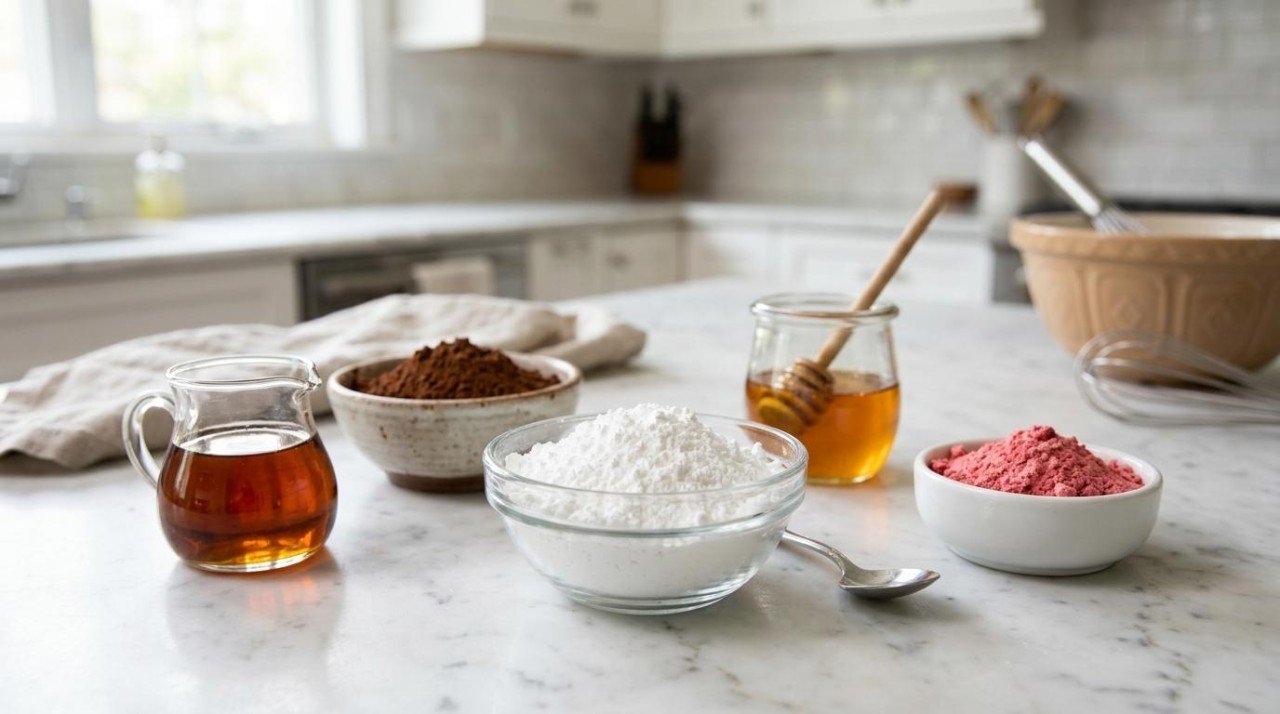
A snowfall of powdered sugar on a brownie or a stack of pancakes is mostly decoration. Unsweetened cocoa does the same job on anything chocolate and adds flavor instead of sweetness. Cinnamon, or cinnamon mixed with a little cocoa, looks lovely on French toast, apple cake, or a latte foam.
One small advantage over the real thing: powdered sugar dissolves when it sits on a warm or moist dessert, so it disappears within an hour on a fresh-from-the-oven cake. Cocoa does not melt. Dust just before serving either way, and let the dessert cool first.
Take the Guesswork Out of Eating Well
Eat Well Planner helps you organize your favorite recipes, plan balanced meals, and automatically generate shopping lists — all in one place. Whether you're tracking macros, managing dietary restrictions, or just trying to stop asking "what's for dinner?", we've got you covered.
Our AI-powered tools can adapt any recipe to your dietary needs, help you discover new meals you'll love, and even log your nutrition effortlessly. It's meal planning made simple.
Start Organizing Your Meals — Free11. Freeze-Dried Fruit Powder
- Swap: Pulse 1 cup freeze-dried strawberries, raspberries, or mango into a fine powder and sift out the seeds. Dust as-is, or replace up to a quarter of the powdered sugar in a frosting with it
- Best for: Dusting cakes, pancakes, yogurt bowls, and chocolate desserts; naturally colored and flavored buttercream
- Skip it for: White frosting, and anything that has to stay dry for hours — it pulls moisture and darkens
Freeze-dried fruit grinds into a vivid, tangy powder that tastes intensely of the fruit. On its own it is far less sweet than powdered sugar, so it is not a straight swap for sweetness. What it does well is make a little sugar go further: a pink raspberry dusting on a chocolate torte, or a strawberry buttercream where the fruit powder takes the place of some of the powdered sugar and all of the food coloring. Use it in place of fresh fruit or jam in a frosting, since those add water and break the emulsion.
It also brings real fruit along with it, fiber included, and counts toward the plants in your week. Store any leftover powder in a sealed jar; like starch-free powdered sugar, it clumps as soon as it meets humid air.
Healthier Upgrades: Use Less, Not Just Something Else
Here is the honest nutrition picture. Most of the swaps above are still sugar in a different form, and that is fine — nobody needs a lecture about the frosting on a birthday cake. But it helps to know the scale. A cup of powdered sugar weighs about 113 grams, which is roughly 28 teaspoons of sugar. The CDC puts the average American adult at about 17 teaspoons of added sugar a day already. A classic buttercream for one layer cake can use three or four cups.
So the most useful upgrades are frostings and toppings where sugar plays a supporting role:
- Swiss meringue or ermine frosting (#5) — less sweet by design, and most people prefer the flavor once they try it
- Whipped Greek yogurt topping — fold 1 cup plain Greek yogurt into 1 cup softly whipped heavy cream with 1 to 2 tablespoons maple syrup; it adds protein and holds on cake for a few hours in the fridge
- Lightly sweetened cream cheese frosting (#7) — 3 to 4 tablespoons of maple syrup in place of a few cups of powdered sugar
- Fruit-powder dusting (#11) — color and flavor with a fraction of the sugar
- Just cutting it — most American buttercream recipes still taste good with a quarter less powdered sugar; add a pinch of salt and an extra splash of vanilla to keep the balance
If you want to see what a frosting swap actually does to the nutrition of a specific recipe, that is easy to check rather than guess at. In Eat Well Planner, the Recipe Playground lets you edit the ingredients and watch the nutrition score change live with each tweak, and Make It Healthier will suggest swaps like these for the whole recipe and verify the real gain before showing them to you.
What Not to Use
- Unblended granulated sugar in buttercream or glaze. The crystals never fully dissolve in butter or a few spoonfuls of milk, so the frosting stays gritty no matter how long you beat it.
- Brown sugar straight from the bag. It is moist and coarse and makes a sandy, sticky frosting. Dried and blended, it can work in a pinch for a dark frosting, but coconut or maple sugar (#8) grinds far more easily.
- Extra cornstarch "to make it thicker." More than about a tablespoon per cup and you can taste the raw starch. Thicken a runny frosting with more sugar or by chilling it, not with starch.
- Cup-for-cup granulated sugar in a baked recipe. As covered in #6, a cup of granulated weighs nearly twice what a cup of powdered does. Swap by weight.
- Liquid sweeteners in royal icing. Royal icing sets hard because it is almost all dry sugar. Corn syrup, honey, or maple will keep it tacky forever.
Which One Should You Use?
For almost everyone, almost every time: blend granulated sugar with a tablespoon of cornstarch per cup, sift it, and carry on with the recipe. It is the same ingredient you ran out of. If you have no blender, switch the frosting rather than the sugar — Swiss meringue, ermine, or a maple cream cheese frosting all skip powdered sugar entirely. For dusting, reach for cocoa or fruit powder. For a cookie dough, use granulated and measure by weight.
And if you're looking at a specific recipe and still are not sure which one fits, ask about that recipe directly. The AI recipe chat in Eat Well Planner reads the whole recipe, so you can say "I'm out of powdered sugar for this frosting, what should I do?" and get an answer for that frosting, with amounts. If you want a lower-sugar or dairy-free version of the whole thing, Recipe Variations can rewrite it with the swaps already worked in. For more swaps on the sweet side of the pantry, see our guides to white sugar and brown sugar.