The oven is preheating, the flour is measured, and the brownie recipe wants half a cup of cocoa powder. The canister has a dusty tablespoon in the bottom. Or maybe it is the other problem: you have cocoa, but the recipe says Dutch-process and yours says natural, and you are wondering whether that actually matters.
Both problems are fixable. Cocoa powder does three jobs at once: it brings chocolate flavor, it brings a deep brown color, and it acts as a dry ingredient that soaks up liquid, a bit like flour. In some recipes it does a fourth job too, reacting with baking soda to help the batter rise. A good substitute has to cover whichever of those jobs your recipe depends on, and that is different for a cake, a mug of hot cocoa, and a dusting on top of tiramisu.
So this guide is split by use: baking first, then drinks, then dusting and finishing. Every swap comes with an exact ratio and an honest note on how it changes the result.
The Quick List
- The other kind of cocoa (natural or Dutch-process) — works almost everywhere, sometimes with a small leavening tweak
- Cacao powder — a 1:1 swap for natural cocoa
- Black cocoa — for up to half the cocoa, when you want the darkest color
- Unsweetened baking chocolate — the closest swap for cakes, brownies, and frosting
- Bittersweet or semisweet chocolate (bars or chips) — brownies, cakes, and cookies, with less sugar and fat in the recipe
- Carob powder — caffeine-free and naturally sweet; tastes like carob, not chocolate
- Hot cocoa mix — drinks, pancakes, and mug cakes only
- Chopped chocolate or chocolate syrup — hot cocoa, mochas, and chocolate milk
- Finely grated dark chocolate — dusting tiramisu, mousse, and cappuccino foam
- Powdered sugar, cinnamon, or flour — dusting desserts, rolling truffles, and prepping cake pans
First: Natural vs. Dutch-Process Cocoa (and Why It Matters)
There are two main kinds of unsweetened cocoa, and recipes are written around one or the other. Natural cocoa (Hershey's regular, most store brands) is simply roasted cocoa solids ground to a powder. It is acidic, with a pH of about 5 to 6, and it tastes sharp and fruity. Dutch-process cocoa (also labeled "alkalized" or "processed with alkali") is treated to neutralize that acid, bringing it to a neutral pH of about 7. It is darker, smoother, and mellower.
The acid is what matters in baking. Baking soda needs an acid to produce its lift, and in many chocolate cakes the natural cocoa is that acid. Dutch-process cocoa brings no acid, so recipes built on it usually lean on baking powder, which carries its own. Swap one cocoa for the other in a big quantity without adjusting the leavening and you can end up with a flat, dense cake or a faintly soapy aftertaste. In recipes with no leavening at all — frosting, hot cocoa, pudding, no-bake treats, most fudgy brownies — the two are interchangeable, and the only difference is flavor and color.
If the recipe just says "cocoa" without specifying, it almost always means natural, especially in older American recipes.
For Baking: Cakes, Brownies, Cookies, and Frosting
1. The Other Kind of Cocoa
- Swap, natural for Dutch-process: 1:1. If the recipe uses 3 tablespoons of cocoa or less, change nothing else. For more than that, replace the baking powder with half as much baking soda
- Swap, Dutch-process for natural: 1:1, and replace the baking soda with twice as much baking powder. For a small amount, you can instead add 1/8 teaspoon cream of tartar or lemon juice per 3 tablespoons of cocoa
- Best for: Everything — cakes, brownies, cookies, frosting, drinks
- Skip it for: Nothing, as long as you adjust the leavening in a big-cocoa cake
If the cocoa you have is simply the "wrong" kind, you do not need a substitute at all, just a small leavening fix. King Arthur Baking's rule of thumb is that with 3 tablespoons of cocoa or less, there is no need to make any adjustments. Above that, adjust the leavening as shown above. Joy of Baking's version of the same fix is 3 tablespoons natural cocoa plus a pinch (1/8 teaspoon) of baking soda in place of 3 tablespoons Dutch-process, or 3 tablespoons Dutch-process plus 1/8 teaspoon cream of tartar, lemon juice, or vinegar in place of natural.
Expect a visible difference even when the rise is perfect. Natural cocoa in a Dutch recipe gives a lighter, redder crumb and a tangier chocolate flavor. Dutch in a natural recipe gives a darker, rounder, more cookie-like result. Neither is wrong. In brownies and frosting, swap freely and pick whichever flavor you like better.
2. Cacao Powder
- Swap: 1:1 for natural cocoa powder; treat it as natural cocoa when swapping for Dutch-process (see #1)
- Best for: Any recipe written for natural cocoa, smoothies, energy bites, oatmeal
- Skip it for: Recipes that rely on Dutch cocoa's dark color and mellow flavor, unless you adjust the leavening
Cacao powder is made from cacao beans processed at lower temperatures and is not alkalized, so in the kitchen it behaves like natural cocoa: acidic, light brown, a bit fruity and more bitter. It is often sold at a premium on health grounds, and it does start with more of its plant compounds intact, but regular natural cocoa is far closer to it than the price gap suggests. The big nutritional divide is between natural and Dutch-process, not between cocoa and cacao (more on that in the upgrades section).
3. Black Cocoa
- Swap: Replace up to half the cocoa with black cocoa, and use Dutch-process or natural for the rest
- Best for: Chocolate sandwich cookies, dark chocolate cakes, Halloween bakes, anything where color is the point
- Skip it for: Replacing all the cocoa, and any recipe that relies on natural cocoa's acidity for lift
Black cocoa is cocoa that has been very heavily Dutched. It is nearly black, almost completely neutral, and has the exact flavor of a chocolate sandwich cookie. It is also low in fat, so a cake made with only black cocoa tends to come out dry and a little bitter. King Arthur recommends using it in combination with another Dutch-process cocoa, which is the right instinct. Since it carries no acid, treat any black cocoa in the recipe as Dutch-process when it comes to leavening.
4. Unsweetened Baking Chocolate
- Swap: 3 tablespoons cocoa → 1 ounce unsweetened chocolate, and cut 1 tablespoon of butter or oil from the recipe. For 1/2 cup of cocoa, that is about 2 1/2 ounces of chocolate and 2 1/2 tablespoons less fat
- Best for: Brownies, chocolate cake, fudge, chocolate frosting
- Skip it for: Recipes with no fat to cut (meringues, cocoa-and-water drinks), and dusting
Unsweetened chocolate is essentially cocoa solids still mixed with their own cocoa butter, which is why the standard conversion works so well in both directions. Joy of Baking gives it as 3 tablespoons (18 grams) of cocoa plus 1 tablespoon (14 grams) of unsalted butter for every ounce of unsweetened chocolate. Run it backward and you get the swap above: the chocolate brings the extra fat, so you take it out of the butter or oil.
The trick is getting the chocolate into the batter. Cocoa gets whisked into dry ingredients; chocolate has to be melted. Chop it, then melt it together with the recipe's butter or oil (over low heat or in 20-second bursts in the microwave), let it cool slightly, and add it where the fat goes in. Brownies made this way come out a little fudgier and richer than the cocoa version, which most people consider an upgrade. In frosting, melted and cooled chocolate makes a silkier, denser result than cocoa does. Most unsweetened baking chocolate is not Dutched, so it acts more like natural cocoa in a recipe leavened with baking soda.
5. Bittersweet or Semisweet Chocolate (Bars or Chips)
- Swap: 3 tablespoons cocoa → 2 ounces bittersweet or semisweet chocolate, melted. Then cut about 2 tablespoons of sugar (a little less with a 70% bar) and 1 tablespoon of butter or oil
- Best for: Brownies, chocolate cake, cookies, chocolate pudding, hot fudge
- Skip it for: Recipes with very little sugar to cut, and frosting where cocoa is the main dry ingredient
Sweetened chocolate is cocoa, sugar, and cocoa butter in one package, so swapping it in means removing some of each from the recipe. Joy of Baking puts one ounce of bittersweet or semisweet chocolate at roughly 9.5 grams of cocoa, 14.5 grams of sugar, and 7 grams of butter. Three tablespoons of cocoa weighs about 18 grams, so you need about 2 ounces of chocolate to replace it, and those 2 ounces bring roughly 29 grams of sugar (just over 2 tablespoons) and a tablespoon's worth of fat. Darker bars run less sweet, so cut slightly less sugar with a 70% bar.
Chocolate chips work too. They contain a little extra stabilizer to help them hold their shape in the oven, so melt them gently and stir them smooth before adding. The result tastes rounder and sweeter than a cocoa-based bake, and in brownies it is one of the best substitutions in this guide. In a cake that calls for a whole cup of cocoa, though, you would need over 5 ounces of chocolate and a large cut to the sugar and fat, so at that scale it is worth checking whether a recipe written for melted chocolate would be easier.
6. Carob Powder
- Swap: 1:1 by volume, and cut about 2 tablespoons of sugar for every 1/2 cup of carob used
- Best for: Caffeine-free bakes for kids or evening treats, muffins, cookies, energy bites, smoothies, warm carob milk
- Skip it for: Recipes where deep chocolate flavor is the whole point — a carob brownie is a carob brownie
- Health notes: No caffeine or theobromine; about 2.4 g fiber per tablespoon, slightly more than cocoa; much less magnesium and iron
Carob comes from the pod of a Mediterranean tree, not from cacao, and it has been the classic stand-in for decades. It looks like cocoa and bakes like it — the American Society of Baking notes that a one-to-one carob to chocolate replacement has been demonstrated in many baked goods. But it tastes like itself: sweet, earthy, and caramel-like, with none of chocolate's bitterness. Go in expecting a pleasant cousin, not a twin. A teaspoon of vanilla and a pinch of salt make it taste fuller.
The big difference is sugar. Cocoa powder is nearly sugar-free, at under 2 grams per 100 grams, while carob flour is about 49 percent natural sugar. Half a cup of carob (about 51 grams) carries roughly 25 grams of sugar, which is about 2 tablespoons of granulated, so cut that from the recipe to keep it from tasting cloying. Baking experts also recommend a little extra fat, since carob is almost fat-free and cocoa is not; an extra tablespoon of butter or oil per cup of carob helps. Carob's real advantage is that it is completely caffeine-free, which makes it the go-to for a chocolate-ish bedtime drink or a snack for small kids.
For Hot Cocoa, Smoothies, and Other Drinks
7. Hot Cocoa Mix
- Swap: In drinks, use the mix as the package directs and skip any sugar in the recipe. In pancakes, waffles, or a mug cake, use about 2 tablespoons of mix per tablespoon of cocoa and cut about 1 1/2 tablespoons of sugar for every 2 tablespoons of mix, then taste
- Best for: Hot cocoa, mochas, chocolate pancakes, mug cakes, chocolate whipped cream
- Skip it for: Fudgy brownies, layer cakes, and anything that needs real chocolate depth
Hot cocoa mix sounds like the obvious swap, but read the label first. A typical packet lists sugar first, then modified whey, then cocoa processed with alkali, then oil and milk powder. Cocoa is often the third or fourth ingredient. So you need a lot of mix to get any chocolate flavor, and by then you have added a lot of sugar and milk solids. The ratios above are starting points; brands vary, so taste the batter and adjust.
Where it shines is in drinks, because a drink is what it was made for. If a recipe calls for cocoa plus sugar plus milk, an envelope of mix covers all three. In baking, stick to forgiving, sweet-is-fine recipes like pancakes and mug cakes. The milk powder can make batters a little thicker, so add a splash of extra liquid if the batter looks stiff.
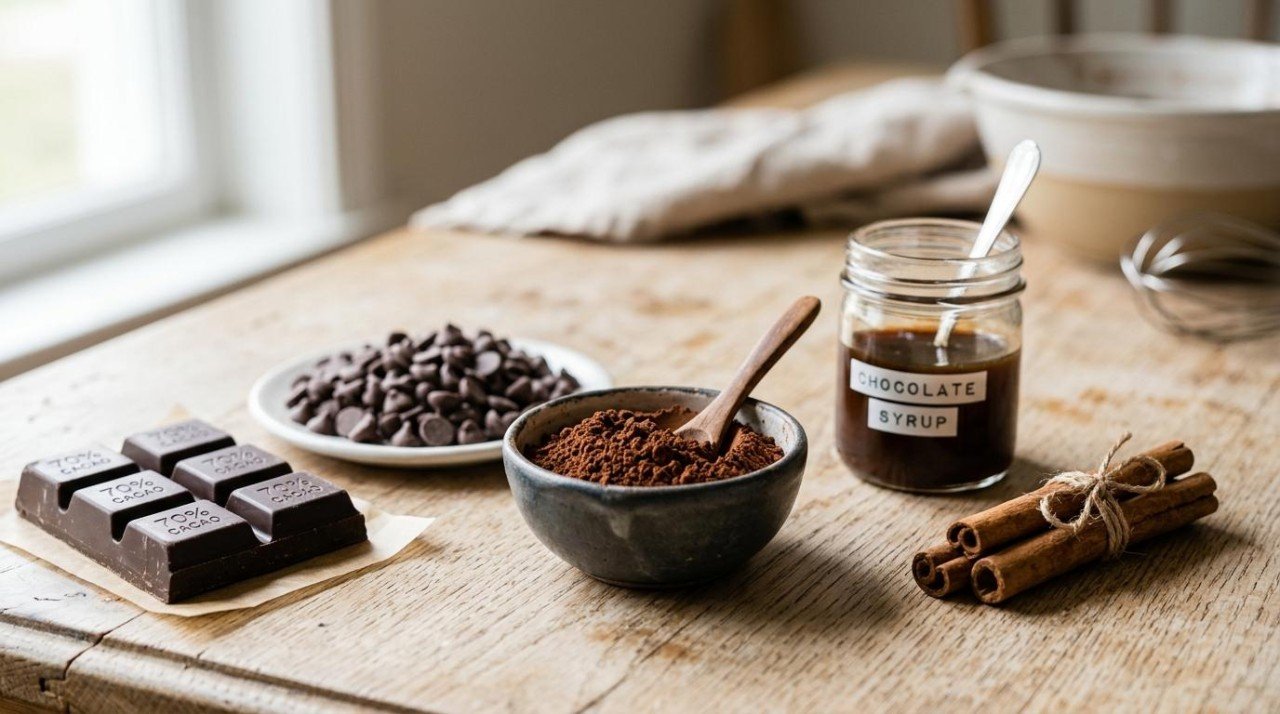
8. Chopped Chocolate or Chocolate Syrup
- Swap: For hot chocolate, whisk 1 1/2 to 2 ounces of finely chopped bittersweet or semisweet chocolate into 1 cup of warm milk and skip the sugar. For chocolate milk or a mocha, use 2 tablespoons of chocolate syrup per cup of milk
- Best for: Hot chocolate, mochas, chocolate milk, milkshakes
- Skip it for: Cold smoothies with chopped chocolate — it seizes into flecks instead of blending in
Melting real chocolate into milk makes a richer, thicker, more European-style hot chocolate than cocoa does, and it is arguably the better drink. Heat the milk until it steams (don't boil it), take it off the heat, add the chopped chocolate, and whisk until smooth. Because sweetened chocolate already has sugar, taste before adding any. Unsweetened chocolate works too: use about 1 ounce per cup of milk and sweeten to taste.
For a smoothie, carob powder (#6) or a small amount of melted chocolate blended with the milk first works better than chopped chocolate. Chocolate syrup is the quickest fix for cold drinks, but it is mostly sugar or corn syrup, so treat it as a treat-level swap rather than an everyday one.
For Dusting and Finishing
9. Finely Grated Dark Chocolate
- Swap: Grate a cold bar of dark chocolate on the finest side of a box grater or a rasp grater, and scatter it in place of a cocoa dusting
- Best for: Tiramisu, chocolate mousse, cappuccino foam, whipped cream, ice cream
- Skip it for: Warm desserts (it melts on contact) and rolling truffles
A cocoa dusting is mostly about color and a hit of bitter flavor, and grated dark chocolate does both while adding a little richness. It is a common finish on tiramisu, and it looks lovely on anything creamy. Chill the bar for 15 minutes first so it shaves into fine snow instead of smearing, and pick something 70% or darker so it reads as bitter, not sweet.
10. Powdered Sugar, Cinnamon, or Flour
- Swap: Dust powdered sugar or cinnamon through a fine sieve exactly as you would cocoa. For rolling truffles, use powdered sugar, finely chopped nuts, or shredded coconut. For greasing and dusting a cake pan, use flour, or line the bottom with parchment
- Best for: Brownies, cakes, French toast, truffles, prepping pans for chocolate cake
- Skip it for: Any recipe where the bitter cocoa note balanced a very sweet dessert
When cocoa is just the finishing touch, you are free to change the look. Powdered sugar on a brownie or a chocolate cake is as classic as cocoa, and cinnamon is lovely on anything with coffee or warm spice in it. Truffles rolled in chopped toasted hazelnuts or pistachios are arguably better than the cocoa version.
Pan prep is the sneaky one. Many chocolate cake recipes say to dust the greased pan with cocoa instead of flour because flour can leave a faint white film on a dark cake. Flour still works perfectly well for release, and the film is mostly cosmetic. A parchment circle on the bottom of the pan avoids the question entirely.
Healthier Upgrades: Cocoa Is Already the Good Part
Here is something worth knowing before you substitute: unsweetened cocoa powder is one of the more nutrient-dense things in the baking cupboard. Per USDA data, a tablespoon has about 12 calories, 2 grams of fiber, 27 mg of magnesium, and 0.75 mg of iron, with almost no sugar. Most of the swaps above add sugar, fat, or both. That doesn't make them bad — they make great desserts — but it does mean that when you have a choice, a few options keep more of what cocoa brings.
- Choose natural cocoa or cacao when the recipe allows. Cocoa's flavanols are the reason it shows up in health research at all, and Dutching strips them. In a 2008 study in the Journal of Agricultural and Food Chemistry, natural cocoa averaged 34.6 mg of flavanols per gram, while lightly Dutched cocoa kept about 40 percent and heavily Dutched only about 10 percent. A Cochrane review of 35 studies in 1,804 people found flavanol-rich cocoa lowered blood pressure by a modest 1.8 mmHg on average over short trials. It is moderate-quality evidence and a small effect, but it is a free bonus for picking one canister over another.
- Prefer unsweetened or dark chocolate over mixes and syrups. Swaps #4 and #5 keep the cocoa solids front and center; hot cocoa mix and syrup are mostly sugar with cocoa as a minor ingredient.
- Use carob for caffeine-free, not as a health upgrade across the board. It wins on fiber and on being caffeine-free (a tablespoon of cocoa has about 12 mg of caffeine and 111 mg of theobromine, carob has none), but cocoa has roughly nine times the magnesium and nearly five times the iron.
- Make hot cocoa from cocoa, not mix, once you restock. Our healthier hot chocolate makeover walks through exactly what that switch does to the sugar, and our healthier brownies post does the same for the most common cocoa bake.
If you want to know what a particular swap does to a specific recipe, you don't have to guess. In Eat Well Planner, the Recipe Playground lets you swap cocoa for melted chocolate or carob and watch the nutrition score change with each edit, and Make It Healthier suggests swaps for the whole recipe and checks the real nutritional gain before showing them to you.
Take the Guesswork Out of Eating Well
Eat Well Planner helps you organize your favorite recipes, plan balanced meals, and automatically generate shopping lists — all in one place. Whether you're tracking macros, managing dietary restrictions, or just trying to stop asking "what's for dinner?", we've got you covered.
Our AI-powered tools can adapt any recipe to your dietary needs, help you discover new meals you'll love, and even log your nutrition effortlessly. It's meal planning made simple.
Start Organizing Your Meals — FreeWhat Not to Use
- Chocolate milk powder in baking. Powders like Nesquik are mostly sugar with a small amount of cocoa. You would need so much to get chocolate flavor that the recipe's sugar balance falls apart.
- Ground cacao nibs. Nibs are roughly half fat, so grinding them gives you a gritty paste, not a powder. They add great crunch to cookies and granola, but they cannot do cocoa's job as a dry ingredient.
- All black cocoa. As covered in #3, a cake made entirely with black cocoa tends to bake up dry and bitter. Use it for half at most.
- A big Dutch-for-natural swap with no leavening change. In a cake that uses a lot of natural cocoa with baking soda as the only leavener, Dutch-process cocoa leaves the soda with nothing to react with. Swap the soda for twice as much baking powder (#1).
- Instant coffee or espresso powder alone. It deepens chocolate flavor beautifully — 1/2 teaspoon in a batch of brownies is a great trick — but on its own it tastes like coffee, not chocolate. Use it as a booster alongside carob or a weaker substitute, not instead of cocoa.
- Chocolate protein powder. It brings sweeteners, gums, and a lot of protein that dries out baked goods and changes texture unpredictably. Save it for smoothies.
Which One Should You Use?
If you have the other kind of cocoa, use it 1:1 and only tweak the leavening for a big quantity in a cake. If you have no cocoa at all and you're baking, reach for unsweetened chocolate first (cut a little fat) or bittersweet chocolate (cut some fat and sugar). For a caffeine-free version, carob is the classic, as long as you trim the sugar. For a drink, melt chopped chocolate into warm milk or use hot cocoa mix as directed. And for dusting, grate dark chocolate or switch to powdered sugar or cinnamon.
When you're looking at one specific recipe and still not sure, ask about that recipe directly. The AI recipe chat in Eat Well Planner reads the whole recipe, so you can ask "I'm out of cocoa for these brownies, I have a bar of 70% dark chocolate, how much do I use?" and get an answer with the sugar and butter adjustments worked out for that recipe. If you want a caffeine-free carob version for the kids, Recipe Variations can rewrite the whole thing with the swap already built in. And for the rest of the baking shelf, see our guides to butter and white sugar.