The paella pan is hot, the risotto is ready for its stock, or the dough for saffron buns is waiting, and the tiny saffron jar is empty. Or there never was a jar, because the recipe calls for a spice that can cost more per gram than almost anything else in the grocery store. Saffron gives a dish two things: a deep golden color, and a flavor that is floral, honeyed, a little hay-like and faintly bitter.
Here is the honest version up front. The color is easy to fake. The flavor is not. Nothing in the spice aisle tastes like saffron, so every substitute below is either a color match with its own mild flavor, or a different flavor that suits the dish in its own way. Which one to reach for depends on whether saffron is a supporting player in your recipe (most paellas, soups and stews) or the whole point (risotto alla Milanese, Persian saffron rice, Swedish saffron buns).
All ratios below are per 1 pinch of saffron threads, about 20 threads, the amount most home recipes mean by "a pinch." If your recipe gives saffron in teaspoons, see the section on threads and powder first, because the two are not measured the same way.
The Quick List
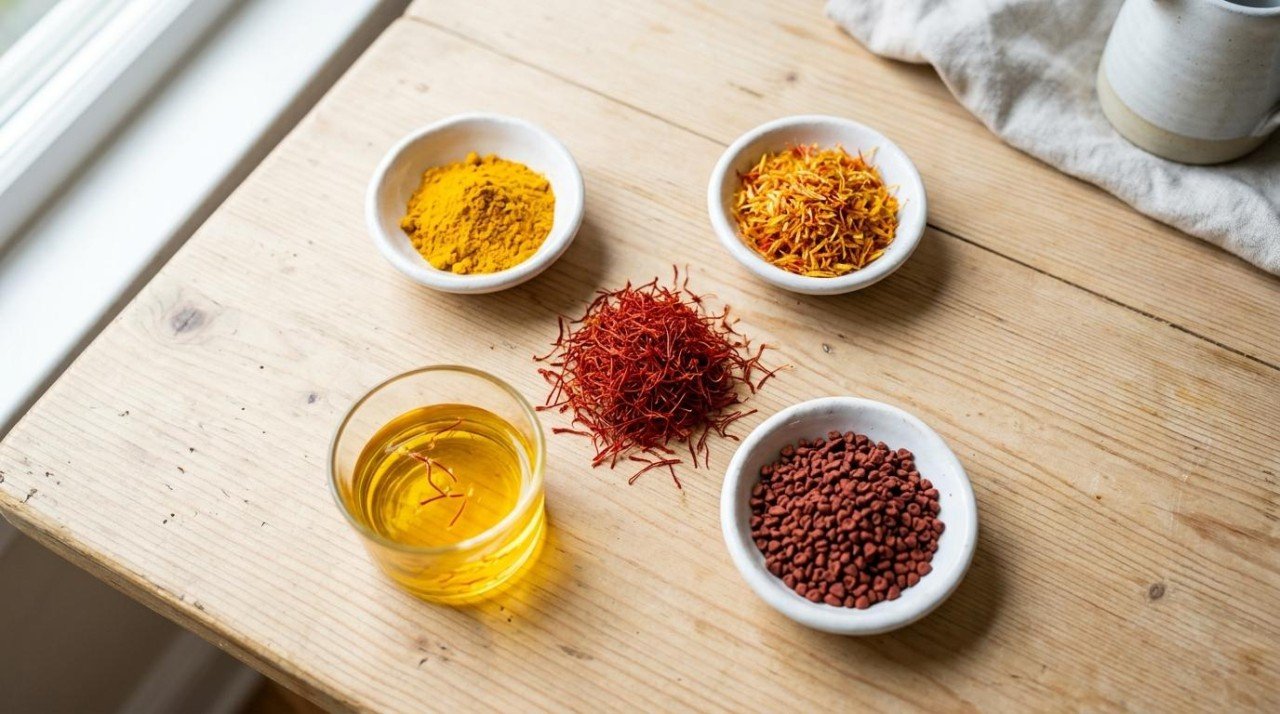
- Turmeric + sweet paprika — the best all-purpose color match for paella, yellow rice and stews
- Safflower — golden color with almost no flavor of its own, the cleanest swap for delicate dishes
- Turmeric alone — bright yellow and always on hand, but only in small amounts
- Annatto (achiote) — warm orange-gold color with a mild peppery, nutty taste
- Calendula or marigold petals — the original "poor man's saffron," gentle color for rice and soups
- Saffron powder — the real thing in a different form, if that's what you have
- Less saffron, steeped longer — the best option when the dish is built around saffron's flavor
- Leave it out — perfectly fine in many stews and soups where saffron is one of a dozen flavors
Threads vs. Powder: Read Your Recipe First
Saffron is the dried stigmas of the saffron crocus flower. Each flower has only three, they are picked by hand, and that is why the price is so high. It's sold two ways:
- Threads: The whole dried stigmas, deep red and shaped like tiny trumpets. Most recipes assume threads.
- Powder: Ground threads. It dissolves instantly and is easy to measure, but it loses aroma faster and is much easier to adulterate (more on that below).
To convert, Marx Food suggests 1 pinch of powder (about 1/16 teaspoon) for every 20 threads, and the reverse when going from powder to threads. They also note that many powders are weaker than good threads, so you may need a little more powder. You can also crush threads into your own powder with a pinch of sugar or salt in a mortar and use the original recipe's measurement.
One more thing worth knowing before you buy a substitute: a little real saffron goes a long way. A typical home paella for four to six uses a single generous pinch, and one gram of threads holds hundreds of them. Saffron is expensive by weight, but per dish it's often cheaper than the shrimp.
Match the Substitute to the Dish
Saffron plays a different role in each classic dish, and that decides which swap works.
- Paella and Spanish rice dishes — Saffron shares the pan with smoked paprika, garlic, tomato and stock, so a color swap works well. Use turmeric + sweet paprika, safflower or annatto.
- Risotto alla Milanese — Saffron is the defining flavor alongside butter and Parmesan. Use less real saffron if you possibly can. Otherwise use safflower or a tiny amount of turmeric for color, and call it a golden Parmesan risotto rather than Milanese.
- Persian rice (chelow, tahdig) and sholeh zard — The saffron bloom poured over the rice is both color and aroma. Real saffron is best; safflower or calendula give the gold layer without competing flavors.
- Biryani and pulao — Saffron milk streaks the top layer of rice, surrounded by whole spices. Safflower or a pinch of turmeric in warm milk works well here, since cardamom, cinnamon and cloves carry the aroma.
- Saffron buns, cakes, kheer and other sweets — Turmeric can turn bitter and earthy in sweet dishes, so use safflower or calendula for color and lean on cardamom, vanilla or orange zest for aroma.
- Bouillabaisse, fish stews and soups — Saffron is one voice in a crowd of fennel, orange, garlic and tomato. Safflower, a little turmeric, or nothing at all.
Take the Guesswork Out of Eating Well
Eat Well Planner helps you organize your favorite recipes, plan balanced meals, and automatically generate shopping lists — all in one place. Whether you're tracking macros, managing dietary restrictions, or just trying to stop asking "what's for dinner?", we've got you covered.
Our AI-powered tools can adapt any recipe to your dietary needs, help you discover new meals you'll love, and even log your nutrition effortlessly. It's meal planning made simple.
Start Organizing Your Meals — FreeTurmeric + Sweet Paprika
- Swap: 1 pinch saffron → 1/8 teaspoon ground turmeric + 1/4 teaspoon sweet paprika
- Best for: Paella, Spanish and Mexican yellow rice, chicken and rice, stews, soups
- Skip it for: Risotto alla Milanese, sweets, and pale cream sauces where the paprika's red tint shows
This is the swap to try first for savory rice. Turmeric alone gives a bright lemon-yellow, and paprika warms it toward saffron's orange-gold. The paprika also rounds out turmeric's earthiness with a little sweetness. In a paella that already has pimentón, the paprika simply blends in.
Use sweet paprika unless you want the dish smokier. If your paella recipe already calls for smoked paprika, keep that amount as it is and just add the turmeric. Out of paprika too? The smoked paprika substitutes guide covers the options. Add both spices to the oil with your sofrito or onions for 30 seconds before the liquid goes in, so they bloom and lose their raw, dusty taste.
Safflower
- Swap: 1 pinch saffron → 1/2 teaspoon dried safflower petals, steeped in a few tablespoons of the recipe's hot liquid for 10 minutes
- Best for: Risotto, Persian rice, biryani, sweets and any delicate dish where you want gold color with nothing else
- Skip it for: Dishes where you hoped to get saffron's flavor; safflower has almost none
Safflower is a thistle-like plant whose dried orange-red florets look a lot like saffron threads, which is why it's sold as "Mexican saffron," "American saffron" or "bastard saffron" in Latin and Middle Eastern markets. It costs a tiny fraction of the price. It colors rice and broth a soft yellow-orange and adds only a faint, slightly earthy note, which makes it the most neutral substitute here.
That neutrality is the trade-off. A safflower risotto looks right and tastes like a good butter-and-Parmesan risotto, not a saffron one. Steep it the way you would steep saffron so the color goes into the liquid evenly, then either strain out the petals or leave them in as flecks. And be clear on what you're buying: safflower petals are a fine ingredient sold honestly, but they're also one of the most common things passed off as real saffron (see below).
Turmeric Alone
- Swap: 1 pinch saffron → 1/8 teaspoon ground turmeric, no more than 1/4 teaspoon for a pan that serves 4 to 6
- Best for: Yellow rice, chicken soup, stews, biryani-style rice, anywhere warm spices are already in play
- Skip it for: Sweets and very delicate dishes, where its earthy bitterness stands out
Turmeric is the substitute most people already own, and the reason it gets a bad reputation is quantity. A little gives bright, convincing color. Too much turns the dish mustard-yellow and adds a dusty, bitter, slightly medicinal edge that tastes nothing like saffron. Start at 1/8 teaspoon, stir it into the cooking fat or the hot stock, and judge the color once the rice has absorbed some liquid. You can always add a little more; you can't take it out.
Turmeric is also yellower than saffron, which leans orange-gold. If the shade matters, pair it with paprika (above) or a few annatto seeds.
Annatto (Achiote)
- Swap: 1 pinch saffron → 1/4 teaspoon ground annatto, or replace 1 tablespoon of the recipe's cooking oil with annatto oil
- Best for: Paella, arroz con pollo, yellow rice, stews, Latin American and Filipino dishes
- Skip it for: Risotto and sweets, where its orange-red tone and peppery note feel out of place
Annatto comes from the red seeds of the achiote tree and is the color behind orange cheddar and many yellow rice mixes. According to WebMD, it earned the nickname "poor man's saffron" because it gives food a similar golden color, and its taste is slightly sweet and peppery. That flavor is mild enough to disappear into a well-seasoned rice dish.
The easiest way to use the whole seeds is annatto oil: warm 1/4 cup neutral oil or olive oil with 1 tablespoon annatto seeds over low heat for about 5 minutes, until the oil turns deep orange, then strain. It keeps in the fridge for weeks. Ground annatto works too, but it can turn bitter if it scorches, so add it with the liquid rather than frying it in hot oil. Annatto colors more orange than saffron, so start with less and add more if needed.
Calendula or Marigold Petals
- Swap: 1 pinch saffron → about 1 teaspoon crumbled dried calendula petals, steeped in a few tablespoons of hot liquid for 10 minutes
- Best for: Rice, soups, egg dishes, custards and buns, especially if you grow calendula
- Skip it for: Any dish where you need a strong color; petals vary a lot in strength
Pot marigold (calendula) has been called "poor man's saffron" for centuries, and dried petals give rice and broth a soft golden color with a faintly peppery, grassy taste. In Georgia, dried and ground marigold petals are sold as "Imeretian saffron" and used in dishes like chicken satsivi and the spice blend khmeli suneli. If you find it, use about 1/2 teaspoon of the ground petals per pinch of saffron.
Only use petals sold for food or from plants you grew yourself without pesticides; flowers from a florist or garden center are not grown to be eaten. Strength varies from batch to batch, so taste the steeping liquid and add more petals if the color is pale.
Saffron Powder
- Swap: 20 threads → about 1/16 teaspoon saffron powder; 1/2 teaspoon threads → about 1/4 teaspoon powder
- Best for: Everything saffron threads are used for, especially baking, where powder spreads evenly through dough
- Skip it for: Dishes where you want visible red threads on top, like Persian rice
If you have powder and the recipe calls for threads (or the other way around), you don't need a substitute, just a conversion. Powder doesn't need long steeping. Dissolve it in 1 to 2 teaspoons of warm water or milk, or stir it straight into the liquid. Because it loses aroma faster than threads, buy it in small amounts and keep it sealed in a dark, cool place.
Do check its age. A jar that has been open for two years will give color but very little aroma, so taste the dish before serving and season with that in mind.
Less Saffron, Steeped Longer
- Swap: Use half the saffron the recipe calls for, crushed and steeped in hot liquid for 20 minutes or more
- Best for: Risotto alla Milanese, Persian rice, saffron buns, paella when you have a little saffron but not enough
- Skip it for: Nothing, if you have any saffron at all
When saffron is the dish's main flavor, the best substitute is often simply less saffron, used well. Most of saffron's flavor and color is locked inside the threads until something draws it out. Marx Food recommends steeping threads in a hot, acidic or alcoholic liquid for at least 20 minutes, and notes that saffron keeps releasing flavor into the liquid for up to 12 hours.
So crumble your few threads between your fingers (or grind them with a pinch of sugar), cover them with 2 to 3 tablespoons of hot stock, water, milk or white wine, and let them sit while you prep everything else. Then add the threads and their liquid to the dish. Done this way, half a pinch can do the work of a full pinch tossed in dry. If you want to stretch it even further, add a pinch of safflower or a tiny bit of turmeric for color and let the real saffron carry the aroma.
Leave It Out
- Swap: Skip the saffron; add 1 extra tablespoon of the recipe's wine or a strip of orange zest to the liquid if the dish has room for it
- Best for: Bouillabaisse, fish stews, tagines, chicken soups and rice dishes heavy with other spices
- Skip it for: Risotto alla Milanese, saffron buns and other dishes named for it
In a dish with garlic, fennel, tomato, paprika, cumin or a dozen other strong flavors, saffron is a subtle background note. Leaving it out changes the color more than the taste. If the color matters for the table, use one of the color swaps above; if it doesn't, nobody will miss it.
Real Saffron, Fake Saffron, and Why Powder Is Riskier
Because it's so valuable, saffron is one of the most counterfeited foods in the world. Food Republic lists corn silk, coconut filaments and safflower as common fakes sold as saffron threads, and warns that powdered saffron may be cut with turmeric and paprika. The worst fakes use industrial dyes that are not allowed in food.
Threads are much easier to check than powder:
- Look: Real threads are deep red with a slightly flared, trumpet-shaped end, sometimes with a short pale yellow tail. Uniform, stringy or perfectly straight threads are suspect.
- Water test: Drop a thread or two in hot water. Real saffron slowly turns the water golden yellow over several minutes and the threads stay red. Fakes tend to release color fast, often reddish, and the threads may fade to white.
- Smell: Real saffron smells sweet, floral and hay-like. If it smells like nothing, or like turmeric, it isn't saffron.
The cheapest path to real saffron flavor is usually a small jar of threads from a reputable spice seller, not a big bag of suspiciously cheap "saffron" at a market. That suspiciously cheap bag is often safflower, which is a perfectly good coloring ingredient at the right price, and a bad deal at the saffron price.
A Note on Health
None of these substitutes changes a dish's nutrition in a meaningful way, since you're using a pinch or a fraction of a teaspoon. What you get from them is color and a little flavor, and that's enough reason to use them.
Saffron itself has been studied for mood. A 2019 meta-analysis of randomized trials in people with mild to moderate depression found saffron more effective than placebo and comparable to the antidepressants it was tested against. Those were small trials, most of them done in Iran, using daily capsules of saffron extract rather than a pinch spread across a pan of rice for six people, so the results don't carry over to cooking. Talk to your doctor before trying saffron supplements, especially if you take other medications.
Turmeric gets a lot of attention for curcumin, but the 1/8 teaspoon used here is a coloring amount, not a health intervention. And annatto is considered safe in food amounts, though WebMD notes that rarely, sensitive people have had hives or stomach upset after eating it.
Where these rice dishes can genuinely get more nourishing is everything around the saffron: the vegetables, the stock and the rice itself. The healthier paella makeover shows how much a few changes there can do, and the white rice substitutes guide and chicken broth substitutes guide cover the two ingredients that usually matter most.
What Not to Use
- A spoonful of turmeric: More is not more. Past 1/4 teaspoon in a family-size pan, turmeric starts to taste like turmeric rice, and in sweets it turns bitter fast.
- Curry powder: It has turmeric for color, but also cumin, coriander, fenugreek and chiles, which will take over a paella or risotto entirely. Great in curry, wrong here. (If curry powder is what you are out of, see the curry powder substitutes guide.)
- Yellow rice or sazón seasoning packets, without reading the label: They can work in a pinch for color, but many are mostly salt and MSG, and some get their color from artificial dyes rather than saffron or annatto. If you use one, cut the salt elsewhere in the recipe.
- Vanilla to "replace" the floral note: In savory rice it tastes like dessert. In saffron buns, a little vanilla or cardamom is fine as its own flavor, just not as a saffron imitation.
- Very cheap "saffron": Real saffron is never cheap. If it is, you're probably buying safflower at a markup, or worse.
Which Swap Fits Your Recipe?
The quick rule: if saffron is one of many flavors, swap for color with turmeric and paprika, safflower or annatto. If saffron is the main flavor, use a smaller amount of real saffron and steep it well, and if you have none at all, aim for a good golden dish rather than a fake saffron one.
If you're not sure which camp your recipe falls into, save it to Eat Well Planner (you can import it from any recipe website, Instagram reel or YouTube video) and ask the AI recipe chat something like "I don't have saffron for this, what should I use?" It sees the whole recipe, so it can tell you whether turmeric will clash with your other spices or how much safflower to steep for your pan size. And if you'd rather not adapt it line by line, Recipe Variations can rewrite the whole recipe around what's actually in your pantry.