The filling is ready, the oven is hot, and the box of puff pastry you were sure was in the freezer turns out to be a bag of peas. Or it's there, but rock-solid frozen with dinner due in 40 minutes. Either way, you have options, and some of them are already in your fridge.
The right substitute depends on what the puff pastry was supposed to do. In some recipes it has to rise into tall, shattering layers (vol-au-vents, palmiers, napoleons). In others it's just a flaky wrapper (sausage rolls, turnovers, baked brie), or a lid on a pot pie. Nothing but real puff pastry rises like puff pastry, but a lot of doughs wrap, crisp, and brown well enough that nobody at the table will mind.
This guide covers the closest swaps first, then lighter and healthier options, then a dish-by-dish cheat sheet so you can find the best fit for what you're actually making.
The Quick List
- Rough puff (homemade) — the only true replacement; real layers in about an hour
- Phyllo dough, buttered and stacked — crisp, flaky layers for wraps, tarts, and pot pie lids
- Pie dough — the best everyday swap for turnovers, hand pies, galettes, and pot pie tops
- Crescent dough sheet — fastest option for pinwheels, baked brie, and quick napoleons
- Cream cheese pastry — tender and rich, made in a food processor in 5 minutes
- Biscuit dough — the sturdiest, least soggy pot pie topper
- Wonton or egg roll wrappers — mini cups and bite-size appetizers
- Phyllo with olive oil — the lighter upgrade, with a fraction of the fat
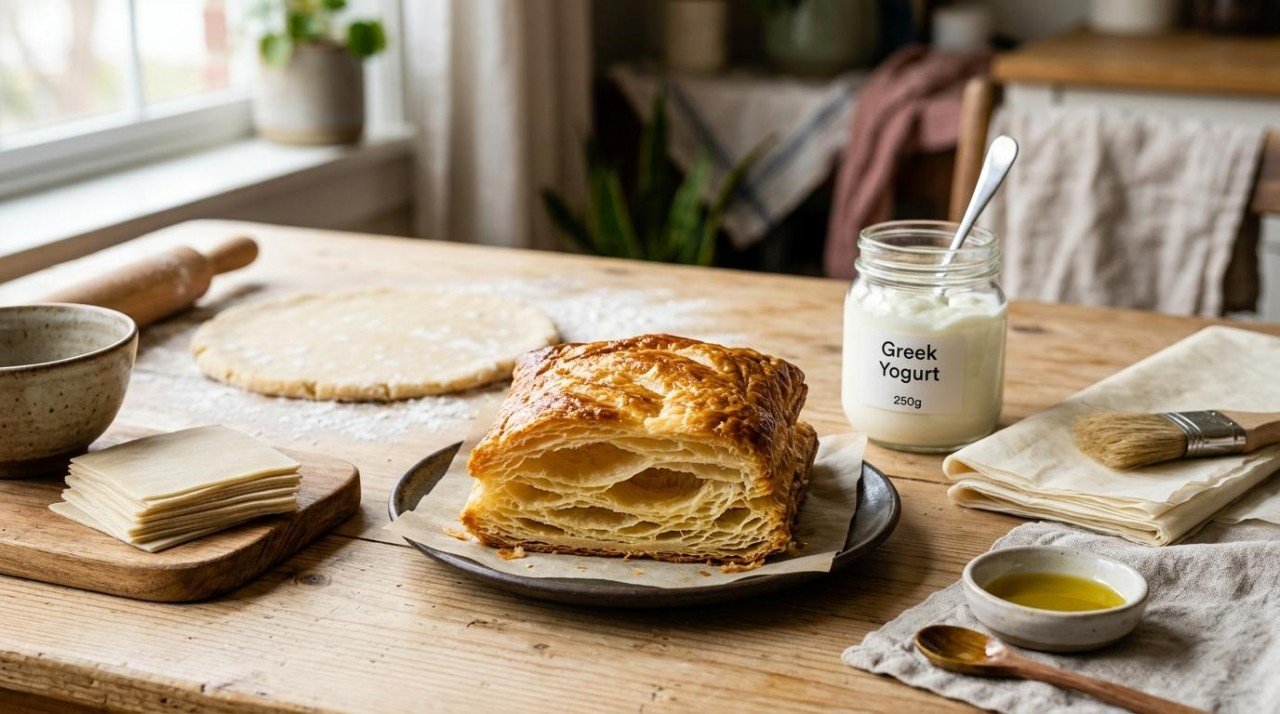
- Greek yogurt dough — a two-ingredient, higher-protein wrap for hand pies
- Whole wheat pie crust — more fiber for pot pies and savory tarts
Before You Swap: What Puff Pastry Actually Does
Puff pastry is a laminated dough: dozens of paper-thin layers of dough separated by layers of fat. In a hot oven, the water in the dough turns to steam and pushes the layers apart, and the fat fries them crisp. That's where the dramatic rise comes from, with no yeast or baking powder involved.
Most substitutes recreate only part of that. Phyllo gives you the thin, crisp layers but not the lift. Pie dough and cream cheese pastry give you flakiness but stay fairly flat. Crescent dough and biscuit dough rise, but they're leavened, so they turn soft and bready rather than shattering. So before you choose, ask one question: does this recipe need height, or does it just need a flaky crust? If it's the second (and most recipes are), you have plenty of choices.
For sizing, a standard 17.3-ounce box of frozen puff pastry holds two sheets, so "one sheet" in a recipe means roughly 8 1/2 ounces of dough.
The Closest Substitutes
1. Rough Puff Pastry (Homemade)
- Swap: 1 box (2 sheets) puff pastry → half of a rough puff batch: 1 1/2 cups (180 g) all-purpose flour + 12 tablespoons (170 g) cold unsalted butter + 1 teaspoon table salt + 1/2 cup (113 g) cold water
- Best for: Anything that needs to rise: vol-au-vents, palmiers, cheese straws, napoleons, beef Wellington, pithiviers
- Skip it for: A last-minute dinner (it needs about an hour, mostly chilling)
Rough puff (also called blitz or quick puff) gets you most of the way to real puff pastry without the classic method of folding a single slab of butter into the dough. Instead, you mix chunks of cold butter straight into the flour and roll and fold the dough a few times, which flattens those chunks into streaks. King Arthur's version uses 3 cups (360 g) of flour, 24 tablespoons (340 g) of cold butter, 2 teaspoons of salt, and 1 cup of cold water. It's mixed until crumbly, chilled 30 minutes, then given one letter fold and two book folds before a final 30-minute chill. That full batch makes a generous 2 pounds, roughly two boxes' worth, so halve it for most recipes or freeze the extra (it keeps up to a month).
Keep everything cold. If the butter starts to smear or the dough springs back when you roll it, put it in the fridge for 5 to 10 minutes. Rough puff rises a little less evenly than commercial puff pastry, but it tastes noticeably better, because store-bought sheets are usually made with vegetable oils instead of butter.
2. Phyllo Dough, Buttered and Stacked
- Swap: 1 sheet puff pastry → 6 to 8 sheets phyllo, each brushed lightly with melted butter (about 1 teaspoon per sheet)
- Best for: Pot pie lids, baked brie, savory tarts, strudel-style rolls, turnovers, and Wellington-style wraps
- Skip it for: Anything that needs to puff up tall, like vol-au-vents or palmiers
Phyllo is the other famous layered pastry, but it's built the opposite way. Instead of fat folded inside the dough, you get tissue-thin sheets of nearly fat-free dough, and you add the fat yourself as you stack them. The result bakes crisper and lighter than puff pastry, with an audible crackle, but it won't rise. Think of it as a crust, not a cushion.
Thaw the phyllo in the fridge overnight if you can, and keep the stack you aren't using covered with a towel while you work. Exposed sheets dry out and crack within minutes. Brush each layer lightly and evenly, all the way to the edges, since bare spots bake dry and flake off. Tears in the middle layers don't matter at all, since the next sheet hides them. For a pot pie, stack the sheets, lay them over the filling, tuck in the edges, and cut a few steam slits on top.
3. Pie Dough (Store-Bought or Homemade)
- Swap: 1 sheet puff pastry → 1 round of refrigerated pie dough or one disk of homemade, rolled about 1/8 inch thick
- Best for: Turnovers, hand pies, galettes, savory tarts, pot pie tops, sausage rolls
- Skip it for: Palmiers, vol-au-vents, napoleons, and anything else defined by its rise
Pie dough is the swap most people have on hand, and for anything folded, crimped, or laid over a filling, it works beautifully. It bakes flaky and crisp, browns well, and holds a filling without leaking. What you lose is the height: pie dough puffs a little where the butter pockets steam, but it bakes up flat and short, more like a crisp biscuit than a pillow. Roll it thinner than you would for a pie, and chill your shaped turnovers or hand pies for 15 minutes before baking so they hold their shape.
Bake at about the same temperature your puff pastry recipe calls for (usually 375 to 425°F), and use time as a rough guide only. Pie dough tends to need a few minutes longer to turn deep golden. An egg wash on top gives it the same glossy finish.
4. Crescent Dough Sheet
- Swap: 1 sheet puff pastry → one 8-ounce can of crescent dough sheet (or crescent rolls with the seams pinched shut)
- Best for: Pinwheels, baked brie, quick napoleons, ham-and-cheese bundles, weeknight hand pies
- Skip it for: Long bakes and juicy fillings (it browns quickly and goes soft underneath)
Pillsbury actually markets its crescent dough this way. Its own strawberry napoleon recipe says "easy-bake crescents stand in for traditional puff pastry", cutting the sheet into small rectangles and baking them at 375°F for just 8 to 10 minutes. That timing is the main thing to remember: crescent dough browns much faster than puff pastry, so check it early and tent it with foil if the filling still needs time.
The texture is soft, buttery, and a little sweet, closer to a croissant roll than flaky pastry. That makes it lovely wrapped around a wheel of brie or rolled up with pesto and cheese, and a bit disappointing anywhere you wanted crunch. If you only have crescent rolls, unroll the dough and press the perforations together firmly so they don't split open in the oven.
5. Cream Cheese Pastry
- Swap: 1 sheet puff pastry → 1 batch cream cheese dough: 1/2 cup (4 oz) cold cream cheese + 1/2 cup (1 stick) cold butter + 1 1/4 cups all-purpose flour + 1 teaspoon sugar + 1/4 teaspoon salt
- Best for: Turnovers, hand pies, empanadas, mini tartlets, rugelach-style rolls
- Skip it for: Big flat sheets or anything that needs to rise
If you have no pastry of any kind but do have butter and cream cheese, this dough is your fastest from-scratch option. Garlic and Zest's version uses half an 8-ounce block of cream cheese, one stick of butter, 1 1/4 cups of flour, a teaspoon of sugar, and 1/4 teaspoon of salt. You pulse the butter and cream cheese until smooth in a food processor, add the flour, and pulse just until the dough clumps, then chill it 30 minutes. No ice water, no folding, and it's very hard to mess up.
It bakes tender and rich with a slight tang, a little like a cross between pie dough and shortbread. It's also much more forgiving to roll than puff pastry, which makes it great for crimped shapes that would tear in other doughs. It makes one 9-inch crust, so double it for a recipe that calls for both sheets. See our cream cheese guide if you're short on that too.
6. Biscuit Dough (for Pot Pies and Cobblers)
- Swap: Puff pastry lid → drop biscuits: 2 cups flour + 1 tablespoon baking powder + 1/4 teaspoon baking soda + 1/2 teaspoon salt + 1 teaspoon sugar + 1/2 cup cold butter + 1 cup buttermilk, scooped over the filling
- Best for: Chicken or vegetable pot pie, beef stew toppers, savory cobblers
- Skip it for: Anything that's wrapped or folded
For a pot pie, biscuits are arguably better than puff pastry. A puff pastry lid sitting on a hot, wet filling often bakes up gummy underneath, while biscuits are thick enough to steam through on the bottom and still brown on top. Olive and Mango's drop biscuit pot pie uses 2 cups flour, 1 tablespoon baking powder, 1/4 teaspoon baking soda, 1/2 teaspoon salt, 1 teaspoon sugar, a stick of cold butter, and 1 cup of buttermilk, scooped in roughly 1/4-cup dollops to mostly cover the filling and baked at 425°F for 17 to 25 minutes.
Add the biscuits right before the dish goes in the oven, so they don't soak up the filling while they sit, and make sure the filling is hot. Canned refrigerated biscuits work in a pinch: just lay them on top of the bubbling filling and bake according to the package. Out of buttermilk? Our buttermilk guide has easy fixes.
7. Wonton or Egg Roll Wrappers
- Swap: Puff pastry squares or cups → wonton wrappers pressed into a muffin tin (one or two per cup), or egg roll wrappers for small turnovers, brushed lightly with oil
- Best for: Appetizer cups, mini quiches, bite-size tartlets, small crispy turnovers
- Skip it for: Anything larger than a few bites
For mini appetizers that just need a crisp little shell, wonton wrappers do the job almost instantly. Press them into a greased mini muffin tin, brush or spray them lightly with oil, and bake at about 350 to 375°F until the edges are golden, usually 6 to 10 minutes, before filling. They bake thinner and crunchier than puff pastry shells, and they're neutral enough for both sweet and savory fillings. Watch them closely, since the points go from golden to burnt quickly.
Healthier Swaps
Puff pastry is a treat, and there's nothing wrong with enjoying it. But it's worth knowing what's in it. USDA data for frozen ready-to-bake puff pastry lists 551 calories, 38.1 g fat (9.6 g saturated), and just 1.5 g fiber per 100 g. About 60 percent of its calories come from fat. Phyllo dough, by comparison, comes in at 299 calories and 6 g of fat (1.5 g saturated) per 100 g. Most of the fat in a phyllo dish is whatever you brush on, which means you get to choose how much and what kind.
8. Phyllo with Olive Oil (the Lighter Option)
- Swap: 1 sheet puff pastry → 6 to 8 sheets phyllo, brushed or sprayed lightly with olive oil between layers
- Best for: Pot pie lids, savory pies like spanakopita, vegetable tarts, baked fish or chicken parcels
- Skip it for: Sweet pastries where you want a buttery flavor
- Health notes: Swaps most of the saturated fat for olive oil's mostly unsaturated fat, with far fewer calories than puff pastry
This is the swap with the clearest payoff. When we rebuilt a classic chicken pot pie, a phyllo top brushed with olive oil scored 64 on our Nutrition Score, five points higher than our recommended whole wheat butter crust, mainly because it dropped saturated fat to about 9 g per serving. The American Diabetes Association's Diabetes Food Hub does something similar, using 8 sheets of phyllo sprayed lightly between layers over a 9 x 13-inch pot pie, baked at 400°F for about 30 minutes. It comes in at 190 calories and 3 g of fat per square.
If stacking sheets sounds fussy, try ribbons. One phyllo pot pie recipe on Vice cuts 10 sheets into ribbons about 1 1/2 inches wide, tosses them with just 2 teaspoons of olive oil, and scatters them over the filling, baking at 400°F for about 12 minutes. You get a crisp, ruffled top that looks deliberate and uses very little fat. Some brands also sell whole wheat phyllo, which adds a little fiber. For more on choosing an oil, see our olive oil guide.
9. Greek Yogurt Dough
- Swap: 1 sheet puff pastry → about 1 cup self-rising flour + 1/2 cup plain Greek yogurt (a 2:1 ratio), kneaded smooth and rolled thin
- Best for: Savory hand pies, pinwheels, calzone-style pockets, stromboli
- Skip it for: Anything that should be flaky or crisp; this bakes up soft and bready
- Health notes: No butter or shortening, and the yogurt adds protein
This two-ingredient dough is popular for pizza crust and bagels, and it doubles well as a wrapper. Food Republic's guidance is simple: use a two-to-one ratio of self-rising flour to plain Greek yogurt. The dough looks dry and crumbly at first and comes together with kneading; add flour if it stays sticky. No self-rising flour? Mix 1 1/2 teaspoons of baking powder and 1/2 teaspoon of salt into each cup of all-purpose flour. Full-fat yogurt tastes best, though nonfat and 2% work.
Be honest with yourself about what this is: a tender, slightly tangy flatbread, not pastry. Wrapped around spinach and feta or leftover roast vegetables and baked until golden, it's a great weeknight hand pie. As a napoleon, it would be a sad one. Our Greek yogurt guide covers what to do if you're out.
10. Whole Wheat Pie Crust
- Swap: 1 sheet puff pastry → 1 disk of whole wheat (or half whole wheat) pie dough, rolled 1/8 inch thick
- Best for: Pot pie tops, savory galettes, hand pies with hearty fillings
- Skip it for: Delicate sweet pastries where the nutty flavor would stand out
- Health notes: Whole grain flour keeps the bran and germ, adding fiber, B vitamins, and minerals
In the same pot pie makeover, a single whole wheat top crust in place of a double white crust was the biggest single improvement, worth 10 points on the Nutrition Score. Whole wheat pastry flour makes the most tender result. If you only have regular whole wheat flour, start with half whole wheat and half all-purpose, since 100 percent whole wheat can roll out crumbly and bake up dense. Our all-purpose flour guide has more on blending flours.
Not sure which swap makes sense for the dish you're actually making? That's what Eat Well Planner is for. Save the recipe, then ask the AI Recipe Chat something like "I don't have puff pastry for this. What should I use?" It answers with your actual filling, your oven time, and your dietary needs in mind. And if you want to see what a phyllo or whole wheat top does to the dish's nutrition before you commit, open the recipe in the Recipe Playground and watch the Nutrition Score change with each swap.
Take the Guesswork Out of Eating Well
Eat Well Planner helps you organize your favorite recipes, plan balanced meals, and automatically generate shopping lists — all in one place. Whether you're tracking macros, managing dietary restrictions, or just trying to stop asking "what's for dinner?", we've got you covered.
Our AI-powered tools can adapt any recipe to your dietary needs, help you discover new meals you'll love, and even log your nutrition effortlessly. It's meal planning made simple.
Start Organizing Your Meals — FreeWhich Substitute for Which Dish
Here's a quick guide for the most common puff pastry recipes:
- Pot pie: Biscuits (sturdiest), phyllo with olive oil (lightest), or pie dough (most classic). All three are less likely to go soggy than a puff pastry lid.
- Beef Wellington: Rough puff is the only substitute that gives you the classic rise. Pie dough or layered phyllo will still wrap it and bake crisp, but expect a thinner, flatter crust.
- Sausage rolls: Pie dough or rough puff. Crescent dough works for a softer, kid-friendly version.
- Turnovers and hand pies: Pie dough or cream cheese pastry, both easy to crimp. Greek yogurt dough for savory versions.
- Baked brie: Crescent dough sheet or buttered phyllo, both great here.
- Palmiers and cheese straws: Rough puff for real palmiers. Pie dough rolled with cinnamon sugar or cheese and sliced makes a flat, crunchy cookie-cracker version, which is tasty but different.
- Napoleons (mille-feuille): Rough puff, or stacked buttered phyllo baked between two sheet pans to keep it flat. Crescent dough works for an easy, softer version.
- Vol-au-vents and puff pastry cups: Rough puff for full-size cases. Wonton cups or phyllo cups for bite-size appetizers.
- Galettes and free-form tarts: Pie dough is arguably the better choice here anyway.
- Danishes: Crescent dough sheet for a quick version, or rough puff for a flakier one.
What Not to Use
- Unbuttered phyllo. Phyllo sheets stacked dry bake into brittle, papery layers that slide apart and taste like nothing. A light, even coat of fat on each sheet is what holds it together and makes it brown.
- Pizza or bread dough for anything that should be flaky. It's fine for stromboli-style rolls and pinwheels if you think of them as bread, but in a Wellington or turnover it bakes up thick and chewy and can stay doughy around a moist filling.
- Pie dough for recipes that depend on the rise. Vol-au-vents, puff pastry cups, and tall palmiers simply won't happen. Pick a dish that works with a flat crust, or make rough puff.
- Warm, soft butter in homemade pastry. Whether you're making rough puff, pie dough, or biscuits, the flakiness comes from cold butter pieces turning to steam in the oven. Melted or softened butter blends into the flour and gives you a tough, greasy crust.
- Microwave-thawing puff pastry or phyllo. If your real problem is a frozen box, don't microwave it. The butter melts and the layers fuse. Thaw sheets on the counter for about 30 to 40 minutes instead, or in the fridge overnight.
The Bottom Line
If the recipe needs real puff (palmiers, vol-au-vents, a classic Wellington), make rough puff; it takes an hour, mostly hands-off. For everything else, pie dough and buttered phyllo cover nearly every wrap, tart, and turnover, crescent dough handles the quick stuff, and biscuits make the best pot pie lid of all. If you'd like the swap to give you something back, phyllo with olive oil or a whole wheat crust keeps the crunch and drops a lot of the saturated fat.
For an answer specific to the recipe in front of you, paste it into Eat Well Planner and ask the AI Recipe Chat. It knows your filling and what's in your kitchen. And if you want the whole dish rewritten with a lighter crust, Recipe Variations will do the swaps for you, start to finish.