The burger mix is in the bowl, the rub is half measured, or the ranch dip just needs "1 teaspoon onion powder" to be done, and the jar is empty. Or worse, it is a solid brick, because onion powder soaks up humidity and sets like cement if the lid was loose.
Good news: onion powder is nothing more than dehydrated, ground onion, so almost anything onion-based can cover for it. The catch is that it is very concentrated, and it behaves differently in a dry rub than it does in a soup. Fresh onion is perfect in a pot of chili and useless in a spice blend for popcorn. The right swap depends on what you are making.
Below is the conversion chart first, then a quick guide by dish, then each substitute with an exact ratio and what it is good and bad at.
The Quick List
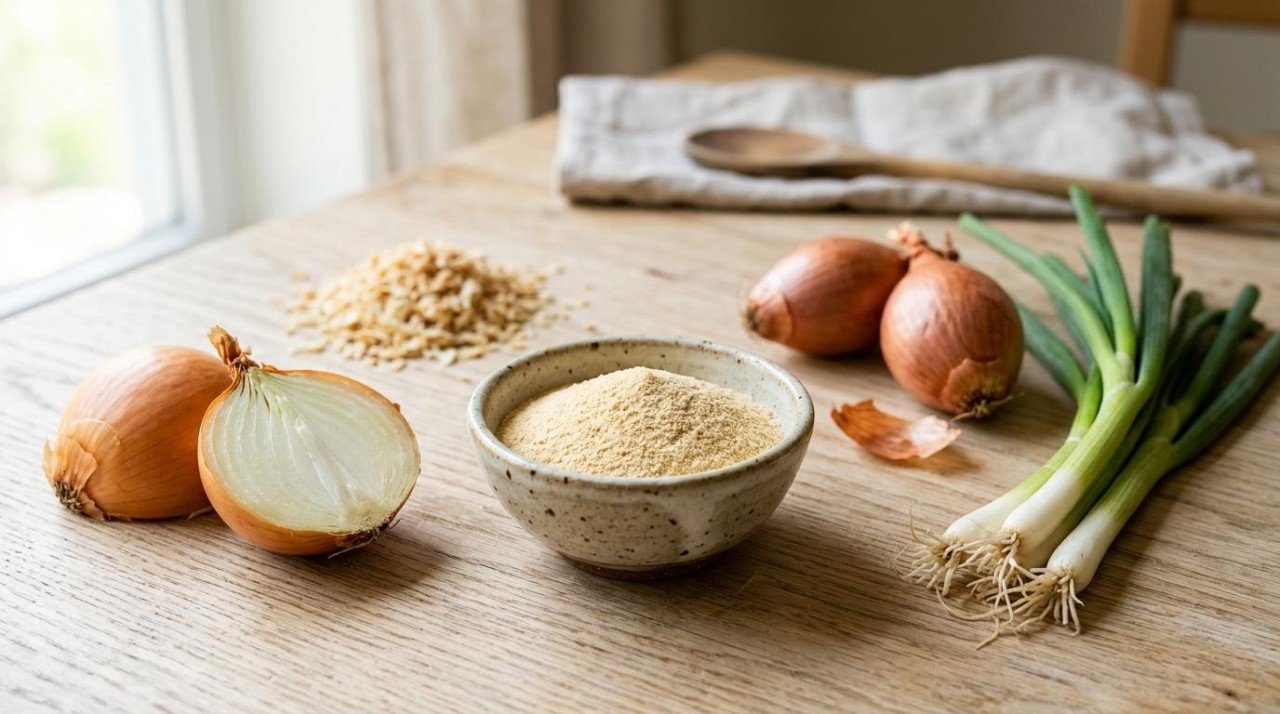
- Dried minced onion (onion flakes) — the closest swap; grind it and it is onion powder
- Granulated onion — the same ingredient in a coarser grind; use about twice as much
- Fresh onion, grated or finely chopped — best in sauces, soups, meatloaf, and burgers
- Shallots — a sweeter, more delicate swap for dressings and pan sauces
- Onion salt — fine for small amounts if you cut the recipe's salt
- Onion soup and dip mix — a shortcut for dips, meatloaf, and pot roast, with a big salt caveat
- Onion-forward seasoning blends — everything bagel seasoning, ranch seasoning, salt-free all-purpose blends
- Garlic powder — not onion, but the closest dry, dispersible stand-in for rubs
- Celery salt or celery seed — savory background for slaws, potato salad, and Bloody Marys
- Onion-infused oil — the low-FODMAP way to get onion flavor
- Green onion tops or chives — mild onion flavor for dips and cold dishes, low-FODMAP friendly
- Asafoetida — the allium-free option; a pinch bloomed in hot oil
The Onion Powder Conversion Chart
The anchor number comes from McCormick, which says one tablespoon of onion powder is equal to one medium onion, or about half a cup of chopped fresh onion. Taste of Home adds the other useful anchor: 1 tablespoon of dried minced onion equals 1/4 cup minced raw onion. Everything below follows from those two. 1 teaspoon onion powder equals roughly:
- About 3 tablespoons finely chopped or grated fresh onion (roughly 1/3 of a medium onion)
- 2 to 3 teaspoons dried minced onion, left whole (or about 1 teaspoon once ground to a powder)
- 1 1/2 to 2 teaspoons granulated onion
- About 3 tablespoons minced shallot (1 medium-large shallot)
- 4 teaspoons onion salt — and a full tablespoon of salt removed from the recipe, which is why onion salt only works for small amounts
Scale from there: 1/4 teaspoon powder is about 2 teaspoons chopped onion, and 1 tablespoon powder is a whole medium onion. Those fresh amounts look large because onions are mostly water. McCormick notes that about 96 percent of the water is removed when the onions are dehydrated, which is what concentrates the flavor so much. Fresh onion also tastes sharper and more pungent than the toasty, sweetish flavor of the powder, so when the swap is going into something raw, start at the low end and taste.
Which Substitute for Which Dish?
Onion powder does three different jobs, and each one points to a different swap:
- Dry rubs, breading, popcorn, and snack seasonings need something dry that sticks to food and will not scorch. Use ground dried minced onion, granulated onion, garlic powder, or a salt-free onion-forward blend. Fresh onion only works if you turn the rub into a paste (see below).
- Soups, stews, chili, sauces, and casseroles are the easy case. There is liquid and time, so fresh onion, shallots, whole dried minced onion, and onion soup mix all work, and fresh onion is arguably an upgrade.
- Dips, dressings, burgers, and meatloaf need even onion flavor without crunchy chunks. Grate fresh onion on the small holes of a box grater, crush dried minced onion and let it soften in the dip for 15 minutes, or use green onion tops or chives for a fresher take.
Dried Minced Onion (Onion Flakes)
- Swap: 1 teaspoon onion powder → about 1 teaspoon dried minced onion ground to a powder, or 2 to 3 teaspoons left whole (start at 2 and taste)
- Best for: Everything onion powder does, once ground; soups, chili, dips, meatloaf, and slow cooker meals if left whole
- Skip it for: Quick, dry dishes like popcorn or a sprinkle over fries, unless you grind it first
This is the closest substitute on the list, because it is literally the same product before the last step. Dried minced onion and onion flakes are dehydrated onion cut into bits instead of ground, so a spice grinder, a mortar and pestle, or even a zip-top bag and a rolling pin turns it into a serviceable onion powder in under a minute. It will be a little coarser than store-bought, which nobody will notice in a rub.
Left whole, the pieces need moisture and about 10 to 15 minutes to soften. In a soup or a braise that happens on its own. In a sour cream dip, stir the flakes in and let the dip sit in the fridge for 15 minutes before serving; they soften and give the dip a pleasant, slightly chewy texture, which is how many classic onion dips are made. Ratios vary between sources because flake sizes vary between brands, so treat 2 to 3 teaspoons as a range, not a rule. A quick dry toast in a skillet before grinding gives you something close to toasted onion powder, but watch it, because the flakes go from golden to bitter fast.
Granulated Onion
- Swap: 1 teaspoon onion powder → 1 1/2 to 2 teaspoons granulated onion
- Best for: Dry rubs, smoked and grilled meats, burgers, soups and stews
- Skip it for: Smooth vinaigrettes and thin sauces where the granules can stay slightly gritty
Granulated onion is onion powder with a coarser grind, closer to sand than flour. The bigger particles leave more air in the measuring spoon, so you need more volume for the same amount of onion; most cooks double it, and some find 1 1/2 times enough. If you like a lighter onion note, start at 1 1/2.
For rubs, granulated onion is arguably the better product. It clumps less, it clings to meat, and it holds up to long smoking. If your jar of onion powder has turned into a rock, granulated onion is what pitmasters keep on the shelf instead.
Fresh Onion
- Swap: 1 teaspoon onion powder → about 3 tablespoons finely chopped or grated onion (roughly 1/3 of a medium onion); 1 tablespoon powder → 1 medium onion
- Best for: Soups, stews, chili, pasta sauce, casseroles, meatloaf, meatballs, burgers, marinades
- Skip it for: Dry rubs for high-heat grilling, breading, popcorn and snack seasonings
- Health notes: Fresh onion brings fiber, prebiotic fructans, and quercetin along with flavor; see the healthier angle below
In anything wet, fresh onion is an upgrade over the powder it replaces. For soups and sauces, chop it finely and saute it at the start of cooking. For burgers, meatloaf, and meatballs, grate it on the small holes of a box grater instead of chopping, so it melts into the meat and adds moisture rather than leaving crunchy bits. A grated onion also disappears into a creamy dressing or dip, but raw onion is noticeably sharper than powder, so start with half the amount and let the dressing sit 10 minutes before you taste and adjust.
For a rub: fresh onion will not mix into a dry blend, but you can turn it into a wet rub. Grate the onion, squeeze out some of the juice, stir in the other spices and a tablespoon of oil, and smear it on. That works well for oven-roasted chicken and pork. Over a very hot grill, onion pulp on the surface can char before the meat is done, so cook at moderate heat. For breading: grate the onion into the egg or buttermilk dip, not into the flour, where it would clump and burn.
If you are out of fresh onion too, our onion substitutes guide covers the rest of the onion family.
Shallots
- Swap: 1 teaspoon onion powder → about 3 tablespoons minced shallot (1 medium-large shallot)
- Best for: Vinaigrettes, creamy dressings, pan sauces, cream sauces, sauteed vegetables, eggs
- Skip it for: Dry rubs and seasoning blends
Shallots are milder and sweeter than onions, with a faint garlicky edge, which makes them an especially good stand-in when onion powder was headed into something raw. A spoonful of minced shallot in a vinaigrette or a homemade ranch tastes fresh and rounded rather than harsh. Let the minced shallot sit in the vinegar or lemon juice for 10 minutes before adding the oil or dairy and its bite softens further.
Cooked, shallots brown faster than onions because they hold less water, so keep the heat at medium. For more on what shallots can do (and what to use when you are out of those), see our shallot substitutes guide.
Onion Salt
- Swap: 1/4 teaspoon onion powder → 1 teaspoon onion salt, and remove 3/4 teaspoon salt from the recipe
- Best for: Rubs, burgers, fries, popcorn, roasted vegetables, anything getting salted anyway
- Skip it for: Recipes calling for more than about 1/4 teaspoon onion powder, or dishes that use little or no salt
- Health notes: The one swap here that can send sodium way up if you do not adjust
Onion salt is mostly salt. Common blends run about three parts salt to one part onion powder, so check your jar's label, but assume roughly 25% onion. To get 1/4 teaspoon of onion powder out of it you need a full teaspoon, and three-quarters of that teaspoon is salt. For perspective, the FDA says the entire 2,300 mg daily sodium limit is about 1 teaspoon of table salt.
The practical rule: onion salt can replace onion powder only up to the amount of salt your recipe already uses. A rub with 2 teaspoons of salt and 1/2 teaspoon of onion powder can swap in 2 teaspoons of onion salt and drop the plain salt, and you end up close to the original. A dip that wants 1 teaspoon of onion powder cannot get there with onion salt without becoming inedibly salty, so use a little and make up the rest with another swap on this list.
Onion Soup and Dip Mix
- Swap: 1 teaspoon onion powder → about 1 tablespoon dry onion soup mix, and leave out all the salt the recipe calls for (and any bouillon)
- Best for: Sour cream onion dip, meatloaf, burgers, pot roast, roasted potatoes
- Skip it for: Dry rubs that already contain salt, delicate dressings, or anyone watching sodium closely
- Health notes: A leading brand's label lists about 610 mg of sodium per tablespoon of dry mix, roughly a quarter of the daily limit
That envelope in the back of the pantry is mainly dried onion, salt, and bouillon-style seasoning, so it gives you onion flavor plus a savory, beefy depth. In a meatloaf or a sour cream dip that is close to the original, which is why so many old family recipes use it in the first place.
Treat it as the recipe's salt, not an extra ingredient. If you do want onion dip without the sodium load, our healthier French onion dip builds the flavor from slowly caramelized fresh onions and Greek yogurt instead.
Onion-Forward Seasoning Blends
- Swap: Salt-free blend → 1:1 for the onion powder, then taste. Salted blend → use it in place of the recipe's salt, starting at that amount
- Best for: Rubs, eggs, avocado toast, roasted vegetables, popcorn, dips
- Skip it for: Recipes where the blend's other flavors (sesame, dill, herbs) would clash
Check the cabinet for everything bagel seasoning (dried onion and garlic, sesame, poppy seeds, and usually salt), dry ranch seasoning (onion, garlic, dill, and buttermilk powder), or a salt-free all-purpose blend, where onion is often near the top of the ingredient list. Read the label first: if onion or garlic is the first or second ingredient, it is a reasonable stand-in.
Everything bagel seasoning brings crunch, so it shines on toppings rather than inside a smooth dip. Ranch seasoning is a natural fit for dips, dressings, and roasted potatoes, where onion powder is usually headed anyway. Salt-free blends are the most flexible, since you can use them without doing sodium math.
Garlic Powder
- Swap: 1 teaspoon onion powder → 1/4 to 1/2 teaspoon garlic powder, or split the role between garlic powder and fresh onion
- Best for: Dry rubs, burgers, breading, roasted vegetables, savory snack mixes
- Skip it for: Anything named for onion, like onion dip or French onion anything
Garlic powder is a role substitute rather than a flavor match. It is dry, fine, and sticks to food exactly the way onion powder does, and it brings the same savory allium depth. It is also considerably stronger and sharper, so use less. In a barbecue rub with paprika, brown sugar, and pepper, the result is different but every bit as good.
Most rubs and blends that call for onion powder already include garlic powder, so leaning a bit harder on the garlic and letting everything else carry on is usually the smoothest fix. If you are out of garlic powder too, our garlic powder substitutes guide has the full chart.
Celery Salt or Celery Seed
- Swap: 1/4 teaspoon onion powder → 1/4 teaspoon celery salt (and cut the recipe's salt by the same amount), or a pinch of ground celery seed
- Best for: Coleslaw, potato salad, egg and tuna salad, Bloody Marys, chicken soup, rubs for pork
- Skip it for: Dishes that need a lot of onion flavor; celery is a background note, not a lead
Celery does not taste like onion, but in a creamy salad or a soup it does the same quiet job: it makes the dish taste savory and complete instead of flat. That is often exactly what the small amount of onion powder in a potato salad or slaw dressing was there for.
Celery salt, like onion salt, is mostly salt, so use it in place of salt rather than on top of it. Celery seed has no salt and a strong, slightly bitter flavor, so a pinch goes a long way. If you are out of celery itself, we have a celery substitutes guide too.
Onion-Infused Oil (The Low-FODMAP Option)
- Swap: Replace the recipe's oil with onion-infused oil 1:1 and leave the onion powder out. If there is no oil in the recipe, add a tablespoon and taste
- Best for: Low-FODMAP cooking, dressings, wet rubs and marinades, roasted vegetables, stir-fries, pasta
- Skip it for: Dry blends, breading, and baking that cannot take extra fat
- Safety note: Store-bought is safest; homemade belongs in the fridge (see below)
If you avoid onion for IBS or a low-FODMAP diet, onion powder is not a workaround. It is dried, concentrated onion, fructans and all, and even a small sprinkle can add up. Infused oil is the workaround. As Monash University explains, oils like this are low FODMAP because "fructans are water soluble but not fat soluble", so the flavor moves into the oil and the problem carbohydrates stay behind with the onion. The same principle is why pulling onion out of a soup does not help; Monash notes that in water-based dishes pulling the pieces out before eating will not work because the fructans have already leached into the liquid.
To use it in a rub, mix your other spices into the oil to make a paste. Drizzle it on vegetables before roasting, or whisk it into a vinaigrette. Store-bought is the easy, safe choice. Fresh vegetables in oil are a low-acid, oxygen-free setup where botulism spores can grow at room temperature, and Penn State Extension advises refrigerating oils made with fresh ingredients and using them within 2 to 4 days. If you make a quick batch by gently warming sliced onion in olive oil and straining it, follow that rule.
Green Onion Tops or Chives
- Swap: 1 teaspoon onion powder → about 3 tablespoons finely chopped chives or green onion tops (or 1 tablespoon freeze-dried chives)
- Best for: Sour cream and yogurt dips, ranch, potato and egg salad, scrambled eggs, baked potatoes, finishing soups
- Skip it for: Dry rubs, breading, and long-cooked dishes, where they fade away
For cold dips and creamy salads, the fresh, mild onion flavor of chives and scallion greens does what onion powder is there to do, with a bonus of color and freshness. The flavor is lighter than powder, so be generous and add them close to serving. They are also a low-FODMAP favorite: Monash suggests using the green parts of spring onion or chives as a replacement for onion. The fructans live mostly in the white and light green part of the scallion, so for low-FODMAP cooking, stop slicing where the green starts to pale.
Our green onion and chive guides have more ideas for both.
Asafoetida (Hing)
- Swap: 1 teaspoon onion powder → a pinch to 1/8 teaspoon asafoetida, bloomed in hot oil or ghee for a few seconds
- Best for: Curries, dal, lentil and bean soups, stir-fries, sauteed vegetables, anyone avoiding onion and garlic
- Skip it for: Dry rubs, dips, and raw dressings; it needs hot fat to taste right
Asafoetida is a dried plant resin that Indian cooking has used for centuries to deliver the savory depth of onion and garlic, especially in traditions that avoid both. Monash also lists it as a way to replace onion flavor. Straight from the jar it smells sulfurous and intense; a few seconds in hot oil turns it into something surprisingly like sauteed onions. It is very strong, so start with a pinch and do not leave it in the pan for more than a few seconds before adding the next ingredient.
Most jars are "compounded" asafoetida, meaning the resin is cut with flour, often wheat flour. If you need it gluten-free, look for a brand made with rice flour.
Make Your Own Onion Powder
The quickest route is the one above: grind dried minced onion in a spice grinder and sift out any big pieces. If you have fresh onions and time, you can also make powder from scratch. Slice onions as thinly as you can, about 1/8 inch, and dry them in a dehydrator at around 125 to 150 degrees F, or on a sheet pan in your oven at its lowest setting with the door propped open. They are ready when the pieces snap cleanly instead of bending, which usually takes 6 to 12 hours depending on the thickness. Higher heat browns them and turns them bitter.
Cool the dried onion completely, grind it, and store it in an airtight jar. A medium onion shrinks to only about a tablespoon of powder, which is a nice illustration of the conversion chart above. Because homemade powder pulls in moisture even faster than store-bought, add a few grains of uncooked rice to the jar, or keep it in the freezer, to stop it from clumping.
Rescuing a rock-hard jar: if your onion powder has caked, it is usually still fine as long as it smells like onion and shows no sign of mold. Break it up with a fork or blitz it in a spice grinder. McCormick says onion powder can last up to two years sealed and stored somewhere dry, so keep it away from the steam of the stove.
The Healthier Angle: Watch the Salt, and Use Fresh When You Can
Plain onion powder is just onion, with no meaningful sodium, so it does not need fixing. The nutrition traps are the salty substitutes that tend to travel with it.
- Onion salt, celery salt, and soup mixes are mostly salt. Swapping them in without cutting the recipe's salt is how a rub or dip ends up with most of a day's sodium. The FDA notes that Americans average about 3,400 mg of sodium a day, well above the 2,300 mg Daily Value, and seasoning blends are an easy, invisible source.
- Fresh onion brings more than flavor. When the dish allows it, a fresh onion counts as a vegetable, not just seasoning. Onions are a good source of prebiotic fructans (the same compounds that feed beneficial gut bacteria, and the same ones that trouble people on a low-FODMAP diet) and quercetin, a plant compound concentrated in the outer layers. Our onion guide covers the research.
- Swapping alliums adds variety. Using shallots, leeks, scallions, or chives in place of the usual powder adds a different plant to your week, which is the idea behind aiming for 30 different plants a week.
Take the Guesswork Out of Eating Well
Eat Well Planner helps you organize your favorite recipes, plan balanced meals, and automatically generate shopping lists — all in one place. Whether you're tracking macros, managing dietary restrictions, or just trying to stop asking "what's for dinner?", we've got you covered.
Our AI-powered tools can adapt any recipe to your dietary needs, help you discover new meals you'll love, and even log your nutrition effortlessly. It's meal planning made simple.
Start Organizing Your Meals — FreeWhat Not to Use
- Onion salt measured like onion powder. A 1:1 swap gives you a quarter of the onion and a lot of extra salt.
- Chopped fresh onion in a dry rub over high heat. The wet pieces scorch before the meat is done. Grate it into a paste rub and cook at moderate heat.
- Whole onion flakes in a quick, dry dish. Without liquid and time, they stay hard and chewy. Grind them first.
- Fresh onion in breading flour. It clumps and burns in hot oil. Put it in the wet dip.
- Raw onion at full strength in a dressing. It is much sharper than powder. Start with half, let it rest in the acid, and taste.
- Onion powder, or "just a little" of it, on a low-FODMAP diet. It is concentrated onion. Use infused oil, green tops, chives, or asafoetida instead.
The Short Version
1 teaspoon onion powder = about 3 tablespoons fresh onion = 2 to 3 teaspoons dried minced onion (or 1 teaspoon ground) = 1 1/2 to 2 teaspoons granulated onion = about 3 tablespoons minced shallot. For rubs, stay dry: ground onion flakes, granulated onion, or garlic powder, or switch to a paste rub. For soups and sauces, fresh onion is an upgrade. For dips and burgers, grate fresh onion or let crushed flakes soften in the mix. For low-FODMAP cooking, infused oil, green tops, chives, and asafoetida do the job.
What a chart cannot tell you is which option fits the recipe in front of you, especially if it is a rub that calls for four different powders or a dip that has been in the family for decades. That is where Eat Well Planner helps. Save the recipe, open the AI recipe chat, and ask "I'm out of onion powder, what should I use?" and it answers with your actual ingredients and method in view. If someone you cook for cannot eat onion, Recipe Variations can rewrite the whole recipe with infused oil, scallion greens, or asafoetida worked in, so you are not adjusting every line by hand. It is free, and it means the next empty spice jar does not derail dinner.