You are halfway through a batch of gingerbread, or building a pot of barbecue sauce, and the recipe calls for molasses. You reach for the jar and find it either empty or crystallized into a dark, unspoonable mass. The good news: molasses is one of the more forgiving ingredients to work around, as long as you match what it is actually doing in your recipe.
Molasses pulls several jobs at once. It sweetens, but less than sugar. It adds moisture and a chewy density to bakes. It brings a deep, bittersweet, almost smoky caramel flavor and a dark color. And because it is mildly acidic, it helps baking soda do its lifting in recipes like gingerbread and gingersnaps. In a barbecue sauce it adds body, color, and a tangy backbone. The best substitute depends on which of those jobs matters most in what you are making.
Below are the swaps that genuinely work, with exact ratios, starting with the one that is closest and most likely to already be in your kitchen.
The Quick List
- Dark brown sugar — the closest everyday swap; already contains molasses
- Dark corn syrup — matches the color and thick texture, milder flavor
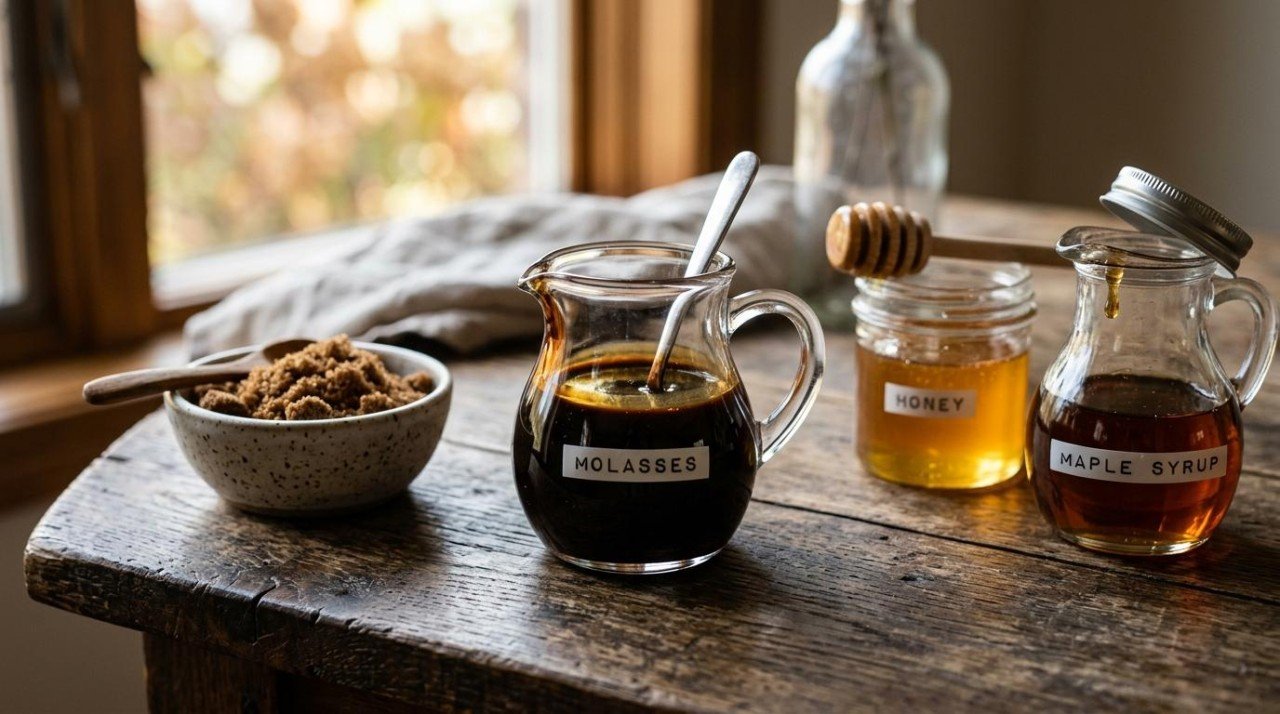
- Honey — 1:1 and easy, though sweeter and lighter in flavor
- Maple syrup — use the darkest grade; reduce the recipe's other liquid
- Golden syrup or black treacle — treacle is nearly identical; golden syrup is milder
- Sorghum syrup — the old-fashioned Southern match, earthy and close
- Date syrup — a whole-fruit upgrade with real depth and some fiber
- Granulated sugar — the always-on-hand last resort for sweetness only
Dark Brown Sugar (the Closest Everyday Swap)
- Swap: 1 cup packed dark brown sugar for 1 cup molasses. If the recipe needs a pourable syrup, dissolve about 3/4 cup dark brown sugar in 1 to 4 tablespoons of hot water.
- Best for: Cookies, gingerbread, cakes, quick breads — most baking
- Tip: Reach for dark over light; it has more molasses and a closer flavor
This is the swap to try first, and it makes sense once you know that brown sugar is just white sugar with molasses added back in. Dark brown sugar carries the most molasses of any pantry sugar, so it brings back much of the color, moisture, and caramel depth in one move. Use it packed, at a straight 1:1, and most bakes will barely notice the difference.
The one thing brown sugar does not replace is molasses's liquid volume. In a dry-heavy batter that is fine, but if you are making something where molasses was providing real moisture (a sticky glaze, a wet gingerbread batter), dissolve the sugar in a splash of hot water to bring it closer. If you keep molasses on hand for baking, it is worth knowing this works both directions — our guide to brown sugar substitutes leans on the same trick in reverse.
Dark Corn Syrup
- Swap: 1:1 with molasses
- Best for: Pecan pie, barbecue sauces, glazes, and anywhere texture and color matter more than deep flavor
- Skip it for: Recipes built around molasses's signature bittersweet flavor, like a proper gingerbread
Dark corn syrup is the best structural match on this list. It has almost the same thick, pourable body and dark color as molasses, so it behaves identically in a sauce or a sticky bake and swaps in cup for cup. What it lacks is flavor: it is slightly sweeter and far milder, without the smoky, faintly bitter edge that defines molasses.
That makes it ideal wherever molasses was mostly doing physical work — holding a pecan pie together, giving a barbecue sauce its glossy body — and less ideal where the flavor is the whole point. If you want the texture of molasses but a little more of its character, stir a tablespoon of dark brown sugar into the corn syrup.
Honey
- Swap: 1:1 with molasses
- Best for: Marinades, glazes, quick breads, and softer bakes
- Skip it for: Bakes that go above 350°F, where honey scorches
Honey is the easiest swap when you have nothing more molasses-like around: it is liquid, roughly the same consistency, and works at a clean 1:1. The trade-offs are that it is noticeably sweeter and its flavor is floral rather than dark and smoky. Reaching for a darker, stronger honey (buckwheat or wildflower) closes some of that gap in both color and taste.
One technical note: honey browns and scorches faster than most sweeteners, so King Arthur Baking recommends keeping it out of recipes baked above 350°F. For a stovetop barbecue sauce or a lower-temperature bake, it is a fine stand-in; for a hot, dark gingerbread it is not the strongest choice.
Maple Syrup
- Swap: About 3/4 cup maple syrup per 1 cup molasses, and reduce the recipe's other liquid by 3 to 4 tablespoons per cup
- Best for: Baked beans, marinades, muffins, and quick breads
- Tip: Use the darkest grade you can find for the closest color and flavor
Maple syrup brings its own lovely depth, and a dark Grade A syrup gets reasonably close to molasses in color. Because it is thinner and sweeter than molasses, use a little less and cut back the recipe's other liquids. King Arthur suggests decreasing the liquid by 3 to 4 tablespoons per cup of syrup; if the recipe has no liquid to trim, add a tablespoon of flour per quarter cup of syrup instead.
Maple will read clearly as maple, which is wonderful in baked beans or a breakfast bread and a little out of place in a spice cookie meant to taste of molasses. It is a swap that changes the flavor rather than hiding the change, so use it where its own character is welcome.
Golden Syrup or Black Treacle
- Swap: 1:1 with molasses
- Best for: Almost any baking or sauce, especially if you already keep these British pantry staples
- Tip: Black treacle is the near-exact match; golden syrup is much milder
These two often sit side by side on the shelf but behave very differently. Black treacle is essentially the British name for dark molasses, so it is about as close to a perfect substitute as exists — a touch thicker and slightly more bitter, swapping in cup for cup with no other changes.
Golden syrup is a different animal: it is a light, clear cane syrup with a gentle caramel flavor and none of molasses's dark bitterness. It swaps in 1:1 for texture and moisture, but your bake will come out lighter in both color and flavor. Treat golden syrup like corn syrup with more personality, and treacle like molasses under another name.
Sorghum Syrup
- Swap: 1:1 with molasses
- Best for: Gingerbread, biscuits, and old-fashioned Southern baking
- Tip: It is a little thinner and sweeter, so expect a slightly milder result
Sorghum syrup, pressed from the sorghum cane, was the everyday sweetener across much of the American South before molasses and sugar took over, and it remains one of the most authentic swaps. It shares that same earthy, malty depth, so it slots naturally into anything molasses-forward.
It is a bit thinner and sweeter than molasses, so it swaps in 1:1 with only minor differences in the finished dish. If you can find it, it is one of the more characterful substitutes here — closer in spirit to molasses than honey or maple, without any of the bitterness that can make blackstrap tricky.
Date Syrup (the Whole-Food Upgrade)
- Swap: 1:1 with molasses
- Best for: Gingerbread, marinades, sauces, and drizzling, where you want dark depth without harsh bitterness
- Health notes: Made from whole dates, so it carries some of the fruit's fiber, potassium, and minerals
Date syrup is molasses's most interesting stand-in. Made by cooking down whole dates, it has a thick, pourable body and a rich, dark, caramel-and-dried-fruit flavor that lands remarkably close to molasses. It swaps in cup for cup, and its natural sweetness means you rarely need to adjust anything else.
Because it comes from the whole fruit rather than a sugar refinery, it holds onto some of the fiber and minerals dates are known for, which slows how quickly its sugars hit your bloodstream. It is fruitier and less assertively bitter than molasses, so it works best where you want that dark depth without the smoky edge. It is not a health food, but as sweeteners go it is one of the more honest upgrades.
A Word on Blackstrap Molasses
Blackstrap deserves its own note, because it is the one type of molasses with a genuine nutrition angle. It is what remains after sugar is extracted from cane a third time, which concentrates the minerals: a single tablespoon delivers around 20 percent of the Daily Value for iron and 15 percent for calcium, plus a solid dose of potassium and magnesium. Even regular molasses is surprisingly mineral-rich, with nearly 300 milligrams of potassium per tablespoon — a rare thing for a sweetener.
The catch is flavor. Blackstrap is much stronger and more bitter than regular molasses, and King Arthur notes it can turn bitter when baked. If a recipe calls for regular molasses and blackstrap is all you have, use a bit less and expect a deeper, more assertive result. Its minerals make it a favorite for savory braises, baked beans, and barbecue sauce, where its intensity is an asset rather than a distraction.
Take the Guesswork Out of Eating Well
Eat Well Planner helps you organize your favorite recipes, plan balanced meals, and automatically generate shopping lists — all in one place. Whether you're tracking macros, managing dietary restrictions, or just trying to stop asking "what's for dinner?", we've got you covered.
Our AI-powered tools can adapt any recipe to your dietary needs, help you discover new meals you'll love, and even log your nutrition effortlessly. It's meal planning made simple.
Start Organizing Your Meals — FreeGranulated Sugar (the Last Resort)
- Swap: About 3/4 cup granulated sugar per 1 cup molasses, plus a tablespoon or two of water if the recipe needs the liquid
- Best for: Emergencies where molasses is a minor player and you only need the sweetness
- Expect: None of the color, moisture, depth, or acidity that molasses provides
When the cupboard is truly bare, plain white sugar will at least cover the sweetness. Molasses is less sweet than sugar, so use a little less, and add a splash of water if the recipe was counting on molasses for moisture. (Our guide to white sugar substitutes covers the reverse situation.)
Be honest with yourself about what you are giving up: the dark color, the chew, the caramel flavor, and the acidity that helps baking soda lift a gingerbread. In a recipe where molasses is a background tablespoon, no one will notice. In a molasses cookie or a dark spice cake, plain sugar leaves a pale, flat shadow of the original. If any of the swaps above are within reach, use them first.
What Not to Use
A couple of tempting options tend to disappoint:
- Pancake or table syrup. The bottled "maple-flavored" syrups are thin, artificially flavored, and mostly corn syrup with coloring. They lack real depth and will water down both flavor and texture. Real maple syrup is a fine swap; the imitation stuff is not.
- Blackstrap molasses, swapped 1:1 in a delicate bake. Because it turns bitter and is so much stronger, using it cup for cup where regular molasses was called for can overpower a subtle recipe. Scale it back if it is your only option.
- Artificial sweeteners. They may match sweetness, but they bring none of molasses's moisture, body, browning, or acidity, so bakes come out flat and pale.
The Bottom Line
If you have dark brown sugar, you are basically set: 1 cup packed swaps in for 1 cup molasses, and a splash of water restores the moisture. Dark corn syrup, honey, maple syrup, golden syrup, treacle, sorghum, and date syrup all work too, each trading a little flavor or sweetness for what is on hand. And when you want the minerals more than a delicate flavor, blackstrap earns its place in savory, robust dishes. Like baking soda, molasses is one of those ingredients that feels irreplaceable until you understand the handful of jobs it is doing.
The tricky calls are always recipe-specific: will corn syrup flatten these gingersnaps, or is date syrup close enough for this glaze? That is exactly what the Eat Well Planner AI recipe chat is built for — pull up the recipe you are making and ask, and it reads your actual ingredient list to tell you which swap fits and what to adjust. And when you would rather genuinely lighten a recipe than just make do, its Make It Healthier feature suggests swaps like date syrup and checks the real nutritional gain before recommending them — so the next time you find the molasses jar empty, you have a tool that does the thinking with you.