The energy ball recipe calls for a cup of soft Medjool dates, and the pantry has a box of prunes, a bag of the small, firm dates from the baking aisle, and some raisins. Or you're halfway into a smoothie, a sticky toffee pudding or a batch of homemade bars and realize the dates you thought you had went into someone's lunchbox. Medjools are pricey and not always on the shelf, so this happens a lot.
Good news: dates are one of the easier ingredients to replace, because other dried fruits do most of the same work. What changes is which substitute fits. In no-bake recipes like energy balls, Larabar-style bars and raw pie crusts, Medjools are the glue, so you need something sticky and thick. In smoothies, sauces and date-sweetened baking, they're mostly sweetener, and a syrup can do the job. The swaps below are split by those two jobs, with exact amounts for each.
The Quick List
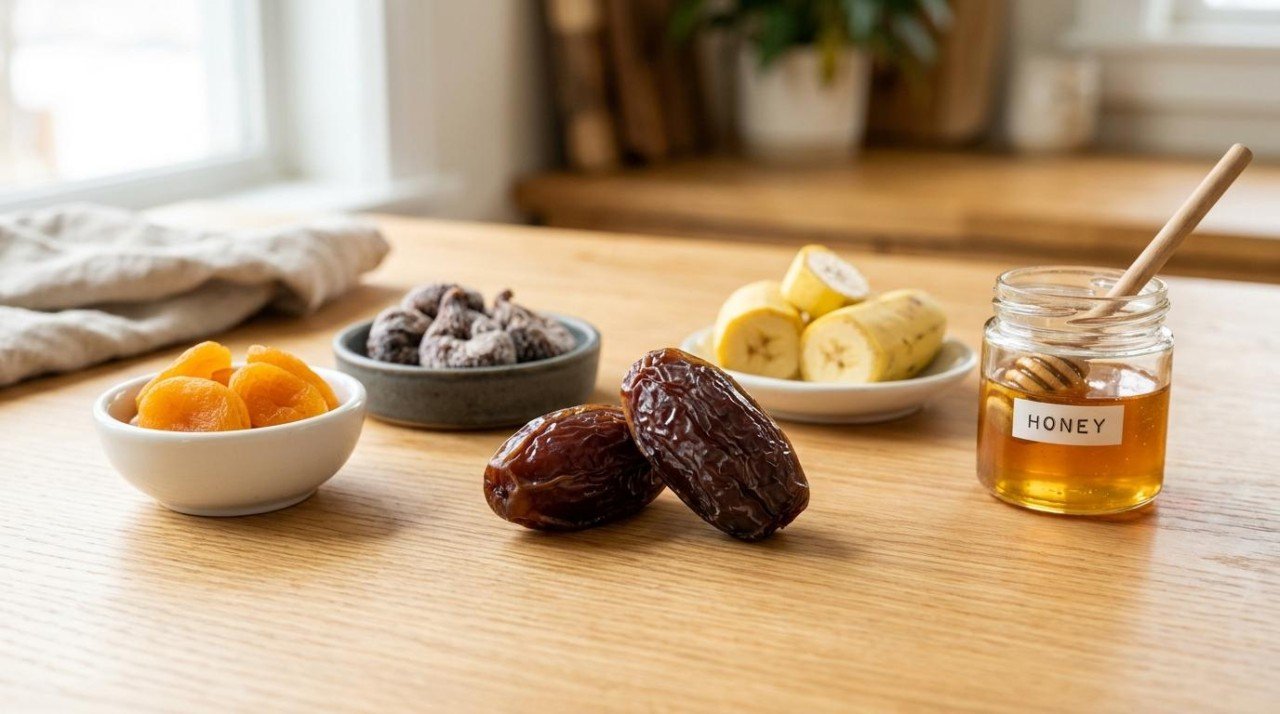
- Deglet Noor dates, soaked — the closest match; same flavor, just firmer and smaller
- Prunes — soft, sticky and less sweet; excellent binder and the best pick for sticky toffee pudding
- Dried figs — the most fiber of the bunch, with a honeyed, seedy crunch
- Raisins, soaked — cheap and nearly as sweet; bind well once blended into a paste
- Dried apricots — bright and tangy; best mixed with a sweeter fruit
- Nut butter + honey or maple syrup — the no-dried-fruit fix for energy balls
- Date syrup — real date flavor for smoothies, dressings and baking, but no binding power
- Maple syrup or honey — easy sweetening swap in smoothies, sauces and batters
- Ripe banana — natural sweetness and body in smoothies
Swap by Weight, Not by Count
Medjools are big. USDA puts a pitted Medjool at about 24 g, while a pitted Deglet Noor is about 7 g. So "10 dates" can mean three very different amounts, and most failed date swaps come from swapping one-for-one by count. If you have a kitchen scale, weigh the dates the recipe calls for (or multiply the number of Medjools by 24 g) and use the same weight of substitute. That one habit fixes almost everything.
No scale? Here's roughly what replaces 1 pitted Medjool date (24 g), based on USDA's average weights:
- Deglet Noor dates: 3 to 4
- Prunes: 2 to 3 (a pitted prune is about 9.5 g)
- Dried figs: about 3 small dried figs (about 8 g each), stems trimmed
- Raisins: about 2 1/2 tablespoons, lightly packed
- Dried apricots: about 7 halves (3.5 g each)
- Date syrup, maple syrup or honey: about 1 tablespoon, for sweetening only
Dried fruit sizes vary by brand and harvest, so treat these as starting points and trust the texture in the bowl.
What Medjool Dates Do in a Recipe
Medjools are prized in no-bake recipes because they're soft, moist and sticky. They have about 21 percent water and roughly 16 g of sugar each, and when you blitz them in a food processor they turn into a thick, tacky paste that holds oats, nuts and seeds together without any cooking. They also bring a deep, caramel-like flavor that reads as "rich" in desserts, and about 1.6 g of fiber per date.
So when you replace them, you're replacing up to three things: stickiness (critical in energy balls and raw crusts, irrelevant in smoothies), sweetness, and that caramel flavor. Dried fruits cover all three to different degrees. Syrups cover sweetness and some flavor, but they add zero bulk, so they can't hold a ball together on their own.
Substitutes for Binding: Energy Balls, Bars and Raw Crusts
For any recipe where the dates hold things together, reach for another sticky dried fruit. One rule applies to every option here: if the fruit is at all firm or dry, soak it first. Cover it with hot water for 10 to 15 minutes (or room-temperature water for an hour), drain well, and pat it dry. Too much water and your mixture turns mushy, so save the soaking liquid and add it back a teaspoon at a time only if the mix is crumbly.
Deglet Noor Dates (Soaked)
- Swap: 1 Medjool → 3 to 4 Deglet Noor dates, or equal weight; soak in hot water 10 to 15 minutes, then drain
- Best for: Energy balls, date bars, raw crusts, stuffed dates, sticky toffee pudding, everything
- Skip it for: Eating as a soft snack straight from the box, if you love Medjools' fudgy texture
- Health notes: Slightly more fiber than Medjool per 100 g (8.0 g vs 6.7 g) and slightly less sugar
Deglet Noors are the small, golden-brown dates sold in most supermarkets' baking aisles, and they're usually far cheaper than Medjools. They're the same fruit with the same flavor, just drier, firmer and a little less sweet. Straight out of the bag they're too stiff to blend into a smooth paste, and they'll leave your food processor rattling around hard little chunks. A short hot-water soak fixes that completely.
After soaking, they process into a paste that binds about as well as Medjools do. If your energy balls taste a little less rich, add a teaspoon of maple syrup or a pinch of salt (salt makes the caramel notes pop). Buy whole, pitted Deglet Noors rather than pre-chopped "baking dates." Those are often coated in oat flour or dextrose to keep the pieces separate, and the coating makes them noticeably worse at binding.
Prunes
- Swap: 1 Medjool → 2 to 3 pitted prunes, or equal weight; no soaking needed if they're soft
- Best for: Energy balls, brownie bites, chocolate bars, sticky toffee pudding, braises and stews
- Skip it for: Light, delicately flavored recipes where the darker, winey flavor would stand out
- Health notes: About 40 percent less sugar than Medjools per 100 g (38 g vs 66.5 g) with slightly more fiber (7.1 g) and potassium
Prunes are the most underrated date substitute. Soft prunes are already moist (about 31 percent water versus 21 percent for Medjools) and sticky, so they blend into a thick, glossy paste with no soaking, and they bind every bit as well. Their flavor is darker and slightly tart, a little like a red wine reduction, which disappears into anything with chocolate, cocoa, coffee or warm spices. In chocolate energy balls, most people can't tell.
Because prunes are less sweet, a recipe that's balanced around Medjools may taste a touch less dessert-like. Taste the mixture before rolling and add a teaspoon or two of maple syrup or honey if you want it sweeter. One heads-up: prunes contain sorbitol, a naturally occurring sugar alcohol that is part of why they keep things moving. In the amounts used in a batch of energy balls, that's a nice fiber bonus, not a problem, but it's worth knowing if you're eating several at once.
Dried Figs
- Swap: 1 Medjool → about 3 small dried figs, or equal weight; trim the hard stems and soak 10 minutes if firm
- Best for: Energy balls, fig-and-nut bars, raw crusts, cheese boards, stuffing
- Skip it for: Silky-smooth recipes like date caramel or smoothies, where the tiny seeds stay gritty
- Health notes: The most fiber on this list, 9.8 g per 100 g, plus 162 mg calcium, with about 28 percent less sugar than Medjools
Dried figs are chewy and honey-sweet, with a pleasant crunch from their seeds. Blended, they make a sturdy, sticky paste that holds together well, though the texture is a little more rustic than date paste. Mission figs are darker and sweeter. Calimyrna and Turkish figs are golden, milder and nuttier. Either works.
Snip off the woody stems before blending, since they don't break down. Figs pair especially well with walnuts, almonds, orange zest and cardamom, so a fig-and-almond energy ball is a great place to start. For a closer match to Medjool's sweetness, use half figs and half dates or raisins.
Raisins (Soaked)
- Swap: 1 Medjool → about 2 1/2 tablespoons raisins, or equal weight; soak in hot water 10 to 15 minutes, drain well
- Best for: Energy balls, oat bars, granola bites, raw crusts, sticky toffee pudding in a pinch
- Skip it for: Stuffed dates or any recipe where the date shape matters
- Health notes: Similar sugar to dates (59 g per 100 g) but only about half the fiber (3.7 g)
Raisins are the budget option, and almost everyone has a box somewhere. They're nearly as sweet as Medjools and taste milder and fruitier. Unsoaked, they're too dry and springy to blend; the food processor will just bounce them around. After a soak, they break down into a thick, sticky paste that binds energy balls surprisingly well. Golden raisins give a lighter, tangier result; dark raisins taste closer to dates.
Drain them very well after soaking, because raisins absorb more water than you'd expect. If the mix still feels too wet, add a tablespoon of oats, ground flaxseed or nut flour to firm it up.
Dried Apricots
- Swap: 1 Medjool → about 7 dried apricot halves, or equal weight; soak 10 minutes if firm
- Best for: Bright, fruity energy balls (apricot-coconut, apricot-almond), bars, tagines and stews
- Skip it for: Chocolate or caramel-style recipes, where their tartness clashes
- Health notes: 7.3 g fiber per 100 g and much more potassium than dates (1,162 mg vs 696 mg), plus some vitamin A
Dried apricots are less sweet and more tart than dates, with a sunny, almost floral flavor. They make a slightly looser paste, so they bind best when they share the job. Half apricots and half dates, raisins or figs gives you the stickiness and the brightness. On their own, they're lovely in coconut-based energy balls with a pinch of salt and a little lemon zest.
Unsulfured apricots are darker and taste more like caramel, which makes them a better stand-in for dates than the bright orange sulfured kind.
Nut Butter + Honey or Maple Syrup
- Swap: For each 1 cup of packed dates, use about 1/2 cup nut butter + 1/4 to 1/3 cup honey or maple syrup, and add oats until the mix holds together
- Best for: Energy balls, no-bake oat bars, when you have no dried fruit at all
- Skip it for: Raw crusts and Larabar-style bars, which depend on fruit paste for their texture
- Health notes: More protein and healthy fat, but honey and maple bring sugar with essentially no fiber
If there's not a dried fruit in the house, switch to the other classic style of energy ball: oats bound with nut butter and a sticky syrup. Peanut, almond or cashew butter supplies the bulk and richness, and the syrup supplies the stickiness. Since syrups are runnier than date paste, you'll need more dry ingredients. Stir in rolled oats, ground flaxseed or chopped nuts a few tablespoons at a time, then chill the mixture for 20 to 30 minutes before rolling so it firms up.
Honey is the stickier of the two and holds better at room temperature. Maple syrup works too, but bites made with it can soften if they sit out. For more on each, see our guides to peanut butter substitutes and rolled oat substitutes, which cover nut-free and oat-free versions.
Substitutes for Sweetening: Smoothies, Sauces and Baking
When dates are blended into a smoothie, a salad dressing, a curry or a batter, their job is sweetness and flavor, not structure. That opens the door to syrups, which blend instantly and need no soaking.
Date Syrup
- Swap: 1 Medjool → about 1 tablespoon date syrup
- Best for: Smoothies, dressings, oatmeal, yogurt, glazes, marinades, date-sweetened baking
- Skip it for: Energy balls, bars and crusts; it adds sweetness but no bulk or binding
- Health notes: About 15 g sugar per tablespoon, similar to one Medjool, but almost none of the fiber
Date syrup (also sold as silan) is made by cooking dates in water and straining and reducing the liquid, so it tastes exactly like dates: deep, fruity and caramel-like. It's the best flavor match on this list, and a tablespoon carries roughly the same sugar as one Medjool. It's a natural in smoothies, tahini dressings, and drizzled over yogurt or oatmeal.
In baking, it behaves like other liquid sweeteners. If you're swapping it in for a lot of blended dates in a cake or muffin batter, which add bulk as well as moisture, the batter will come out a little thinner, so hold back a tablespoon or two of the recipe's other liquid. The trade-off is fiber: because the fruit solids are strained out, most of the fiber stays behind.
Maple Syrup or Honey
- Swap: 1 Medjool → 1 tablespoon maple syrup or 2 to 3 teaspoons honey
- Best for: Smoothies, oatmeal, dressings, sauces, batters
- Skip it for: Recipes where dates are the bulk of the dish, like date bars or raw crusts
- Health notes: Maple has about 12 g sugar per tablespoon, honey about 17 g; neither has meaningful fiber
Both are pantry staples and blend instantly. Maple is a little less sweet than a Medjool per tablespoon and brings its own toasty flavor that works beautifully in smoothies with oats, cinnamon or coffee. Honey is sweeter, so start with a bit less. Neither tastes like dates, but in a smoothie with banana, nut butter and cinnamon, nobody will notice.
Dates are often used specifically so a recipe has no added sugar. If that's your goal, a whole-fruit option like banana or a few prunes keeps the fiber that syrups leave behind. Our guides to maple syrup substitutes and honey substitutes cover more liquid sweeteners if you're out of these, too.
Ripe Banana
- Swap: 1 Medjool → 1/2 to 1 very ripe banana (frozen is great)
- Best for: Smoothies, smoothie bowls, overnight oats, nice cream
- Skip it for: Energy balls and bars; bananas are too wet to hold them together
- Health notes: A medium banana has about 14 g sugar and 3 g fiber, with plenty of potassium
For smoothies, a ripe banana is arguably better than a date. It sweetens, adds thick, creamy body, and a whole banana has about twice the fiber of one Medjool. The riper and more speckled the banana, the sweeter it is; frozen chunks make the smoothie thick and frosty. If you want that caramel note back, add a pinch of cinnamon and a few drops of vanilla. For more on building a filling, not-too-sweet blend, see our guide to balanced smoothies.
Sticky Toffee Pudding and Date-Based Baking
In sticky toffee pudding, date bread and date muffins, dates are soaked in boiling water (usually with a little baking soda), then mashed or blended into the batter. They provide moisture, sweetness and that dark, toffee-like depth. Because they're cooked into a batter, firmness doesn't matter, so almost any dried fruit works if you soak it the same way.
- Swap: Equal weight of prunes, Deglet Noor dates, dried figs or raisins, soaked exactly as the recipe soaks the dates
- Best pick: Prunes, or half prunes and half Deglet Noors
- Skip it for: Swapping in date syrup for all of the soaked dates, which leaves the batter thin and less moist
Prunes are the star here. Their winey depth plays perfectly with the brown sugar and toffee sauce, and they keep the sponge incredibly moist. Deglet Noors taste the most like the original; they just need the full soak (they'll soften completely in the boiling water). Figs give a slightly lighter, honeyed pudding with a bit of seedy texture. Raisins work but taste fruitier and less toffee-like, so they're best mixed half-and-half with another fruit.
Since prunes and figs are less sweet than Medjools, you can add a tablespoon of extra brown sugar or molasses to the batter if you like a very sweet pudding, though the toffee sauce usually makes up the difference. Out of brown sugar too? Our brown sugar substitutes guide has you covered.
Stuffed Dates and Savory Dishes
When dates are the star of an appetizer (stuffed with goat cheese, almonds or blue cheese, or wrapped in bacon), you need something with a pocket. Deglet Noor dates are the easy answer: same flavor, just bite-size. Dried figs split and stuffed with goat cheese and walnuts are excellent. Prunes wrapped in bacon are a classic British appetizer called "devils on horseback." Dried apricots pair well with soft cheese and pistachios.
In tagines, stews, curries and grain salads, swap chopped Medjools 1:1 by weight for chopped prunes or dried apricots, both of which are traditional in Moroccan cooking. They hold their shape a little better than Medjools in long braises.
Fiber and Sugar: How the Substitutes Compare
Here's how each option compares per 100 g, based on USDA data. Values are rounded.
- Medjool dates: 6.7 g fiber, 66.5 g sugar, 277 calories
- Deglet Noor dates: 8.0 g fiber, 63.4 g sugar, 282 calories
- Dried figs: 9.8 g fiber, 47.9 g sugar, 249 calories
- Dried apricots: 7.3 g fiber, 53.4 g sugar, 241 calories
- Prunes: 7.1 g fiber, 38.1 g sugar, 240 calories
- Raisins: 3.7 g fiber, 59.2 g sugar, 299 calories
- Date syrup, maple syrup, honey: essentially 0 g fiber, mostly sugar
The takeaway: if you're using dates as the sweetener in a no-added-sugar recipe, figs, prunes and apricots give you the same job with more fiber and noticeably less sugar. Raisins and syrups are perfectly good swaps, but they shift the balance toward sugar. And per-gram differences matter less than you might think in a batch of energy balls split 12 ways; what matters more is choosing the texture you need.
Healthier Upgrades
Medjool dates are already a whole food, so this isn't about replacing something "bad." It's about the extras you can pick up along the way.
Prunes for bone health. In a 12-month randomized trial of 235 postmenopausal women published in the American Journal of Clinical Nutrition, those who ate 50 g of prunes a day (about 5 or 6 prunes) preserved their hip bone density, losing 0.3 percent versus 1.1 percent in the control group. The study was funded by the California Prune Board, and it's one trial, not a guarantee. But swapping prunes into your energy balls is an easy way to work them into the week, alongside 40 percent less sugar per gram than Medjools.
Figs for fiber. Gram for gram, dried figs carry nearly 50 percent more fiber than Medjools, plus a little calcium. If you make energy balls weekly, swapping in figs is one of the simplest ways to nudge your fiber intake up, which matters, since most of us fall short. Our post on the two kinds of fiber explains why variety counts.
Mix your fruits. Dates, figs, prunes and apricots are four different plants. Blending two or three into one batch of energy balls gives you a more interesting flavor and a little more plant diversity, which research links to a more varied gut microbiome. It's an easy win if you're tracking toward 30 different plants a week.
Not sure which swap fits the specific recipe in front of you? That's exactly where a general guide runs out. In Eat Well Planner, you can open the recipe and ask the AI recipe chat, "I only have prunes and raisins, how do I adjust these energy balls?" It answers with your full ingredient list in mind. And if you want to see what a swap does to the numbers, the Recipe Playground shows the nutrition score update live as you trade Medjools for figs or prunes, before you commit.
Take the Guesswork Out of Eating Well
Eat Well Planner helps you organize your favorite recipes, plan balanced meals, and automatically generate shopping lists — all in one place. Whether you're tracking macros, managing dietary restrictions, or just trying to stop asking "what's for dinner?", we've got you covered.
Our AI-powered tools can adapt any recipe to your dietary needs, help you discover new meals you'll love, and even log your nutrition effortlessly. It's meal planning made simple.
Start Organizing Your Meals — FreeWhat Not to Use
- Pre-chopped, coated baking dates — the oat flour or dextrose coating keeps them dry and powdery, so they won't bind. Fine for sprinkling into muffins, poor for energy balls.
- Sweetened dried cranberries or cherries alone — they're tart, often sugar-infused, and too springy to make a sticky paste. A handful mixed with dates or figs is great; a full swap tends to crumble.
- Granulated sugar or date sugar for binding — they add sweetness with no stickiness. Date sugar (ground dried dates) is a good 1:1 swap for brown sugar in baking, but it won't hold an energy ball together.
- Unsoaked firm dried fruit — dry Deglet Noors, raisins or apricots straight from the bag will jam your food processor and leave hard bits. Ten minutes in hot water saves the batch.
- Swapping by count instead of weight — 10 Deglet Noors is less than a third of the fruit in 10 Medjools. Your mixture will be dry and crumbly.
The Bottom Line
For binding, any sticky dried fruit can stand in for Medjools if you match the weight and soften it first. Deglet Noors are the closest match, prunes and figs are the most nutritious, and raisins are the cheapest. For sweetening smoothies and sauces, a tablespoon of date syrup, maple syrup or honey per date, or a ripe banana, does the job. And for sticky toffee pudding, reach for prunes.
If you find yourself making energy balls every week, save your favorite version in Eat Well Planner and ask the recipe chat for a prune or fig variation. Then rotate the variations through your meal plan, so the dried fruit ends up on your shopping list before the box runs out.