The pancakes are stacked and steaming, or you are halfway through a batch of granola, and the maple syrup bottle turns out to be empty — or you only have the good stuff and would rather not bake away twelve dollars of it. Either way, you need a stand-in, and you need it now.
Good news: maple syrup is easier to work around than most people think. It is doing three jobs in a recipe — adding sweetness, adding its own woodsy-caramel flavor, and adding liquid — and depending on what you are making, you may only need to replace one or two of them.
That is the key to picking the right swap: are you pouring it over something, baking it into something, or brushing it on as a glaze? Below are the substitutes that genuinely work, ordered from most versatile to most specialized, each with an exact ratio and the use cases it fits.
The Quick List
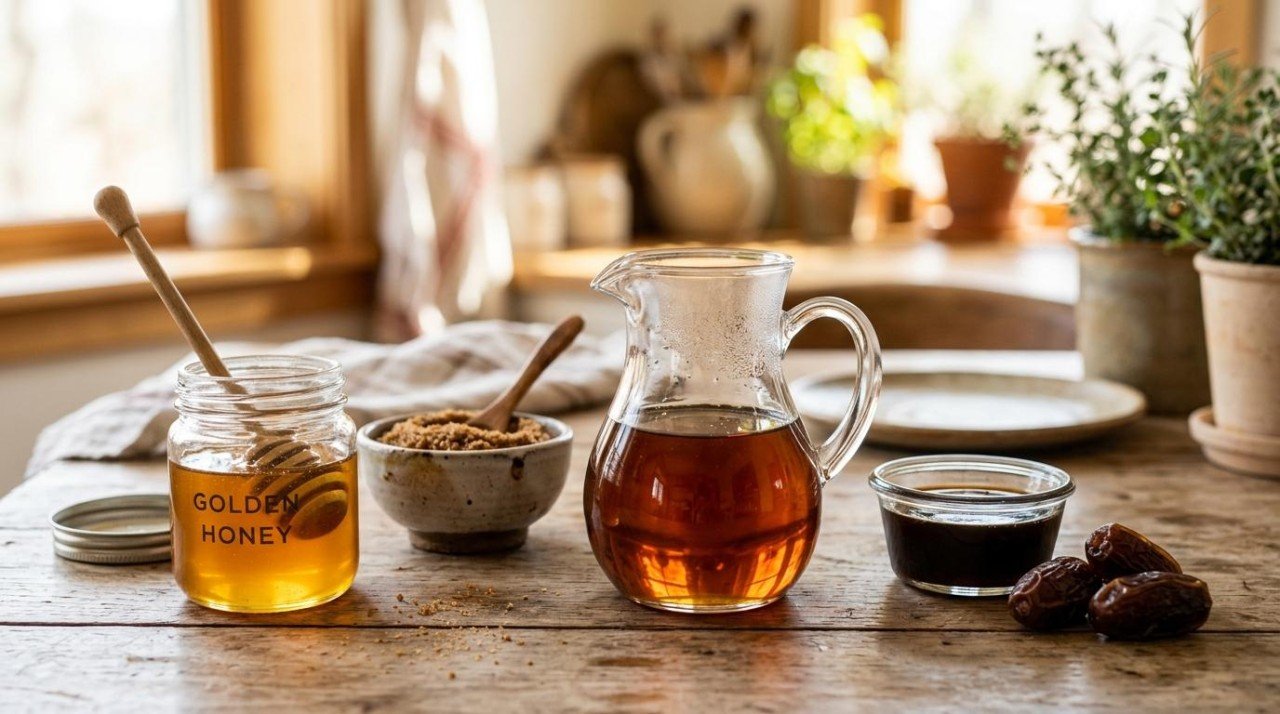
- Honey — the closest all-purpose swap for pouring and baking, 1:1
- Date syrup — the best healthier pick; whole-fruit caramel depth
- Brown sugar simple syrup — a 2-ingredient DIY pourable you can make in five minutes
- Granulated or brown sugar — best when maple is just the sweetener in a bake
- Molasses — for deep flavor in gingerbread and glazes; use it partially
- Agave nectar — mild and thin; dissolves even in cold drinks
- Corn or golden syrup — for candy, caramel, and shiny glazes that must not crystallize
- Brown rice syrup or coconut nectar — pantry pourables, great for vegan baking and granola
Honey
- Swap: 1:1 (or 3/4 cup honey per 1 cup maple syrup if you would rather it less sweet)
- Best for: Pancakes, drizzling, baking, marinades, salad dressings
- Skip it for: Strictly vegan recipes, and anything meant to taste distinctly of maple
- Tip: Honey browns faster, so lower the oven by about 25 degrees Fahrenheit when baking
Honey is the most available and most versatile stand-in, and it swaps in at a clean 1:1 for pouring, baking, and glazing alike. It is a touch sweeter than maple syrup, so if you want to stay closer to the original sweetness you can scale back to about 3/4 cup per cup. The flavor is floral rather than woodsy, but it lands in the same warm, comforting register.
The one thing to watch is browning: honey caramelizes faster than maple syrup, so in a bake it is worth dropping the oven temperature by around 25 degrees Fahrenheit and keeping an eye on the edges. And because it comes from bees, honey is off the table for vegan cooking — in which case skip down to date syrup or agave. If you find yourself reaching for honey often, our guide to honey substitutes covers the swaps that work when that jar runs dry too.
Date Syrup (the Healthier Pick)
- Swap: 1:1
- Best for: Baking, oatmeal, smoothies, drizzling, marinades
- Skip it for: Pale, delicate bakes where you do not want a deep brown color, and true maple flavor
- Health notes: Made from whole dates, so it keeps some fiber, potassium, and antioxidants that refined syrups lack
If your goal is to nudge a recipe toward whole foods, date syrup is the swap to reach for. It has a rich, caramel-fig depth that sits surprisingly close to maple, and because it is simply pureed and strained whole dates, it carries nutrition that refined sweeteners do not. Dates are a genuine source of potassium and antioxidants and bring real fiber — a 40-gram serving has around 3.2 grams of fiber and 262 milligrams of potassium — and some of that survives into the syrup.
Be honest with yourself about the limits, though: pureeing dates into a pourable syrup reduces the fiber, and it is still a concentrated sugar. It also runs dark and full-flavored, so it will tint a light cake and make itself known. Where that depth is welcome — spice cakes, oatmeal, barbecue-style glazes, energy bars — it is a lovely 1:1 swap, and a vegan one.
Brown Sugar Simple Syrup (the 2-Ingredient DIY)
- Swap: Simmer 1 cup packed brown sugar with 1/2 cup water until dissolved; makes about 1 cup of pourable syrup
- Best for: Pouring over pancakes and waffles right now, and drizzling
- Tip: A pinch of salt and a splash of vanilla push the flavor closer to maple
When you need something to pour and you have no liquid sweetener at all, you can build one in five minutes. Brown sugar is white sugar with molasses in it, and that molasses gives a homemade syrup a caramel note in the same neighborhood as maple. Combine roughly two parts brown sugar to one part water and simmer for a few minutes until it thickens into a glossy syrup — the higher sugar ratio is what keeps it pourable rather than watery.
It will not fool a maple purist, but a pinch of salt and a little vanilla go a long way, and it costs pennies. This is a pouring-and-drizzling fix rather than a baking one; for baking, you are usually better off just using the sugar dry (below). Our brown sugar guide covers what to do if that bag is hard as a rock, too.
Granulated or Brown Sugar (for Baking)
- Swap: Replace 1 cup maple syrup with 3/4 cup granulated or packed brown sugar plus 1/4 cup of the liquid already in the recipe (water, milk, or buttermilk)
- Best for: Cakes, cookies, and muffins where maple is just the sweetener, not the headline flavor
- Skip it for: Maple glazes, maple frostings, or anything where maple is the star
When a recipe uses maple syrup mostly to sweeten, plain sugar does the job — you just have to account for the liquid maple was providing. Maple syrup is roughly a third water, so swap in 3/4 cup of dry sugar and add back about 1/4 cup of whatever liquid the recipe already calls for. Brown sugar gets you closer in color and flavor thanks to its molasses; white sugar is cleaner and more neutral.
This works beautifully in an everyday muffin or quick bread and falls flat only where maple flavor is the whole point. If white sugar is what you have and you want to double-check how it behaves, our white sugar guide walks through it.
Molasses (Use It Partially)
- Swap: Replace up to half the maple syrup with molasses — for example, 1/2 cup molasses plus 1/2 cup honey or simple syrup per 1 cup maple. Use mild (not blackstrap) molasses unless you want it bold
- Best for: Gingerbread, baked beans, barbecue sauce, marinades, dark glazes
- Skip it for: Pouring straight onto pancakes and delicate, light-flavored bakes
- Health notes: Blackstrap molasses carries real minerals — about 20 percent of the Daily Value for iron per tablespoon, plus calcium and potassium
Molasses is intense, slightly bitter, and a little goes a long way, which is why it works best as a partial swap that borrows maple's dark, sticky depth rather than a full one-for-one. In anything already leaning toward warm spice or smoke — gingerbread, baked beans, a barbecue glaze — it is arguably the most flavor-authentic option on this list.
There is a genuine nutritional footnote here. Blackstrap molasses is a standout source of minerals, delivering roughly 20 percent of the Daily Value for iron along with meaningful calcium and potassium in a single tablespoon. That is a real bonus in the small amounts you would use, though not a reason to pour it on — it is still a sugar. If molasses is the ingredient you keep running short on, our molasses substitutes guide has you covered.
Agave Nectar
- Swap: 2/3 to 3/4 cup agave per 1 cup maple syrup (it is sweeter); reduce other liquid slightly, and lower the oven 25 degrees Fahrenheit for bakes
- Best for: Iced drinks, dressings, drizzling, and mild-flavored bakes
- Skip it for: Maple flavor — and do not mistake it for a health upgrade
Agave is thin, mild, and neutral, and its best trick is that it dissolves in cold liquids where honey and maple seize up — handy for iced tea, lemonade, and cold dressings. Because it is noticeably sweeter than maple syrup, scale back to about 2/3 to 3/4 cup per cup and trim a little of the other liquid.
Agave gets marketed as the low-glycemic sweetener, and that part is technically true, but it is worth understanding why. Agave has a low glycemic index precisely because it is very high in fructose — higher than table sugar and most other sweeteners — and a heavy fructose load is hard on the liver. It is a fine functional swap for its mild flavor and cold solubility, but treat it as added sugar, not a nutritional win.
Corn or Golden Syrup
- Swap: 1:1
- Best for: Candy, caramel, pecan-style pies, and shiny glazes that must not crystallize
- Skip it for: Any health goal, and recipes that want real maple flavor
In certain recipes, maple syrup is there partly as an invert sugar that keeps things smooth and glossy and stops crystals from forming — think pecan pie, caramels, and glazes. Light corn syrup fills that structural role at a straight 1:1, even if it brings no flavor of its own. Golden syrup (the British pantry staple) does the same job but tastes far better, with a warm butterscotch note that stands in nicely for maple's caramel side.
Brown Rice Syrup or Coconut Nectar
- Swap: Coconut nectar 1:1; brown rice syrup use a bit more, since it is less sweet and very thick
- Best for: Vegan drizzling and baking, granola, and sticky bars
- Skip it for: A precise flavor match to maple
These two natural-foods pourables are easy 1:1-ish swaps if you already keep them around. Coconut nectar has a mild caramel flavor and works one-for-one in most recipes. Brown rice syrup is less sweet, thicker, and mild, with a standout talent as a sticky binder — it is what holds many granola bars together — and because it is glucose-based with no fructose, it behaves differently in the body than agave. Neither is a health food, but both are genuinely useful vegan options.
The Healthier Swaps (and an Honest Caveat)
If the reason you are looking is that you want a more nutritious sweetener, two swaps here actually give something back: date syrup, which carries fiber, potassium, and antioxidants from whole fruit, and blackstrap molasses, which is a real source of iron and calcium. Both edge out refined syrups nutritionally.
But the honest truth is that every option on this list is still added sugar, and the biggest lever is not which sweetener you pick — it is using a little less of whatever you choose. Maple syrup itself is on the better end of the sweetener spectrum, with trace minerals and antioxidants that pancake syrup does not have, so if you have real maple, it is often the healthiest choice already.
Take the Guesswork Out of Eating Well
Eat Well Planner helps you organize your favorite recipes, plan balanced meals, and automatically generate shopping lists — all in one place. Whether you're tracking macros, managing dietary restrictions, or just trying to stop asking "what's for dinner?", we've got you covered.
Our AI-powered tools can adapt any recipe to your dietary needs, help you discover new meals you'll love, and even log your nutrition effortlessly. It's meal planning made simple.
Start Organizing Your Meals — FreeA Word on "Pancake Syrup"
If you literally just need something to pour over your pancakes, the bottle of table syrup in the door of the fridge does that job — it was designed for exactly that. What it is not is a substitute for pure maple in the pantry sense. Most "pancake" or "breakfast" syrups are built on corn syrup or high-fructose corn syrup with caramel color and maple flavoring added, and they carry none of the minerals, antioxidants, or complex flavor of the real thing.
The label is the giveaway. Pure maple syrup has exactly one ingredient: maple syrup. Anything reading "maple-flavored," or leading with corn syrup, is a different product wearing a similar costume. It is fine to use knowingly — just do not reach for it expecting maple's flavor or its nutrition in a recipe that leans on either.
The Bottom Line
For most recipes, honey is your fastest 1:1 rescue; for a whole-food-leaning swap, date syrup is the honest pick; and when maple is only there to sweeten a bake, 3/4 cup of sugar plus a splash of liquid does the trick. Match the substitute to the job — pouring, baking, or glazing — and you will rarely miss the original.
The tricky calls are always recipe-specific: will honey overpower this particular glaze, or is date syrup fine in these muffins? That is exactly what the Eat Well Planner AI recipe chat is built for — pull up the recipe you are cooking and ask, and it reads your actual ingredient list to tell you which swap fits and what to adjust. And when you want to genuinely lighten a recipe rather than just make do, its Make It Healthier feature suggests swaps and checks the real nutritional gain before recommending them — so the next time the maple bottle comes up empty, you have a tool that does the thinking with you.