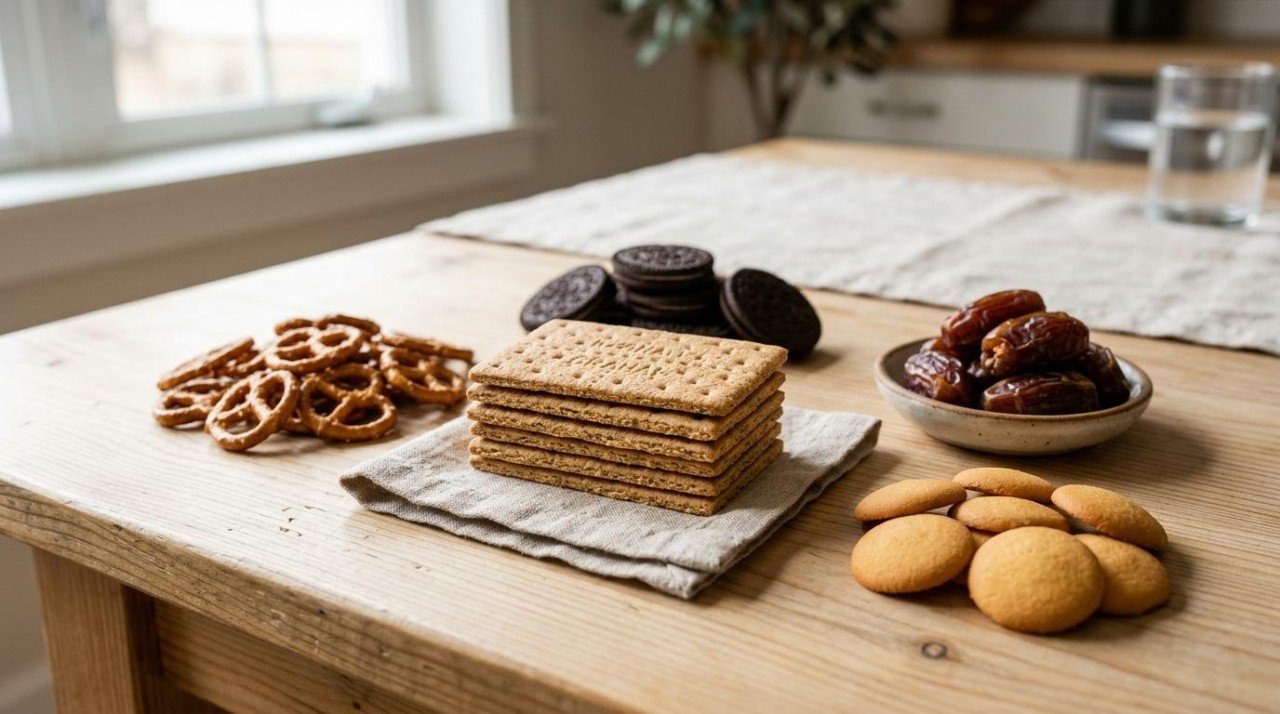
The cheesecake filling is mixed, or the campfire is going and the marshmallows are out, and the graham cracker box turns out to hold three broken pieces and a lot of crumbs. Good news: graham crackers are one of the easier ingredients to replace. Most of the time you only need something crisp, dry, and a little sweet, and most pantries have at least one option.
The catch is in pie and cheesecake crusts. Graham crackers are a fairly lean cookie, and crumb-crust recipes are balanced around that. Swap in a richer cookie at the same ratio and the crust can turn greasy and slide down the sides of the pan. The fix is easy (less butter, usually no added sugar), and every substitute below comes with its own adjusted ratio.
This guide is organized around how graham crackers usually get used: crumb crusts first, then healthier crust upgrades, then s'mores, then layered no-bake desserts. Gluten-free options are flagged throughout.
The Quick List
- Animal crackers — the one true drop-in for crusts; use the recipe exactly as written
- Digestive biscuits — the British graham cracker; great in crusts and s'mores
- Vanilla wafers — a sweeter, more buttery crust for icebox and cream pies
- Gingersnaps — a spiced crust for pumpkin pie and cheesecake, no sugar needed
- Chocolate sandwich cookies — filling and all, for a dark chocolate crust
- Biscoff (speculoos) cookies — caramelized, cinnamon-spiced, crust and s'mores
- Pretzels — a salty-sweet crust that's great with fruit and lime fillings
- Crushed cereal — corn flakes, Golden Grahams, or rice cereal for ice cream and pudding pies
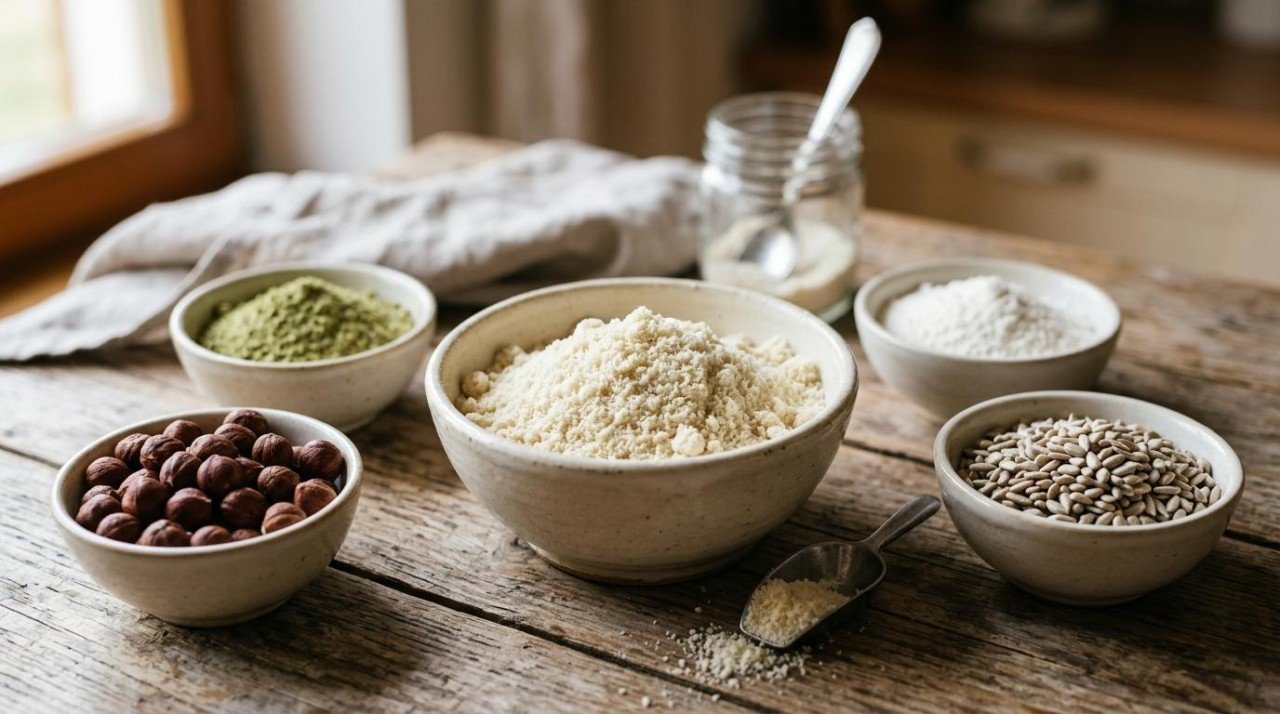
- Oat and nut crust — the healthier upgrade, with about four times the fiber
- Date and nut crust — no-bake, no added sugar, naturally gluten-free
- Almond flour crust — the gluten-free baked crust that holds up under cheesecake
- Apple slices or chocolate chip cookies — two very different ways to build a s'more
Before You Swap: How a Crumb Crust Works
A graham cracker crust is just three things: crumbs, melted butter to glue them together, and a little sugar, which melts and sets as the crust bakes or chills. Ratios vary more than you'd expect. Mark Bittman's version uses 1 1/2 cups graham crumbs (about 6 ounces), 3 tablespoons sugar, and 4 tablespoons melted butter, adding more butter only if the crumbs stay dry. Many box-style recipes go richer, up to 6 tablespoons of butter and 1/3 cup sugar. For volume conversions, King Arthur puts 1 cup of graham crumbs at 100 g, or 6 to 7 crackers.
Why do substitutes need adjusting? America's Test Kitchen tested this directly. Their testers found that crumb crusts slump when the mixture holds too much fat or sugar, and that cookies work best as graham stand-ins when fat plus sugar make up around 35 percent of their weight. Animal crackers (about 39 percent) made sturdy crusts. Gingersnaps, Lorna Doone shortbread, and Nilla Wafers, at 45 to 57 percent, slid down the sides of the pie plate when dropped into a standard graham recipe.
That leads to one rule you can apply to almost any cookie: the richer and sweeter the cookie, the less butter and sugar it needs. Bittman's note says the same: if the cookies are very buttery, cut the butter by 1 to 2 tablespoons, and if they're sweet, cut the sugar. For any crumb crust, the mixture is right when it looks like damp sand and holds together when you squeeze a handful. Press it in firmly with the flat bottom of a measuring cup.
Substitutes for Graham Cracker Crusts
1. Animal Crackers
- Swap: 1 1/2 cups graham crumbs → 1 1/2 cups finely ground animal cracker crumbs; keep the butter and sugar the same
- Best for: Any recipe written for a graham crust: cheesecake, key lime pie, icebox pies, bars
- Skip it for: S'mores (they're too small and break apart under a hot marshmallow)
This is the closest structural match you can buy, and it's the only cookie that passed America's Test Kitchen's test as a straight swap. Animal crackers are only lightly sweet, with a mild vanilla flavor, so the finished crust tastes a little plainer than graham, and the honey and molasses notes are gone. If you want some of that warmth back, add 1/4 teaspoon cinnamon and use brown sugar in place of white.
Grind them fine. Animal crackers are harder and denser than graham crackers, and coarse pieces leave gaps that let the crust crumble when you slice it.
2. Digestive Biscuits
- Swap: 1 1/2 cups graham crumbs → 1 1/2 cups digestive crumbs; start with 1 tablespoon less butter and cut the sugar to 1 tablespoon or none
- Best for: Cheesecake, lemon tarts, banoffee pie, and s'mores
- Skip it for: Recipes that rely on graham's honey flavor (it will taste more like a butter cookie)
In the UK, Ireland, and much of the Commonwealth, digestives are what goes into a cheesecake base, and they do the job of a graham cracker almost exactly. Both are made partly with whole wheat flour, and both have a toasty, wheaty, slightly salty flavor. Digestives are richer and a bit more crumbly, which is why you should pull back the butter and add it gradually until the crumbs hold.
Most US grocery stores sell them in the international or cookie aisle. Chocolate-coated digestives work in crusts too (the chocolate melts into the binder, so cut the butter by 2 tablespoons), and they're a s'more shortcut that comes with the chocolate already on.
3. Vanilla Wafers
- Swap: 2 cups (8 ounces) vanilla wafer crumbs + 6 tablespoons melted butter + 0 to 2 tablespoons sugar for a 9-inch crust
- Best for: Banana cream pie, lemon icebox pie, no-bake cheesecake, pudding pies
- Skip it for: A full-strength graham recipe with its sugar left in (it slumps)
Vanilla wafers make a sweeter, more buttery, cookie-like crust. They were among the cookies that slid down the pan in the America's Test Kitchen test, so use a recipe built for them rather than your graham recipe. Everyday Pie's version uses 2 cups (8 ounces) of wafer crumbs, about 27 wafers, with 6 tablespoons melted butter, 2 tablespoons sugar, and 1/4 teaspoon kosher salt, baked at 350°F for 10 minutes for a toastier flavor or simply frozen before filling. The wafers are already sweet, so you can skip the sugar if you like.
Wafer sizes vary by brand, and the recipe's own comments note that 27 wafers wasn't always enough. Measure the crumbs, not the cookies. This crust is at its best under cold, creamy fillings, where its sweetness balances a tart lemon or a mild custard.
4. Gingersnaps
- Swap: 8 1/2 ounces (230 g) crisp gingersnaps, finely ground + 7 tablespoons (98 g) melted butter, no sugar, for a 9-inch crust
- Best for: Pumpkin pie, pumpkin or eggnog cheesecake, lemon and lime pies, sweet potato pie
- Skip it for: Delicate vanilla or fruit fillings that the ginger would overpower
Gingersnaps bring heat, molasses, and spice, and they turn a plain cheesecake or pumpkin pie into something that tastes deliberate. Culinary Ginger's two-ingredient version uses 8.5 ounces (230 g) of crisp gingersnaps and 7 tablespoons (98 g) of melted butter with no added sugar, pre-baked at 350°F for 10 minutes for baked fillings or chilled for an hour for no-bake ones. The cookies supply all the sweetness the crust needs.
Use the hard, crisp kind, sold as gingersnaps or ginger nuts. Soft, chewy molasses cookies hold too much moisture and grind into paste. Several brands make gluten-free gingersnaps, which turns this into one of the easiest gluten-free crusts there is.
5. Chocolate Sandwich Cookies
- Swap: 24 chocolate sandwich cookies, filling included, finely ground + 5 tablespoons melted butter, no sugar, for a 9-inch crust
- Best for: Chocolate cream pie, peanut butter pie, mint or coffee ice cream pie, cheesecake
- Skip it for: Light fruit fillings, where the dark crust takes over
Grind the cookies whole. The creme filling melts in the oven and acts as part of the binder, which is why these crusts use less butter than a graham crust and no sugar at all. Once Upon a Chef's version is 24 Oreos and 5 tablespoons of melted butter, baked at 350°F for just 5 to 6 minutes. The crust darkens fast and the color hides browning, so watch the clock rather than the color.
Plain chocolate wafer cookies work the same way and give a cleaner, less sweet chocolate flavor; add 1 to 2 tablespoons of sugar if you use them. Gluten-free sandwich cookies (including a gluten-free version of Oreos) swap in at the same ratio.
6. Biscoff (Speculoos) Cookies
- Swap: One 8.8-ounce package (about 32 cookies), finely ground + 5 to 7 tablespoons melted butter, no sugar, for a 9-inch crust
- Best for: Cheesecake, pumpkin pie, apple or caramel fillings, coffee-flavored desserts, and s'mores
- Skip it for: Bright citrus fillings that clash with the caramel
Speculoos cookies taste like brown sugar and cinnamon, somewhere between a graham cracker and a gingersnap but without the ginger's bite. They're sweet enough that you can skip the added sugar entirely. Start with 5 tablespoons of butter and add more only until the crumbs hold when squeezed. Bake at 350°F for about 10 minutes, or chill for a no-bake crust.
Whole Biscoff cookies also make a great s'more: they're the same rectangular shape as a graham cracker, and their caramel flavor works with both milk and dark chocolate.
7. Pretzels
- Swap: 1 1/2 cups finely crushed pretzels + 1/4 cup sugar + 8 tablespoons melted unsalted butter
- Best for: Key lime, strawberry, and margarita pies, chocolate or peanut butter pies, no-bake cheesecake
- Skip it for: Anyone who doesn't like a salty edge in dessert
Pretzels behave the opposite way from rich cookies: they have almost no fat or sugar, so they need more butter and sugar than graham crumbs, not less. The Baking ChocolaTess's version is 1 1/2 cups crushed pretzels, 1/4 cup granulated or brown sugar, and 8 tablespoons melted butter, pressed into a 9-inch pie plate and baked at 350°F for 8 to 10 minutes until golden. A 10-minute chill instead of baking works for no-bake fillings.
Grind the pretzels fine. A pretzel crust that falls apart almost always started with crumbs that were too coarse or with too little butter. Use unsalted butter, since the pretzels already bring the salt. Gluten-free pretzels work at the same ratio.
8. Crushed Cereal (Corn Flakes, Golden Grahams, Rice Cereal)
- Swap: 4 cups corn flakes (crushed to about 1 cup crumbs) + 2 tablespoons sugar + 2 tablespoons softened butter + 2 tablespoons light corn syrup
- Best for: Ice cream pies, pudding pies, no-bake cheesecake
- Skip it for: Long-baked fillings, where the thin crust can scorch
Cereal is lean and crisp like a graham cracker, but its flakes need a sticky binder. Kellogg's own corn flake crust uses 4 cups of corn flakes (or 1 cup crumbs), 2 tablespoons sugar, 2 tablespoons softened butter, and 2 tablespoons light corn syrup, pressed into a 9-inch pan and baked at 350°F for about 5 minutes. The result is thinner and crunchier than a graham crust, which is ideal under ice cream, since it doesn't go soggy as quickly.
Golden Grahams are worth knowing about. They're made mostly from whole grain wheat and brown sugar and taste closer to a graham cracker than anything else in the cereal aisle. Crush them and use the corn flake ratio above. Rice and corn cereals labeled gluten-free make a gluten-free version, but check the label, since many corn flakes contain malt flavoring made from barley.
9. Shortbread and Butter Cookies
- Swap: 1 1/2 cups shortbread crumbs + 2 to 3 tablespoons melted butter, no sugar; add butter a teaspoon at a time only if it won't hold
- Best for: Lemon bars, fruit tarts, no-bake cheesecake
- Skip it for: Tall baked cheesecakes, where extra fat makes the sides slump
Shortbread is mostly butter already, which makes it the cookie most likely to go greasy. Lorna Doones were one of the cookies that slumped in the America's Test Kitchen test. Treat the added butter as optional: grind the cookies, squeeze a handful, and add melted butter in small amounts only until the crumbs stick. The crust that results is tender and rich, closer to a shortbread tart base than a graham crust, and lovely under lemon.
Healthier Crust Upgrades
A graham cracker crust is a small amount of a fairly ordinary cookie, and nobody needs to feel bad about eating one. If you want the crust to contribute something, though, it's one of the easiest parts of a dessert to upgrade. Graham crackers are mostly refined starch and sugar. USDA data puts them at 430 calories, 6.7 g protein, and 3.4 g fiber per 100 g. Rolled oats carry 10.1 g fiber and 13.2 g protein per 100 g, with no added sugar, and nuts and seeds add healthy fats on top of that.
10. Oat and Nut Crust
- Swap: 1 1/2 cups graham crumbs → 1 cup (90 g) old-fashioned rolled oats + 3/4 cup (70 g) pecans + 3 tablespoons ground flaxseed + 2 1/2 tablespoons melted butter + a pinch of salt
- Best for: Cheesecake, pumpkin pie, fruit bars, any baked filling
- Skip it for: Desserts where you want a sweet, cookie-like crust (this one tastes toasty and nutty rather than sugary)
- Health notes: About four times the fiber of a graham crust, plus omega-3 ALA from the flax, with no added sugar unless you add some
This is the crust from our healthier New York cheesecake, where swapping it in for graham and butter was worth 6 points on the Nutrition Score, raised fiber, cut added sugar without touching the filling, and lowered sodium. Pulse everything except the butter in a food processor to coarse crumbs, add the butter, pulse again, press into the pan, and bake for about 12 minutes before adding the filling. The oats crisp up and the pecans toast, and under a sweet filling nobody misses the sugar. If you want it sweeter on its own, add 1 to 2 tablespoons of maple syrup or brown sugar.
Walnuts or almonds work in place of the pecans. Use oats labeled gluten-free and the crust is gluten-free too. For more ways to use oats, see our rolled oats guide.
11. Date and Nut Crust (No-Bake)
- Swap: 1 cup pitted Medjool dates + 1 cup walnuts or pecans + 1/2 cup unsweetened shredded coconut + 1 teaspoon vanilla + 1/2 teaspoon cinnamon
- Best for: No-bake cheesecakes, cream pies, chilled tarts, energy bars
- Skip it for: Baked pies (dates scorch in a long bake)
- Health notes: No added sugar, gluten-free and vegan, and dates bring about 6.7 g of fiber per 100 g
Blend the dates and nuts in a food processor until the mixture clumps into a ball, then press it into the pan and chill. Eat Plant-Based's version uses 1 cup Medjool dates, 1 cup walnuts or pecans, 1/2 cup unsweetened shredded coconut, vanilla, and cinnamon, and notes that cashews or almonds work too. The author's FAQ says it can be baked briefly (about 8 minutes at 350°F) for a firmer texture, but one reader's crust burned under a baked pumpkin pie, so keep this one for chilled fillings.
The texture is chewy and fudgy rather than crumbly, more like a raw energy bar than a cookie crust. That's a feature under a cold, tangy filling. If your dates are dry, soak them in hot water for 10 minutes and drain well, or the mixture won't hold together.
12. Almond Flour Crust
- Swap: 1 1/2 cups graham crumbs → 1 cup (120 g) almond flour + 3 tablespoons ground flaxseed + 2 1/2 tablespoons melted butter + a pinch of salt
- Best for: Gluten-free cheesecake, tarts, and bars
- Skip it for: Nut-free kitchens
Almond flour bakes into a tender, shortbread-like crust that holds up well under a heavy baked filling. In the cheesecake makeover, this version actually scored 2 points higher than the oat crust. We kept the oats for cost and texture, but it's the best choice when the crust needs to be gluten-free and baked. Bake for 10 to 12 minutes and watch the edges, since almond flour browns faster than graham crumbs. If you're out of almond flour too, our almond flour guide covers sunflower and pumpkin seed flours for nut-free crusts.
Not sure which crust suits the recipe you're actually making, or what each swap does to its nutrition? That's exactly what Eat Well Planner is built for. Save the recipe, ask the AI Recipe Chat "I don't have graham crackers, what should I use for this crust?", and it answers with your filling, pan size, and dietary needs in mind. Then open the recipe in the Recipe Playground to see how the Nutrition Score moves when you swap graham crumbs for oats and nuts, before you bake anything.
Take the Guesswork Out of Eating Well
Eat Well Planner helps you organize your favorite recipes, plan balanced meals, and automatically generate shopping lists — all in one place. Whether you're tracking macros, managing dietary restrictions, or just trying to stop asking "what's for dinner?", we've got you covered.
Our AI-powered tools can adapt any recipe to your dietary needs, help you discover new meals you'll love, and even log your nutrition effortlessly. It's meal planning made simple.
Start Organizing Your Meals — FreeSubstitutes for Graham Crackers in S'mores
A s'more needs two things from its cracker: a flat, sturdy surface that won't shatter when you squeeze it, and a flavor that holds up to toasted marshmallow and chocolate. A lot of things meet both requirements.
Digestive Biscuits or Chocolate Digestives
- Swap: 1 graham square → 1 digestive biscuit
- Why it works: Round, sturdy, wheaty, and lightly sweet, the closest flavor match on this list
Chocolate-coated digestives go one better: put the hot marshmallow straight onto the chocolate side and it melts on contact. They're a little more crumbly than graham crackers, so press gently.
Cookies: Chocolate Chip, Biscoff, Shortbread, or Maria
- Swap: 1 graham square → 1 flat, crisp cookie
- Why it works: Crisp cookies hold their shape under heat; soft ones fold
Thin, crunchy chocolate chip cookies make a richer, sweeter s'more (you can even skip the chocolate bar). Biscoff adds caramel and cinnamon, shortbread adds butter, and Maria cookies, sold in the Hispanic foods aisle, are the plainest and closest to a graham cracker in sweetness. Avoid soft-baked cookies, which turn to mush the moment a hot marshmallow lands on them.
Buttery Crackers
- Swap: 1 graham square → 2 buttery round crackers (such as Ritz)
- Why it works: The salt makes a sweet-salty s'more, like a chocolate-covered pretzel
This sounds odd and tastes excellent, especially with dark chocolate. The crackers are small, so use bite-size pieces of marshmallow and chocolate to keep everything inside.
Apple Slices or Strawberries (the Fresh Option)
- Swap: 2 graham squares → 2 thick, crisp apple rounds (cored, about 1/4 inch thick), or skewer a strawberry next to the marshmallow
- Health notes: Trades refined flour and added sugar for fruit, fiber, and water, and it's naturally gluten-free
Crisp, tart apples like Granny Smith or Honeycrisp stand up to a hot marshmallow and cut its sweetness. It's a different snack, more like a caramel apple than a s'more, but kids tend to love building them. A squeeze of lemon on the slices keeps them from browning if you cut them ahead.
Gluten-Free Graham-Style Crackers
Several brands make gluten-free graham-style crackers and s'mores crackers, usually from rice, tapioca, or oat flour. They're the most faithful gluten-free s'more and work in crusts at a 1:1 ratio, though some are crisper and more crumbly than wheat graham crackers, so grind them fine and press firmly. Look for a certified gluten-free label if you're cooking for someone with celiac disease.
Substitutes for Graham Crackers in Layered and No-Bake Desserts
In icebox cakes, banana pudding, and layered "lasagna" desserts, graham crackers aren't crumbs. They're whole sheets that soften overnight into something cake-like. Any crisp, flat cookie that absorbs moisture works, swapped by weight:
- Vanilla wafers — the original banana pudding cookie; sweeter and softer once chilled
- Maria cookies — the classic for Mexican icebox cakes like carlota de limón; mild and thin
- Chocolate wafers — the traditional icebox cake cookie, layered with whipped cream
- Digestive biscuits or Biscoff — sturdier, so give them the full overnight chill to soften
One note from our healthier banana pudding makeover: going the other way (using graham crackers instead of vanilla wafers) was the single biggest nutrition improvement in the recipe, worth 9 points on its own, because graham crackers carry about twice the fiber of vanilla wafers with less sugar and fat. If you're substituting for graham crackers in a layered dessert, Maria cookies or digestives keep you closer to that profile than vanilla wafers do.
For crumb toppings (on yogurt parfaits, ice cream, or a no-bake bar), any of the crust options above work, and so do toasted oats or a spoonful of granola, which add crunch and fiber.
Gluten-Free Graham Cracker Substitutes at a Glance
- Gluten-free graham-style crackers — 1:1 in crusts and s'mores
- Gluten-free gingersnaps or sandwich cookies — use the gingersnap or chocolate cookie ratios above
- Gluten-free pretzels — same ratio as regular pretzels
- Certified gluten-free oats + nuts — the oat and nut crust
- Dates + nuts — naturally gluten-free, no-bake
- Almond flour — the baked gluten-free crust
- Rice or corn cereal labeled gluten-free — the cereal crust ratio
- Apple slices — for s'mores
What Not to Use
- Rich cookies at the full graham ratio. Vanilla wafers, shortbread, and gingersnaps in a standard graham recipe, butter and sugar included, give you a crust that slides down the sides of the pan. Cut the butter and skip the sugar.
- Soft or chewy cookies. Soft-baked chocolate chip cookies, chewy molasses cookies, and cakey cookies grind into a damp paste, not crumbs, and bake into a dense, gummy layer.
- Flour. A pressed-in flour and butter crust is a shortbread base with its own ratio, not a crumb crust. Raw flour in place of crumbs will taste raw and bake up hard.
- Coarse crumbs of anything. Whatever you use, grind it to the texture of sand. Big pieces are the most common reason a substitute crust crumbles when sliced.
- Plain saltines for s'mores. They're too thin and shatter under a hot marshmallow. Use buttery crackers instead.
The Bottom Line
For a crust, animal crackers are the only straight drop-in; almost any other crisp cookie works as long as you cut the butter and sugar to match its richness. Pretzels and cereal go the other way and need more binder. For s'mores, reach for digestives, a crisp cookie, or apple slices. And if you'd like the crust to give you something back, an oat and nut crust adds fiber and flavor at the same time.
If you're halfway through a particular recipe and want an answer for that dessert, paste it into Eat Well Planner and ask the AI Recipe Chat. It knows your filling and your pantry, and if you want the whole dessert rewritten gluten-free, Recipe Variations will do the swaps for you, crust and all.