The tomatoes are sliced, the mozzarella is draining, and the basil plant on the windowsill is down to three sad leaves. Or the pesto is half made and the bunch you bought two days ago has gone black and slippery in the crisper drawer, the way basil always seems to.
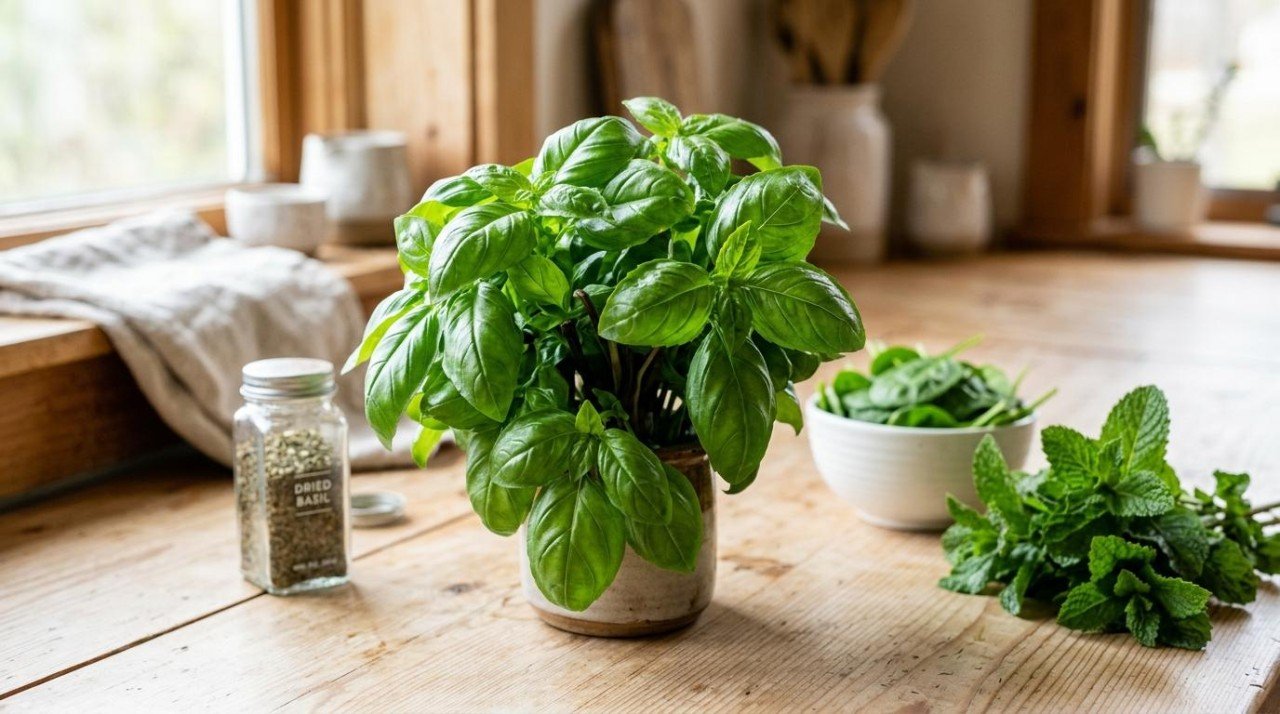
Basil is harder to replace than most herbs, because it has no obvious understudy the way rosemary has thyme. It is sweet and faintly peppery, with a clove-like warmth and a cooling perfume that comes from its being a member of the mint family. Penn State Extension attributes that profile to methyl chavicol (estragole) and linalool in the leaf oil, which impart a sweet taste and floral scent — the anise-adjacent sweetness and the perfume you get when you tear a leaf.
The good news: nothing has to cover all of that at once, because basil does three quite different jobs and your recipe only needs one of them. On a caprese it is perfume and freshness. In pesto it is bulk, color and flavor together. In a simmered tomato sauce it is a quiet background note that plenty of things can fill. Here is what actually works for each, with ratios.
The Quick List
- Fresh mint plus flat-leaf parsley, half and half — the best all-purpose fresh swap, and the closest thing to a real answer
- Flat-leaf parsley — for green freshness and color when basil is a garnish; also the classic pesto stand-in
- Fresh marjoram — oregano's gentle cousin; the one fresh herb that reads sweet rather than sharp
- Fresh mint alone — caprese, watermelon salads, and anything already leaning summery; use half
- Baby spinach — pesto volume with almost no flavor of its own; needs help on flavor
- Arugula — the most convincing basil-free pesto; peppery instead of sweet
- Basil paste in a tube or frozen basil — real basil, already broken down; excellent in sauces, poor raw
- Dried basil — cooked dishes only, at one third the amount, added early
- Fresh oregano — for pizza, marinara and anything Italian and hot; use half, it is much louder
- Italian seasoning — already contains basil; the fastest fix for a pot of sauce
- Fresh thyme with a pinch of fennel seed — a homemade approximation for cooked dishes
- Thai basil — genuinely basil, with a licorice tilt; sturdier in heat than the Italian kind
First: Two Numbers Worth Knowing
Basil gets measured in leaves, in cups, and in bunches, none of which agree with each other. Every ratio below uses 1/4 cup chopped fresh basil (roughly 10 to 12 large leaves, about 10 grams) as the base for garnish and cooked dishes, and 2 cups loosely packed basil leaves — one supermarket bunch or clamshell — as the base for a batch of pesto.
The second number is the fresh-to-dried conversion. Penn State Extension puts it simply: 1 tablespoon fresh herbs = 1 teaspoon dried herbs = 1/4 teaspoon powdered herb, because drying concentrates herbs three to four times over. So 1/4 cup chopped fresh basil lands at roughly 1 tablespoon of dried.
The one rule that matters most: dried basil and fresh basil are not the same ingredient. Drying strips out the volatile top notes that make fresh basil smell like basil, leaving something flatter and more oregano-like. That version is perfectly good stirred into a sauce that will simmer for half an hour, and a disaster scattered over a caprese, where it just tastes like dusty green flecks.
For Raw Uses: Caprese, Garnish, Salads, and Sandwiches
This is the hardest category, because raw basil is doing something aromatic and immediate that no dried herb can fake. You need another fresh, soft-leaved herb — and you almost always need less of it than you think.
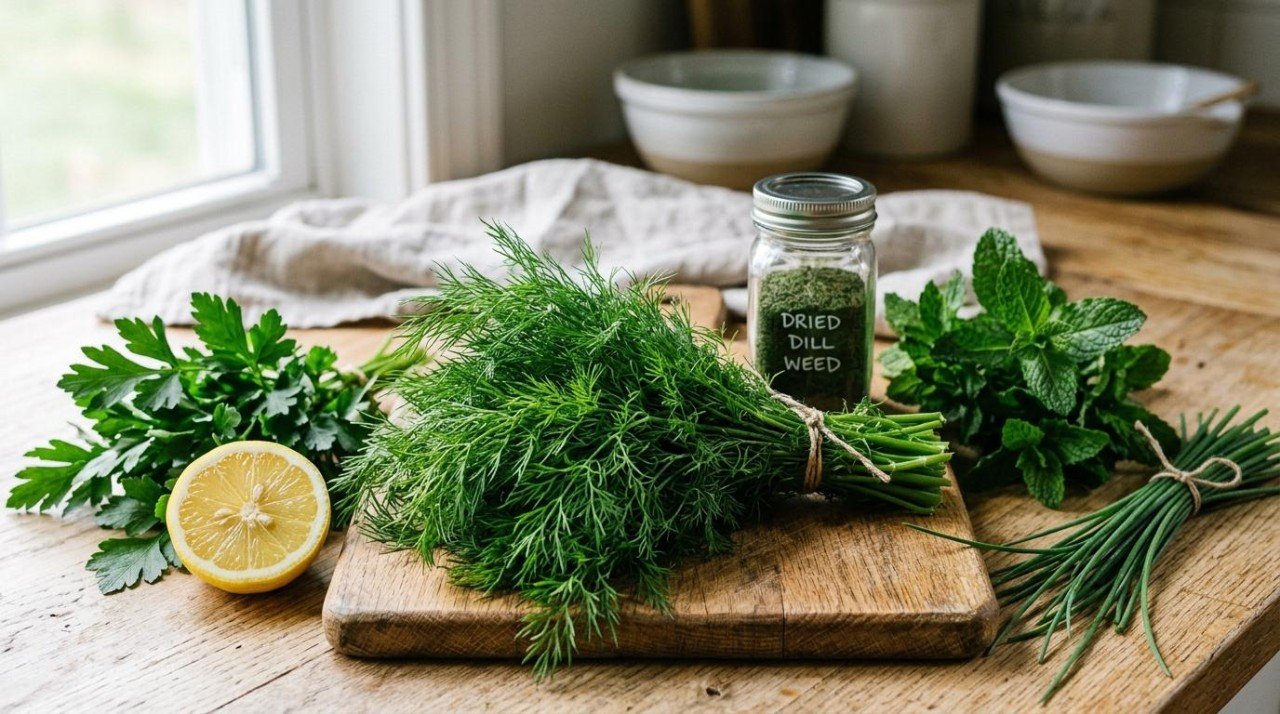
Fresh Mint and Flat-Leaf Parsley, Half and Half
- Swap: 1/4 cup chopped fresh basil → 2 tablespoons chopped flat-leaf parsley + 2 tablespoons chopped fresh mint
- Best for: Caprese, tomato salads, bruschetta, summer rolls, grain salads, finishing pasta, sandwiches
- Skip it for: Long-simmered sauces, where mint turns strangely medicinal
This is the closest thing to a genuine fresh-basil substitute, and it works because it splits the difference. Basil is in the mint family, so mint supplies the cooling, slightly sweet top note that parsley cannot. Parsley supplies the clean green bulk and the grassy background that mint on its own would steamroll. Together they land surprisingly near basil, and on a plate of tomatoes and mozzarella most people will not stop to work out what is different.
Tear or chop both at the last minute. Mint bruises and blackens even faster than basil does, so anything you cut ten minutes early will look tired by the time it reaches the table.
Flat-Leaf Parsley
- Swap: 1/4 cup chopped fresh basil → 1/4 cup chopped flat-leaf parsley (1:1)
- Best for: Garnish, color, pasta, pizza after baking, soups, anywhere basil was mostly decorative
- Skip it for: Dishes where basil is the point — a caprese made with parsley is just a tomato salad
Parsley is the safe 1:1 swap and the one you almost certainly have. It cannot do basil's perfume, but it can do everything else basil was providing: fresh green flavor, a bit of pepperiness, and the visual signal that something bright just got added. It is also the only herb here you can be heavy-handed with and not regret it. If you want more detail on parsley itself, we have a full guide to parsley substitutes too.
Use flat-leaf (Italian) parsley rather than curly if you have the choice — curly parsley is tougher and more assertively bitter, which reads as garnish rather than ingredient. Parsley is also the standard pesto fallback: swap it in at 1:1 by volume, but add the zest of half a lemon and an extra clove of garlic, because parsley alone is flatter than basil and the sauce needs the lift.
Fresh Marjoram
- Swap: 1/4 cup chopped fresh basil → 3 tablespoons chopped fresh marjoram
- Best for: Tomatoes, zucchini, white beans, eggs, roasted vegetables, pizza, mozzarella dishes
- Skip it for: Pesto — it is too resinous in the quantities pesto demands
Marjoram is the herb most people overlook here, and it deserves better. It is oregano's softer, sweeter cousin, and that sweetness is exactly the quality basil brings that thyme and rosemary cannot. It does not taste like basil, but it occupies the same slot in a Mediterranean dish: warm, faintly floral, at home with tomatoes.
The catch is that marjoram is more fragile than oregano and loses its edge with long cooking, so add it in the last few minutes or off the heat. If your store only sells one of the two, buy marjoram for raw and lightly cooked dishes and oregano for anything that simmers.
Fresh Mint Alone
- Swap: 1/4 cup chopped fresh basil → 2 tablespoons chopped fresh mint (half, then taste before adding more)
- Best for: Caprese, watermelon and feta salads, peas, cucumber, Vietnamese and Thai dishes, iced drinks
- Skip it for: Marinara, meatballs, pizza sauce, anything long-cooked and tomato-heavy
Mint alone works better than people expect, because the family resemblance is real — but it is roughly twice as loud as basil, and it pulls a dish toward the Middle East and Southeast Asia rather than Italy. That is often a pleasant place to end up. Mint with tomatoes, mint with peas, and mint with melon and salty cheese are all excellent combinations in their own right.
Where mint fails is heat plus tomato. Simmer it into a marinara and the cooling menthol note curdles into something that tastes faintly like toothpaste. Keep it raw or barely warmed.
For Pesto
Pesto is a volume problem as much as a flavor problem. Two cups of leaves is a lot of anything, and the recipe needs enough green mass to blend into a paste. That is why the pesto answers differ from the garnish answers: you are looking for something that can fill the bowl without going bitter or watery.
Baby Spinach
- Swap: 2 cups packed basil → 2 cups packed baby spinach, plus 1 teaspoon dried basil, the zest of half a lemon, and an extra clove of garlic
- Best for: Stretching a small amount of real basil, feeding a crowd, pesto for kids, freezing in batches
- Skip it for: Pesto served on its own with bread, where there is nothing else to carry the flavor
- Health notes: Raw spinach carries about 483 micrograms of vitamin K per 100 grams, so two cups puts a batch of pesto well past a day's worth
Spinach is the volume filler, not the flavor. On its own it makes a pesto that is beautifully green, silky, and slightly boring, so it needs the additions listed above: dried basil for the herb note, lemon zest for lift, extra garlic for backbone. Do not skip them and expect it to work.
Where spinach genuinely shines is as a stretcher. If you have half a bunch of basil rather than a whole one, blending it half and half with baby spinach gives you a full batch of pesto that still tastes like basil, because the flavor is concentrated in what you do have and the spinach quietly makes up the difference. This is the single most useful trick on this page.
Arugula
- Swap: 2 cups packed basil → 2 cups packed arugula (or 1 cup arugula + 1 cup baby spinach if you want it milder)
- Best for: Pesto for pasta, sandwiches, roasted vegetables, grain bowls, spooning over steak or white beans
- Skip it for: Anyone who dislikes bitterness, and for delicate dishes where basil's sweetness was the point
Arugula makes the most convincing non-basil pesto, full stop. It has enough character to stand up to garlic, Parmesan and olive oil without disappearing, and its pepperiness plays the same structural role basil's sweetness does — it gives the sauce a shape. It is a different pesto rather than a fake basil pesto, and it is better to serve it as that.
Two practical notes. Older arugula gets noticeably more bitter, so taste as you go and hold back half the leaves until you have blended the rest. And because bitterness is amplified by heat, toss arugula pesto through hot pasta off the burner rather than cooking it. A 50/50 blend with spinach is the standard fix if the first taste is too aggressive.
Basil Paste in a Tube, or Frozen Basil
- Swap: 1/4 cup chopped fresh basil → 1 tablespoon basil paste, or 2 frozen basil cubes; for pesto, about 1/4 cup paste replaces 2 cups of leaves
- Best for: Sauces, soups, dressings, marinades, pesto in a hurry
- Skip it for: Garnish and caprese — the texture is wrong and the color is dull
This is real basil that has already been broken down with oil and salt, which makes it far better than dried basil for anything where the herb needs to taste like itself. It blends seamlessly into a sauce or a vinaigrette and it keeps for weeks in the fridge once opened.
Check the label before you commit, though: many tubes carry a meaningful amount of added salt, and some include sugar or acidity regulators. Reduce the salt elsewhere in the dish accordingly. The freezer version — basil blitzed with olive oil and frozen in an ice cube tray — has none of those issues and is worth making the next time you have basil about to turn.
For Cooked Dishes: Marinara, Pizza, Soups, and Braises
This is the forgiving category. Once basil has spent twenty minutes in a simmering pot, most of what made it special has already cooked off — which is why Penn State Extension advises adding fresh basil toward the end of cooking to maintain its fresh taste. If the recipe puts basil in early, you can substitute freely.
Dried Basil
- Swap: 1/4 cup chopped fresh basil → 1 tablespoon dried basil, added early in the cooking
- Best for: Marinara, pizza sauce, meatballs, soups, chili, braises, spice rubs — anything with heat and time
- Skip it for: Every raw use — caprese, garnish, fresh salads, finishing pasta
Basil dries worse than rosemary, thyme or oregano. Those herbs keep most of their character; basil loses the bright, perfumed part and holds onto a flatter, hay-like flavor. But that flatter flavor is genuinely useful in a pot of tomato sauce, where it infuses into the liquid and reads correctly as Italian seasoning.
Add it early rather than late. Dried basil needs liquid and time to rehydrate, and sprinkled on at the end it stays gritty and tastes of very little. If a recipe calls for basil both early and as a finishing garnish, use dried for the first addition and something fresh from the raw section above for the second.
Fresh Oregano
- Swap: 1/4 cup chopped fresh basil → 2 tablespoons chopped fresh oregano (or 2 teaspoons dried)
- Best for: Pizza, marinara, roasted tomatoes, chicken, lamb, Greek and southern Italian dishes, tomato-based braises
- Skip it for: Pesto, caprese, and any dish where basil's sweetness carried the whole thing
Oregano is the reflex answer, and it is a decent one for hot Italian dishes — it is the herb your brain already associates with pizza. The thing to understand is that oregano and basil are not interchangeable in strength or direction. Oregano is pungent, slightly bitter and savory where basil is sweet and floral, and it is roughly twice as assertive. Use half the volume and taste.
Use fresh oregano for anything cooked for less than fifteen minutes, and dried for long simmers where it has time to soften. Oregano is one of the few herbs that many cooks consider as good dried as fresh, so the jar in your cupboard is a legitimate option rather than a consolation prize.
Italian Seasoning
- Swap: 1/4 cup chopped fresh basil → 2 teaspoons Italian seasoning, added early
- Best for: Marinara, pizza sauce, meatballs, garlic bread, roasted vegetables, red sauce of any kind
- Skip it for: Anything raw, and any non-Italian dish — it drags Thai and Vietnamese food somewhere strange
Italian seasoning already contains dried basil alongside oregano, thyme, marjoram and often rosemary, so you are not really substituting at all — you are adding basil plus a few friends. For a pot of tomato sauce that is usually an improvement rather than a compromise.
Use less than a straight dried-basil conversion would suggest, since only a fraction of the blend is basil and the rest is doing its own work. Two teaspoons in a pot of sauce is a sensible starting point. Check the label for salt: some supermarket blends are heavily salted, and a few include garlic and onion powder, which changes how much fresh garlic you want.
Fresh Thyme with a Pinch of Fennel Seed
- Swap: 1/4 cup chopped fresh basil → 1 tablespoon fresh thyme leaves + 1/4 teaspoon fennel seed, lightly crushed
- Best for: Tomato sauces, ratatouille, sausage and pepper dishes, white bean stews, roasted vegetables
- Skip it for: Raw uses, and anywhere an anise note would be unwelcome
This is the do-it-yourself option, and it works on a specific logic: thyme covers basil's savory, herbal base, and the fennel seed supplies the faint licorice sweetness that estragole gives real basil. Crush the fennel briefly between your fingers or in a mortar to wake it up, and add both early enough to infuse.
Keep the fennel restrained. A quarter teaspoon reads as an unplaceable sweetness in the background, which is what you want. A whole teaspoon turns the sauce into sausage seasoning.
For Thai, Vietnamese, and Southeast Asian Dishes
Thai Basil
- Swap: 1/4 cup chopped Italian basil → 3 tablespoons Thai basil (it is stronger). Going the other way: 1/4 cup Thai basil → 1/4 cup Italian basil plus a small pinch of crushed fennel seed or star anise
- Best for: Stir-fries, curries, pho, spring rolls, drunken noodles — and as an Italian-basil stand-in in dishes that already carry strong flavors
- Skip it for: Caprese and classic Genovese pesto, where the licorice note reads as wrong rather than interesting
The two are the same species but not the same ingredient. America's Test Kitchen describes Thai basil as having slightly savory, spicy, anise-like notes against Italian basil's peppery-sweet taste, and notes that Thai basil's sturdier leaves stand up to cooking while delicate Italian basil works best as a finishing touch. That durability is the practical difference: you can stir Thai basil into a hot wok and it survives.
Going the other direction, the same source says Italian basil substitutes acceptably for Thai basil in dishes with many other strong flavors, but that Thai basil is preferred where its flavor and texture are the point. If you are making pho or fresh spring rolls where the basil is a table herb, fresh mint — or mint with a little cilantro — is a better answer than Italian basil, because the cooling quality matters more there than the sweetness.
The Healthier Angle: Pesto Is a Good Place to Add a Second Green
Basil is genuinely nutrient-dense per gram — fresh basil carries roughly 415 micrograms of vitamin K per 100 grams, several times the 120 microgram Daily Value. The honest caveat is that you almost never eat 100 grams of basil. A generous 1/4 cup of chopped leaves is about 10 grams, which works out to around 40 micrograms, or roughly a third of a day's vitamin K. Real, but not a headline.
Pesto is the exception, because it is the one dish where you eat basil by the bowlful — which makes it the best place to build in a second green. Blending baby spinach or arugula in alongside your basil does three useful things at once: it stretches an expensive ingredient, it keeps the vitamin K and folate high, and it adds another distinct plant to your week. If you are working toward the thirty-different-plants-a-week idea from gut microbiome research, a two-green pesto quietly counts twice rather than once.
Be straight about what does not change, though: pesto is still mostly olive oil and cheese, and swapping the greens does not turn it into a light sauce. What it does is add fiber and micronutrients to something you were going to eat anyway, which is usually the more useful kind of upgrade.
Take the Guesswork Out of Eating Well
Eat Well Planner helps you organize your favorite recipes, plan balanced meals, and automatically generate shopping lists — all in one place. Whether you're tracking macros, managing dietary restrictions, or just trying to stop asking "what's for dinner?", we've got you covered.
Our AI-powered tools can adapt any recipe to your dietary needs, help you discover new meals you'll love, and even log your nutrition effortlessly. It's meal planning made simple.
Start Organizing Your Meals — FreeWhat Not to Use
- Dried basil in anything raw. The most common mistake by far, and no amount of it fixes the problem.
- Holy basil (tulsi) in Italian food. Despite the name, holy basil is a different species with a peppery, clove-heavy, almost medicinal flavor. It is wonderful in Thai holy basil stir-fries and wrong in marinara.
- Dried mint in place of fresh mint. Mint dries badly in the same way basil does. If the mint swap appeals to you, it has to be fresh.
- Basil-flavored seasoning salts and pesto seasoning blends. These are mostly salt, and using enough to taste the basil will wreck the seasoning of the dish.
- Cilantro in Italian dishes. It is a fine fresh herb and a fine Thai-basil stand-in, but the citrusy, soapy note it brings has nothing to do with what basil was doing in a red sauce.
One Last Thing: Keep the Basil You Have Alive Longer
Most basil emergencies are storage failures rather than shopping failures. Basil is a tropical plant and the refrigerator is actively hostile to it — below roughly 50 degrees Fahrenheit the leaves blacken within a day or two. Treat a bunch like cut flowers instead: trim the stems, stand them in an inch of water on the counter out of direct sun, and loosely tent a bag over the top. It will hold for about a week that way, versus a couple of days in the crisper drawer. And when it does start to turn, blend the leaves with olive oil and freeze the puree in an ice cube tray rather than throwing it out — no good on a caprese, excellent in every sauce you make for the next few months.
Still Not Sure Which One Fits Your Dish?
A guide like this can only give you general rules, and substitutions live and die on the specifics — what else is in the pan, whether the dish gets cooked or served cold, how much work the basil was really doing. That is where Eat Well Planner earns its keep: import the recipe you are actually cooking, then ask the AI recipe chat what to use instead of basil. It has your whole ingredient list in front of it, so it can tell you whether the mint-and-parsley blend or the oregano is right for that dish, and how much to use.
If you go the arugula-or-spinach-pesto route, the Recipe Playground shows you exactly what the swap does to a recipe's nutrition score before you commit, and Make It Healthier proposes swaps like these on its own — with a calculator verifying the actual nutritional gain rather than assuming a greener ingredient must be a better one. It is free to use, and it means that next time the basil has gone black, you will already know what is in the fridge that can cover for it.