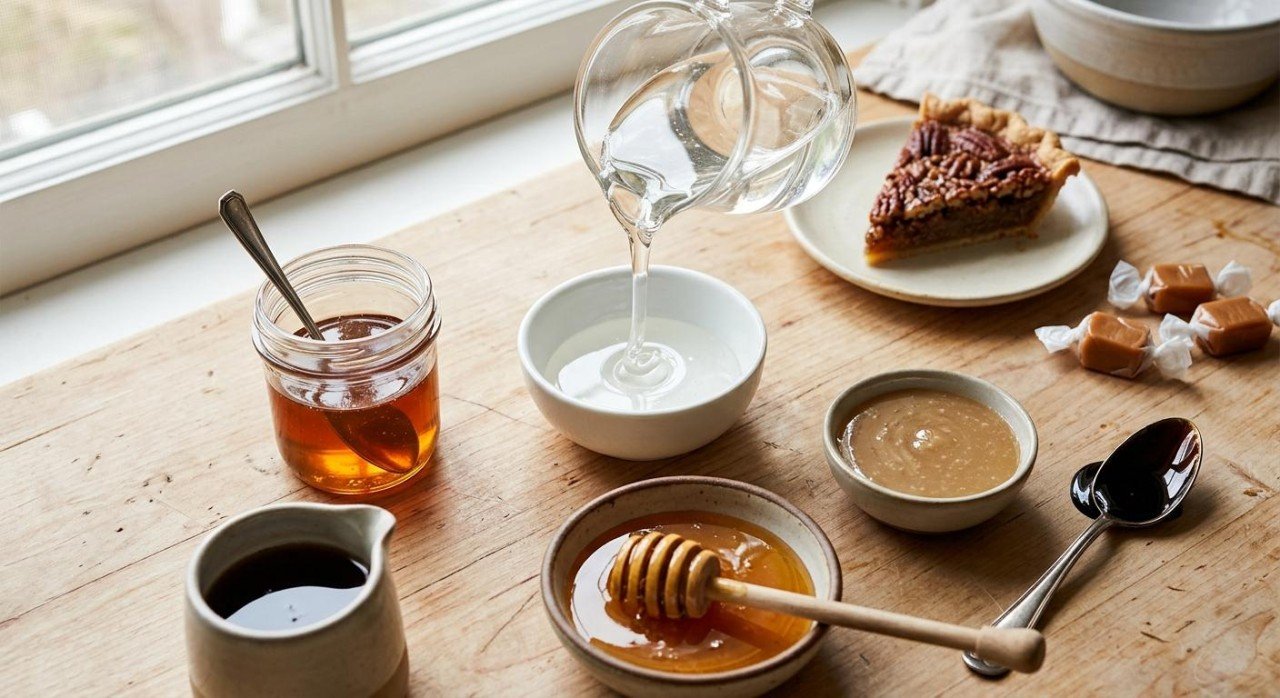
The pecan pie filling is mixed, the caramels are half made, and the bottle of corn syrup in the back of the cupboard turns out to be empty. Before you grab the nearest sticky thing on the shelf, it helps to know what corn syrup was actually doing in there — because it is usually not sweetness.
Corn syrup is mostly glucose, and glucose gets in the way of sugar crystals forming. That is its real job: it keeps caramels from turning grainy, keeps frostings smooth, keeps candy glossy, and gives pecan pie and chewy cookies their soft, bendy set. It is less sweet than sugar, nearly flavorless, and thick enough to add body. A substitute that only brings sweetness will get you a grainy, dull version of what you wanted.
So the right swap depends entirely on what you are making. Below are the substitutes that genuinely work, split by use case, with exact ratios — starting with the hardest case, candy, where most of the popular advice on the internet quietly falls apart.
The Quick List
- Golden syrup — the closest all-purpose stand-in, and one of the few that works in candy
- Glucose syrup — what professional confectioners use; functionally the same thing
- Brown rice syrup — mild, thick, and candy-safe
- Homemade invert sugar syrup — sugar, water, and a pinch of acid; the DIY version
- Plain sugar syrup — fine for pies, sauces, and glazes; not for candy
- Maple syrup — best in pecan pie and glazes, with a thickener
- Honey — easy 1:1 for fillings and frostings, noticeably sweeter
- Agave nectar — neutral and pourable for sauces and frostings
- Molasses — for dark corn syrup only
- Black treacle — the closest match for dark corn syrup
- Date syrup — a whole-fruit upgrade for dark, gooey fillings
First: This Is Not High-Fructose Corn Syrup
Worth clearing up, because it sends a lot of people looking for a substitute they may not need. The corn syrup in the baking aisle and the high-fructose corn syrup in soda are not the same product. Plain corn syrup is essentially pure glucose made from corn starch. To make HFCS, manufacturers take that glucose and use enzymes to convert some of it to fructose, producing HFCS 42 or HFCS 55 — and as the FDA explains, the resulting fructose-to-glucose ratio ends up similar to that of ordinary table sugar.
None of that makes corn syrup a health food. It is pure added sugar with no meaningful nutrients. But if you have been avoiding it because you thought you were buying soda sweetener, it is closer to a technical ingredient than a dietary villain — and every substitute below is also sugar.
For Candy, Caramel, and Anything Cooked to a Hard Stage
This is the case that matters most. When you boil sugar syrup, corn syrup is the insurance policy against crystallization — the difference between silky caramel and a gritty mess. Honey, maple syrup, and agave do not do that job reliably, so this section is short and specific.
Golden Syrup
- Swap: 1 cup golden syrup for 1 cup light corn syrup
- Best for: Caramels, toffee, fudge, marshmallows, pecan pie, sauces — almost everything
- Skip it for: Recipes where a pale color or a completely neutral flavor is the point, like clear hard candy or white frosting
Golden syrup is the best all-round answer. It is an inverted sugar syrup produced during cane sugar refining, which means its sucrose has already been split into glucose and fructose — the same chemistry that makes corn syrup resist crystallization. It is thick, pourable, and swaps in cup for cup, and WebstaurantStore's ingredient comparison rates it as ideal for candy making.
The trade-off is flavor and color: corn syrup tastes of almost nothing, while golden syrup is buttery and caramelized with an amber tint, so marshmallows come out cream-colored rather than white. In most recipes that reads as an improvement. Look for it near the honey or in the British foods section.
Glucose Syrup
- Swap: 1:1, measured by weight if you can
- Best for: Any candy work — caramels, nougat, pulled sugar, sorbet, glazes
- Skip it for: Nothing, technically; the only obstacle is finding it
Glucose syrup is essentially what corn syrup is, sold under its functional name and often made from wheat or tapioca instead of corn. Confectioners reach for it because it behaves identically while being thicker and less sweet than the supermarket bottle, so if you are avoiding corn rather than avoiding syrup, this is the cleanest one-to-one answer. It sets stiff at room temperature, so warm the jar in hot water or scoop it with an oiled spoon. Baking supply shops and online sellers carry it; most grocery stores do not.
Brown Rice Syrup
- Swap: 1:1 with light corn syrup
- Best for: Caramels, marshmallows, fudge, granola bars, chewy cookies
- Skip it for: Recipes needing full sweetness with no flavor of their own
Brown rice syrup is the health-food-aisle option that actually holds up under heat. Like corn syrup it is a glucose syrup at a comparable concentration — WebstaurantStore lists it at 78 Brix against corn syrup's 77 — so it resists crystallization at candy temperatures instead of seizing up. Expect it to taste noticeably less sweet, with a gentle butterscotch note that suits caramels and granola bars, and to be thick enough that you should measure it into an oiled cup.
Homemade Invert Sugar Syrup
- Swap: Make a batch, then use it 1:1 for corn syrup
- Best for: Candy, caramel, fudge, ice cream — anywhere crystals are the enemy
- Skip it for: Right now, if dinner is in twenty minutes; this takes about half an hour plus cooling
If you have sugar and an acid, you can make the anti-crystallizing syrup yourself. Heating sugar and water with a little acid splits the sucrose into glucose and fructose — the same inversion that makes corn syrup and golden syrup work. WebstaurantStore's method is 4 cups sugar, 2 cups water, and 1/4 teaspoon citric acid, brought to a boil then simmered without stirring for about 20 minutes until it reaches 234 to 236°F, brushing crystals off the pan sides with a wet pastry brush. Halve or quarter it for a normal batch; cream of tartar or a tablespoon of lemon juice works in place of citric acid.
Caramelizing part of the sugar first gives you a full-flavored homemade golden syrup instead — Bigger Bolder Baking's version simmers sugar, water, and 1 tablespoon of lemon juice into about 2 cups that keep for months in a sealed jar. Either way, store it airtight and use it by volume.
For Pecan Pie, Tarts, and Gooey Fillings
Here corn syrup is doing gentler work: adding body, keeping the filling glossy and soft-set rather than sugary. Nothing is boiled to a hard stage, so the field opens up considerably — as long as you compensate for the fact that most substitutes are thinner.
Maple Syrup
- Swap: 1 cup pure maple syrup per 1 cup corn syrup, plus 1 tablespoon of all-purpose flour whisked into the melted butter
- Best for: Pecan pie, tarts, glazes, sticky buns, granola
- Skip it for: Candy and caramel, where it tends to crystallize
- Health notes: A tablespoon carries about 25% of the daily value for manganese, plus zinc and potassium
Maple syrup is the classic corn-syrup-free pecan pie, and it works because a small amount of starch replaces the thickening corn syrup was providing. Sally's Baking Addiction's maple pecan pie uses 1 cup of maple syrup with 1/2 cup packed brown sugar and 1 tablespoon of flour, noting that the filling starts out thinner than a corn syrup version but sets firm as it cools. Because the filling is looser going in, blind-bake the crust so the bottom does not go soggy.
The flavor payoff is real — warm, woody maple against toasted pecans beats neutral sweetness, especially in a darker grade. It is still sugar, but as Healthline notes, pure maple brings trace minerals and antioxidant compounds corn syrup has none of: a small bonus, not a reason to eat more pie. Our maple syrup substitutes guide covers the swap in the other direction.
Honey
- Swap: 1:1 for light corn syrup; scale back to about 3/4 cup if the recipe is already very sweet
- Best for: Pie fillings, glazes, granola bars, barbecue sauces, frostings
- Skip it for: Boiled candy and caramel, where it crystallizes, and anything you want to taste neutral
Honey is the swap most people already have, and for anything that does not get boiled it does the job: thick, glossy, and good at holding a filling together. It is sweeter than corn syrup and unmistakably floral, so it stamps its own flavor on the recipe — welcome in a pecan or walnut pie, less so in a delicate frosting. Choose a mild clover or acacia honey to stay in the background, or dark buckwheat honey in place of dark corn syrup. It also browns faster, so tent a long-baking pie with foil if the edges darken early. If that bottle is empty too, see our honey substitutes guide.
Plain Sugar Syrup
- Swap: Dissolve 1 cup granulated sugar in 1/4 cup water over low heat to yield roughly 1 cup of syrup
- Best for: Pies, sauces, glazes, drinks — anywhere the syrup is not cooked to a candy stage
- Skip it for: Candy, caramel, and fudge; with no inversion it will crystallize on you
The always-available answer: warm the sugar and water together just until completely clear, then cool. It is not an invert sugar, so it brings body and sweetness but none of the anti-crystallizing insurance, and WebstaurantStore is blunt that it should not be used for candy. Two upgrades worth knowing — a squeeze of lemon juice or a pinch of cream of tartar as it heats partially inverts it, which helps in softer uses like frostings, and brown sugar in place of white gives you a dark corn syrup stand-in with a caramel edge.
Agave Nectar
- Swap: 1:1 with light corn syrup
- Best for: Sauces, dressings, pie fillings, frostings, drinks
- Skip it for: Candy making
Agave is thin, pourable, and far more neutral than honey, which makes it useful when you want the syrup to disappear into the recipe. It is sweeter than corn syrup, so pull back slightly in an already-sugary recipe, and expect a looser filling. Worth knowing: agave is high in fructose, so despite its reputation it is not a nutritional upgrade over what it replaces.
For Dark Corn Syrup
Dark corn syrup carries molasses-type flavoring, so it needs a darker stand-in. All three of these swap in cup for cup.
- Black treacle — the closest match in color, body, and bittersweet depth; use 1:1.
- Molasses — stronger and more bitter than dark corn syrup, so it works best blended: 1 part molasses to 3 parts of any light syrup above. Straight 1:1 is fine in barbecue sauce or baked beans, where the extra depth is welcome.
- Dark maple syrup or buckwheat honey — both bring color and enough character to stand in for dark corn syrup in fillings and glazes.
Healthier Upgrades (Honestly Assessed)
Corn syrup is pure glucose with no nutrients at all, so almost anything you replace it with looks better on paper. Be clear-eyed about the size of that win, though: maple syrup, honey, agave, and date syrup are all added sugars, and swapping one for another changes your total sugar intake by roughly nothing.
Two swaps do add something real. Date syrup, made by cooking down whole dates, has a deep fig-and-caramel flavor that works beautifully in place of dark corn syrup in pies, sticky glazes, and granola bars — swap 1:1, and expect a darker, less sweet, more interesting result. Pure maple syrup brings the manganese and antioxidant compounds mentioned above. Neither is candy-safe.
The bigger win is usually not a swap at all: in fillings and glazes you can often cut the total syrup by a quarter without anyone noticing, especially if you lean on toasted nuts, vanilla, citrus zest, or a pinch of salt to carry the flavor. In candy, do not try it — there the sugar is the structure.
Take the Guesswork Out of Eating Well
Eat Well Planner helps you organize your favorite recipes, plan balanced meals, and automatically generate shopping lists — all in one place. Whether you're tracking macros, managing dietary restrictions, or just trying to stop asking "what's for dinner?", we've got you covered.
Our AI-powered tools can adapt any recipe to your dietary needs, help you discover new meals you'll love, and even log your nutrition effortlessly. It's meal planning made simple.
Start Organizing Your Meals — FreeWhat Not to Use
- Honey, maple, or agave in boiled candy. The most common mistake here. They lack the crystallization-inhibiting behavior candy needs, so caramels and nougat can turn grainy. Golden syrup, glucose syrup, brown rice syrup, and homemade invert sugar are the candy-safe options.
- Stevia or other zero-calorie sweeteners. They match sweetness and nothing else — no body, no shine, no set. A pecan pie made with stevia in place of corn syrup does not thicken.
- Plain simple syrup in caramel. Sugar and water with no acid and no inversion is exactly the mixture corn syrup exists to protect you from.
- Pancake syrup. Thin, artificially flavored, and often mostly corn syrup anyway — a diluted version of what you ran out of.
- Molasses for light corn syrup. Right texture, wrong everything else; it will darken and dominate a pale recipe.
The Bottom Line
Ask what the corn syrup is there to do. If sugar is being boiled — caramels, toffee, fudge, marshmallows — you need an invert or glucose syrup: golden syrup first, then glucose syrup, brown rice syrup, or a homemade batch of invert sugar. For a pecan pie, glaze, or frosting, maple syrup with a spoonful of flour, honey, agave, or a plain sugar syrup all get you there, and treacle or a molasses blend covers dark corn syrup.
The judgment calls are always recipe-specific: is this filling loose enough to need a thickener, will golden syrup's caramel note clash here, how far can the sugar come down before the texture goes? That is what the Eat Well Planner AI recipe chat is for — open the recipe you are actually making and ask, and it reads your ingredient list to tell you which swap fits and what else to adjust. Its Recipe Playground also lets you make the swap and watch the nutrition score move before you commit. Either way, the empty bottle goes back to being a detail rather than a problem.