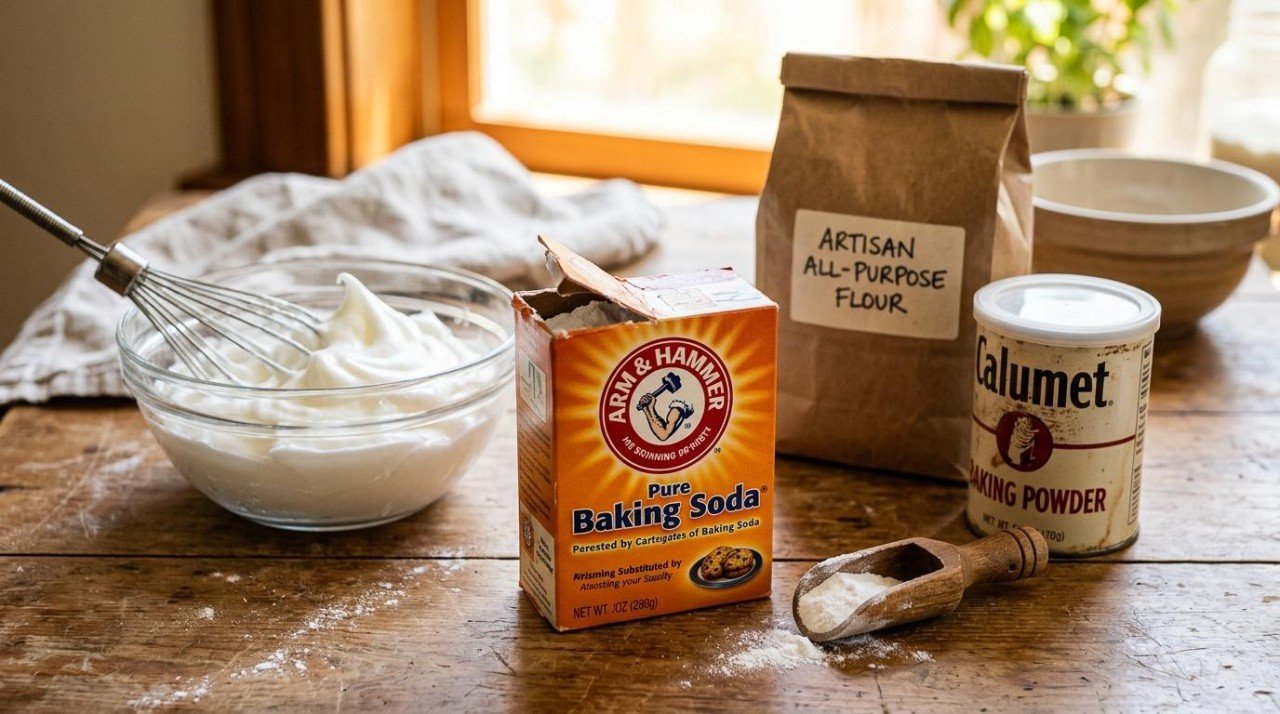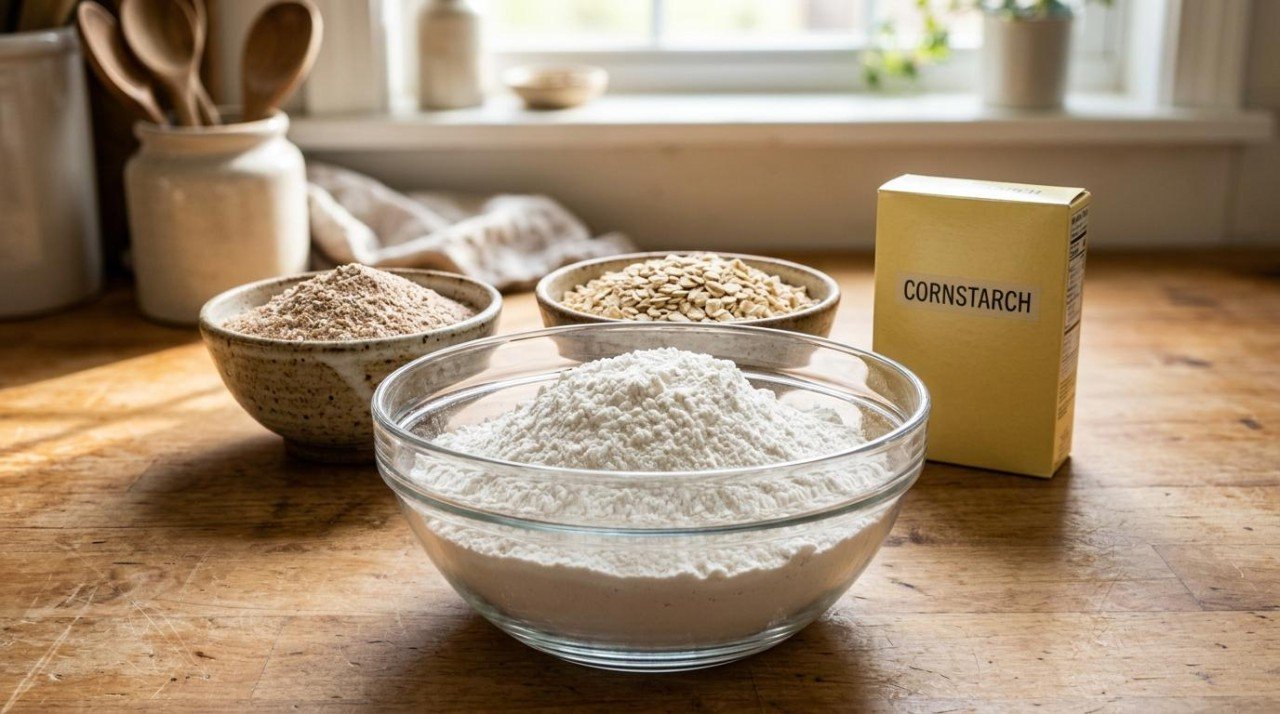
The butter is creamed, the oven is at 350F, and the recipe says cake flour. The bag in your pantry says all-purpose. This is one of the most fixable substitutions in baking, and the fix takes about ninety seconds with something you almost certainly already have: cornstarch.
Cake flour is simply flour with less protein. Less protein means less gluten, and less gluten means a softer, finer, more tender crumb — the difference between a bakery layer cake and a slightly bready homemade one. Supermarket cake flour like Swans Down runs 6 to 8 percent protein, while all-purpose sits around 11.7 percent. Every good substitute below is a way of getting that number down.
One honest caveat before the list. Most supermarket cake flour is also chlorinated, which does something to the starch that no home blend replicates: bleached flour is better able to hold together a high-ratio cake, the very sweet, very wet kind. So for an angel food or a snow-white boxed-style layer cake, a substitute gets you close but not identical. For nearly everything else, nobody will be able to tell.
The Quick List
- All-purpose flour + cornstarch — the classic DIY, and the answer for almost everyone
- Pastry flour — the closest true flour; swap it 1:1
- All-purpose flour on its own — fine for cupcakes and butter cakes if you measure right
- Soft-wheat all-purpose flour — White Lily and other Southern brands are nearly cake flour already
- Self-rising flour — soft wheat, but you must pull the leavening out of the recipe
- All-purpose flour + arrowroot or potato starch — the DIY when the cornstarch box is empty
- Whole wheat pastry flour — the fiber upgrade; best at half
- Oat flour — a partial swap that keeps things tender and adds beta-glucan
1. All-Purpose Flour + Cornstarch
- Swap: 1 cup cake flour → 14 tablespoons (about 105 g) all-purpose flour + 2 tablespoons (about 14 g) cornstarch, sifted together twice
- Best for: Layer cakes, cupcakes, sheet cakes, tender muffins, shortcake, biscuits
- Skip it for: Angel food and chiffon cakes, where real cake flour genuinely does better
The measuring is the part people get wrong, so do it in this order. Spoon 14 tablespoons of all-purpose flour into a bowl — that is 1 cup minus 2 tablespoons — add 2 tablespoons of cornstarch, then sift the two together twice. Sally McKenney sifts it twice and then spoons and levels a cup from the mixture, which is the safest way to do it: sifting adds air, so a cup scooped straight out of the sifted pile can come up light. King Arthur gives the same blend by weight, 105 g flour to 14 g cornstarch, used in place of cake flour by equal weight or volume.
The two sifts are not optional busywork. Cornstarch is much finer than flour and will sit in streaks if you only stir, and a streak of pure starch in a cake batter bakes into a chalky, slightly gummy patch. Make each cup separately rather than mixing a big batch and dipping into it, and if the recipe calls for several cups, weigh rather than measure. One more thing worth knowing: 1 cup sifted cake flour and 1 cup cake flour, sifted are not the same amount. Swans Down puts a sifted cup at 105.6 g and an unsifted cup at 118.6 g — a 12 percent difference, which is enough to dry out a cake. Your homemade blend weighs about 119 g per cup, so it matches an unsifted cup almost exactly.
2. Pastry Flour
- Swap: 1 cup cake flour → 1 cup pastry flour (1:1 by weight or volume)
- Best for: Butter cakes, cupcakes, muffins, scones, pie crust, tender cookies
- Skip it for: Angel food cake and pure-white layer cakes — slightly less lift and a faintly creamier color
If you happen to keep pastry flour, this is the easiest swap in the post. King Arthur's unbleached pastry flour tests at 8 percent protein, right between bleached cake flour and all-purpose, so it behaves almost identically without any blending.
The only real difference is that pastry flour is generally not bleached or chlorinated. In practice that means a hair less rise in the tallest, sweetest cakes and a crumb that reads ivory rather than bright white. In a chocolate cake, a spice cake, or anything frosted, that is invisible.
3. All-Purpose Flour on Its Own
- Swap: 1 cup cake flour → 1 cup minus 2 tablespoons all-purpose flour, spooned and leveled
- Best for: Cupcakes, sturdy butter cakes, muffins, quick breads, cobbler topping
- Skip it for: Angel food, chiffon, sponge, and delicate white layer cakes
No cornstarch either? All-purpose alone still works. King Arthur's own verdict is that you can substitute all-purpose for cake flour in a pinch and the result is similar, though slightly less tender, with a slightly coarser crumb. The reason to pull out those 2 tablespoons is weight, not protein: cake flour is finer and lighter, so a cup of it weighs less than a cup of all-purpose. Swans Down runs the same conversion in the other direction, calling for 1 cup plus 2 tablespoons of cake flour for every cup of all-purpose. If you are weighing, just match the grams and skip the arithmetic.
Then protect the tenderness with technique, since the flour is not going to give it to you. Cream the butter and sugar longer than you think — that aeration is doing work the low-protein flour would have done. Add the flour last, mix only until the streaks disappear, and finish the final few strokes by hand with a spatula. Overmixing is what turns an all-purpose cake bready, and it is entirely under your control.
4. Soft-Wheat All-Purpose Flour (White Lily and Friends)
- Swap: 1 cup cake flour → 1 cup soft-wheat all-purpose flour, spooned and leveled
- Best for: Nearly anything cake flour is used for — layer cakes, cupcakes, biscuits, shortcake
- Skip it for: Angel food cake, where the last percentage point of protein still matters
This one is a quiet cheat code if you bake in the American South. White Lily and similar regional brands are milled from pure soft wheat, never blended with hard wheat, which puts them around 9 percent protein — much closer to cake flour than to a national all-purpose brand. It is a big part of why Southern biscuits have that particular fluff.
Check the bag before you count on it, because the label just says all-purpose. If it names soft wheat or soft winter wheat, you can use it for cake flour more or less straight. Going the other direction, if you are putting soft-wheat flour into a recipe written for standard all-purpose, White Lily suggests 1 cup plus 2 tablespoons per cup, since their flour is lighter by volume.
5. Self-Rising Flour
- Swap: 1 cup cake flour → 1 cup self-rising flour, then remove 1 1/2 teaspoons baking powder and 1/4 teaspoon salt from the recipe
- Best for: Cupcakes, snack cakes, muffins, cobbler topping, shortcake
- Skip it for: Angel food and chiffon, which use no chemical leavening at all, and recipes already leavened with baking soda plus an acid
Self-rising flour is a better structural match than people expect: King Arthur's is milled from soft wheat at 8.5 percent protein against 11.7 for all-purpose. The catch is the extras. Every cup carries roughly 1 1/2 teaspoons of baking powder and 1/4 teaspoon of salt, so you have to subtract exactly that much from the recipe or the cake will rise fast, fall, and taste faintly metallic.
That subtraction only works if the recipe's own leavening is in the same neighborhood — around 1 to 1 1/2 teaspoons of baking powder per cup of flour, which covers most cupcake and layer cake recipes. If the recipe uses baking soda with buttermilk, sour cream, or cocoa, leave the soda in; it is there to react with that acid and to brown, and the baking powder in the flour does not do the same job.
6. All-Purpose Flour + Arrowroot or Potato Starch
- Swap: 1 cup cake flour → 14 tablespoons all-purpose flour + 2 tablespoons arrowroot or potato starch, sifted twice
- Best for: Exactly what the cornstarch version is good for, corn-free households included
- Skip it for: Nothing the cornstarch blend handles
The starch in this blend is not thickening anything — its only job is to dilute the flour's protein — so the usual rules about one starch thickening more powerfully than another do not apply. Measure the same 2 tablespoons and sift the same two times.
Tapioca starch will also do it, though it can add a slight chew in a very light cake, so keep that one for muffins and quick breads rather than a delicate layer.
Healthier Upgrades
Cake flour is one of the most refined ingredients in the pantry: the bran and germ are milled out, and with them nearly all of the fiber. Enriched white flour carries about 2.7 g of fiber per 100 g, while whole-grain wheat flour carries about 10.7 g — roughly four times as much. A cake is still a cake, but if you bake often, this is a swap worth having in your pocket.
7. Whole Wheat Pastry Flour
- Swap: 1 cup cake flour → 1/2 cup whole wheat pastry flour + 1/2 cup cake flour or the cornstarch blend, plus 1 teaspoon extra liquid
- Best for: Muffins, snack cakes, banana and carrot cake, scones, cobbler, spiced layer cakes
- Skip it for: White layer cakes and angel food — both the color and the lift take a hit
- Health notes: Whole grain, so roughly four times the fiber of white flour in the portion you swap
Whole wheat pastry flour is milled from soft wheat, so unlike regular whole wheat it is genuinely low in protein. The complication is the bran, which physically cuts through gluten strands and can leave a bake crumbly if you go too far. King Arthur suggests starting at up to 50 percent whole wheat for non-yeasted bakes, adding about 2 teaspoons of liquid per cup of whole wheat flour used.
Let the batter sit 20 to 30 minutes before it goes in the pan so the bran can soften and stop feeling gritty. Expect a tan crumb and a faint nuttiness, which is an asset in carrot cake, banana cake, and anything with brown sugar or spice, and a liability in a wedding-white vanilla layer.
8. Oat Flour
- Swap: Replace up to 1/4 of the cake flour by weight with oat flour
- Best for: Muffins, snack cakes, pancakes, soft cookies
- Skip it for: Anything that has to hold a tall, fine structure
- Health notes: Whole grain, and the source of beta-glucan, the soluble fiber oats are known for
You do not need to buy it — blitz rolled oats in a blender until they are powdery. Oat flour has no gluten of its own, so cap it at about a quarter of the flour and let the wheat carry the structure. What you get back is a soft, faintly sweet crumb that stays moist an extra day, which suits muffins and snack cakes particularly well.
Take the Guesswork Out of Eating Well
Eat Well Planner helps you organize your favorite recipes, plan balanced meals, and automatically generate shopping lists — all in one place. Whether you're tracking macros, managing dietary restrictions, or just trying to stop asking "what's for dinner?", we've got you covered.
Our AI-powered tools can adapt any recipe to your dietary needs, help you discover new meals you'll love, and even log your nutrition effortlessly. It's meal planning made simple.
Start Organizing Your Meals — FreeThe Reverse Problem: Cake Flour When the Recipe Wants All-Purpose
Bought the wrong bag? Going this direction is riskier. Swans Down's conversion is 1 cup plus 2 tablespoons of cake flour for every cup of all-purpose, which works fine in muffins, pancakes, and tender cakes.
What it does not survive is anything that needs structure. King Arthur warns that swapping cake flour 1:1 into all-purpose recipes produces sunken cakes or bars, and cookies too delicate to hold together. Keep cake flour out of yeast breads, pizza dough, and chewy cookies entirely.
What Not to Use
- Bread flour, with or without cornstarch. At 12 to 13 percent protein it is the furthest thing on the shelf from cake flour, and 2 tablespoons of starch will not close that gap. You get a chewy, bready cake.
- More cornstarch than the blend calls for. If a little makes a cake tender, more does not make it more tender — past about 2 tablespoons per cup you lose enough protein to hold the crumb together, and the cake turns gummy and chalky, then falls apart when sliced.
- Cornstarch on its own. It is a starch, not a flour. There is no version of this that works.
- Regular whole wheat flour, 1:1. Standard whole wheat is milled from hard wheat at 13 to 15 percent protein, so you get the toughness of bread flour plus the crumb-cutting bran. Whole wheat pastry flour is a different product; the regular kind is not a cake flour substitute.
- Almond or coconut flour, 1:1. Neither is a wheat flour swap at equal volume. Coconut flour absorbs several times its weight in liquid and needs extra eggs just to hold together.
- Boxed cake mix. It already contains sugar, leavening, and usually fat and emulsifiers, so measuring it as flour throws off every other ingredient in the recipe.
Which One Fits Your Recipe
For most people reading this at the counter, it is the first swap: 14 tablespoons all-purpose flour, 2 tablespoons cornstarch, sifted twice, measured to a cup. Pastry flour if you keep it, plain all-purpose minus 2 tablespoons if the cornstarch is gone too, and the whole wheat pastry blend when the bake is a weekday muffin rather than a birthday cake.
What a blog post cannot do is look at your recipe and tell you which of these it can take. That is where Eat Well Planner comes in: import the cake you are making and the AI recipe chat answers with the full ingredient list and method in front of it, including whether the batter is sweet and wet enough that real cake flour is worth a trip to the store. Ask it to rework the recipe gluten-free or dairy-free and Recipe Variations hands back the whole thing with the swaps already written in. And before you commit to the whole wheat version, the Recipe Playground lets you make the swap and watch the nutrition score move, with a per-edit delta showing exactly what that extra fiber cost you.