The shrimp are peeled, the cast iron is heating, and the Cajun seasoning jar is empty. Good news: Cajun seasoning is not a secret formula. It is paprika, cayenne, garlic, onion, black pepper and a couple of dried herbs, held together by a lot of salt, and you almost certainly have enough of those spices to rebuild it in a couple of minutes.
The best substitute depends on what you are making. Blackened fish and chicken need a dry blend heavy on paprika that can take a scorching pan. Gumbo, jambalaya and red beans are forgiving and happily take a Creole blend, a quick three-spice mix or even hot sauce. Shrimp, crab and seafood boils are where Old Bay can step in.
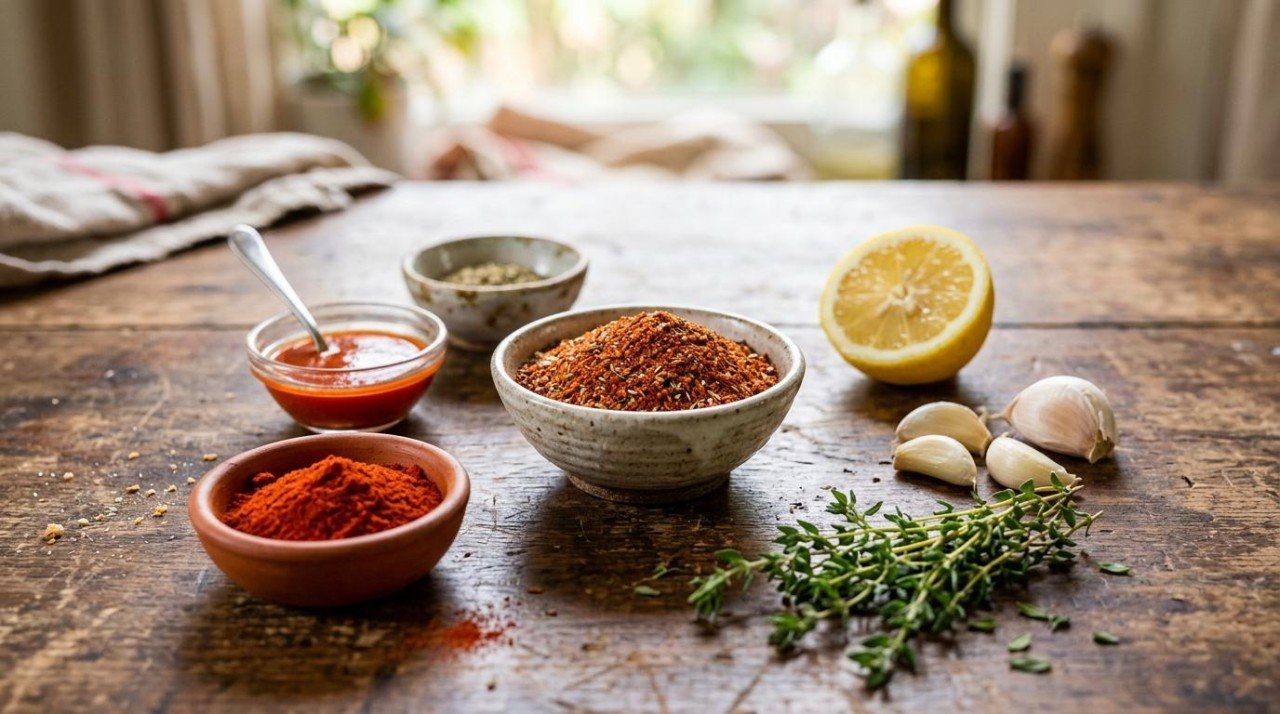
All the ratios below are per 1 tablespoon of store-bought Cajun seasoning, the amount most recipes call for to season about a pound of shrimp, chicken or fish. If you only remember one thing, make it this: 1 teaspoon paprika + 1/4 teaspoon each garlic powder, onion powder, dried thyme, dried oregano and black pepper + a pinch of cayenne + salt to taste gets you most of the way there.
The Quick List
- Homemade Cajun seasoning — the closest match, and you decide how much salt goes in
- Creole seasoning — a near 1:1 swap, a little more herbal and a little milder
- Blackening seasoning — 1:1 for blackened fish and chicken, and fine nearly everywhere else
- Paprika + garlic powder + cayenne — the 3-spice pantry fix
- Smoked paprika + Italian seasoning + cayenne — covers the herbs with one jar
- Chili powder + paprika + thyme — works well, just slightly more Tex-Mex
- Old Bay — best for shrimp, crab, seafood boils and potatoes
- Louisiana-style hot sauce + spices — for gumbo, jambalaya, soups and cream sauces
- Taco seasoning + thyme + cayenne — a last-resort pinch hitter for rice and beans
What's Actually in Cajun Seasoning
Read the label and the first ingredient is usually salt. McCormick's Cajun Seasoning lists "salt, spices (including paprika, red pepper, thyme, black pepper, celery seed), garlic & onion," with 160 mg of sodium per 1/4 teaspoon. That works out to about 1,900 mg in a single tablespoon, most of the 2,300 mg daily limit the FDA recommends for adults, in one pound of shrimp.
The Louisiana blend many cooks reach for, Tony Chachere's Original Creole Seasoning, is saltier still: 350 mg of sodium per 1/4-teaspoon (1.1 g) serving, with salt, red pepper, black pepper, chili powder and garlic as its ingredients. Do the math and the blend is roughly 80% salt by weight, and a tablespoon carries about 4,200 mg of sodium. So when you replace a store blend, you are really rebuilding three things: the paprika-and-pepper flavor, the heat from cayenne, and the salt. Every substitute below tells you how to handle all three.
And yes, Cajun and Creole blends overlap a lot. As Tasting Table explains, Cajun seasoning leans on peppers (black, white and cayenne) and is the spicier of the two, while Creole seasoning leans on herbs like thyme, basil and oregano and tastes more earthy. In practice, brands blur the line, and the two are used interchangeably.
Match the Substitute to the Dish
- Blackened fish, chicken or shrimp — homemade seasoning, blackening seasoning, paprika + garlic powder + cayenne, smoked paprika + Italian seasoning
- Gumbo, jambalaya, étouffée and red beans — homemade seasoning, Creole seasoning, Louisiana hot sauce + spices, chili powder + paprika + thyme
- Shrimp boils, crab cakes and seafood — Old Bay, homemade seasoning, Creole seasoning
- Cajun pasta and cream sauces — homemade seasoning, Creole seasoning, Louisiana hot sauce + spices
- Roasted potatoes, fries, vegetables and popcorn — homemade seasoning, Old Bay, smoked paprika + Italian seasoning
Homemade Cajun Seasoning
- Swap: 1 tablespoon store-bought → 1 teaspoon paprika + 1/4 teaspoon each garlic powder, onion powder, dried thyme, dried oregano and black pepper + 1/8 teaspoon cayenne (more if you like it hot) + 1/4 to 1/2 teaspoon salt
- Best for: Everything a jar does: blackened fish and chicken, shrimp, gumbo, jambalaya, pasta, roasted vegetables
- Skip it for: Nothing. If you have the spices, this is the one to make.
- Health notes: About 575 to 1,150 mg of sodium per tablespoon-equivalent depending on the salt you add, vs. about 1,900 mg for McCormick and 4,200 mg for Tony Chachere's
Paprika is the backbone: it gives Cajun seasoning its brick-red color and mild, sweet pepper flavor. Garlic and onion powder bring the savory base, thyme and oregano add an herbal note, and black pepper and cayenne bring two different kinds of heat. You may notice this mix is a little smaller than a full tablespoon. That is on purpose. A store blend is mostly salt by volume, so a tablespoon of it holds less actual spice than a tablespoon of homemade; matching it spoon for spoon would make the dish taste louder than the recipe intended.
If you cook Cajun food often, make a salt-free jar: 2 tablespoons paprika (sweet, or half smoked), 1 tablespoon each garlic powder and onion powder, 2 teaspoons each dried thyme, dried oregano and black pepper, and 1 to 2 teaspoons cayenne. Add 1 teaspoon white pepper and 1/2 teaspoon celery seed if you have them; both show up in classic blends. That makes a little under 1/2 cup. Use about 2 teaspoons of the jar wherever a recipe calls for 1 tablespoon of store-bought Cajun seasoning, then salt the dish to taste. Keeping the salt out of the jar matters more here than in most blends, because Cajun dishes are often built on salty ingredients like andouille, tasso ham, canned tomatoes and stock.
Creole Seasoning
- Swap: 1 tablespoon Cajun seasoning → 1 tablespoon Creole seasoning + a pinch of cayenne if you want the heat
- Best for: Gumbo, jambalaya, étouffée, shrimp, red beans, crab cakes
- Skip it for: Nothing in particular; it is the most direct swap you can buy
Creole seasoning is Cajun seasoning's closest relative. Both come out of Louisiana, both are built on paprika, garlic, onion and pepper, and both work in the same dishes. The difference is in the balance: Creole blends usually carry more dried herbs, like oregano, thyme and sometimes basil, and less cayenne, so they taste more herbal and a little milder. In a pot of gumbo or jambalaya, most people cannot tell which one went in.
Check the label before you add salt. Some "Creole" seasonings, Tony Chachere's included, are saltier than most Cajun blends, so if your recipe also calls for salt, leave it out and taste at the end. If yours is a milder, herb-forward blend and you miss the kick, a pinch of cayenne or a few dashes of hot sauce brings it back.
Blackening Seasoning
- Swap: 1 tablespoon Cajun seasoning → 1 tablespoon blackening (blackened) seasoning
- Best for: Blackened fish, chicken, shrimp and steak; also fine in pasta, rice and vegetables
- Skip it for: Very little, though some blends add sugar, which can burn in a long sauté
Blackening is really a technique: fish or chicken coated in a thick layer of spices and seared in a smoking-hot cast-iron pan until the spices char into a dark, flavorful crust. Blackening seasoning is a blend designed for that job, and it uses nearly the same lineup as Cajun seasoning, with paprika, garlic powder, onion powder, cayenne, oregano and thyme. Many versions go heavier on paprika and herbs and lighter on cayenne, which keeps the crust from tasting harsh.
That makes it an easy 1:1 swap, especially for anything seared. To blacken with any of the blends in this post, pat the protein dry, brush it with melted butter or oil, press on a generous coat of seasoning, and sear in a very hot cast-iron skillet for 2 to 3 minutes per side for a thin fish fillet. Turn on the fan first; real blackening smokes.
Paprika + Garlic Powder + Cayenne
- Swap: 1 tablespoon Cajun seasoning → 2 teaspoons paprika + 1/2 teaspoon garlic powder + 1/4 teaspoon black pepper + 1/8 to 1/4 teaspoon cayenne + 1/4 to 1/2 teaspoon salt
- Best for: Blackened fish and chicken, shrimp, roasted potatoes, fries
- Skip it for: Gumbo and jambalaya, where the missing herbs leave the pot a bit one-note
If you only have a few jars, these are the ones that matter. Paprika covers the color and the sweet pepper flavor, cayenne covers the heat, and garlic powder makes it taste savory rather than just spicy. It is a slightly flatter version of the real thing, but on a seared chicken breast or a sheet pan of potatoes, nobody will complain.
Add any of these if you have them: 1/4 teaspoon onion powder for more depth, 1/4 teaspoon dried thyme for the herbal note, or a few shakes of celery salt in place of some of the plain salt. If you are out of paprika too, our smoked paprika substitutes guide covers what else gives that red, peppery base.
Smoked Paprika + Italian Seasoning + Cayenne
- Swap: 1 tablespoon Cajun seasoning → 1 1/2 teaspoons smoked paprika + 1/2 teaspoon Italian seasoning + 1/2 teaspoon garlic powder + 1/4 teaspoon onion powder + 1/4 teaspoon black pepper + 1/8 to 1/4 teaspoon cayenne + 1/4 to 1/2 teaspoon salt
- Best for: Blackened chicken, roasted vegetables, red beans, jambalaya, shrimp
- Skip it for: Delicate fish if your Italian seasoning is heavy on rosemary, which can overpower it
Italian seasoning is a quick way to get the thyme and oregano Cajun blends need without two separate jars. Its basil, marjoram and rosemary are not classic Cajun flavors, but at 1/2 teaspoon they blend into the background, and basil already appears in many Creole blends. Smoked paprika adds a light smokiness that makes the mix taste deeper, almost like a dish cooked with andouille sausage.
Smoked paprika is strong, so do not swap it in at full strength for sweet paprika in the other mixes. Here it is balanced against the other spices. If you only have sweet paprika, use 2 teaspoons of it instead. Out of Italian seasoning too? Our Italian seasoning substitutes guide shows how to build it from single herbs.
Chili Powder + Paprika + Thyme
- Swap: 1 tablespoon Cajun seasoning → 1 1/2 teaspoons chili powder + 1 teaspoon paprika + 1/4 teaspoon dried thyme + 1/4 teaspoon black pepper + a pinch of cayenne. Taste before salting.
- Best for: Jambalaya, red beans and rice, dirty rice, chicken, roasted vegetables
- Skip it for: Shrimp boils and delicate seafood, where the cumin is noticeable
American chili powder is already a blend of ground chiles, cumin, garlic and oregano, so it covers several of Cajun seasoning's ingredients at once. The catch is the cumin, which Cajun blends usually do not have. In a big pot of jambalaya or red beans it fades into the background, but on a plain fillet of fish it reads a bit Tex-Mex. The extra paprika and thyme pull it back toward Louisiana.
Many chili powders contain salt, so taste the dish before adding any. If yours is a single-chile powder like ancho or chipotle rather than a blend, add 1/4 teaspoon each of garlic powder and oregano, and start with half the amount if it is chipotle, which is much hotter. Our chili powder substitutes guide has more on the difference.
Take the Guesswork Out of Eating Well
Eat Well Planner helps you organize your favorite recipes, plan balanced meals, and automatically generate shopping lists — all in one place. Whether you're tracking macros, managing dietary restrictions, or just trying to stop asking "what's for dinner?", we've got you covered.
Our AI-powered tools can adapt any recipe to your dietary needs, help you discover new meals you'll love, and even log your nutrition effortlessly. It's meal planning made simple.
Start Organizing Your Meals — FreeOld Bay
- Swap: 1 tablespoon Cajun seasoning → 2 teaspoons Old Bay + 1/4 teaspoon garlic powder + 1/8 teaspoon cayenne. Add no extra salt until you taste.
- Best for: Shrimp, crab cakes, seafood boils, fish, roasted potatoes, fries, corn on the cob
- Skip it for: Blackened chicken and gumbo, where its celery flavor takes over
Old Bay is the Chesapeake Bay's answer to Cajun seasoning: a salty, peppery blend made for seafood. Its label reads "celery salt (salt, celery seed), spices (including red pepper and black pepper), and paprika," so it shares the paprika, red pepper and salt, but the celery seed is front and center, along with a warm-spice note Cajun blends do not have. On shrimp, crab and potatoes that difference is a plus. In a pot of gumbo, it tastes like a different dish.
Old Bay is salty, so it replaces the salt in the recipe as well as the Cajun seasoning. Using a little less of it and adding garlic and cayenne closes the gap: the garlic adds the savory base Old Bay lacks, and the cayenne brings back the heat. For a low-country shrimp boil, it is not even a compromise.
Louisiana-Style Hot Sauce + Spices
- Swap: 1 tablespoon Cajun seasoning → 1 teaspoon paprika + 1/2 teaspoon garlic powder + 1/2 teaspoon onion powder + 1/4 teaspoon dried thyme + 1 to 2 teaspoons Louisiana-style hot sauce, stirred in with the liquid
- Best for: Gumbo, jambalaya, étouffée, Cajun cream pasta, soups, shrimp and grits
- Skip it for: Dry rubs and blackening; the liquid will keep a crust from forming
Thin, vinegary Louisiana-style hot sauce is mostly aged cayenne-type peppers, vinegar and salt, so it brings the heat and some of the salt in liquid form. That is perfect for anything with a sauce or broth, where it dissolves right in, and the vinegar gives a pot of gumbo or a creamy Cajun pasta a nice bit of brightness.
Add the dry spices early, so they can toast in the fat with the onions, celery and peppers, and add the hot sauce with the liquid. Start with 1 teaspoon, taste at the end, and add more if you want it hotter. Hot sauce varies a lot in heat, so do not dump it in all at once.
Taco Seasoning + Thyme + Cayenne
- Swap: 1 tablespoon Cajun seasoning → 2 teaspoons taco seasoning + 1/4 teaspoon dried thyme + 1/8 teaspoon cayenne + 1/2 teaspoon paprika. Taste before salting.
- Best for: Red beans and rice, dirty rice, roasted chicken, sweet potato fries
- Skip it for: Seafood and blackened dishes, where the cumin and cornstarch are out of place
This one is for when the spice cabinet is nearly bare. Taco seasoning shares the chili, garlic, onion and paprika base, but it is heavy on cumin and usually contains cornstarch, which can make a pan sauce slightly gummy and keeps a blackened crust from forming. The added thyme and cayenne push it back in the right direction. It works best in a pot of rice and beans, where all the flavors meld.
Taco seasoning packets are salty, so skip any other salt the recipe calls for until you taste. If you have the individual spices instead, the homemade blend at the top of this post is a far better option, and our taco seasoning substitutes guide shows how close the two families of blends really are.
Healthier Upgrade: Make Your Own and Control the Salt
With most spice blends, homemade is just a stand-in. With Cajun seasoning, it is a real upgrade, because the problem with the jar is not the spices. It is the salt, and since it is the first ingredient, you cannot add the flavor without the sodium.
- McCormick Cajun Seasoning: About 1,900 mg of sodium per tablespoon, based on the label above. For a pound of shrimp that feeds four, that is roughly 480 mg per serving, before the rice, butter or andouille.
- Tony Chachere's Creole Seasoning: About 4,200 mg per tablespoon, nearly twice the daily limit. The FDA notes that 2,300 mg is about 1 teaspoon of table salt.
- Homemade with 1/2 teaspoon salt: About 1,150 mg, roughly 40% less than McCormick.
- Homemade with 1/4 teaspoon salt: About 575 mg, or roughly 145 mg per serving for four. With garlic, onion, cayenne and a squeeze of lemon doing the work, most people do not miss it.
Bold spice blends are one of the best tools for cutting salt without a flavor penalty. In the 20-week SPICE trial summarized by Harvard's Nutrition Source, adults who were coached to cook with spices and herbs instead of salt ended up excreting about 957 mg less sodium per day than a self-directed control group. Cajun seasoning is a good blend to practice with, because cayenne, garlic and black pepper are loud enough that you notice the heat and depth more than the salt. A finishing squeeze of lemon also helps; acid brightens a dish so it tastes fully seasoned with less salt.
If you buy a jar, look for a salt-free or reduced-sodium version, which several Louisiana brands now sell, and salt the dish yourself. And if you are working on blood pressure, sodium is only half the story. Our post on potassium, the other half of the salt equation explains why the beans, okra, greens and tomatoes in so many Louisiana dishes count in your favor. Over-seasoned a dish already? Our guide to rescuing a dish that is too salty has fixes.
What Not to Use
- Cayenne or red pepper flakes alone: Heat is only part of Cajun seasoning. Without paprika, garlic and onion, the dish just tastes hot, not seasoned.
- A full tablespoon of a salt-free homemade blend in place of a salty store blend, with no adjustments: The spices are more concentrated without the salt, and the dish will taste both too strong and underseasoned. Start with about two-thirds and salt to taste.
- Seasoned salt or garlic salt as the main flavor: They are mostly salt, with none of the pepper or paprika. You will get the sodium without the flavor.
- Curry powder: It shares the cayenne, but turmeric, cumin and fenugreek make it taste distinctly Indian, and it turns everything yellow.
- Jerk seasoning: It is also spicy, but allspice, cinnamon and thyme give it a Caribbean flavor, and many blends include sugar that burns in a blackening pan.
Which Cajun Seasoning Substitute Should You Use?
If you have paprika, garlic powder and cayenne, make the homemade blend; it takes two minutes, tastes like the jar, and lets you decide how much salt goes in. For blackened fish and chicken, blackening seasoning or a paprika-heavy homemade mix is the best swap. For gumbo, jambalaya and red beans, almost anything here works, and Creole seasoning or hot sauce plus a few spices is hard to beat. For shrimp and crab, Old Bay is a natural fit. And whatever you use, taste before you salt; Creole blends, Old Bay, taco seasoning and hot sauce all bring their own.
Not sure which of these suits the recipe in front of you? Eat Well Planner's AI recipe chat can answer with your actual recipe in context: ask "I'm out of Cajun seasoning, what should I use?" and it will work from the spices and protein you are cooking with. If you want to see exactly what a homemade blend does to the dish, the Recipe Playground lets you swap ingredients and watch the nutrition score and sodium change live, and Make It Healthier suggests more swaps like this one, each checked against the nutrition score before it is shown to you.