You are creaming butter for cookies, or stirring together a marinade, and the recipe calls for brown sugar. You reach for the bag and it is either empty or fossilized into a single rock-hard brick. Annoying, but not a reason to stop.
Here is the reassuring part: brown sugar is not some special ingredient. It is just white sugar with molasses stirred back into it. That means you can often rebuild it in seconds from things already in your kitchen, and when you cannot, there are plenty of stand-ins that work.
The catch is that brown sugar does two quiet jobs beyond sweetness. The molasses adds moisture, which is what makes cookies chewy and cakes tender, and it is mildly acidic, which helps baking soda do its lifting. The best swap depends on how much those jobs matter in what you are making. Below are the substitutes that genuinely work, with exact ratios, starting with the one that is a perfect match.
The Quick List
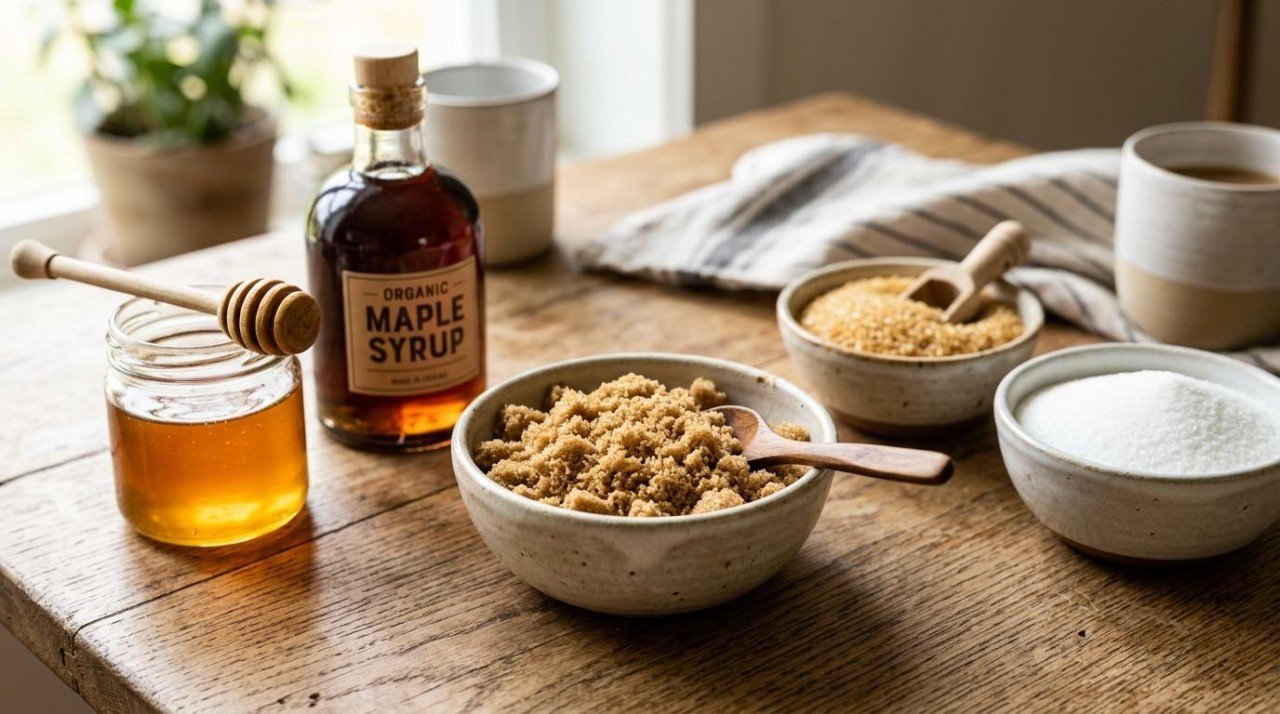
- White sugar + molasses — the exact match; rebuilds real brown sugar in seconds
- Muscovado sugar — a richer 1:1 upgrade with even more molasses depth
- Turbinado or raw sugar — 1:1; grind it fine for baking, superb as a crunchy topping
- Maple sugar — a granulated 1:1 swap with real maple flavor (a splurge)
- White sugar alone — always on hand; fine for sweetness, but expect crisper, less chewy results
- Maple syrup or honey — for moist bakes and sauces; cut the other liquid to compensate
- Coconut sugar — 1:1, similar look and taste, just a touch drier
- Date sugar — a whole-food swap that actually adds fiber; best as a topping
White Sugar + Molasses (the DIY Fix)
- Swap: For 1 cup light brown sugar, use 1 cup white sugar + 1 tablespoon molasses. For dark brown sugar, use 2 tablespoons molasses.
- Best for: Everything — this is a true 1:1 replacement, not a compromise
- Tip: No need to blend them first; just add both to the recipe at the same time
This is the answer, and it is barely a substitute at all. Commercial brown sugar is literally white sugar with molasses added back in — light brown sugar is around 3.5 percent molasses and dark is closer to 6.5 percent, which is exactly what you are recreating when you stir a spoonful of molasses into granulated sugar. It brings back the moisture, the color, the caramel flavor, and the gentle acidity all at once.
Some sources call for slightly less molasses (2 teaspoons for light, 1 tablespoon for dark), so if you like a milder result, start on the low end. You can whisk the two together to make a batch that behaves just like store-bought, or simply drop both into the bowl. Either way, this is the swap to reach for first whenever you have molasses on hand.
Muscovado Sugar
- Swap: 1:1 with brown sugar
- Best for: Anything where you want deep flavor — gingerbread, chocolate cookies, barbecue sauces, spice cakes
- Tip: It is stickier and moister than regular brown sugar, so break up any clumps before measuring
Muscovado (sometimes labeled Barbados sugar) is an unrefined cane sugar that keeps all of its natural molasses instead of having it stripped out and added back. That makes it darker, moister, and more intensely flavored than ordinary brown sugar. In most recipes it is not just a stand-in but an upgrade, adding a rich, almost toffee-like depth.
Because it holds even more moisture, it can make cookies a shade chewier and denser, which is usually a good thing. The only place to be a little careful is a delicate cake where you want a light crumb and a mild flavor, since muscovado will make itself known.
Turbinado or Raw Sugar
- Swap: 1:1 by volume
- Best for: Sprinkling on top of muffins, scones, and pie crusts for crunch; sweetening coffee and oatmeal
- Skip it for: Bakes where the sugar has to dissolve or cream in fully — unless you grind it first
Turbinado and demerara sugars (the tan crystals often sold as raw sugar) are lightly processed cane sugars that keep a little of their molasses. Flavor-wise they are a fine match, a touch milder and less moist than brown sugar. The issue is the crystal size: they are big and coarse, so in cookie dough or a creamed batter they can stay gritty and cause cookies to spread more than you want.
The easy fix is to pulse the sugar in a blender or spice grinder for a few seconds to bring it closer to the fine texture of brown sugar. Left whole, that coarseness becomes a feature — a scattering of raw sugar on a muffin top or pie crust bakes into a lovely crackly crunch.
Maple Sugar
- Swap: 1:1 with brown sugar
- Best for: Bakes and toppings where a warm maple note is welcome — oatmeal cookies, muffins, sweet potato dishes
- Health notes: Nutritionally close to brown sugar; the appeal is flavor, not a health win
Maple sugar is simply maple syrup boiled until it crystallizes into a dry granulated sugar. Because it is dry, it behaves like brown sugar in a recipe — no liquid adjustments needed — while carrying a distinct maple flavor. It is a genuinely delicious 1:1 swap.
The only real downside is the price. Maple sugar is expensive and not something most people keep around, so this is more of a happy-accident swap for when you already have it than a pantry staple. If maple is a flavor you love, though, it is a lovely one to reach for.
Plain White Sugar (the Always-On-Hand Fallback)
- Swap: 1:1 by volume
- Best for: Recipes where brown sugar is a minority of the total sugar, or that use baking powder rather than baking soda
- Expect: Crisper, less chewy results and a lighter color and flavor
Everyone has white sugar, which makes it the realistic fallback when the molasses jar is empty too. (It works the other way around, too — see our guide to white sugar substitutes.) It will sweeten your recipe correctly at a 1:1 swap. What you give up is everything the molasses was doing: the moisture that makes things chewy and tender, and the mild acidity. So cookies come out crisper and flatter in flavor, and cakes lose a little of their tenderness and color.
There is one more wrinkle worth knowing. In recipes leaning on brown sugar's acidity to activate the baking soda, swapping in neutral white sugar can change how things rise and spread. (Our guide to baking soda substitutes explains that acid-plus-soda reaction in more detail.) This swap is at its safest when brown sugar is only part of the sugar in the recipe, or when the recipe relies on baking powder, which brings its own acid. For a batch of chewy chocolate chip cookies, expect a thinner, crispier result — still tasty, just different.
Maple Syrup or Honey
- Swap: Use about 2/3 to 3/4 cup per 1 cup brown sugar, and reduce the other liquid in the recipe by 3 to 4 tablespoons
- Best for: Moist, forgiving bakes and anything saucy — quick breads, muffins, marinades, glazes, oatmeal
- Skip it for: Crisp cookies and anything that depends on creaming solid sugar for structure
Liquid sweeteners bring brown sugar's moisture and caramel character in spades, but they change the batter, so this swap needs a couple of adjustments. Because you are adding liquid, cut back the other liquids by 3 to 4 tablespoons per cup of syrup or honey. If the recipe has no other liquid to cut, add about 1 tablespoon of flour per 1/4 cup of sweetener to compensate.
Honey is a little sweeter than sugar and browns fast — it can scorch above 350 degrees Fahrenheit — so keep the oven at or below that and watch the edges. Maple syrup swaps in at roughly equal sweetness and behaves a bit more forgivingly. Both add their own unmistakable flavor, which is wonderful in a banana bread or a barbecue glaze and out of place in a recipe meant to taste of butter and vanilla.
Coconut Sugar
- Swap: 1:1 with brown sugar
- Best for: Cookies, muffins, and quick breads where its caramel note fits right in
- Tip: It holds less moisture, so add a little extra fat if your bake seems dry
- Health notes: A slightly lower glycemic index, but still added sugar — treat it as such
Coconut sugar (made from the sap of the coconut palm) looks and tastes remarkably like brown sugar, with a similar caramel-molasses note and a hair less sweetness. It swaps in one-to-one and is a favorite in natural-foods baking. Its main quirk is that it holds less moisture than brown sugar, so bakes can come out slightly drier or denser — a little extra butter or oil evens that out.
It gets marketed as a health food, and it is worth being honest here. Coconut sugar does carry trace minerals and a bit of a gut-friendly fiber called inulin, and its glycemic index is modestly lower, around 54 versus about 60 for table sugar. But the amounts are small, and nutritionally it is still added sugar. It is a fine 1:1 swap if you like it and already have it; it is not a reason to feel differently about how much sugar a recipe contains.
Date Sugar
- Swap: Roughly 1:1, but see the caveat below
- Best for: Toppings, crumbles, granola, oatmeal, and rustic bakes where a little texture is fine
- Skip it for: Smooth batters, creaming, and anything that needs the sugar to dissolve
- Health notes: The one swap here that genuinely adds nutrition — it is just dried dates
Date sugar is not really sugar at all: it is whole dried dates ground into granules. That is what makes it the only swap on this list with a real nutritional upside, because it keeps the fiber, potassium, and antioxidants of the fruit instead of stripping them away. If your goal is to nudge a recipe toward whole foods, this is the one to look at.
The trade-off is that because it is dried fruit, it does not dissolve or melt the way sugar does. It stays a bit gritty in smooth batters, will not cream with butter, and can scorch at high heat. Use it where texture is forgiving — sprinkled over oatmeal, stirred into granola, or in a hearty crumble topping — and it shines. Push it into a fine-crumbed cake and you will be disappointed.
Take the Guesswork Out of Eating Well
Eat Well Planner helps you organize your favorite recipes, plan balanced meals, and automatically generate shopping lists — all in one place. Whether you're tracking macros, managing dietary restrictions, or just trying to stop asking "what's for dinner?", we've got you covered.
Our AI-powered tools can adapt any recipe to your dietary needs, help you discover new meals you'll love, and even log your nutrition effortlessly. It's meal planning made simple.
Start Organizing Your Meals — FreeWhat Not to Use
A few swaps look tempting but tend to backfire:
- Powdered (confectioners') sugar. It is white sugar ground with added cornstarch, so it changes the moisture and structure of a batter and can leave a starchy edge. Not a clean swap.
- Artificial sweeteners, in bakes. They may match the sweetness, but they bring none of the bulk, moisture, or browning that sugar provides, so cookies and cakes come out flat and pale. Fine in a drink, unreliable in baking.
- Just leaving it out. In something like a savory-leaning marinade you can often skip a tablespoon of brown sugar. In a cookie or cake, the sugar is structural, not just sweet — omitting it changes texture, spread, and rise, so use one of the swaps above instead.
The Bottom Line
If you have molasses, you barely have a problem: 1 cup white sugar plus 1 to 2 tablespoons of molasses rebuilds brown sugar exactly. No molasses? Muscovado, turbinado, coconut sugar, and maple sugar all swap in 1:1 with small trade-offs, while liquid sweeteners and plain white sugar work with a few adjustments. And if you want a swap that adds something back nutritionally, date sugar is the honest pick. Like vanilla extract, brown sugar is one of those ingredients you can almost always work around once you know what it is actually doing.
The tricky calls are always recipe-specific: will white sugar ruin these particular cookies, or is coconut sugar fine here? That is exactly what the Eat Well Planner AI recipe chat is built for — pull up the recipe you are making and ask, and it reads your actual ingredient list to tell you which swap fits and what to adjust. And when you want to genuinely lighten a recipe rather than just make do, its Make It Healthier feature suggests swaps and checks the real nutritional gain before recommending them — so the next time you find a bag of brown sugar turned to stone, you have a tool that does the thinking with you.