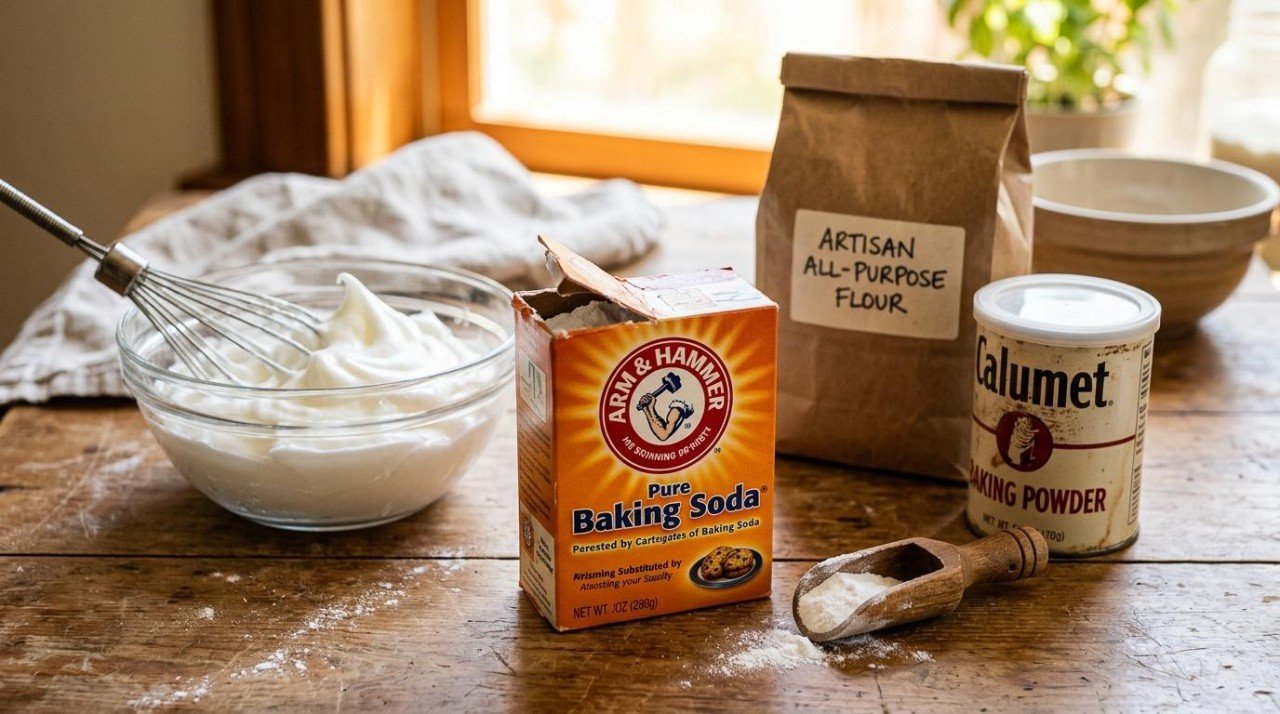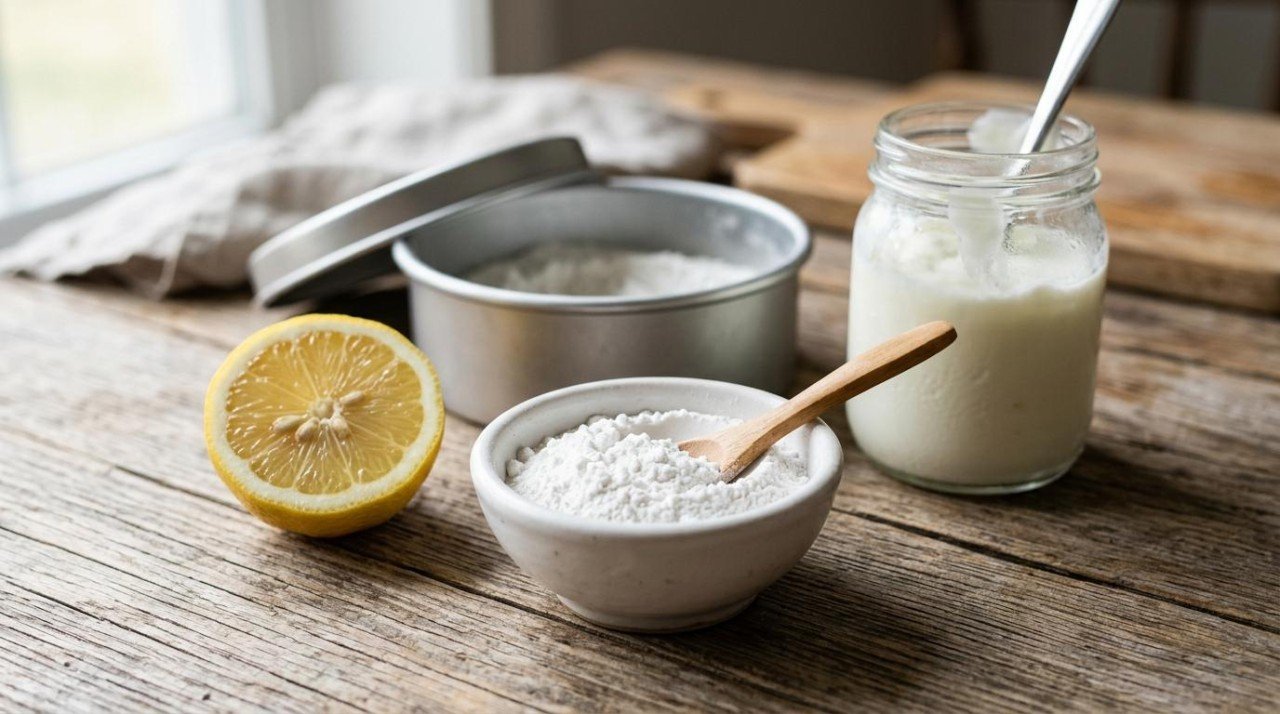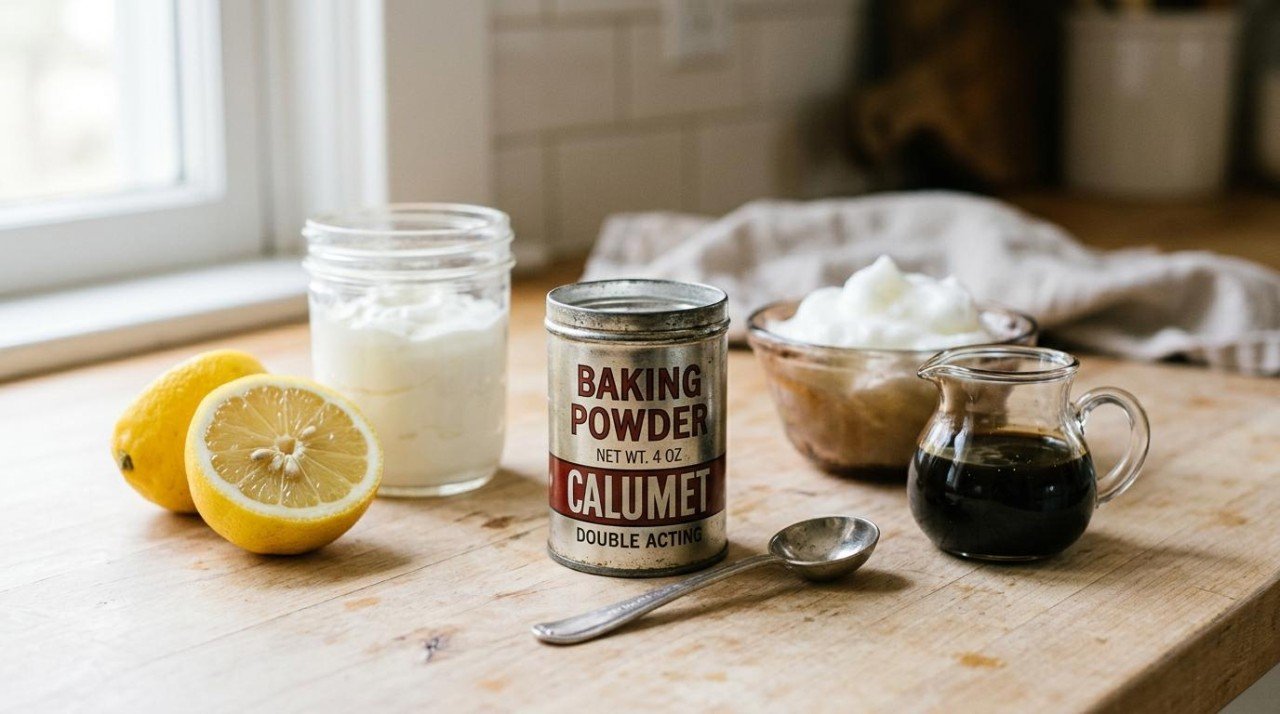
You are halfway through a batch of pancakes or muffins, you reach for the baking powder, and the tin is empty (or worse, it expired two years ago). The batter is waiting. What now?
Good news: baking powder is one of the easiest ingredients in your kitchen to replace, because it is not really one ingredient at all. Baking powder is just baking soda (a base) plus a powdered acid, with a little starch to keep them from reacting in the tin. When those two hit moisture, they produce the carbon dioxide bubbles that make your cake rise. Once you understand that, you can rebuild it from whatever you have on hand.
The catch is that the right swap depends on what else is in your bowl. If your recipe already contains something acidic — buttermilk, yogurt, lemon juice — you may only need a pinch of baking soda. If it does not, you will need to supply the acid yourself. Here is exactly how, with ratios that actually work.
The Quick List
- Baking soda + cream of tartar — the true DIY baking powder; works in anything
- Baking soda + buttermilk or yogurt — best when the recipe has room for liquid
- Baking soda + lemon juice or vinegar — the no-fuss pinch swap for small batches
- Baking soda + molasses — for gingerbread and dark, spiced bakes
- Self-rising flour — if you have it, the leavening is already built in
- Whipped egg whites — mechanical lift for pancakes, waffles, and sponges
- Club soda — a light assist for thin batters, not a full replacement
One rule applies to almost all of these: homemade leaveners are single-acting. More on that at the end, but the short version is get the batter into a hot oven quickly and do not let it sit on the counter.
Baking Soda + Cream of Tartar (the Real DIY Baking Powder)
- Swap: 1 teaspoon baking powder → 1/4 teaspoon baking soda + 1/2 teaspoon cream of tartar
- Best for: Anything — cakes, cookies, muffins, biscuits, pancakes
- Skip it for: Nothing, really; this is a true 1:1 replacement
- Good to know: No liquid adjustment needed; it is naturally aluminum-free
This is the substitute, because it is literally what commercial baking powder is made of. Cream of tartar is a dry, powdered acid (a byproduct of winemaking), so combined with baking soda it behaves exactly like the real thing without adding any moisture or flavor. Whisk it into your dry ingredients and proceed as written.
If you are mixing up a larger batch to keep, add 1/4 teaspoon cornstarch per teaspoon to absorb humidity and stop the acid and base from reacting in the jar — that starch is the only reason store-bought baking powder can sit on a shelf. For a single recipe you are using right away, skip the cornstarch. As a bonus, this version contains no sodium aluminum sulfate, the additive some people find leaves a faintly metallic taste in aluminum-based baking powders.
Baking Soda + Buttermilk or Yogurt
- Swap: 1 teaspoon baking powder → 1/4 teaspoon baking soda + 1/2 cup buttermilk or plain yogurt
- Best for: Pancakes, quick breads, muffins, cakes — anything with liquid to spare
- Skip it for: Dry, stiff doughs where you cannot add half a cup of liquid
- Good to know: Reduce another liquid in the recipe by 1/2 cup to keep the texture right
If your recipe already leans on a cultured dairy product, you are in luck — the acid is built in. Buttermilk and plain yogurt (Greek or regular) are both tangy enough to react fully with baking soda. Because you are adding half a cup of liquid, cut an equal amount of whatever other liquid the recipe calls for, whether that is milk, water, or a little of the oil.
This swap also does nice things for the crumb: the acidity tenderizes gluten, so buttermilk pancakes and yogurt cakes come out especially soft. If you only have plain milk, you can sour it in a pinch — see the buttermilk substitutes guide for that trick and a few others. And if it is Greek yogurt you are reaching for, thin it with a splash of milk so it pours like buttermilk.
Baking Soda + Lemon Juice or Vinegar
- Swap: 1 teaspoon baking powder → 1/4 teaspoon baking soda + 1/2 teaspoon lemon juice or white vinegar
- Best for: Small batches, single-layer cakes, quick pancakes
- Skip it for: Delicate flavors where a faint tang would show through
- Good to know: The amount of liquid is tiny, so no other adjustment is needed
This is the swap when you have no cream of tartar and no cultured dairy — just baking soda and a bottle of vinegar or a lemon. The half teaspoon of acid is enough to react with the soda and small enough that it will not throw off your batter's consistency. Stir the acid into the wet ingredients and the baking soda into the dry, then combine.
Because this reaction starts the instant everything meets, work fast and bake right away. The lift is real but brief, which is why it suits smaller or flatter bakes better than a tall layer cake that needs sustained rise.
Baking Soda + Molasses
- Swap: 1 teaspoon baking powder → 1/4 teaspoon baking soda + 1/4 cup molasses
- Best for: Gingerbread, spice cakes, bran muffins, dark quick breads
- Skip it for: Light-colored or delicately flavored bakes — molasses is assertive
- Good to know: Reduce another liquid by 1/4 cup, and cut back slightly on the recipe's sugar
Molasses is acidic enough to activate baking soda, and it happens to belong in exactly the kind of deep, warm-spiced bakes where its flavor is welcome. Trim about a quarter cup of other liquid to compensate, and since molasses is sweet, ease off the sugar a touch so the finished bake is not cloying.
This is a narrow but genuinely good swap: in gingerbread it is arguably an upgrade, and molasses brings along a little iron, potassium, and calcium that plain baking powder does not — not enough to call it a health food, but a small bonus in a bake that suits it.
Self-Rising Flour
- Swap: Replace the plain flour in the recipe with self-rising flour; omit the baking powder and any added salt
- Best for: Biscuits, pancakes, quick breads, simple cakes
- Skip it for: Recipes that also call for baking soda to neutralize a lot of acid
- Good to know: Self-rising flour is just flour with leavening and salt already mixed in
If you have self-rising flour on the shelf, the problem is basically solved — it is all-purpose flour premixed with baking powder and salt, at a ratio of roughly 1 1/2 teaspoons baking powder and 1/4 teaspoon salt per cup of flour. Swap it in for the plain flour and leave out the separately listed baking powder and salt.
This works cleanly when the recipe's own ratio is close to that standard. If your recipe calls for a lot more or less leavening than 1 1/2 teaspoons per cup, the rise will be off, so this is a best-fit swap rather than a precise one. (Working the other direction — out of self-rising flour instead? The all-purpose flour guide covers how to build it yourself.)
Whipped Egg Whites
- Swap: Separate the eggs, whip the whites to soft peaks, and fold them in last
- Best for: Pancakes, waffles, popovers, sponge cakes, souffles
- Skip it for: Sturdy cookies, biscuits, or drop batters that cannot support folded-in air
- Good to know: This is mechanical lift, not a chemical reaction — no acid or soda involved
Long before baking powder existed, cooks made things rise by beating air into eggs. Whipped whites trap tiny air pockets that expand in the oven, giving you a light, airy lift. If your recipe already uses eggs, separate them, whisk the whites to soft peaks, mix the yolks into the batter as usual, then gently fold the whites in at the very end so you do not knock the air back out.
It takes a little more effort than a spoonful of powder, but for pancakes and waffles the payoff is a noticeably fluffier result — some cooks do this on purpose even when they have baking powder.
Club Soda
- Swap: Replace the milk or water in the recipe with an equal amount of club soda
- Best for: Pancakes, waffles, tempura, and other thin batters that just need a light touch
- Skip it for: Cakes, muffins, or anything needing real, structured rise
- Good to know: This is the weakest option here — treat it as a boost, not a full replacement
Club soda carries dissolved carbon dioxide, and those bubbles add a bit of lightness when you use it in place of the liquid in a batter. It is genuinely handy for pancakes and waffles, where light and tender is the goal and you are cooking right away.
Be realistic about it, though: the lift is modest and short-lived, so club soda cannot carry a cake that depends on baking powder for structure. Use it for thin batters, and pour it in at the last moment so the fizz has not gone flat.
Which Swap Fits Your Recipe?
The honest answer is that it depends on what is already in your bowl — a recipe built on buttermilk wants a different fix than a dry biscuit dough. That is exactly the kind of judgment call that is hard to make from a general list and easy to make when something can see your actual recipe.
That is where Eat Well Planner comes in handy. Its AI recipe chat reads your recipe and tells you which substitution actually fits it — how much baking soda to use, whether the acid is already covered, and what to adjust so the texture holds. And if you need a bigger change, like making a bake egg-free or dairy-free, it can rewrite the whole recipe as a variation with the swaps already worked in. It is a free web app that also imports recipes from any site, plans your meals, and builds your shopping list — so the next time you are missing an ingredient, you can check before you are elbow-deep in batter.
Take the Guesswork Out of Eating Well
Eat Well Planner helps you organize your favorite recipes, plan balanced meals, and automatically generate shopping lists — all in one place. Whether you're tracking macros, managing dietary restrictions, or just trying to stop asking "what's for dinner?", we've got you covered.
Our AI-powered tools can adapt any recipe to your dietary needs, help you discover new meals you'll love, and even log your nutrition effortlessly. It's meal planning made simple.
Start Organizing Your Meals — FreeWhat Not to Use
- Baking soda on its own. This is the most common mistake. Baking soda is only the base half of the equation — without an acid to react with, it will not produce enough gas to leaven, and any excess leaves a soapy, metallic taste. Always pair it with an acid.
- Expired baking powder. If your only baking powder is old, do not assume it still works. Stir 1/2 teaspoon into a few tablespoons of hot water — if it fizzes energetically, it is fine; if it barely bubbles, it is dead and your bake will be flat.
- Yeast. Yeast is a living leavener that needs time to ferment and produce gas. It is not a fast, one-for-one stand-in for baking powder in a quick batter, so do not reach for it here.
A Quick Word on Single vs Double Acting
Most store-bought baking powder is double-acting: it releases some gas the moment it gets wet, then a second burst when it hits oven heat. That built-in delay is forgiving — the batter can sit for a few minutes and still rise well.
Nearly every homemade substitute above is single-acting. The reaction happens all at once, as soon as the acid meets the baking soda in a wet batter, and then it is spent. The practical takeaway is simple: mix quickly, do not let the batter rest, and get it into a preheated oven or onto a hot griddle right away. Do that, and a two-ingredient fix will rise just as proudly as the tin you ran out of.