The recipe says "top with a big handful of arugula," and the clamshell in your fridge is either empty or has gone dark and slick at the bottom. Arugula is delicate and spoils fast, so this happens a lot. The good news is that it is easy to replace, as long as you know which part of arugula your recipe actually needs.
Arugula does three jobs at once. It brings a peppery, mustardy bite, a little bitterness, and a tender leaf that wilts in seconds on a hot pizza or a bowl of pasta. No single substitute nails all three. Watercress comes closest on flavor, baby spinach on texture, and radicchio or endive on bitterness. So pick the swap by the dish: a raw salad, a finish for pizza or pasta, or a pesto.
One number before you start: arugula is light. By USDA weights, half a cup of arugula is only about 10 g, so a cup is about 20 g and a standard 5-ounce clamshell holds roughly 7 cups. Most greens below swap 1:1 by loosely packed cups, which is how most salad and pizza recipes measure. If your recipe gives ounces or grams, swap by weight instead.
The Quick List
- Watercress — the closest flavor match: peppery, tender, and good raw or wilted
- Baby spinach — the easiest, most available swap; mild, so add pepper elsewhere
- Mizuna — a Japanese mustard green that tastes like gentler arugula
- Baby mustard greens or a "spicy greens" mix — more heat than arugula, best mixed with a milder leaf
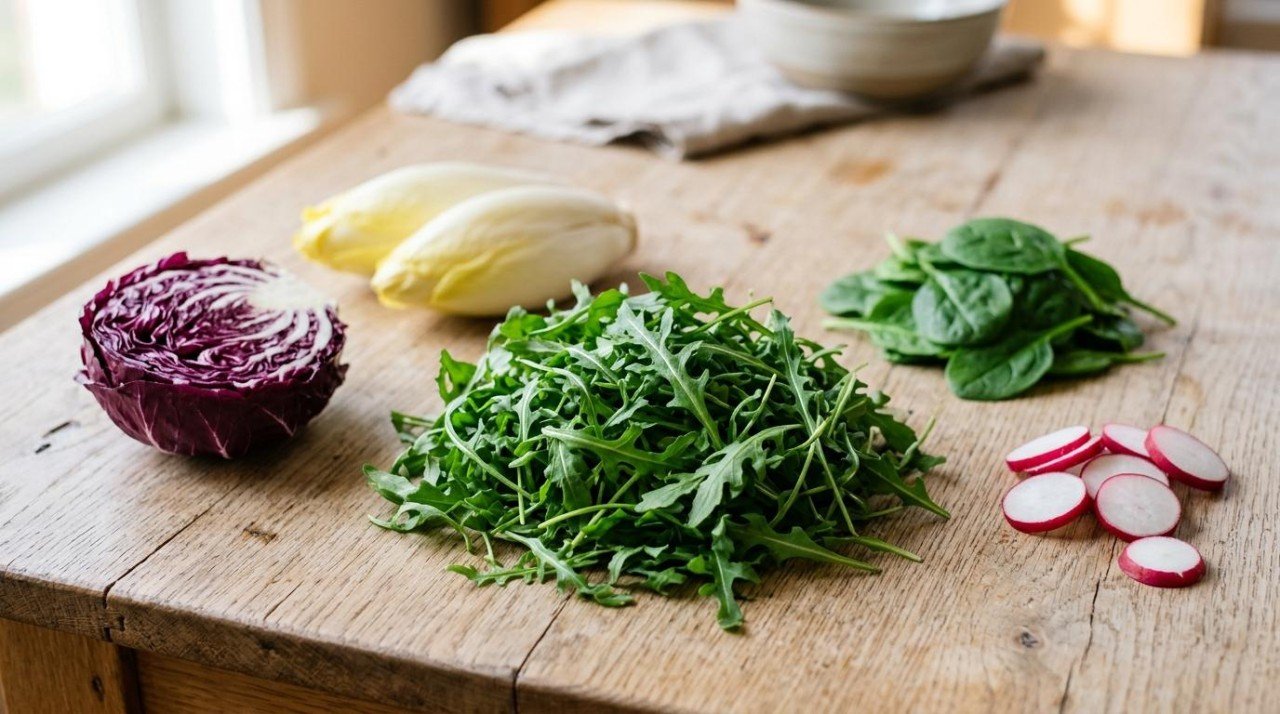
- Radicchio — bitter and crunchy; great in salads and grilled or wilted into pasta
- Endive, frisée, or escarole — the bitter-leaf family, from crisp raw salads to wilted soups
- Dandelion greens — the most bitter swap; young leaves raw, older ones cooked
- Baby kale — sturdier and earthier; holds up in salads that sit, and in pesto
- Spring mix (mesclun) — an easy all-purpose salad swap that often contains some arugula already
- Romaine or leaf lettuce plus radish — fake arugula's pepper with what is already in your fridge
- Radish microgreens or garden cress — a peppery finishing garnish for pizza, toast, and eggs
- Fresh basil — for pesto and pizza only, where it is the original green anyway
Best Swap by Dish
- Simple green salad with lemon and Parmesan: watercress, mizuna, or half baby spinach and half radicchio
- Salad with fruit, cheese, and nuts: watercress, spring mix, or baby kale
- Topping for pizza or flatbread: watercress, baby spinach, or radish microgreens
- Wilted into hot pasta, grains, or risotto: baby spinach, watercress, radicchio, or escarole
- Sandwiches and wraps: watercress, baby spinach, or romaine with a little black pepper
- Pesto: watercress, basil, baby spinach, or baby kale
- Soups: watercress, escarole, or baby spinach, stirred in at the end
Fresh Leafy Substitutes
Watercress
- Swap: 1:1 by loosely packed cups or by weight. Trim off any thick lower stems first
- Best for: Raw salads, sandwiches, pizza toppings, pesto, soups, and wilting into pasta or grains
- Skip it for: Salads that need to sit dressed for a long time; watercress goes limp within an hour
- Health notes: Per 100 g raw, 43 mg vitamin C and 250 mcg vitamin K, against arugula's 15 mg and 109 mcg
If you want your dish to taste the way the recipe intended, watercress is the swap. It is in the same plant family as arugula (the mustards and cabbages), and its bite comes from the same kind of mustard-oil compounds, released when the leaf is cut or chewed. It is crisper and juicier than arugula, with a clean, peppery heat that is sometimes a little stronger, so taste a sprig before you decide how much to use.
Watercress is also the best cooked swap. Scatter it over a pizza after it comes out of the oven, toss it through hot pasta off the heat, or stir it into a brothy soup in the last 30 seconds. It wilts as fast as arugula does. Most stores sell it in bunches, often near the herbs, or as "living" watercress with the roots still attached, which keeps several days longer in the fridge.
Baby Spinach
- Swap: 1:1 by loosely packed cups. For more bite, add freshly cracked black pepper, a few sliced radishes, or a teaspoon of Dijon mustard to the dressing
- Best for: Pizza toppings, wilting into pasta and grains, sandwiches, wraps, egg dishes, and milder salads
- Skip it for: Salads where arugula's pepper is the main flavor, like a simple arugula, lemon, and Parmesan salad
- Health notes: More folate than arugula, at 194 mcg per 100 g against 97 mcg
Baby spinach is the substitute most people already have, and for texture it is nearly perfect. The leaves are just as tender, they wilt just as fast on a hot pizza or in pasta, and they hold up in a sandwich. What you lose is the flavor. Spinach is mild and a little sweet, so on its own it makes a dish taste flatter than the recipe intended.
The fix is to put the bite back somewhere else. Crack plenty of black pepper over the top, add thin slices of radish, or whisk a little Dijon into the vinaigrette. A 50/50 mix of baby spinach and any of the bitter leaves below (radicchio, endive, frisée) gets surprisingly close to the real thing. And if spinach is the thing you are out of, our fresh spinach substitutes guide runs this swap in the other direction.
Mizuna
- Swap: 1:1 by loosely packed cups, thin white stems and all
- Best for: Raw salads, grain bowls, noodle salads, sandwiches, and soups (stir in at the end)
- Skip it for: Pesto, where its feathery leaves and crunchy stems blend thinner and milder than arugula
Mizuna is a Japanese mustard green with deeply cut, feathery leaves and crisp white stems. It tastes like a toned-down arugula: mildly peppery, a little sweet, and fresh. You will often find it in spring mixes, and some stores sell it on its own in clamshells or at farmers' markets, especially in cool months.
Because it is milder, mizuna is a good pick for anyone who finds arugula a bit aggressive. In a salad that relies on arugula's bite, add a little extra lemon or a sharper cheese to make up the difference.
Baby Mustard Greens or a "Spicy Greens" Mix
- Swap: Start with half the amount and make up the rest with a mild green like baby spinach or butter lettuce; taste before adding more
- Best for: Salads with rich ingredients (bacon, blue cheese, roasted squash), sandwiches, and stir-fries
- Skip it for: Delicate salads and pesto, where the heat can take over
- Health notes: Per 100 g raw, 70 mg vitamin C and 3.2 g fiber, roughly double arugula's fiber
Baby mustard greens (red giant, green wave, and similar varieties) have real heat, closer to horseradish than to black pepper. Many stores sell them in blends labeled "spicy greens," "spicy mix," or "Asian greens," often with mizuna, tatsoi, and sometimes arugula itself. A blend like that is one of the best swaps you can buy, because it already balances heat and mildness for you.
If you have straight baby mustard greens, cut them with a mild leaf. A 50/50 mix gives you about arugula's level of bite. Mature mustard greens are too tough and too hot to eat raw; save them for cooking, where they work in place of arugula in sautés and soups.
Radicchio
- Swap: In salads, use half radicchio and half a mild green, thinly sliced, to replace the arugula 1:1 by cups. For cooked dishes, use 1:1
- Best for: Salads with fruit, nuts, and cheese; grilled or roasted as a side; wilted into pasta and risotto
- Skip it for: Pizza toppings and sandwiches if you want something soft; radicchio is crunchy and firm
Radicchio swaps arugula's pepper for bitterness, and that is often exactly what a recipe wants. In a salad with pears, walnuts, and Parmesan, or with oranges and olives, the bitterness does the same job arugula does: it cuts through richness and sweetness. On its own, a whole bowl of radicchio is a lot, so slice it thin and mix it with a mild green.
Radicchio also cooks beautifully, which arugula really does not beyond a quick wilt. Sliced and stirred into hot pasta or risotto, it softens and its bitterness mellows. Halved and grilled or roasted until the edges char, it turns into a side dish all its own. Tip: a 10-minute soak in ice water softens its bite and crisps it up for salads.
Endive, Frisée, or Escarole
- Swap: 1:1 by loosely packed cups, chopped or torn into bite-size pieces
- Best for: Belgian endive for crisp raw salads; frisée for bistro salads with egg and bacon; escarole for soups, beans, and wilted pasta
- Skip it for: Pesto and pizza toppings (except escarole, which wilts well)
- Health notes: Curly endive and escarole have 3.1 g fiber and 142 mcg folate per 100 g, about double arugula's fiber and half again its folate
These are all chicories, the same family as radicchio, and they all bring a gentle bitterness in place of arugula's pepper. Belgian endive is the small, tight, pale head; sliced into rounds or separated into leaves, it is crisp and mild. Frisée is the frizzy, pale-centered head that holds dressing well and is classic under a poached egg. Escarole has broad, tender leaves with a buttery feel; it is great raw in a salad and even better cooked.
Escarole is the best cooked swap in the group. It holds its shape when wilted into soup (it is the classic green in Italian wedding soup and greens-and-beans), and stirred into hot pasta it behaves much like arugula, softening in a minute or two. For raw salads, mix any of these with watercress or a few radish slices if you miss the pepper.
Dandelion Greens
- Swap: 1:1 for young, tender leaves in salads; for larger, older leaves, blanch 30 to 60 seconds or sauté before using
- Best for: Salads with a warm bacon or garlic dressing, sautés, pasta, and grain bowls
- Skip it for: Anyone sensitive to bitter flavors, and delicate salads where arugula plays a supporting role
- Health notes: Per 100 g raw, 3.5 g fiber, 187 mg calcium, 3.1 mg iron, and 778 mcg vitamin K, more than arugula on all four
Dandelion greens are more bitter than arugula, with a little of the same green bite. Young leaves (small, thin, from spring or a tender bunch at the store) work raw, especially with a warm, salty dressing that balances the bitterness. Older, larger leaves get much more bitter. A quick blanch in boiling water, then a sauté with garlic and olive oil, turns them into an excellent side or pasta green.
Buy them from a store or a farmers' market rather than picking them from a lawn, unless you know for sure the area has not been sprayed. And note the vitamin K: it is high enough to matter for anyone on warfarin (more on that below).
Baby Kale
- Swap: 1:1 by loosely packed cups
- Best for: Salads that need to sit dressed for a while, lunch-box salads, grain bowls, and pesto
- Skip it for: Delicate pizza toppings and quick-wilt pasta, where it stays chewier than arugula
- Health notes: Per 100 g raw, kale has 4.1 g fiber, 254 mg calcium, and 93 mg vitamin C, against arugula's 1.6 g, 160 mg, and 15 mg
Baby kale is more substantial than arugula: a little chewier, earthier, and only faintly peppery. That sturdiness is an advantage in a salad you dress ahead, since it does not wilt into a puddle the way arugula does. It is also a good pesto green, with more body than arugula and less bite.
Mature curly or lacinato kale can work in a raw salad too, but only if you strip out the ribs, slice the leaves thin, and massage them with a little olive oil and salt for a minute or two until they darken and soften. Without that step, it is too tough to stand in for arugula.
Spring Mix (Mesclun)
- Swap: 1:1 by loosely packed cups
- Best for: Any everyday green salad, sandwiches, wraps, and as a bed for grilled chicken or fish
- Skip it for: Pesto and dishes where arugula's flavor is the point
Spring mix is a blend of young lettuces and other baby greens, and many brands include some arugula, mizuna, or radicchio in the blend. Check the label. A mix that lists arugula or mustard greens will be your closest match. Plain lettuce blends are milder, so add a bitter or peppery element (a few radicchio shreds, black pepper, or radish) if the salad tastes flat.
Romaine or Leaf Lettuce Plus Radish
- Swap: For every 4 cups of arugula, use 4 cups of torn romaine or leaf lettuce plus 1/4 cup thinly sliced radishes and plenty of freshly cracked black pepper
- Best for: Weeknight salads, sandwiches, and wraps when lettuce is all you have
- Skip it for: Wilting into pasta or onto pizza; lettuce turns watery and limp with heat
This is the "use what is in the fridge" option. Lettuce gives you the crisp, fresh base, and radishes bring the peppery note, from the same family of mustard-oil compounds as arugula. A teaspoon of Dijon or whole-grain mustard in the dressing pushes it further. It will not fool anyone, but it fills the role.
Lettuce has less going on nutritionally than arugula. Green leaf lettuce has 36 mg calcium and 1.3 g fiber per 100 g, against arugula's 160 mg and 1.6 g. That is fine for one salad, but if lettuce is your default green every night, the swaps above give you more.
Radish Microgreens or Garden Cress
- Swap: About 1/2 cup per pizza or per 4-cup salad, mixed with a mild green to make up the volume
- Best for: Topping pizza, flatbreads, avocado toast, eggs, sandwiches, and grain bowls
- Skip it for: A full salad base or pesto; they are a garnish, not a green
Radish microgreens and garden cress (the tiny sprouts sold in small boxes, sometimes called pepper cress) are intensely peppery for their size. They will not give you a bed of leaves, but scattered over a pizza or a sandwich, they bring back the flavor arugula would have added. Pair them with baby spinach for volume.
Fresh Basil (for Pesto and Pizza Only)
- Swap: In pesto, 1:1 by packed cups. On pizza, use about half as much basil as arugula, torn
- Best for: Arugula pesto, pizza, flatbread, and tomato-based pasta
- Skip it for: Green salads, where basil is an herb, not a leafy base
If your arugula was going into pesto or onto a margherita-style pizza, basil is the obvious answer, since it is what those dishes were built around in the first place. You trade pepper for sweetness, so the result is a different dish, not a copy. For something in between, blend half basil and half baby spinach or watercress. Our fresh basil substitutes guide covers arugula as a basil replacement, and the pesto substitutes guide has the full pesto formula for whatever greens you have.
Arugula Pesto Without Arugula
For a typical batch of arugula pesto (2 packed cups of arugula), here is how the substitutes stack up:
- Watercress: 2 packed cups, thick stems removed. The closest flavor, peppery and bright
- Half basil, half baby spinach: 1 cup of each. Classic, milder, and a little sweet
- Baby kale: 2 packed cups. Thicker and earthier; add an extra squeeze of lemon and a little more oil to loosen it
- Baby spinach: 2 packed cups, plus extra garlic, lemon zest, and black pepper so it does not taste flat
Whatever green you use, add it gradually and taste as you go, and toss the pesto through hot pasta off the heat, since heat makes peppery greens taste more bitter. If you are short on pine nuts too, our pine nut substitutes guide has you covered.
How the Substitutes Compare Nutritionally
Arugula is a light, low-calorie green, at about 25 calories per 100 g, with 1.6 g fiber, 160 mg calcium, and 97 mcg folate. Several substitutes beat it on specific nutrients, per 100 g raw, using USDA data:
- Fiber: Kale (4.1 g), dandelion greens (3.5 g), mustard greens (3.2 g), and escarole/curly endive (3.1 g) all have about double arugula's 1.6 g. Watercress (0.5 g) and radicchio (0.9 g) have less.
- Calcium: Kale (254 mg) and dandelion greens (187 mg) beat arugula's 160 mg. Watercress (120 mg) and spinach (99 mg) come in lower, and spinach's calcium is poorly absorbed because of its oxalate.
- Vitamin C: Kale (93 mg), mustard greens (70 mg), and watercress (43 mg) are all well ahead of arugula (15 mg).
- Folate: Spinach (194 mcg) and escarole/curly endive (142 mcg) beat arugula's 97 mcg; watercress has very little (9 mcg).
One thing arugula does better than almost any other common vegetable: dietary nitrate. In one study, autumn arugula samples averaged about 435 mg of nitrate per 100 g, roughly double the spinach and more than three times the lettuce and kale in the same autumn samples. Nitrate content varies a lot with soil and season, but arugula reliably ranks near the top. If you eat arugula partly for that, spinach and lettuce are the next best swaps. Our post on dietary nitrates and blood pressure explains what the research does and does not show.
If you take warfarin, pay attention to vitamin K when you swap greens. Arugula has about 109 mcg per 100 g, but watercress has 250, radicchio 255, kale 390, spinach 483, and dandelion greens 778. MedlinePlus lists many of these greens among the foods that affect warfarin, and advises people not to change how much of them they eat day to day or week to week. A one-time swap in a salad is unlikely to matter much, but if you are replacing arugula as a daily habit, talk with your provider first. Our guide to food-drug interactions goes into more detail.
A bonus: trying a green you do not usually buy, like mizuna, escarole, or dandelion greens, adds a new plant to your week. A wider variety of plants is linked to a more diverse gut microbiome, as we explain in 30 plants a week: what actually happens inside your body, and Eat Well Planner's Plant Points tracker counts each new green toward that goal.
Still not sure which green fits the recipe in front of you? In Eat Well Planner, you can ask the AI recipe chat right from your saved recipe ("I'm making this pizza and I only have spinach and radicchio — what should I do?") and get an answer that accounts for everything else in the dish. Or open the recipe in the Recipe Playground, swap arugula for kale or watercress, and see what changes in the nutrition score before you commit.
Take the Guesswork Out of Eating Well
Eat Well Planner helps you organize your favorite recipes, plan balanced meals, and automatically generate shopping lists — all in one place. Whether you're tracking macros, managing dietary restrictions, or just trying to stop asking "what's for dinner?", we've got you covered.
Our AI-powered tools can adapt any recipe to your dietary needs, help you discover new meals you'll love, and even log your nutrition effortlessly. It's meal planning made simple.
Start Organizing Your Meals — FreeWhat Not to Use
- Iceberg lettuce on its own. It is crunchy and watery with almost no flavor, so it cannot stand in for arugula's bite or bitterness. Mix it with something sharper, or skip it.
- Any lettuce on a hot pizza or in hot pasta. It turns limp and watery with heat. Use baby spinach, watercress, or escarole instead.
- Mature mustard greens or collards raw. They are too tough and, in the case of mustard greens, too hot. Save them for cooking.
- Unmassaged mature kale in a raw salad. It stays tough and chewy. Use baby kale, or massage it first.
- Dried herbs. Arugula is a leafy green, not a seasoning, and no dried herb gives you its fresh bite or its volume.
- Peppery greens in a sweet smoothie. Arugula is rarely in smoothies anyway, but if it was, use baby spinach, not watercress or mustard greens.
The Bottom Line
Watercress is the best all-around substitute for arugula, raw or wilted, at 1:1. Baby spinach is the easiest swap, as long as you add some bite back with black pepper, radish, or a sharp dressing. Mizuna and spicy greens mixes bring the pepper, radicchio, endive, and dandelion greens bring the bitterness, and escarole is the best green for cooking. For pesto, use watercress or a basil-and-spinach blend. Several of these swaps also add more fiber, calcium, or vitamin C than arugula would have.
And when you are looking at a specific recipe and still are not sure, you do not have to adapt it line by line. Eat Well Planner can create a recipe variation with the swap already worked in, from the salad dressing to the cooking times, so dinner still happens with whatever greens are in your fridge.