The flour is measured, the milk is warming, and the yeast jar turns out to hold a dusting of granules and a 2024 expiration date. Before you give up on the bread, look at what you do have, because yeast is one of the few ingredients where the best substitute is very often a different form of the same thing.
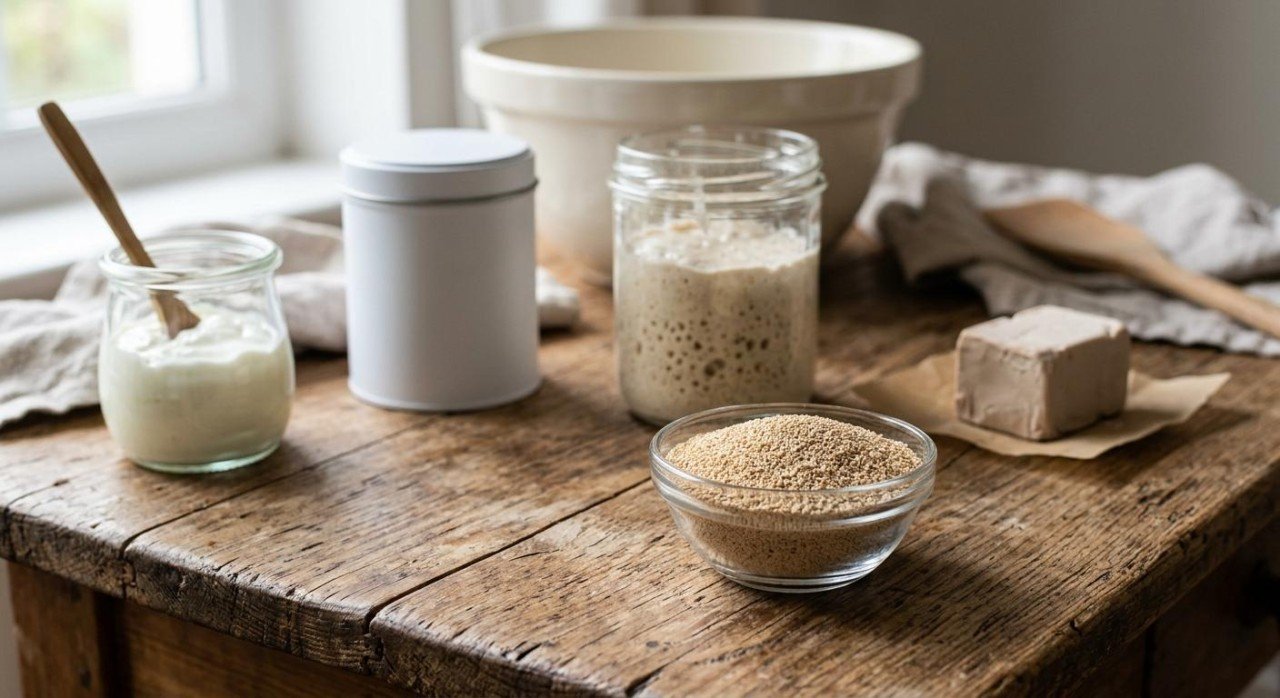
If there is any instant yeast, rapid-rise yeast, bread machine yeast, or fresh cake yeast in the house, you are fine: those convert to active dry with simple, exact numbers. If there is half a packet, that is also enough, with a longer rise. And if you have a sourdough starter, you have something arguably better than what the recipe asked for.
With no yeast of any kind, you can still bake, but not the same thing. Baking soda and baking powder leaven a dough in minutes instead of hours, which means a different recipe, not a swap. Below are the conversions first, then the yeast-free options sorted by what you are making: bread, pizza, or sweet enriched dough.
The Quick List
- Instant yeast (also sold as rapid-rise, quick-rise, or bread machine yeast) — a 1:1 swap; rises 15 to 20 minutes faster
- Fresh cake yeast — about 2 1/2 times the weight; 0.6 oz replaces one packet
- Less yeast and a longer rise — when you have some yeast, just not enough
- Sourdough starter — about 100 g replaces a packet; slower, tangier, and the most nutritious option
- Buttermilk + baking soda — no-yeast bread: switch to a soda bread
- Greek yogurt + baking powder — no-yeast pizza and flatbread dough, ready in 20 minutes
- Baking powder biscuit dough — no-yeast cinnamon rolls and dinner rolls
The Conversion Cheat Sheet
Bookmark this part. One standard packet of yeast equals all of the following, according to Red Star's conversion chart and the other sources linked below:
- Active dry yeast: 1 packet = 1/4 oz = 7 g = 2 1/4 teaspoons
- Instant yeast: the same 7 g or 2 1/4 teaspoons
- Fresh cake yeast: 0.6 oz (about 17 g), or one third of a 2 oz cake
- Active sourdough starter: about 100 g (a scant 1/2 cup), minus 50 g flour and 50 g water from the recipe
- How much flour it raises: up to about 4 cups
If your recipe lists yeast in teaspoons from a jar rather than packets, the same math works: 2 1/4 teaspoons is one packet.
1. Instant Yeast (Rapid-Rise, Quick-Rise, Bread Machine Yeast)
- Swap: 1 packet (2 1/4 teaspoons) active dry → 2 1/4 teaspoons instant yeast, mixed straight into the flour
- Best for: Everything — sandwich loaves, pizza dough, rolls, cinnamon rolls, focaccia
- Skip it for: Nothing, though in a bread machine use about 25% less (see below)
Instant and active dry are both dried baker's yeast; instant is just milled finer and dried more gently, so it wakes up faster. King Arthur's advice is blunt: substitute instant 1:1 by weight or volume. You will see "use 25% less instant" repeated online, but that figure comes from bread machine guidance, where the warm, short cycles make instant too lively. For hand-kneaded or stand-mixer dough, the same amount is right.
Two adjustments. First, skip the proofing step: whisk the instant yeast into the dry ingredients and add the recipe's liquid as written. If the recipe had you dissolve the yeast in a separate 1/4 cup of water, just add that water with the rest. Second, start checking the dough early. Instant yeast dough rises about 15 to 20 minutes faster than active dry in the first rise, and in a long 2 to 3 hour rise the difference mostly disappears. Watch the dough, not the clock: it is ready when it has roughly doubled and a floured finger poke springs back slowly.
2. Fresh Cake Yeast
- Swap: 1 packet active dry → 0.6 oz (17 g) fresh yeast, or one third of a 2 oz cake, crumbled
- Best for: Brioche, challah, cinnamon rolls, panettone-style breads, any bread
- Skip it for: Nothing — but check the date, since it lasts only weeks
Fresh yeast is the same organism with the water left in, which is why you need about two and a half times as much by weight. Red Star pegs it at one third of a 2 oz cake per packet of dry yeast. If you find a different size in a European grocery, the 2.5:1 ratio by weight still holds: 7 g of active dry becomes about 17 g fresh.
Use cooler liquid than you would for active dry. Red Star recommends liquids around 90°F for fresh yeast, and crumbling it over the flour away from the salt and sugar, which can slow it down. Fresh yeast is perishable: refrigerated, it keeps about five weeks from production. It should smell pleasantly beery and crumble cleanly. Gray, sticky, or sour-smelling yeast is past it.
3. Less Yeast and a Longer Rise
- Swap: Whatever yeast you have, down to about 1/2 teaspoon per 4 cups of flour, with a much longer or overnight rise
- Best for: Lean doughs — sandwich bread, pizza dough, focaccia, rustic loaves
- Skip it for: Very sweet, buttery doughs, which already slow yeast down
Yeast multiplies as dough ferments, so the amount in a recipe really controls speed, not whether the dough rises. Half a packet does the same job as a full one; it just needs more time. That makes "not enough yeast" the most forgiving problem in baking, and slow, cool rises also build more flavor, which is why many pizza and artisan bread recipes use small amounts of yeast on purpose.
For an overnight rise in the refrigerator, Nigella Lawson's team suggests cutting the yeast in a standard loaf to about 1 to 1 1/4 teaspoons (3 g), then letting the shaped dough rise again the next day for around 2 hours since it starts cold. At room temperature, half the yeast roughly means plan for a rise that takes up to twice as long. The dough tells you when it is ready, so judge by volume and the poke test rather than the timer.
4. Sourdough Starter
- Swap: 1 packet active dry → about 100 g (a scant 1/2 cup) active, bubbly starter; reduce the recipe's flour by 50 g (about 6 tablespoons) and its water by 50 g (about 3 1/2 tablespoons)
- Best for: Rustic loaves, sandwich bread, pizza dough, focaccia, dinner rolls
- Skip it for: Anything you need today, and very rich doughs if you are new to sourdough
- Health notes: Long sourdough fermentation breaks down more phytic acid, which frees up minerals (details below)
A healthy starter is a community of wild yeasts and lactic acid bacteria, so it leavens bread on its own. The conversion from The Pantry Mama is easy to remember: about 100 g of bubbly starter per packet of yeast, then take 50 g each of flour and water out of the recipe, since a typical starter is equal parts of both. If the recipe's liquid is milk, reduce the water instead of the milk.
Be realistic about timing. The same guide warns you will need to more than double the rising time in most cases; a dough that rose in 1 to 2 hours with yeast may take 4 to 6 with starter, plus the final proof. Use the starter at its peak, a few hours after feeding when it has roughly doubled. A starter straight from the fridge will leave you with a dense loaf. Expect a mild tang, more in lean bread, barely any in sweet dough.
No Yeast at All? Pick a Recipe Built for Chemical Leavening
Here is the honest truth that most "yeast substitute" lists skip: baking soda and baking powder cannot stand in for yeast in a yeast recipe. Yeast gives a dough hours to develop gluten and flavor while it slowly fills with gas. Chemical leaveners release almost all their gas within minutes of getting wet and in the oven's first moments, so a yeast dough leavened with baking powder comes out dense, pale, and flavorless. Kneading it makes it worse.
What works is switching to a recipe designed around chemical leavening for the same use. The three below cover most situations.
5. For Bread: Buttermilk + Baking Soda (Soda Bread)
- Swap: Instead of a yeast loaf → 4 cups all-purpose flour + 1 teaspoon baking soda + 1 teaspoon salt + 1 1/2 cups buttermilk, baked at about 425°F for roughly 40 minutes
- Best for: A rustic loaf for soup, stew, toast, or butter and jam
- Skip it for: Sandwich bread with a soft, even crumb; it will not slice that thin
Irish soda bread is the original no-yeast bread, and this four-ingredient version is about as simple as baking gets. Stir the dough just until it comes together; it should be shaggy, not smooth. Shape a round, cut a deep cross on top so the center bakes through, and get it in the oven right away, since the baking soda starts reacting the moment it hits the buttermilk. If the dough looks dry and crumbly, add more buttermilk a splash at a time.
Out of buttermilk too? Our buttermilk substitutes guide has the milk-plus-lemon-juice fix, and the baking soda guide covers what to do if that is the missing piece. Soda bread is also an easy place to work in whole grains: swapping up to half the flour for whole wheat gives a hearty, nutty loaf, closer to the traditional brown soda bread.
6. For Pizza and Flatbreads: Greek Yogurt + Baking Powder
- Swap: Instead of yeast pizza dough → 1 1/2 cups all-purpose flour + 1 1/2 teaspoons baking powder + 1/2 teaspoon salt + 1 cup plain Greek yogurt, baked at 425°F
- Best for: Weeknight pizza, flatbreads, naan-style wraps, calzones
- Skip it for: A tall, airy, Neapolitan-style crust with big holes
- Health notes: The yogurt replaces water, adding protein and calcium to the crust
This is the one no-yeast swap that people often end up preferring. The recipe from iFoodReal makes one pizza: mix 1 1/4 cups of the flour with the baking powder and salt, stir in the yogurt, and knead briefly on the counter with the remaining 1/4 cup of flour. No rise, no rest. Roll it thin for a crisp crust, thicker for a soft one, and bake about 15 minutes with toppings. The yogurt's acidity gives it a gentle tang a lot like a long-fermented dough.
Any fat level of Greek yogurt works. For a dough that sticks badly, add flour a tablespoon at a time, but stop as soon as it is manageable; too much makes the crust dense. If you are out of Greek yogurt, the Greek yogurt guide covers straining regular yogurt, and if your baking powder is old, test a pinch in hot water first. It should fizz hard.
7. For Cinnamon Rolls and Dinner Rolls: Baking Powder Biscuit Dough
- Swap: Instead of an enriched yeast dough → a biscuit-style dough with about 1 1/2 teaspoons baking powder and 1/4 teaspoon salt per cup of flour, plus cold butter and milk or buttermilk
- Best for: Quick cinnamon rolls, pull-apart rolls, sticky buns, savory rolled scrolls
- Skip it for: Brioche, challah, and anything that should be stretchy and feathery
Rich, sweet doughs are where the yeast-free version strays furthest from the original, so go in knowing you are making a biscuit that happens to be rolled. That ratio is the same one built into self-rising flour, so a cup of self-rising flour can stand in for the flour, baking powder, and salt together. Roll the dough about 1/2 inch thick, fill, roll up, slice, and bake hot (400 to 425°F) until golden. Handle it as little as possible; overworked biscuit dough turns tough.
The result is tender and flaky rather than soft and pillowy, and best eaten warm the same day. They make good, quick cinnamon rolls. They are not a convincing dinner roll for a holiday table, where it is worth getting real yeast or starting a starter-based dough the day before.
Which Swap Fits What You Are Baking
Sandwich Bread and Rustic Loaves
Instant yeast 1:1 if you have it. Otherwise use whatever yeast is left with a longer or overnight rise, or sourdough starter if you can wait. With no yeast at all, soda bread is a different loaf but a very good one.
Pizza Dough
Pizza dough is the most flexible case. It actively benefits from small amounts of yeast and a slow cold rise, so even 1/2 teaspoon of yeast and a night in the fridge gives you a better crust than a full packet and an hour. No yeast at all? The Greek yogurt dough is ready faster than the oven heats up.
Enriched Doughs (Brioche, Challah, Cinnamon Rolls)
Sugar and butter slow yeast down. Red Star advises adding one extra packet of dry yeast when a recipe has more than 1/2 cup of sugar per 4 cups of flour, so these are the doughs where cutting the yeast back hurts most. Instant or fresh yeast are your best swaps here; fresh yeast is a traditional favorite for brioche. Sourdough works but takes practice and a long day. For the no-yeast version, biscuit-dough cinnamon rolls are the practical answer.
The Healthier Upgrade: Sourdough Starter
All forms of commercial yeast are nutritionally identical in the amounts used, so switching between them changes your schedule, not your nutrition. Sourdough is the exception, and the difference comes from the long fermentation rather than the starter itself.
Whole grains contain phytic acid, which binds minerals like magnesium, zinc, and iron and makes them harder to absorb. In a 2001 study in the Journal of Agricultural and Food Chemistry, sourdough fermentation cut the phytate in whole wheat bread by 62%, compared with 38% for yeast fermentation, and the extra acidity increased the solubility of magnesium and phosphorus. The authors noted that human studies are still needed to confirm how much more of those minerals the body actually takes up, so treat it as a likely bonus, not a guarantee.
The benefit is largest in whole grain bread, since that is where most of the phytic acid is, so this pairs well with the whole wheat swap. Some research also suggests well-fermented sourdough raises blood sugar a little less than ordinary bread. We dug into how strong that evidence is in Does Sourdough Really Go Easier on Your Blood Sugar?, and if you are buying rather than baking, How to Buy Bread That's Actually Whole Grain covers reading the label.
Take the Guesswork Out of Eating Well
Eat Well Planner helps you organize your favorite recipes, plan balanced meals, and automatically generate shopping lists — all in one place. Whether you're tracking macros, managing dietary restrictions, or just trying to stop asking "what's for dinner?", we've got you covered.
Our AI-powered tools can adapt any recipe to your dietary needs, help you discover new meals you'll love, and even log your nutrition effortlessly. It's meal planning made simple.
Start Organizing Your Meals — FreeThe Reverse Problem: The Recipe Calls for Instant and You Have Active Dry
Use the same amount, and add 15 to 20 minutes to the first rise. King Arthur notes that modern active dry no longer needs to be dissolved first, so you can stir it straight into the flour too. If the jar is old or you are not sure it is alive, though, proofing it is a cheap test: stir it into 1/4 cup of water at about 110°F with a pinch of sugar. Within 10 minutes it should be foamy and smell like bread. No foam means dead yeast, and it is better to find out now than after a two-hour rise that never happens. Subtract that 1/4 cup from the recipe's liquid.
For bread machines, follow the manual. Machines are timed for a specific yeast type, and active dry may not be fully awake by the end of an instant-yeast cycle.
What Not to Use
- Nutritional yeast. It is yeast, but it has been heated and deactivated, so it adds savory, cheesy flavor and zero rise. If that is what you are short on, see our nutritional yeast substitutes instead.
- Brewer's yeast supplements. Also inactive. Sold as a nutritional supplement, not a leavener, and quite bitter.
- Beer. Most commercial beer is filtered or pasteurized and carries little or no live yeast. Beer bread rises because of the baking powder in its self-rising flour, not the beer.
- Baking powder or baking soda, teaspoon for teaspoon, in a yeast recipe. As above: the dough needs to be a different recipe. Baking soda alone in a recipe with no acid also tastes soapy and metallic.
- Expired yeast you have not tested. Dried yeast loses strength over time, especially once the jar is opened. Proof it first; it takes 10 minutes.
- Liquid hotter than about 130°F. Not a substitute, but the most common way a fine swap fails. Very hot liquid kills yeast. Warm to the touch is the target.
Which One Should You Use?
Check the cupboard for instant yeast first; it is a 1:1 swap and most kitchens that bake have some. Fresh yeast works at about 2 1/2 times the weight. A little leftover yeast plus patience gets you the same bread, often a better one. A sourdough starter gets you a slower, tangier, more nutritious loaf. And with no yeast at all, change the recipe instead of forcing it: soda bread for a loaf, Greek yogurt dough for pizza, biscuit dough for cinnamon rolls.
A guide like this cannot see your recipe, though, and enriched doughs in particular vary a lot. In Eat Well Planner, you can import the recipe you are making and ask the AI recipe chat something like "I only have half a packet of yeast; how should I adjust the rise?" or "Can I convert this to sourdough?" and it answers with your exact ingredient list and method in front of it. If you would rather have the whole thing rewritten, Recipe Variations can turn a yeast bread into a sourdough version, or a pizza recipe into the no-yeast yogurt crust, with the amounts already worked out. And if you swap in some whole wheat flour while you are at it, the Recipe Playground shows how the nutrition score moves with each change before you commit.