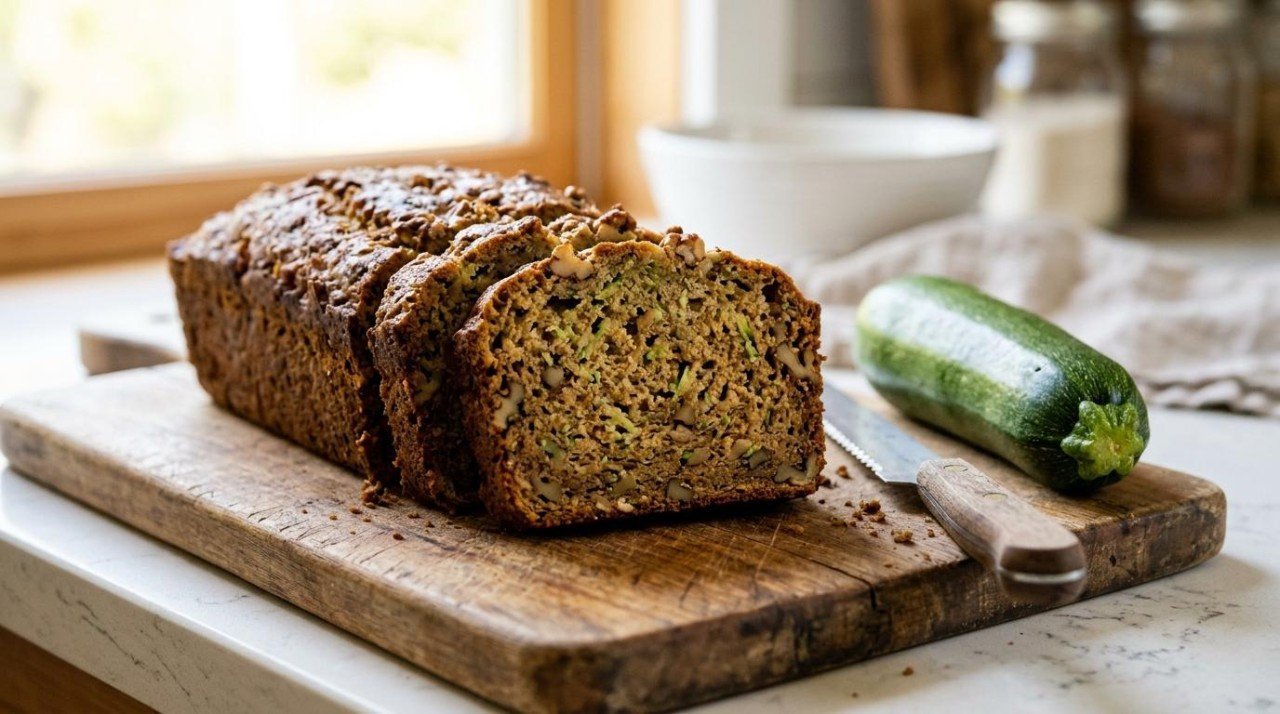
Zucchini bread is what happens every August when one zucchini plant produces enough for the whole street. It is moist, cinnamon-warm, studded with walnuts, and it carries a quiet health halo: there is a vegetable in it, so a second slice feels almost responsible.
So we scored it. A classic two-loaf zucchini bread, the kind passed around on recipe cards for decades, earns a Nutrition Score of 25 out of 100. Then we took the zucchini out to see what it was really contributing. Without it, the loaf scores 22. The vegetable everyone credits is worth three points, because a slice holds about a tablespoon of it. In this recipe the zucchini is a garnish.
Then we rebuilt it. Four swaps take the same bread to 47, with less than half the added sugar, about a third fewer calories, half the saturated fat, and nearly three times the fiber per slice. It is still tender, still sweet enough to serve with coffee, and still full of walnuts. The biggest lever turned out to be the flour, not the zucchini. Here is every swap and what it is worth.
The original: what's in it and how it scores
We used the most widely shared version of the classic, often called Mom's Zucchini Bread, which bakes two 8x4-inch loaves (24 slices):
- 3 cups all-purpose flour
- 2 1/4 cups white sugar
- 1 cup vegetable oil
- 3 eggs and 1 tablespoon vanilla
- 1 tablespoon cinnamon, plus 1 teaspoon each salt, baking soda, and baking powder
- 2 cups grated zucchini
- 1 cup chopped walnuts
Per slice, the app puts it at 258 calories, 18.7 g of added sugar, 13.4 g of fat (1.75 g saturated), 0.9 g of fiber, 3.6 g of protein, and 180 mg of sodium. The score of 25 carries one formal caution, rated very high: added sugar. That single slice holds 37% of the FDA's 50 g Daily Value for added sugars. Its listed weaknesses are "High Added Sugar," "High Omega 6," and "Low Vitamin D."
Here is what drags it down:
- Sugar outweighs the flour. 2 1/4 cups of sugar is about 450 g against 375 g of flour. By weight this is closer to a cake than a bread.
- A full cup of oil. About 120 of the 258 calories per slice come from fat. The generic vegetable oil row the app uses is soybean-style oil, which is where the "High Omega 6" flag comes from.
- Refined flour. All-purpose flour brings enriched thiamine and iron but almost no fiber, which is why a slice of something called bread has under a gram of it.
And what is already fine: sodium is moderate, and the walnuts are doing real work. They are the main source of the omega-3 ALA that tops the original's strengths list. To see where the halo actually lives, we pulled the zucchini and walnuts out one at a time:
- The same batter with no zucchini and no walnuts: 18
- Zucchini, no walnuts: 22
- Walnuts, no zucchini: 22
- Both (the original): 25
The zucchini and the walnuts each earn about three or four points. Neither is the problem, and neither is enough to fix it. So the makeover starts with the flour, the sugar, and the oil.
The upgrades
Here are the swaps, highest impact first, with each delta measured cumulatively in the order you would make them.
1. All-purpose flour to whole wheat pastry flour
- Swap: 3 cups all-purpose flour to 3 cups whole wheat pastry flour
- Score impact: +8 points (25 to 33)
- What it changes: Fiber per slice goes from 0.9 g to 2.6 g, and it adds a plant point
- What it costs you: A slightly nuttier, darker crumb, which the cinnamon and walnuts cover almost completely
This was the single biggest move, and it barely changes the bread. Whole wheat pastry flour is milled from soft wheat, so it is lower in protein than regular whole wheat and bakes up tender rather than chewy. Zucchini bread is an ideal place for it. As King Arthur's PJ Hamel notes in their 100% whole wheat zucchini bread, "whole grains need more liquid than all-purpose flour," and "the liquid in fruit helps soften wheat's bran, making it less likely to produce a crumbly loaf." The zucchini is better at that job than at adding nutrition.
White whole wheat flour scored identically (47 on the finished bread), so use whichever you can find. Going half and half with all-purpose scored 5 points lower than going all the way. Putting all-purpose flour back into the finished recipe costs 12 points, more than any other single change. A large meta-analysis in The Lancet found that people eating the most fiber had 15 to 30% lower rates of heart disease, stroke, type 2 diabetes, and colorectal cancer than people eating the least, and whole grains showed similar results. One fair note: the app's whole wheat pastry flour data runs a little generous on fiber, so your real loaf may land closer to 2 g per slice. That is still more than double the original. Our all-purpose flour substitution guide covers the other whole grain options.
2. Cut the sugar to 1 cup, half of it brown
- Swap: 2 1/4 cups white sugar to 1/2 cup white sugar plus 1/2 cup packed brown sugar
- Score impact: +5 points (33 to 38)
- What it changes: Added sugar drops from 18.7 g to 8.2 g per slice, and calories drop about 40 per slice
- What it costs you: Noticeably less sweet. Think muffin, not cake. The brown sugar's caramel note helps a lot
We cut the sugar by more than half, and King Arthur's testing is the reason we stopped at 1 cup instead of going lower. In their sugar-reduction experiments on muffins and banana bread, sugar at about 50% of the flour's weight was the sweet spot. At 25% the loaves came out dry. One cup of sugar against 3 cups of flour lands at roughly 53%, right where their tests said a quick bread still bakes up moist and tender. Splitting it between white and brown sugar was worth one more point than all white, and it tastes richer.
On the original recipe, this cut alone was worth only 4 points, because the cup of oil and the refined flour were still holding the score down. Putting the original 2 1/4 cups of white sugar back into the finished bread costs 7 points. If you want to go a little further, 3/4 cup total scored 48 (one more point). We kept 1 cup in the recipe because that is the level King Arthur actually tested. For more on cutting back, see our white sugar substitution guide.
3. Replace half the oil with Greek yogurt, and use canola
- Swap: 1 cup vegetable oil to 1/2 cup canola oil plus 1/2 cup plain low fat Greek yogurt
- Score impact: +7 points (38 to 45)
- What it changes: Fat per slice drops from 13.4 g to 8.9 g, saturated fat halves, and the "High Omega 6" flag clears
- What it costs you: A slightly tighter crumb. It is still tender, and the yogurt's tang plays well with cinnamon
Oil is what keeps quick breads tender and moist for days, so we cut it in half instead of removing it, and let the yogurt replace the moisture. The calorie drop is the big story here: about 38 calories per slice from this step alone. Putting the full cup of oil back into the finished recipe costs 6 points.
Two honest notes. First, unsweetened applesauce in place of the yogurt scored exactly the same (47 on the finished bread), so use either. The yogurt adds a little protein and the applesauce makes the bread dairy-free. Second, the canola part of this swap did not move the score on its own. Generic vegetable oil scored the same 47 on the finished build. We use canola anyway because it has about half the saturated fat of soybean-based vegetable oil and a bit more omega-3 ALA, and it is what cleared the omega-6 flag. Our Greek yogurt guide covers how it behaves in baking.
4. Double the zucchini
- Swap: 2 cups grated zucchini to 4 cups (about 1 1/4 pounds)
- Score impact: +2 points (45 to 47)
- What it changes: A moister loaf. The nutrition gain per slice is small
- What it costs you: Nothing in flavor. You need to squeeze the zucchini lightly and bake a little longer
This is the swap everyone expects to matter most, and it is the smallest. Zucchini is mostly water, so even doubling it adds little nutrition per slice. It earns its place anyway, because the extra moisture is what lets the whole wheat flour and reduced sugar bake up soft. Grate it, then press it gently in a clean towel to remove some of the liquid, but not all of it. King Arthur's 100% whole wheat version uses 2 cups of zucchini for 2 cups of flour, a higher ratio than the original's 2 cups for 3. Our zucchini substitution guide has ideas if your garden gives you yellow squash instead.
What we kept (on purpose)
- The walnuts, all of them. Taking them out of the finished bread actually raised the score by a point (to 48), because nuts are calorie-dense and the score works per bite. We refused. Walnuts are why each slice still delivers 55% of the Daily Value for omega-3 ALA, and a 2026 meta-analysis of 49 randomized trials found that eating walnuts lowered LDL cholesterol by about 6 mg/dL. They are also half of what makes zucchini bread zucchini bread.
- The salt. Halving it cut sodium from 180 mg to 130 mg per slice and scored exactly the same. Salt keeps a reduced-sugar loaf from tasting flat, so it stays.
- The eggs and the vanilla. They give the bread its structure and flavor, and none of the problems.
Where we stopped: the finished bread still carries a "High Added Sugar" caution. It is a sweet bread. A sweet quick bread can climb into the high 40s, and the swaps that push further (below) cost more texture than they earn.
Take the Guesswork Out of Eating Well
Eat Well Planner helps you organize your favorite recipes, plan balanced meals, and automatically generate shopping lists — all in one place. Whether you're tracking macros, managing dietary restrictions, or just trying to stop asking "what's for dinner?", we've got you covered.
Our AI-powered tools can adapt any recipe to your dietary needs, help you discover new meals you'll love, and even log your nutrition effortlessly. It's meal planning made simple.
Start Organizing Your Meals — FreeThe healthier version: full recipe
Healthier Zucchini Bread, Nutrition Score 47 (up from 25). Makes 2 loaves, 24 slices.
- 3 cups (375 g) whole wheat pastry flour or white whole wheat flour
- 1 tablespoon ground cinnamon
- 1 teaspoon baking soda
- 1 teaspoon baking powder
- 1 teaspoon salt
- 3 large eggs
- 1/2 cup (110 g) canola oil
- 1/2 cup (120 g) plain low fat Greek yogurt or unsweetened applesauce
- 1/2 cup (100 g) white sugar
- 1/2 cup (100 g) packed brown sugar
- 1 tablespoon vanilla extract
- 4 cups (about 500 g) grated zucchini, from about 2 medium zucchini
- 1 cup (117 g) chopped walnuts
- Heat the oven to 325°F. Grease and flour two 8x4-inch loaf pans.
- Grate the zucchini, unpeeled, on the large holes of a box grater. Press it gently in a clean kitchen towel to remove some of the liquid, but leave it damp.
- In a medium bowl, whisk together the flour, cinnamon, baking soda, baking powder, and salt.
- In a large bowl, whisk the eggs, oil, yogurt, both sugars, and vanilla until smooth. Stir in the zucchini.
- Add the dry ingredients to the wet ingredients and stir just until no dry flour remains. Fold in the walnuts.
- Divide the batter between the pans. Bake 55 to 65 minutes, until a toothpick inserted in the center comes out clean.
- Cool in the pans for 10 minutes, then turn out onto a rack and cool completely before slicing. The flavor and texture are even better the next day.
Per slice, original vs. healthier:
- Nutrition Score: 25 vs. 47
- Calories: 258 vs. 176
- Added sugar: 18.7 g vs. 8.2 g
- Fat: 13.4 g vs. 8.9 g
- Saturated fat: 1.75 g vs. 0.89 g
- Fiber: 0.9 g vs. 2.6 g
- Protein: 3.6 g vs. 3.7 g
- Sodium: 180 mg vs. 180 mg
One trade-off to know: the original's enriched all-purpose flour provided thiamine at 15% of the Daily Value per slice, and that highlight drops off with whole wheat. Iron, phosphorus, and omega-3 ALA all still make the "good source of" list.
Swaps we tested and skipped
- Triple the zucchini (6 cups): +2 more (49). That is six cups of a very wet vegetable in two loaves, which risks a center that never sets. Doubling is where we stopped.
- Cut the oil to 1/3 cup with 3/4 cup yogurt: +2 (49). Fat is what keeps a quick bread tender, and two whole wheat loaves on 1/3 cup of oil push toward a dry, tough crumb. Half the oil is the safer stopping point.
- Butter instead of oil: +0 (47), but saturated fat triples from 0.89 g to 2.66 g per slice. Oil also keeps quick breads moist longer. We skipped it.
- Half whole wheat, half all-purpose: -5 (42). A fine starting point if your family is skeptical, but whole wheat pastry flour is tender enough to go all the way.
- No walnuts: +1 (48). Refused, for the reasons above.
Make it fit other diets
- Dairy-free: Use the applesauce option instead of yogurt. It scored the same.
- Gluten-free: Swap the flour for a 1:1 gluten-free baking blend. You will lose most of the whole grain fiber gain unless the blend includes whole grain flours like oat or brown rice.
- Nut-free: Replace the walnuts with pumpkin seeds for the crunch.
Or skip the guesswork: import this recipe into Eat Well Planner and ask Recipe Variations for a vegan or gluten-free version. It rewrites the whole recipe with the swaps worked in.
Do this to any recipe
Every number in this post came from Eat Well Planner's Nutrition Score, and the process is exactly what the app's Make It Healthier feature does: import a recipe from any website, Instagram post, or YouTube video, see its score, and get concrete swaps with the gain verified by a calculator before you see it. Want to test your own version first, like keeping all the oil and cutting more sugar instead? The Recipe Playground updates the score live with every edit, so you can see what each change costs and make it up elsewhere.
If zucchini bread is your weakness, our healthier banana bread and healthier carrot cake follow the same lesson: the produce gets the credit, but the flour, sugar, and fat decide the score.