Apple pie is the one dessert that does not need marketing. It shows up at Thanksgiving, at church suppers, on windowsills in cartoons. Nobody makes it because it is good for them, and nobody should have to defend making it.
But it is worth knowing what is actually in it. Under the lattice, a standard double-crust apple pie is two and a half cups of refined flour, a stick of butter, half a cup of shortening, and a cup of sugar, with fruit in the middle. We built that version in Eat Well Planner and ran it through the app's Nutrition Score. It came back at 19 out of 100, with two flags in the very-high band. Then we rebuilt it, one verified swap at a time, and got it to 64.
Two things made this makeover different from the one we expected. Six of the seven swaps, added together, were worth 24 points. The other one was worth 21 by itself - as much as the first five combined - because it crossed a line the FDA drew. And when we tested the move every "healthy apple pie" article recommends, taking the pastry away entirely, the score went down six points. Here is the whole thing, with receipts.
The original: what's in it and how it scores
We scored the version most home bakers make. The crust: 2 1/2 cups all-purpose flour, 1 stick (1/2 cup) butter, 1/2 cup vegetable shortening, a tablespoon of sugar, a teaspoon of salt, egg wash and coarse sugar on top. The filling: about 2 1/2 pounds of peeled, sliced apples, 1 cup granulated sugar, 3 tablespoons flour to thicken, a teaspoon of cinnamon, a grating of nutmeg, a tablespoon of lemon juice, and 2 tablespoons of butter dotted over the fruit. Eight slices. Every number below is per slice.
Nutrition Score: 19/100. Per slice: about 588 calories, 6 g protein, 4.4 g fiber, 12.4 g saturated fat, and the number that sinks it - 28 g of added sugar, which the app flags as very high at 106% of a day's reference. The American Heart Association recommends no more than 24 g of added sugar a day for women and 36 g for men. One slice of pie clears a woman's entire daily allowance and most of a man's, before anything else you eat that day. Saturated fat came in second at 53% of the daily ceiling, also very high.
Almost all of that sugar is one ingredient: the cup in the filling, 200 g of sucrose poured over fruit that is already about 10% sugar by weight. It is not there for no reason - sugar does real work in a fruit pie, which we will come back to - but the recipe is built on an assumption that apples are not sweet enough on their own, and that assumption is doing the damage.
Plenty here is genuinely fine, and it is worth saying so. There is nothing ultra-processed in this pie - it is flour, butter, sugar, apples, and spice. Sodium is not flagged. And even in the original, the fruit is doing real work: 4.4 g of fiber a slice is enough for the app to call it a good source, and it registers as an excellent source of omega-3 ALA and a good source of vitamin A. What holds it at 19 is the sugar, the saturated fat, and a crust that brings starch and fat and almost nothing else.
The upgrades
We applied these in order and re-scored after each one, so every delta is what that swap was worth at that point in the build. The order matters more than usual here, and the last big one explains why.
1. Whole wheat pastry flour in the crust
- Swap: 2 1/2 cups all-purpose flour → 2 1/2 cups whole wheat pastry flour
- Score impact: +10 points (19 to 29) - the biggest single-ingredient gain in the post
- What it changes: Fiber from 4.4 g to 8.2 g a slice; adds iron, phosphorus, magnesium and zinc highlights
- What it costs you: A slightly nuttier, more assertive crust. Not a dense one, if you use the right flour.
Ten points from the ingredient nobody blames. Flour is the biggest thing in the pan by weight after the apples, and refined, it contributes starch and very little else - which matters when adults need 25 to 35 g of fiber a day and most Americans get about 15, and when a meta-analysis found that eating 70 g of whole grains a day was associated with a 22% lower risk of total mortality.
The word "pastry" is the whole trick. Whole wheat pastry flour is milled from soft wheat, so it has less gluten-forming protein than either all-purpose or regular whole wheat - and in a pie crust, strong structure reads as tough. Regular whole wheat flour also works and actually scores two points higher (66 in the finished pie versus 64), but it makes a chewier, more bread-like crust, and King Arthur's advice for baking with it is to let the dough rest at least 30 minutes before rolling so the bran has time to soften. We took the two-point loss for the better texture. Our all-purpose flour substitutes guide covers the other options.
2. Cut the filling sugar to 1/4 cup, and double the cinnamon
- Swap: 1 cup granulated sugar → 1/4 cup, with cinnamon up from 1 to 2 1/2 teaspoons
- Score impact: +3 points (29 to 32)
- What it changes: Added sugar from 28 g to 9.3 g a slice, dropping it from very high to high; 74 fewer calories
- What it costs you: Real sweetness. This is where apple choice starts to matter.
Three points for cutting three quarters of the sugar out of the filling. That looks like a bad trade, and it is the most useful number in this post - hold onto it, because swap six is the same swap again and it pays 21.
Two things buy back the sweetness. The first is the apples: with only 2 tablespoons of sugar in the dish, a bag of mealy storage apples will taste like nothing, so use a mix of a genuinely tart variety and a sweet firm one. Granny Smith, which USApple describes as very tart, is the reliable half of that pair; Braeburn and Jonagold are both on Illinois Extension's list of varieties suited to pies and baking and bring the sugar. The second is aroma. Odors we read as sweet measurably raise how sweet something tastes: in a study of 129 adults, vanilla aroma increased sweetness ratings of plain sucrose solutions - most consistently in women - and cinnamon works on the same cross-modal channel. More cinnamon really does make a less-sweet pie taste sweeter. Keep the tablespoon of lemon juice too - acid sharpens the fruit flavor, and our lemon juice guide has the swaps if you are out.
3. Trade the top crust for an oat and walnut crumble
- Swap: Second crust → 1 cup rolled oats, 1/3 cup whole wheat pastry flour, 1/2 cup walnuts, butter and brown sugar
- Score impact: +3 points (32 to 35)
- What it changes: Omega-3 ALA from 25% to 60% of a day's target, plant points from 2.5 to 4.5, sodium from 350 mg to 200 mg
- What it costs you: The lattice. If that is the part you love, see the alternative below - it is not a bad option.
A crumble is where a pie gets to smuggle in food. Oats bring beta-glucan, the soluble fiber the FDA lets manufacturers link to reduced risk of coronary heart disease, with a meta-analysis putting 3 g a day at about a 12-point drop in blood cholesterol. Walnuts bring the plant omega-3 that pushed the ALA highlight from good to excellent; Harvard's review of nut research associates eating walnuts once a week or more with lower cardiovascular risk. And it is easier to make than a lattice.
There is a practical bonus, too: King Arthur specifically lists crumb toppings as a fix for a runny pie, because they let steam escape instead of trapping it under a sealed lid.
4. A third more apples
- Swap: 2 1/2 lb prepped apples → 3 1/4 lb
- Score impact: +0 points (35 to 35)
- What it changes: Fiber from 8.2 g to 9.2 g a slice, potassium from 330 mg to 380 mg, and a new vitamin C highlight
- What it costs you: A couple more apples and a deeper dish.
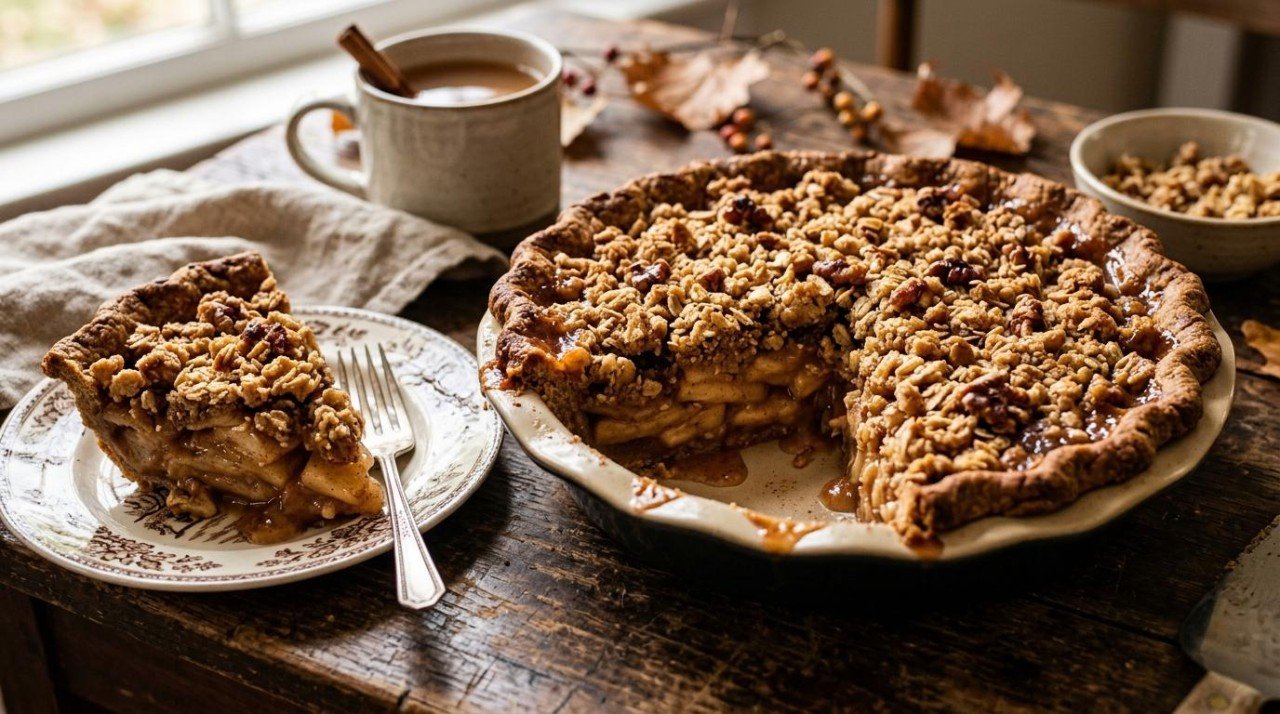
We are reporting a zero because it is honest, and taking the swap anyway. The extra fruit added calories at the same rate it added nutrients, so the per-calorie score did not move - but it is what makes the pie tall enough to look like the picture, and more of the pie is now fruit. If you leave some of the skins on, better still: Harvard notes that discarding apple skin removes much of the fiber and the majority of the flavonoids. The scoring data does not distinguish peeled from unpeeled apples, so we have not claimed a point for it - but it is free, and it is real.
5. Rebuild the fat: an olive oil press-in crust
- Swap: Butter-and-shortening rolled crust → whole wheat press-in crust with 1/4 cup olive oil; no butter dotted on the filling; crumble butter down to 3 tablespoons
- Score impact: +5 points (35 to 40)
- What it changes: Saturated fat from 11.4 g to 4.6 g a slice - from 48% of the daily ceiling to 19%, clearing the flag - and 81 fewer calories
- What it costs you: Flakiness. An oil crust is tender and crisp, not shattering-layered.
This is the swap with the most honest trade in it. Flakiness comes from solid fat staying in visible pieces that steam apart in the oven; oil disperses through the flour instead, coating the proteins and giving you a short, crumbly, almost shortbread-like crust. It is a different pleasure, not a lesser one, and it is genuinely easier - King Arthur's own no-roll pie crust is built on exactly this idea (2 cups flour to 7 tablespoons oil, olive oil explicitly allowed), pressed into the pan with the bottom of a measuring cup. No rolling pin, no cracking whole wheat dough, no chilling.
The 2 tablespoons of butter dotted over the filling came out because with a crumble on top, they were doing nothing you would notice. The crumble butter stayed. See our butter substitutes guide if you want to push further than we did - and read the next section before you do.
6. Cut the sugar again - all the way under the line
- Swap: Filling sugar 1/4 cup → 2 tablespoons; crumble brown sugar 3 tablespoons → 1; crust sugar out entirely
- Score impact: +21 points (40 to 61) - as much as the first five swaps put together
- What it changes: Added sugar from 12.6 g to 4.8 g a slice, which clears the caution completely; 31 fewer calories
- What it costs you: This is the edge. Below this the pie stops tasting like dessert.
Same swap as number two, seven times the payoff. The reason is a threshold, not a curve. On a nutrition label, 20% of the Daily Value or more of added sugar per serving is considered high, and the score treats that line seriously. At 12.6 g a slice we were at 48% - flagged, and no amount of fiber or walnuts could talk over it. At 4.8 g we were at 18%, and the flag came off. Everything the earlier swaps had already earned suddenly had somewhere to land.
Two receipts that this is a line and not a slope. Take all the remaining sugar out - a completely sugar-free pie - and the score goes to 65. One point, for the last 39 g. Go the other way and put half the sugar back - 60 g total across filling and crumble instead of 39 g, still well under a standard pie - and it drops to 55. The entire prize is on the near side of 20%.
Technique matters more at this sugar level, because sugar is not only sweetness in a fruit pie - it pulls juice out of the apples by osmosis, which pre-shrinks them so the filling does not collapse away from the topping. Use the 2 tablespoons you have left to do exactly that job: toss the apples with the sugar and lemon juice, let them sit 30 to 45 minutes, then drain the juice and simmer it down to a syrup before pouring it back over the fruit. That syrup is concentrated apple, and it is now carrying a lot of the flavor. Our white sugar substitutes guide covers the alternatives, though maple syrup and honey count as added sugar too - the app scores them the same way.
7. Two tablespoons of ground flaxseed in the crumble
- Swap: Nothing → 2 tablespoons ground flaxseed, mixed into the crumble
- Score impact: +3 points (61 to 64)
- What it changes: Omega-3 ALA from 54% to 84% of a day's target, fiber to 9.7 g, plant points from 4.5 to 5.5
- What it costs you: Nothing. You cannot see it or taste it under oats and walnuts.
The cheapest three points in the post, and the same trick that worked in our cinnamon roll makeover. Buy it pre-ground or grind it yourself - whole flaxseed passes through you intact.
One quirk worth reporting, since we are showing our work: adding the flaxseed nudged saturated fat from 19% of the daily ceiling to exactly 20%, which put the saturated fat caution back on the label even as the score rose three points. The flag and the score are answering different questions, and this is a good reminder to read both.
Take the Guesswork Out of Eating Well
Eat Well Planner helps you organize your favorite recipes, plan balanced meals, and automatically generate shopping lists — all in one place. Whether you're tracking macros, managing dietary restrictions, or just trying to stop asking "what's for dinner?", we've got you covered.
Our AI-powered tools can adapt any recipe to your dietary needs, help you discover new meals you'll love, and even log your nutrition effortlessly. It's meal planning made simple.
Start Organizing Your Meals — FreeWhat we kept, and where we stopped
We kept 3 tablespoons of real butter in the crumble. That is the single biggest score left on the table, and we know exactly how big: rebuild the crumble with olive oil instead and the pie scores 72, eight points higher, with no caution flags at all. We did not take it, because butter rubbed into oats and flour is what makes a crumble taste like a pie topping instead of like granola. If that trade sounds fine to you, take it - you have the number.
We also kept the crust, and this is where the received wisdom about healthier pie turns out to be wrong. Make the exact same filling and crumble in a baking dish with no pastry underneath - an apple crisp - and the score drops to 58. Six points down, at 309 calories instead of 431. The crust is 150 g of whole grain flour and a quarter cup of olive oil, and it earns its calories. Giving it up makes a lighter dessert and a worse one.
And if the lattice is the part you love, you do not have to give it up either. A whole wheat olive-oil double crust with the same low-sugar filling and no crumble scores 68 - four points above our version, since it contains no butter at all. You trade the oats, the walnuts, and two plant points for a real top crust and a slightly better number. That is a genuinely close call, and it is yours to make.
The healthier version: full recipe
Final Nutrition Score: 64/100. Serves 8. One 9-inch deep-dish pie.
Crust
- 1 1/4 cups (150 g) whole wheat pastry flour
- 1/4 cup (53 g) extra virgin olive oil
- 1/4 teaspoon fine salt
- 3 tablespoons ice water
Filling
- 3 1/4 lb (1500 g) apples, peeled, cored, and sliced 1/4 inch thick - about 4 lb whole, half Granny Smith and half Braeburn or Jonagold
- 2 tablespoons (25 g) granulated sugar
- 1 tablespoon (15 g) lemon juice
- 3 tablespoons (24 g) all-purpose flour
- 2 1/2 teaspoons (6 g) ground cinnamon
- 1/4 teaspoon ground nutmeg
- 1/2 teaspoon fine salt
Crumble
- 1 cup (90 g) old-fashioned rolled oats
- 1/3 cup (40 g) whole wheat pastry flour
- 1/2 cup (60 g) walnuts, roughly chopped
- 2 tablespoons (20 g) ground flaxseed
- 1 tablespoon (14 g) packed brown sugar
- 3 tablespoons (43 g) cold unsalted butter, cubed
- Toss the sliced apples with the 2 tablespoons granulated sugar and the lemon juice. Let them sit at room temperature for 30 to 45 minutes while you make the crust.
- Whisk the whole wheat pastry flour and 1/4 teaspoon salt directly in a 9-inch deep pie dish. Whisk the olive oil and ice water together until cloudy, pour it over the flour, and stir with a fork until evenly moistened. Press the dough across the bottom and up the sides with your fingers, smoothing the base with the flat bottom of a measuring cup. Chill while the oven heats.
- Heat the oven to 425°F with a rack in the lower third and a rimmed baking sheet on it.
- Drain the juice from the apples into a small saucepan. Simmer over medium heat until reduced by about half and syrupy, 3 to 5 minutes.
- Toss the drained apples with the 3 tablespoons all-purpose flour, cinnamon, nutmeg, and 1/2 teaspoon salt, then stir in the reduced syrup. Pile into the crust, mounding high in the center.
- Mix the oats, whole wheat pastry flour, walnuts, flaxseed, and brown sugar in a bowl. Rub in the cold butter with your fingertips until it holds together in pea-sized clumps. Scatter evenly over the apples.
- Bake on the hot sheet at 425°F for 20 minutes, then reduce to 375°F and bake another 40 to 50 minutes, until the juices bubble thickly at the edges and the crumble is deep golden. Tent loosely with foil if the top browns early, and keep baking at least 10 minutes after you see the juices bubbling.
- Cool at least 4 hours before slicing - overnight is better. The filling sets as it cools, and cutting it hot is what makes a pie look runny.
Per slice, original vs. improved:
- Nutrition Score: 19 → 64
- Calories: 588 → 431
- Added sugar: 28 g (106% of a day's reference, flagged very high) → 4.8 g (18%, no flag)
- Saturated fat: 12.4 g (53%, very high) → 4.7 g (20%)
- Fiber: 4.4 g → 9.7 g (33% DV, an excellent source)
- Potassium: 220 mg → 390 mg
- Sodium: 350 mg → 200 mg
- Plant points: 1.5 → 5.5
The finished pie is an excellent source of omega-3 ALA (84% of a day's target), fiber, phosphorus, iron, and biotin, and a good source of magnesium, riboflavin, thiamine, vitamin E, B6, zinc, potassium, vitamin C, niacin, and pantothenic acid. Its gut health dimension went from 23 to 75.
Swaps we tested and skipped
- Taking the crust away (making it a crisp): 58, six points below the pie. Fewer calories, worse score. The biggest surprise in the whole build.
- Regular whole wheat flour instead of pastry flour: 66, two points up. Skipped for texture - a chewier, breadier crust is not what you want under apples.
- Removing every last gram of sugar: 65, one point up. There is no reward for going below the line, only a duller pie.
- Olive oil in the crumble instead of butter: 72, and no caution flags. Not so much skipped as declined - see above, and decide for yourself.
Make it fit other diets
This pie is nearly vegan already: swap the 3 tablespoons of crumble butter for 3 tablespoons of olive oil (which, as noted, scores higher, at 72) and everything else in it is plant-based. For gluten-free, use a 1:1 gluten-free baking blend in the crust and crumble plus certified gluten-free oats, and add an extra tablespoon of water to the crust - a press-in oil crust is forgiving with those blends, since it is never rolled and has no gluten structure to develop in the first place. In the app, the Recipe Variations feature will rewrite the whole recipe for either one in a single step, amounts adjusted, and you can score the result before you bake it.
Do this to your own recipes
Nothing here required a nutritionist. We imported a recipe, looked at the score, saw two flags in the very-high band, and worked on the biggest one first - then tested each idea instead of trusting it. That is the whole method, and it is what Make It Healthier in Eat Well Planner does automatically: it proposes swaps for whatever you have imported and runs each one through a calculator before showing it to you, so you never see a suggestion that does not actually help.
The per-swap numbers in this post came from the Recipe Playground, where you can change one ingredient at a time and watch the score and the delta move. Import your family's apple pie - from a website, a screenshot, a video, or your grandmother's index card - and go find your own 20% line. It is almost never where you expect.