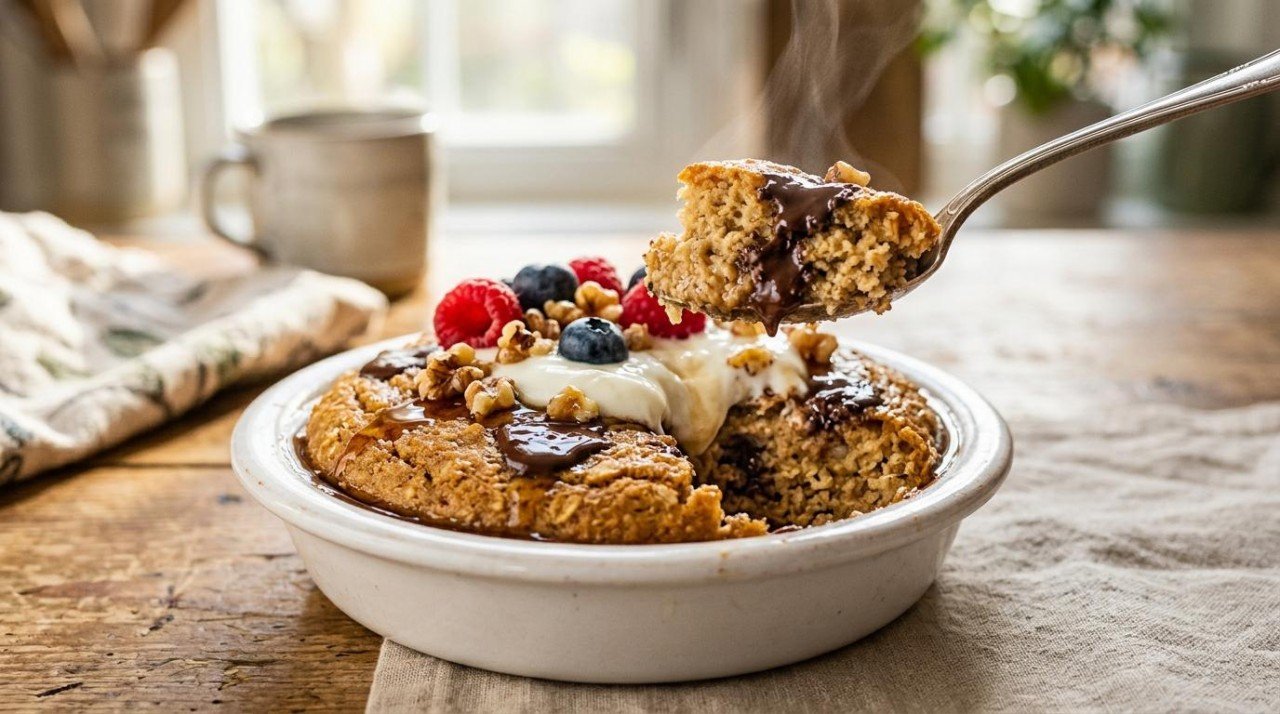
Baked oats is the rare viral recipe that actually works. You put oats, a banana, an egg and some milk in a blender, pour the batter into a dish, and twenty-five minutes later you pull out something with a domed top and a soft middle that eats like cake. No single creator owns it - it spread as a format rather than a recipe, and the baked oatmeal hashtag has passed 139 million views on TikTok, with early versions from creators like Ashley Morton in December 2020 and a Quaker Canada apple crumble version that pulled 3.7 million views in April 2021.
It is also the rare viral recipe that gets sold as health food. "Cake for breakfast, but it's healthy" is the caption on about half of them. So we built the indulgent version - the one with the chocolate chips blended in and the Nutella center and the syrup poured over the top - and ran it through Eat Well Planner's Nutrition Score. It came back at 39 out of 100, with 68 g of added sugar in one dish.
Then we rebuilt it, one verified swap at a time, to 74. And here is the part that stopped us: the improved version has about 846 calories against the original's 850. Four calories apart. This makeover did not make breakfast smaller. It made it a completely different breakfast for the same price.
The original: what's in it and how it scores
There is no canonical baked oats, so we scored the version that shows up over and over in the indulgent tier of the trend: 1/2 cup (40 g) rolled oats, 1 large ripe banana, 1 egg, 1/4 cup whole milk, 1 teaspoon baking powder, a teaspoon of vanilla, about 1/4 cup (60 g) of maple syrup between the batter and the drizzle, a generous handful (40 g) of milk chocolate chips, and a tablespoon (20 g) of chocolate hazelnut spread spooned into the center. One dish, one person.
Nutrition Score: 39/100. Per serving: about 850 calories, 68.1 g of added sugar (258% of a day's reference, flagged very high), 16.1 g saturated fat (69% DV, also very high), 9.7 g fiber, 17.2 g protein, and 2 plant points.
The added sugar is the headline. The American Heart Association recommends no more than 25 g of added sugar a day for women and 36 g for men. This is 68 g before 9 a.m. And when we took the swaps apart, the split was almost even: the chocolate and the hazelnut spread accounted for 28.2 g of it, and the syrup for another 27.2 g above a single tablespoon. Neither one is the villain on its own. Together they are two and a half days of sugar.
But here is the diagnosis that actually surprised us, and it is why this post exists. The batter is fine. Oats, banana, egg, milk, baking powder - that base is genuinely good food, and the score says so even in the original. It comes in as an excellent source of phosphorus (116% DV), riboflavin (91%), iron (65%), biotin (62%), calcium (51%), magnesium (42%) and choline (41%), and it already clears the bar for fiber at 9.7 g, which is 33% of a day's reference. That is more fiber than most people get from an entire breakfast, and it is coming from the oats, whose beta-glucan is the soluble fiber behind the FDA's permitted heart-disease claim - about 3 g of it a day produces modest reductions in blood cholesterol.
So the viral baked oats is not a bad recipe wearing a health costume. It is a genuinely good breakfast with roughly 55 g of added sugar bolted onto it at the end. Everything that sinks the score was added after the blender.
The upgrades
We applied these in order and re-scored after every one, so each number below is what that change was worth at that point in the build. Read the order carefully, because the lesson of this makeover is not the one we expected: the two swaps that removed sugar were worth 9 points combined, and the two swaps that added food were worth 22.
1. Trade the milk chocolate and the Nutella for a little dark chocolate
- Swap: 40 g milk chocolate chips + 20 g chocolate hazelnut spread → 1/2 oz (15 g) dark chocolate, chopped
- Score impact: +5 points (39 to 44)
- What it changes: Added sugar from 68.1 g to 39.9 g, saturated fat from 16.1 g to 6.6 g (69% DV down to 28%), calories from 850 to 637
- What it costs you: Genuinely less chocolate, and darker chocolate is more bitter. This is the swap with a real price tag.
Cutting 28 g of added sugar and more than half the saturated fat for five points looks like a terrible exchange rate, and at this stage it is - because the syrup is still in there and the score has bigger complaints. Keep this number in mind. We tested the reverse at the end of the build, putting milk chocolate chips back into the finished recipe, and it cost 12 points. Same swap, more than twice the value, once everything else was fixed.
The technique that makes 15 g feel like enough: do not blend it into the batter, where it disappears. Scatter it over the dish the moment it comes out of the oven and give it a minute. It melts into visible pools you hit in every third bite, which reads as much more chocolate than it is.
2. Measure the maple instead of pouring it
- Swap: About 1/4 cup (60 g) maple syrup, in the batter and over the top → 1 tablespoon (15 g), drizzled at the end only
- Score impact: +4 points (44 to 48)
- What it changes: Added sugar from 39.9 g to 12.7 g, and the flag drops from "very high" to "high"; calories from 637 to 520
- What it costs you: Sweetness, honestly. This is a measurement, not a substitution, and you will notice it on the first bite.
What buys it back is the banana, if you wait for it. A banana at commercial harvest is 12 to 35% starch, and by late ripening that can fall below 1% as enzymes convert it to soluble sugars - up to about 20% of the ripe pulp's fresh weight, roughly 80% of it sucrose. A yellow banana makes baked oats you need to sweeten. A heavily spotted one makes baked oats that are already sweet. If you are impatient, 15 to 20 minutes at 300°F in the skins will get you there.
The other half of this is where the syrup goes. Syrup blended into the batter is tasted by your tongue as part of a homogenous sweet thing; syrup drizzled on top hits neat, first, and undiluted. Put it on, not in, and one tablespoon does the work of three. (If you want to swap sweeteners rather than cut them, our maple syrup substitutes guide covers the ratios - though the amount, not the type, is what the score responds to.)
3. Add 150 g of berries
- Swap: Nothing → 2/3 cup (75 g) raspberries + 1/2 cup (75 g) blueberries, half folded into the batter, half piled on top
- Score impact: +11 points (48 to 59) - and this one added about 90 calories
- What it changes: Fiber from 7.5 g to 14.1 g, vitamin C from 16% to 42% of a day's reference, plant points from 2 to 4, and the low-vitamin-K weakness clears entirely
- What it costs you: Nothing. This is the free lunch of the whole makeover.
Eleven points from putting fruit on breakfast, and the score went up while the calories went up with it. That is worth sitting with if you have spent years being told these two things move together. Fiber is where most of it came from: only about 5% of American men and 9% of women hit the recommended intake, so a breakfast that doubles its fiber is fixing something almost everyone is short on.
Two technique notes. Fold the batter berries in by hand after blending - blitz them and the whole dish comes out a flat gray-purple. And frozen berries work fine straight from the freezer; they will add two or three minutes to the bake and the raspberries will bleed a little, which is a look, not a problem.
4. Swap the milk for Greek yogurt
- Swap: 1/4 cup whole milk → 1/2 cup (120 g) plain Greek yogurt, half blended into the batter and half spooned over the top
- Score impact: +4 points (59 to 63)
- What it changes: Protein from 16.7 g to 26.9 g, calcium from 46% to 52% DV, vitamin B12 from 36% to 57% DV
- What it costs you: A thicker batter and a slight tang. Both are improvements.
Ten extra grams of protein for four points feels light, and it is - the original was never protein-poor, because an egg and a bowl of oats is a decent start. What the yogurt really does is change what the dish feels like an hour later, and the cold tangy spoonful on top of a hot sweet bake is the single best textural moment in the finished recipe.
If your blender complains about the thicker batter, add a splash of milk; the banana and the egg are carrying the moisture and a tablespoon either way changes nothing. Use plain, not vanilla or fruit-on-the-bottom, which would quietly hand back the sugar we just removed. (Our Greek yogurt substitutes guide has the swaps if you are out.)
5. Add ground flaxseed, walnuts and cinnamon
- Swap: Nothing → 1 tablespoon (10 g) ground flaxseed + 3 tablespoons (20 g) chopped walnuts + 1 teaspoon cinnamon
- Score impact: +11 points (63 to 74) - tied for the biggest move in the build
- What it changes: Omega-3 ALA from 0.16 g to 3.92 g, which is 245% of a day's target; fiber from 14.1 g to 19.1 g; protein from 26.9 g to 31.8 g; plant points from 4 to 6.25
- What it costs you: About 190 calories, and it is off the table entirely if there is a nut allergy in the house
Walnuts do most of this. They are the only tree nut that is an excellent source of ALA, the plant-form omega-3, at about 2.5 g an ounce, and 20 g of them takes this dish from a trace amount to an excellent source. The flaxseed adds the rest plus a gram of fiber, and it has to be ground: a trial comparing flax oil, milled flaxseed and whole flaxseed found that subjects taking whole flaxseed showed no significant rise in plasma ALA at all, while milled flaxseed did. Whole seeds go straight through you.
The cinnamon is the cheapest ingredient on the list and does two jobs: a quarter of a plant point for no calories, and it makes a low-sugar bake taste sweeter than it is. That matters because King Arthur's testing found that cutting sugar leaves baked goods drier and lets background flavors step forward. Here the background flavors are banana, oat and cinnamon, so stepping forward is exactly what you want.
Take the Guesswork Out of Eating Well
Eat Well Planner helps you organize your favorite recipes, plan balanced meals, and automatically generate shopping lists — all in one place. Whether you're tracking macros, managing dietary restrictions, or just trying to stop asking "what's for dinner?", we've got you covered.
Our AI-powered tools can adapt any recipe to your dietary needs, help you discover new meals you'll love, and even log your nutrition effortlessly. It's meal planning made simple.
Start Organizing Your Meals — FreeWhat we kept on purpose, and where we stopped
We kept the whole egg and its yolk, real dark chocolate, a real tablespoon of maple syrup, the whole banana, and actual rolled oats. No protein powder, no sweetener, no oat flour substitute, no dates blitzed into paste. That is what keeps this recognizable as the thing you saved off your phone.
We stopped eight points short, and here is exactly what those points cost. Drop the maple drizzle and it scores 81 with the added sugar flag cleared entirely. Drop the dark chocolate instead and it scores 82. Drop both and it still scores 82 - which means that once the chocolate is gone, the tablespoon of syrup is free. If you are going to give up one of them, give up the chocolate and keep the drizzle. We kept both, because a breakfast that eats like cake without chocolate or syrup on it is a nice bowl of baked oatmeal, and that is a different recipe with a different name.
Two honest limits. The finished version still carries two caution flags - added sugar at 48% of a day's reference and saturated fat at 34% - both dropped a tier from very high, neither cleared. And 19 g of fiber in one sitting is a lot if your current breakfast is toast; if you are not used to it, build up rather than doubling overnight.
The healthier version: full recipe
Final Nutrition Score: 74/100. Makes one generous dish. Bake it in a wider dish and split it in two and it scores 78 at about 423 calories a half, which is the version to make if 846 calories is more breakfast than you want.
- 1/2 cup (40 g) old-fashioned rolled oats
- 1 large very ripe banana, heavily spotted (about 118 g peeled)
- 1 large egg
- 1/2 cup (120 g) plain Greek yogurt, divided
- 1 tablespoon (10 g) ground flaxseed
- 1 teaspoon baking powder
- 1 teaspoon vanilla extract
- 1 teaspoon ground cinnamon
- 2/3 cup (75 g) raspberries, divided
- 1/2 cup (75 g) blueberries, divided
- 1/2 oz (15 g) dark chocolate (70%), chopped
- 3 tablespoons (20 g) walnuts, roughly chopped
- 1 tablespoon (15 g) pure maple syrup
- Heat the oven to 350°F and grease a small oven-safe dish or large ramekin, about 2 cups in capacity.
- Blend the oats, banana, egg, half the Greek yogurt (1/4 cup), the ground flaxseed, baking powder, vanilla and cinnamon until completely smooth and pourable, 30 to 45 seconds. Scrape down the sides and blend again - you should not be able to see individual oat flakes, because the blending is what turns oats into a cake crumb instead of oatmeal.
- Fold half the raspberries and half the blueberries into the batter by hand. Do not blend them in.
- Pour into the dish and bake 22 to 27 minutes, until the top is domed and set and a skewer in the center comes out clean. Add 2 to 3 minutes if your berries were frozen.
- Scatter the chopped dark chocolate over the top the moment it leaves the oven. Leave it one minute to melt into pools, then spread it lightly if you like.
- Spoon over the remaining Greek yogurt, pile on the remaining berries, scatter the walnuts, and drizzle the maple syrup over everything. Eat it warm.
Per serving, original vs. improved:
- Nutrition Score: 39 → 74
- Calories: about 850 → about 846
- Added sugar: about 68.1 g (258% DV) → about 12.7 g (48% DV)
- Saturated fat: about 16.1 g (69% DV) → about 8.0 g (34% DV)
- Fiber: about 9.7 g (33% DV) → about 19.1 g (64% DV)
- Protein: about 17.2 g → about 31.8 g
- Omega-3 ALA: about 0.1 g → about 3.9 g (245% DV)
- Potassium: about 1,040 mg → about 1,240 mg
- Sodium: about 420 mg → about 430 mg
- Plant points: 2 → 6.25
- Caution flags: very high added sugar, very high saturated fat → high added sugar, high saturated fat
Swaps we tested and skipped
Some of these scored higher than what we published. The score is a guide, not a boss.
- Milk chocolate chips instead of dark, in the finished recipe. Scored 62 - twelve points down, and the added sugar caution goes straight back to very high. This is the same swap that was worth only five points when we made it first, which is the clearest receipt in this post that order matters. While a recipe is being flagged for something, changes elsewhere have nowhere to go.
- Adding a scoop of whey protein powder. The single most-recommended baked oats upgrade on the internet. It scored 83, nine points higher, and we skipped it: it pushes the dish to 954 calories and 49 g of protein, and it adds a brand new sodium caution. The egg and the Greek yogurt already deliver 32 g of protein. This is solving a problem the recipe does not have.
- Egg whites instead of the whole egg. Scored 78, four points up, also with a new sodium flag. Skipped, because the yolk is where the choline is (46% of a day's reference) and because the yolk is what makes the middle set custardy rather than spongy. Four points is not worth a worse texture.
- Leaving the walnuts out. Scored 69, five points down. Worth knowing if there is a nut allergy: the ground flaxseed alone still carries ALA to about 2.1 g, comfortably above a day's target, so you lose less than the five points suggest.
- Splitting it into two servings. Scored 78, four points up, at about 423 calories. Genuinely useful and not what we expected - when we tried the same trick on blueberry muffins, shrinking the portion made the score worse. Here the dish is dense enough with real food that a smaller portion is still a complete breakfast.
Make it fit other diets
For gluten-free, use certified gluten-free oats - oats have no gluten of their own but are routinely cross-contaminated in milling. For vegan, use a thick unsweetened coconut or soy yogurt and swap the egg for a flax egg (1 tablespoon of the ground flaxseed you already have, plus 3 tablespoons water, rested 10 minutes); expect a denser, more pudding-like middle, because the egg is doing the lifting. For dairy-free, the coconut yogurt works but understand you are giving back most of swap 4's protein. In Eat Well Planner you can ask the AI to rewrite this exact recipe any of those ways in one step and it hands back the full version with the substitutions worked in. (Our egg substitutes for baking guide has the full ratio table if you would rather do it yourself.)
Do this to any recipe you saw on your phone
Every score in this post came out of Eat Well Planner's Make It Healthier tool, not an estimate. If you saved a recipe from a reel or a TikTok, you can import the video straight into the app - it pulls out the ingredients and instructions, scores it, and tells you what is actually holding the number down before you turn the oven on. Then the Recipe Playground lets you test swaps one at a time and watch the score move, which is exactly how every delta above was measured.
Two things this dish taught us that transfer. First, additions beat subtractions: the two swaps that took sugar out were worth 9 points, and the two that put food in were worth 22, while the whole makeover landed within four calories of where it started. Second, look at when an ingredient enters the recipe - almost everything wrong with the viral baked oats was added after the blender was already switched off. The base was never the problem, which is also why the oats you buy matter less here than what you put on them. Go bake it. It is still cake for breakfast. It just stopped exaggerating.