A bagel with cream cheese is one of the most efficient breakfasts ever invented. No cooking, no plate, no decisions. Warm, chewy, salty, rich, and it survives a commute. There is a reason it has outlasted every breakfast trend thrown at it.
It is also, nutritionally, roughly what you suspect. But "not great" is useless information when you are standing in front of a toaster, so we ran a standard deli bagel and schmear through our Nutrition Score. It gets 28 out of 100.
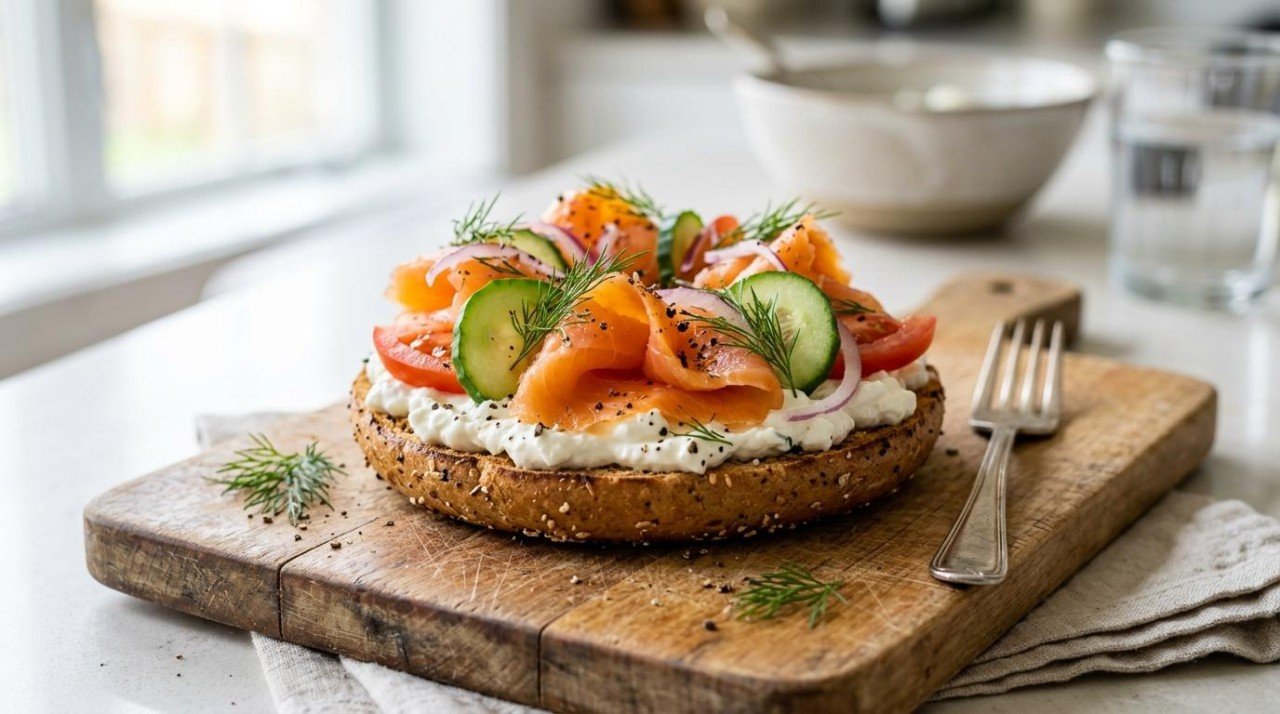
Then we rebuilt it. The version at the bottom of this page scores 69 — forty-one points higher — and it is still a full bagel with a thick schmear on it. No rice cakes, no cauliflower impostors. Here is every swap and what it costs you.
The original: what is in it and how it scores
We scored what you actually get handed at a deli: one plain bagel, about 4 oz (113 g), and a real schmear — 2 oz (57 g) of full-fat cream cheese. That is not an exaggerated portion for effect. It is roughly a quarter of a standard tub, and it is what a bagel counter puts on without being asked.
Scored as one serving, that is 28/100: 494 calories, 15.3 g protein, 1.8 g fiber, 11.6 g saturated fat (50% DV, flagged very high), 690 mg sodium (30% DV, high), 7.9 g added sugar (30% DV, high), and zero plant points. Three caution flags on a two-ingredient breakfast, with gut health at 20/100, heart health 23, longevity 21.
Why it scores 28
The schmear is almost the entire saturated fat problem. We scored the two components separately. Those 2 oz of cream cheese are 196 calories and 11.2 of the 11.6 g of saturated fat — about 96% of it — in exchange for 3.3 g of protein. Cream cheese is a fat with a little dairy in it. That is exactly why it tastes the way it does, and why it is doing almost nothing else for you.
The bagel is more bread than people picture. By weight, a 4 oz bagel is roughly four slices of sandwich bread. On its own it carries 298 calories, all 7.9 g of the added sugar (bagel dough is sweetened, usually with malt), and 480 of the 690 mg of sodium. It also supplies 1.8 g of fiber, which is the entire fiber content of the meal — against a target of 25 to 35 g a day, when most Americans manage about 15. And there are no plants in it whatsoever; refined flour does not count, and cream cheese is not a vegetable.
Now the part these articles usually skip. Plenty here is fine. 15.3 g of protein is not nothing, and enriched flour is genuinely fortified: this breakfast delivers 55% of the Daily Value for thiamine, 50% for iron, 47% for folate, 40% for riboflavin, and 32% for niacin. A bagel is not empty. It is a fortified refined-flour delivery vehicle with no fiber, carrying a lump of saturated fat on top — two separate problems needing two separate fixes.
The upgrades
Every change below was applied cumulatively, in this order, and re-scored at each step against production nutrition data. Each delta is what that change was worth at that point in the build — which matters more than you would think.
1. Switch to a 100% whole wheat bagel
- Swap: Plain refined bagel → 100% whole wheat bagel, same 4 oz
- Score impact: +12 points (28 to 40)
- What it changes: Fiber 1.8 g to 4.6 g, added sugar 7.9 g to 3.4 g (that caution clears entirely), plant points 0 to 1
- What it costs you: A denser, nuttier, less pillowy chew. This is the swap with the most real flavor cost on the page, and it is still the one to make first
Milling strips the bran and germ off a wheat kernel and keeps only the endosperm, which removes more than half of wheat's B vitamins, 90% of its vitamin E, and virtually all of its fiber. Put them back and you get 2.5 times the fiber for fifteen fewer calories.
The catch is at the shelf, not the toaster. "Wheat," "multigrain," and "made with whole grains" all routinely describe refined flour — a bagel can be beige from molasses and still be white bread. The first ingredient needs to say whole wheat flour.
2. Whip cottage cheese into the schmear
- Swap: 2 oz cream cheese → 6 tbsp (3 oz) cottage cheese, blended smooth
- Score impact: +13 points (40 to 53) — the biggest single move on the page
- What it changes: Saturated fat 11.2 g to 1.1 g (flag cleared), protein 14.8 g to 20.9 g, 126 calories gone
- What it costs you: Real tang. Cottage cheese is sharper and lighter, and if you do not blend it properly you will notice the curds
The arithmetic is not close. At the amounts used here, cream cheese is 196 calories for 3.3 g of protein; the cottage cheese is 70 calories for 9.4 g. You get a bigger schmear, nearly three times the protein, and you hand back ten grams of saturated fat. Harvard's protein package idea is exactly this: what a protein arrives wrapped in matters more than the gram count.
Blending is not optional — spooning curds onto a bagel is a different and worse breakfast. Blend it about 30 seconds, scrape, then go another minute until completely smooth, using 4% or at least 2%, because fat-free blends up thin and watery. It comes out spreadable and tastes like a tangier cream cheese. Our cream cheese and cottage cheese substitution guides cover the rest of the spectrum.
One thing worth pausing on. We also tested this exact swap on its own, made first, on the original plain bagel. It scored 33 — worth only +5, against +13 here. Pulling the saturated fat out while the bagel was still refined flour just traded one flagged problem for another. Fix the bagel first and the same swap is worth nearly three times as much.
3. Add 2 oz of smoked salmon
- Swap: Add 2 oz (57 g) cold-smoked salmon
- Score impact: +6 points (53 to 59)
- What it changes: Protein 20.9 g to 31.3 g, and omega-3 EPA+DHA from essentially zero to 103% DV in the finished build
- What it costs you: Money, and 380 mg of sodium. Flavor-wise, nothing — this is the step that makes the sandwich better to eat
Six points is smaller than this swap deserves, and the reason is sodium: lox pushes the sandwich from 770 mg to 1,150 mg and moves that flag from high to very high. The score is charging you for it, correctly. In return you get the biggest nutritional upgrade in the post — from no meaningful omega-3s to more than a full day's worth of EPA and DHA, plus 92% DV of vitamin B12 and 65% of vitamin D. Salmon sits on the FDA and EPA's Best Choices list, with 2 to 3 servings of such fish recommended weekly, and a 3 oz serving of Atlantic salmon runs 1.2 to 1.7 g of EPA+DHA.
Two ounces is plenty — it looks like a lot draped in loose folds rather than laid flat. If lox is not in the budget, hot-smoked salmon or trout flakes cost less; our salmon substitutes guide covers which ones hold up cold on a bagel.
4. Treat the vegetables as the meal, not the garnish
- Swap: Add sliced tomato, cucumber, paper-thin red onion, fresh dill, lemon juice, and black pepper
- Score impact: +10 points (59 to 69)
- What it changes: Fiber 4.6 g to 6.1 g, plant points 1 to 4.5, vitamin C and vitamin K to 17% DV each, potassium to 19%
- What it costs you: About four minutes with a knife
Ten points for vegetables you were probably already picturing on this sandwich. The trick is quantity: half a tomato, a real handful of cucumber, and two tablespoons of onion, not two apologetic slices. Loaded properly, this is the difference between a bagel with tomato on it and an open-faced meal. The plant points number is the one to watch — gut microbiome research points toward eating around 30 different plants a week, and this breakfast went from contributing nothing to contributing 4.5.
Take the Guesswork Out of Eating Well
Eat Well Planner helps you organize your favorite recipes, plan balanced meals, and automatically generate shopping lists — all in one place. Whether you're tracking macros, managing dietary restrictions, or just trying to stop asking "what's for dinner?", we've got you covered.
Our AI-powered tools can adapt any recipe to your dietary needs, help you discover new meals you'll love, and even log your nutrition effortlessly. It's meal planning made simple.
Start Organizing Your Meals — FreeWhat we kept, and where we stopped
The whole bagel stays. The most common advice on this dish is to eat half, so we scored it: the same sandwich on half a bagel gets 72, three points better, with sodium down to 910 mg. But it also drops the meal to 307 calories, which is a snack rather than a breakfast that reaches lunch — and the premise here is that you keep the bagel. If you were going to eat half anyway, take the three points. The real lox stays too, and so does full-fat cottage cheese; the fat-free versions of both are worse to eat, and the cheese blends worse.
The sodium does not get fixed, and we are not going to pretend otherwise. The finished sandwich carries 1,160 mg — 50% of the 2,300 mg daily ceiling in one breakfast, and the only caution flag left. It is structural: about 500 mg is the bagel, 380 mg the cured salmon, 270 mg the cheese. A bagel is salted bread and lox is salt-cured fish; take the salt out of either and you no longer have the dish. What it bought is worth knowing, though — the original was already at 690 mg for bread and cheese alone, and the extra 470 mg bought 17 more grams of protein and a full day of EPA and DHA. If this is your breakfast most days and blood pressure is on your radar, the half-bagel version at 910 mg is the honest lever.
The healthier version: full recipe
Nutrition Score: 69/100 (up from 28). Gut health 64, heart health 59, brain health 76, energy and recovery 74, weight management 84, longevity 64. It qualifies as an excellent source of omega-3 EPA+DHA (103% DV), vitamin B12 (92%), vitamin D (65%), phosphorus (59%), iron (51%), niacin and thiamine (44%), riboflavin (41%), protein (40%), and fiber (20%).
Serves 1. About 10 minutes.
- 1 whole wheat bagel (4 oz / 113 g), split — check that the first ingredient is whole wheat flour
- 6 tablespoons (3 oz / 85 g) cottage cheese, 4% or 2%
- 2 oz (57 g) cold-smoked salmon (lox)
- 1/2 medium tomato (about 2 oz / 60 g), sliced
- 1/3 cup (1.5 oz / 40 g) cucumber, thinly sliced
- 2 tablespoons (0.5 oz / 15 g) red onion, sliced paper-thin
- 1 tablespoon fresh dill, roughly chopped
- 1 teaspoon lemon juice
- Freshly ground black pepper
- Slice the tomato, salt the slices lightly, and set them on a paper towel while you do everything else — they will taste twice as much like tomato. If raw red onion is strong for you at breakfast, soak the slices in cold water for 10 minutes, then drain.
- Blend the cottage cheese completely smooth in a food processor, or in a tall cup with an immersion blender: about 30 seconds, scrape the sides, then up to another minute. Do not add liquid, or it will not hold on the bagel.
- Toast the bagel halves until the cut sides are golden and crisp. That crisp surface is what stops a wet topping from turning the bread soggy.
- Spread the cottage cheese thickly over both halves, right to the edges, and grind black pepper over it.
- Lay the smoked salmon over the cheese in loose folds rather than flat sheets, then layer on the tomato, cucumber, and red onion.
- Scatter the dill over the top, squeeze over the lemon juice, and add one more grind of pepper. Eat it open-faced with a knife and fork, or close it and commit.
Per serving, original vs. improved:
- Nutrition Score: 28 → 69
- Calories: 494 → 447
- Protein: 15.3 g → 32.3 g
- Fiber: 1.8 g → 6.1 g
- Saturated fat: 11.6 g → 1.7 g
- Added sugar: 7.9 g → 3.4 g
- Sodium: 690 mg → 1,160 mg
- Plant points: 0 → 4.5
- Caution flags: 3 → 1
Swaps we tested and skipped
- Reduced-fat cream cheese instead of whipped cottage cheese: 62, five points worse. The swap everyone recommends first is the wrong one — it puts 5.7 g of saturated fat back, re-triggers the caution the cottage cheese had cleared, and delivers less protein. For a middle path, blend Greek yogurt into real cream cheese instead of buying the light tub.
- Low-sodium cottage cheese: 68, one point worse. Genuinely surprising, because in our cottage cheese flatbread makeover the identical swap was worth +17. The difference is where the salt lives: there the cheese was the sodium, here it is under a quarter of it. Switching drops the total to 990 mg and moves the flag from very high to high, but does not buy back a point.
- Capers: 70, one point better, for 350 mg more sodium. Traditional on a lox bagel and delicious. But 1,160 mg to 1,510 mg (65% DV) for a single point is the clearest bad trade we found. Rinse them if you use them, and treat it as a flavor choice rather than a health one.
- Sliced avocado: 71, two points better. This one nearly made it — fiber jumps from 6.1 g to 9.4 g — but it costs 80 calories and starts crowding the plate. If you like avocado on a bagel, add it and take the two points.
Make it fit other diets
- Vegetarian: Drop the salmon for a jammy soft-boiled egg, or double the vegetables and add sliced radish. You lose the omega-3s, so make them up elsewhere that day.
- Dairy-free: Mashed avocado with lemon and salt in place of the schmear. Keep the salmon; it carries the sandwich.
- Gluten-free: Gluten-free bagels are usually low in fiber, so lean harder on the vegetables to make it up.
In the app you do not have to work these out by hand — ask the AI recipe chat to make this dairy-free, or use Recipe Variations, and it rewrites the recipe with the substitutions already worked in.
Do this to your own recipes
Nothing here required guessing. Every number came from tools you get too: the Nutrition Score that gave the original its 28, the Recipe Playground where we tested each swap and watched the delta land, and Make It Healthier, which proposes swaps like these on any recipe and runs the nutrition math before it shows you a suggestion — so you never get told a change helps when it does not. That is how we caught the light-cream-cheese swap being worse than the obvious one.
Import any recipe you love from a URL, an Instagram reel, or a YouTube video and it gets scored before you cook it. Then keep the dish and change the numbers.