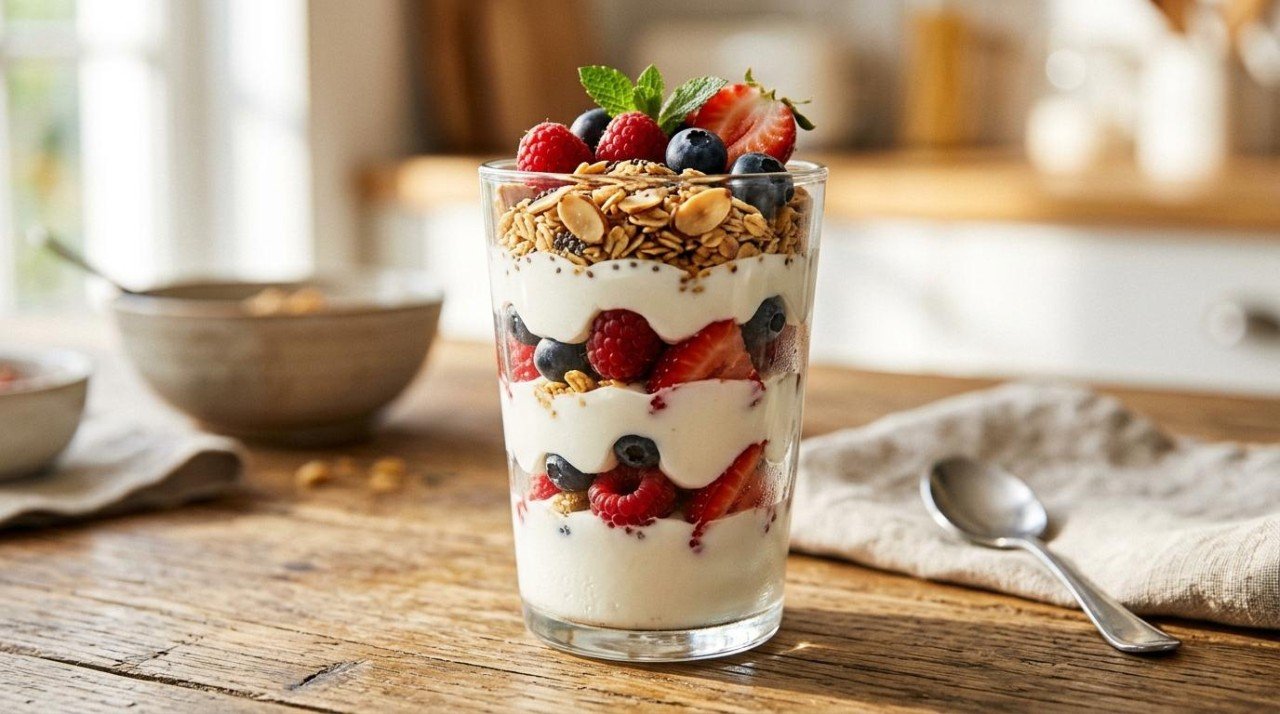
A yogurt parfait is what you order when you are being good. It is the thing in the glass case next to the pastries that lets you walk out feeling like you made the right call. Yogurt, berries, a little granola, layered in a cup. Nothing in it sounds like a problem.
So we built the standard version in Eat Well Planner and ran it through the app's Nutrition Score. It came back at 43 out of 100, with a single caution flag: added sugar, at 210% of a day's reference in one cup. Not 21%. Two hundred and ten.
Then we rebuilt it one verified swap at a time and got it to 91, with no caution flags, 31.6 g of protein and more than twice the fiber. The interesting part is the order. The change everyone reaches for first - less granola - made the parfait worse when we tried it first, and was worth 16 points when we tried it last. Here is the whole thing, with receipts.
The original: what's in it and how it scores
There is no canonical parfait, so we scored the one that actually gets built: 1 cup (227 g) of low-fat vanilla yogurt, 1/2 cup (55 g) of store-bought granola, 1/2 cup of mixed berries (40 g blueberries, 40 g strawberries), and a tablespoon (21 g) of honey drizzled over the top. Layer, repeat, eat. That is the recipe on the back of most granola bags and the one in most healthy-breakfast roundups.
Nutrition Score: 43/100. Per serving: about 528 calories, 14.6 g protein, 5.8 g fiber, 2.1 g saturated fat, 97 g carbohydrate, and 55.5 g of added sugar - 210% of a day's reference, flagged very high. Plant points: 2.
Before the diagnosis, the credit. Real things are happening in that glass. The parfait is an excellent source of phosphorus (61% of a day), riboflavin (41%), calcium (34%) and vitamin C (30%), and a good source of iron, magnesium, zinc, potassium and fiber. The berries are doing exactly what berries do. The yogurt is real dairy with real calcium in it. Nothing here needs defending except one number.
Where the 55 grams of sugar comes from
It arrives in three deposits, and the biggest one is invisible.
- The yogurt: about 27 g. One cup of sweetened vanilla yogurt. You did not add this, and the tub does not say dessert anywhere on it.
- The granola: about 11 g. Half a cup of a commercial blend at roughly 20 g of added sugar per 100 g.
- The honey: about 17 g. One tablespoon, poured in about a second and a half.
For scale: the American Heart Association's daily limit is 24 g of added sugar for women and 36 g for men, and the World Health Organization's additional-benefit target is under 5% of energy, roughly 25 g a day - which is the reference our score works against. This one breakfast spends a full day's allowance twice over.
The yogurt is the part worth staring at, because it is the part nobody counts. When researchers surveyed the sugar content of supermarket yogurts, natural and Greek yogurts came in at a median of 4.7 g of sugar per 100 g while flavored yogurts sat at 11.9 g and fruit yogurts at 11.0 g - and dessert-category yogurts, the ones that at least admit what they are, were only at 16.3 g. Flavored yogurt is closer to dessert than it is to plain yogurt. In the same survey, just 15% of all products cleared the 5 g per 100 g low-sugar threshold.
Commercial granola is the same story in a different bag. Across a survey of breakfast cereals, mean sugar content was 19.9 g per 100 g and only 8.7% of products came in under 5 g per 100 g. If you want the full accounting of what is in a jar of granola, we scored that separately in Healthier Granola.
The cafe version is a different problem
A parfait built at home has a yogurt-to-granola ratio you chose. One built for a display case usually does not - it is engineered to look full, and granola is what fills a cup cheaply. We scored a cafe-shaped version (150 g flavored yogurt, 65 g granola, a token 40 g of berries) and it lands at 46, with 117% of a day's added sugar in only 420 calories. Slightly better score, considerably worse density.
The published figures for a Starbucks Berry Trio Parfait tell the same story from the other end: 164 g, 240 calories, 14 g protein, 25 g of sugar, and 2 g of fiber. Two grams. Americans already average about 15 g of fiber a day against a 25 to 35 g recommendation, and a breakfast built on fruit and oats should be helping with that, not sitting it out.
The upgrades
We applied these in order and re-scored after each one, so every number below is what that change was worth at that point in the build. The order matters more here than in any recipe we have run through this series - the same final swap swings 19 points depending on when you make it.
1. Plain Greek yogurt instead of flavored
- Swap: 1 cup low-fat vanilla yogurt to 1 cup plain 2% Greek yogurt
- Score impact: +9 points (43 to 52)
- What it changes: Removes 27 g of added sugar and doubles the protein, from 14.6 g to 29.1 g
- What it costs you: Tartness, genuinely. Plain Greek yogurt is sour, and if you have been eating vanilla yogurt your palate will notice on day one and stop noticing by about day four
This is the swap the whole post rests on and it is one ingredient. Straining is what makes Greek yogurt Greek: draining the whey concentrates the protein and takes most of the lactose with it, which is why the plain tubs land near 4.7 g of sugar per 100 g while the flavored ones sit at 11.9. We wrote up the full dairy-aisle version of this decision in Greek Yogurt vs. Regular.
The protein is not a side effect worth skipping past. In a randomized crossover trial, young women given a 350-calorie breakfast containing 35 g of protein reported greater daily fullness than the same 350 calories with 13 g. The original parfait is a 528-calorie breakfast sitting in the 13 g neighborhood. This swap moves it into the other one without adding a calorie.
If plain Greek is a bridge too far on the first morning, skyr works identically here - we scored the finished parfait with skyr and got the same 91, with a little more protein (34.5 g) and less saturated fat. Nonfat Greek scored 93, two points better than the 2%, which is a real gain if you want it. We kept the 2% because it is what makes a parfait taste like a parfait rather than like a protein shake in a glass. If you are working from the other direction and just need something that behaves like Greek yogurt, our Greek yogurt substitutes guide ranks the options by how much protein each one keeps.
2. Drop the honey drizzle
- Swap: 1 tablespoon honey to nothing
- Score impact: +3 points (52 to 55)
- What it changes: Removes 17 g of added sugar and 64 calories; the caution drops from very high to high
- What it costs you: A second of pleasure and about a quarter of the sweetness. The fruit picks up most of the slack once the yogurt is no longer competing with it
Three points looks like a rounding error, and at this point in the build it is - the added-sugar flag is still lit either way, so clearing 17 g out of a still-flagged total buys almost nothing. Hold that thought, because it is the same trap the granola falls into, and it reverses completely by the end of the post.
Here is the receipt: we put the tablespoon of honey back on the finished 91-point parfait and it fell to 58. A 33-point drop, from one tablespoon, at the end. We then tried a single teaspoon (7 g) and it still fell to 72. Once everything else is clean, the drizzle is the only thing standing between the parfait and a clear label - which is exactly why it is worth almost nothing to remove it early and everything to leave it off later. Maple syrup is not an escape hatch either: swapped in at the end, it scored the same 58. If you want the honest comparison of the liquid sweeteners, it is in our honey substitutes guide.
3. More berries, and more than one kind
- Swap: 1/2 cup mixed berries to about 1 1/4 cups (60 g blueberries, 60 g strawberries, 40 g raspberries)
- Score impact: +4 points (55 to 59)
- What it changes: Fiber from 5.8 g to 9.2 g, vitamin C up sharply, plant points from 2 to 3
- What it costs you: Nothing. This is the one swap in the post with no downside at all, and it makes the parfait taste more like fruit
Raspberries are the quiet workhorse: 6.5 g of fiber per 100 g against 2.4 g for blueberries and 1.8 g for strawberries. Frozen berries are fine here and often better - they are picked ripe, they cost less, and they weep a little juice into the yogurt as they thaw, which does the sweetening job the honey used to do. Three kinds instead of one is not nutritional theater, either. It is three different plants, and plant diversity is what the gut microbiome actually responds to.
4. A spoonful of chia and a handful of almonds
- Swap: Add 1 tablespoon (12 g) chia seeds and 2 tablespoons (15 g) sliced almonds
- Score impact: +16 points (59 to 75)
- What it changes: Fiber 9.2 g to 14.9 g, protein to 35 g, and plant omega-3 from almost nothing to well over a day's worth
- What it costs you: About 150 calories, and 20 minutes of patience if you want the chia soft rather than crunchy
Sixteen points from two spoonfuls is the biggest single move in the build, and most of it is the chia. Two tablespoons of chia carry about 11 g of fiber, and roughly 60% of the oil in the seed is omega-3 - which in a parfait is close to free, because chia also gels in liquid and thickens the yogurt on its own. Stir it in the night before and it behaves like a pudding.
The almonds are here for crunch and staying power, and they are here instead of walnuts for a reason we did not expect. We tested walnuts first and the parfait scored 88 - three points lower - because 15 g of walnuts adds enough omega-6 linoleic acid to tip the recipe into a high-omega-6 flag. Walnuts carry 38.1 g of omega-6 per 100 g against almonds' 12.1 g. Normally walnuts earn that back with their ALA, but the chia had already covered the omega-3 job several times over, so all the walnuts added was the imbalance. Western diets already run an omega-6 to omega-3 ratio somewhere north of 15:1, against roughly 1:1 for most of human history, so it is not a trivial flag. Almonds cleared it and the score went to 91.
5. Granola as a topping, not a layer
- Swap: 1/2 cup (55 g) granola to 2 heaped tablespoons (20 g), scattered on top at the end
- Score impact: +16 points (75 to 91)
- What it changes: Removes 147 calories and 7 g of added sugar - and clears the added-sugar caution entirely, which is where the points are
- What it costs you: Volume. You will notice the glass is less full. You will not notice on crunch, because granola on top stays crisp while granola in a layer goes soft anyway
Now the part that makes this post worth reading. We also tested this exact swap first, against the untouched original, and the parfait scored 40 - three points worse than doing nothing. Removing 147 calories and 7 g of sugar made the score go down.
That is not a bug in the calculator, it is the calculator being honest. Against the original, cutting the granola takes away real fiber (5.8 g down to 3.2 g) plus a chunk of the iron, magnesium and zinc, while the added-sugar flag stays pinned at very high regardless, because 48 g and 55 g are both far past the line. You pay the full cost of the cut and collect none of the benefit. Only once the yogurt, the honey, the berries and the seeds have brought added sugar down to where 7 g is the difference between flagged and clear does the same swap pay 16 points.
This is the general lesson of these makeovers, and the parfait states it more cleanly than anything else we have scored: the change that feels most virtuous is often the one that has to go last. Eating less of the same thing is the weakest lever in the kitchen. Changing what the thing is made of is the strong one.
Take the Guesswork Out of Eating Well
Eat Well Planner helps you organize your favorite recipes, plan balanced meals, and automatically generate shopping lists — all in one place. Whether you're tracking macros, managing dietary restrictions, or just trying to stop asking "what's for dinner?", we've got you covered.
Our AI-powered tools can adapt any recipe to your dietary needs, help you discover new meals you'll love, and even log your nutrition effortlessly. It's meal planning made simple.
Start Organizing Your Meals — FreeWhat we kept on purpose
We kept the granola. Removing it entirely scores 95 - four points better than leaving 20 g on top - and we are not doing that, because a yogurt parfait without granola is a bowl of yogurt with fruit in it. The crunch is the reason the dish exists. Four points is what that crunch costs, and we think it is the best four points in the recipe. If you disagree, you now know exactly what dropping it is worth.
We kept 2% Greek yogurt rather than nonfat, at a cost of two points, because the fat is doing work on texture and on how long the breakfast holds you. We kept whole fruit rather than a fruit compote or puree, which is how cafe parfaits deliver berries while adding sugar. And we did not swap the granola for plain rolled oats, even though that scores 93 - raw oats on yogurt are not crunchy, they are chewy and faintly dusty, and a parfait is a texture dish before it is anything else.
The healthier version: full recipe
Nutrition Score: 91/100. No caution flags. Makes 1 parfait.
- 1 cup (227 g) plain 2% Greek yogurt
- 1 tablespoon (12 g) chia seeds
- 1/2 cup (60 g) blueberries
- 1/3 cup (60 g) strawberries, sliced
- 1/3 cup (40 g) raspberries
- 2 tablespoons (15 g) sliced almonds
- 2 heaped tablespoons (20 g) granola
- Optional: 1/2 teaspoon vanilla extract, or the zest of half a lemon, stirred into the yogurt
- Stir the chia seeds into the Greek yogurt, along with the vanilla or lemon zest if you are using it. Let it sit 20 minutes at room temperature, or overnight in the fridge, until the seeds soften and the yogurt thickens to a pudding.
- Crush about a third of the raspberries with the back of a spoon and fold them through the yogurt. This is the sweetening step - the juice bleeds pink through the yogurt and does what the honey used to do.
- Spoon half the yogurt into a glass or jar. Add half the whole berries. Repeat with the remaining yogurt and berries.
- Scatter the almonds and granola over the top just before eating, not before storing. Granola in contact with yogurt goes soft within about 20 minutes.
Per serving, original vs. improved:
- Nutrition Score: 43 to 91
- Calories: 528 to 471
- Protein: 14.6 g to 31.6 g
- Fiber: 5.8 g to 12.3 g
- Added sugar: 55.5 g to 4.0 g
- Carbohydrate: 97 g to 48 g
- Saturated fat: 2.1 g to 2.9 g
- Plant points: 2 to 5
- Caution flags: 1 (added sugar, very high) to none
The finished parfait scores as an excellent source of plant omega-3 (147% of a day), phosphorus (80%), riboflavin (70%), vitamin B12 (65%), vitamin C (56%), biotin (45%), fiber (42%), protein (39%), calcium (39%), magnesium (36%), vitamin E (36%), iron (32%), zinc (27%) and potassium (23%). It is 57 calories lighter than the original and carries 51 g less added sugar, which is a full day's allowance handed back to you before 9 a.m.
Swaps we tested and skipped
- Cutting the granola first. 43 to 40. Right change, wrong order - covered above, and the single most useful number in this post.
- Walnuts instead of almonds. 91 to 88, on the omega-6 flag. Walnuts are a great food in a recipe that needs ALA. This one already had chia.
- Pumpkin seeds instead of almonds. 91 to 87. Same omega-6 problem as the walnuts, plus more saturated fat. Fine if you need it nut-free, but it is a four-point trade, not a free one.
- Keeping the honey. 91 to 58 for a tablespoon, or 72 for a single teaspoon. There is no small amount of a liquid sweetener once the rest of the parfait is clean.
- Maple syrup instead of honey. 58, identical to the honey. Swapping one sweetener for another sweetener is not a swap.
- Skipping the chia. 91 to 90 on the surface, which undersells it badly - fiber falls from 12.3 g to 8.2 g and the plant omega-3 goes with it. The score barely moves because nothing tips over a threshold. The label moves a lot.
- Fruit-on-the-bottom yogurt instead of vanilla. The original parfait rebuilt with fruit yogurt scores 50 instead of 43 - better, and still 163% of a day's added sugar. Not a fix, just a slightly smaller hole.
Make it fit other diets
For a dairy-free parfait, plain unsweetened soy yogurt is the only common plant yogurt that keeps the protein anywhere near Greek - coconut and almond versions will cost you 15 to 20 g of it, and you will want a second tablespoon of chia to hold the texture. For nut-free, sunflower seeds replace the almonds at the same 15 g, with the same omega-6 caveat as the pumpkin seeds. For gluten-free, the only thing to check is the granola, since oats are routinely cross-contaminated in milling - use a certified gluten-free blend. In Eat Well Planner you can ask the AI to rewrite the whole recipe for any of these in one step, then re-score it to see what the swap actually cost.
Do this to your own breakfast
Nothing about this process is specific to parfaits. Every number in this post came from building a recipe in Eat Well Planner and running it through the Nutrition Score, then using Make It Healthier, which proposes ingredient swaps and runs each one through a calculator before showing it to you - so what you see is a verified gain, not a guess. The Recipe Playground does the manual version: change one ingredient, watch the score move by the amount that change is worth, decide whether to keep it. That is how we found out the granola cut was worth minus three points at the start of the build and plus sixteen at the end.
The parfait is the clearest case we have scored of a food whose reputation and label disagree, and the gap is not the fruit, and it is not really the granola. It is one cup of yogurt that somebody sweetened for you before you bought it. Read that label once and the rest of this post is optional.
If your mornings run to jars rather than glasses, we put the same process through overnight oats - same yogurt, same trap, different container.