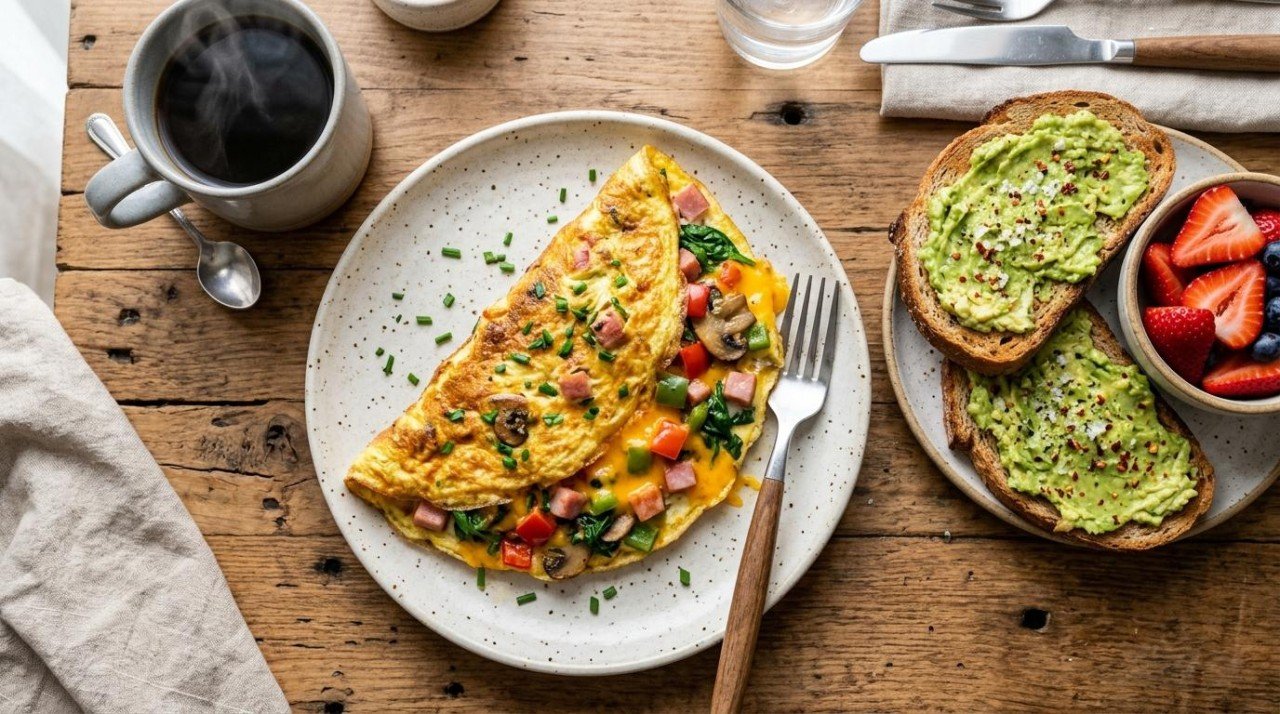
The Western omelet, or Denver omelet if that's what your diner calls it, is about as honest as breakfast gets: eggs, ham, peppers, onion, cheese. No syrup, no batter. It's the order that feels like the sensible choice on the menu.
So we scored it. The full diner plate (the omelet with hash browns and buttered white toast) scores 45 out of 100 in Eat Well Planner's Nutrition Score. The omelet on its own scores even lower: 42. Our version scores 83, and it's still a three-egg omelet with ham, peppers, onion and melted cheddar, with toast on the side.
The surprise is where the points came from. You'd expect this to be a "swap the hash browns" job. The sides helped, but on their own they barely moved the score: the butter, the cheese and the salt were holding it down. Every number below is a real score from the app, including the swaps that did nothing.
The original: what's in it and how it scores
For the omelet, we used Spend With Pennies' Denver omelet as a representative recipe, because it's a classic three-egg version: a tablespoon of butter, 1 ounce of diced ham, 2 tablespoons each of onion, green pepper and red pepper, a splash of milk, and half a cup of shredded cheddar. Then we built the plate the way a diner serves it:
- The omelet: 3 eggs, 1 tbsp butter, 1 oz ham, about 1/3 cup peppers and onion combined, 1/2 cup cheddar, salt
- Hash browns: about 1 cup of shredded potato, fried in 1 tablespoon of oil and salted
- Toast: 2 slices of white bread with 2 pats of butter
Score: 45/100. Per plate: 1,083 calories, 46 g protein, 4.3 g fiber, 29.5 g saturated fat and 1,970 mg sodium. The app flagged three weaknesses: high saturated fat, high sodium and low fiber.
What drags it down:
- Saturated fat is the big one. 29.5 g is 148% of the FDA's 20 g Daily Value, in one meal. It comes from half a cup of cheddar, a tablespoon of butter in the pan, and the butter on the toast.
- Sodium adds up quietly. 1,970 mg is 86% of the 2,300 mg daily limit. No single ingredient is to blame; it's ham, cheese, butter, bread, salted hash browns and salted eggs together. The FDA notes that over 70% of the sodium Americans eat comes from packaged and prepared foods, and a diner plate is a stack of them.
- Very few plants. About 1/3 cup of peppers and onion is all the vegetable on the plate besides the potatoes.
What's already good, and stays: the eggs. The omelet brings 38 g of protein and about 100% of the Daily Value for choline, a nutrient most people fall short on, and nearly all of that choline comes from the yolks. The eggs are not the problem (if you still worry about yolks, here's why that advice changed), and the score agrees.
The upgrades
Eight changes, in the order we applied them. Here's the most useful thing we learned: on the original plate, the swaps that cut fat or sodium (less cheese, oil instead of butter, lower-sodium ham, no added salt) were worth just +1 point each. Saturated fat and sodium were both flagged so heavily that fixing one left the other holding the score down. Later in the build, the same swaps were worth +3 to +8. So for each swap, we show what it was worth at that point and what putting it back costs in the finished recipe.
1. Hash browns → a cup of strawberries
- Swap: 1 cup diner hash browns → 1 cup sliced strawberries
- Score impact: +0 (putting the diner hash browns back on the finished plate: -8)
- What it changes: Cuts about 190 calories, a tablespoon of frying oil and about 390 mg of sodium; adds vitamin C and fiber
- What it costs you: The crispy potatoes. This is the hardest one for most people, and there's a way to keep them (see below)
Zero points for cutting 190 calories looks like a broken scale, but the score measures how nutritious each bite is, not how big the plate is. With 29.5 g of saturated fat still on the plate, a lighter side doesn't change the picture. Once the rest was fixed, the diner hash browns cost 8 points.
If you want potatoes: it was the frying that hurt, not the potato. Hash browns made at home in half a tablespoon of canola oil with a light pinch of salt, served alongside the berries, actually scored 87, four points above our finished plate (for 180 more calories). Served instead of the berries, they scored 81. Our healthier hash browns show how to keep the crust with very little oil.
2. White toast → 100% whole wheat
- Swap: 2 slices white bread → 2 slices 100% whole wheat
- Score impact: +4 (white toast back at the end: -4)
- What it changes: Adds about 2 g of fiber and 2 g of protein, and more magnesium and B vitamins
- What it costs you: Almost nothing. It's toast, and whole wheat toasts beautifully
Look for "100% whole wheat" as the first ingredient; "wheat bread" is often mostly white flour. This was the cheapest win on the plate, and it's also the easiest one to ask for at a diner.
3. Butter on the toast → mashed avocado
- Swap: 2 pats of butter → 1/4 small avocado, mashed with black pepper
- Score impact: +5 (butter back on the finished toast instead of avocado: -15)
- What it changes: Replaces about 4.5 g of saturated fat with mostly unsaturated fat, plus 2+ g of fiber
- What it costs you: Melting butter on hot toast is hard to beat. Avocado toast on the side is a different pleasure, not a lesser one
Look at that put-back number: -15. Two pats of butter cost as much as the tablespoon in the pan, more than any other ingredient. Dry toast scored 4 points lower than the avocado, and nobody likes dry toast. A small bonus: a 2005 study in the Journal of Nutrition found that adding avocado to a salad multiplied how much of the vegetables' carotenoids people absorbed, and the peppers and spinach in this omelet are full of them. If you don't have an avocado, see our avocado substitutes.
4. Butter in the pan → half a tablespoon of canola oil
- Swap: 1 tbsp butter → 1 1/2 tsp canola oil (split between the filling and the eggs)
- Score impact: +3 (a full tablespoon of butter back at the end: -15)
- What it changes: Cuts about 6 g of saturated fat and adds omega-3 ALA
- What it costs you: A little of the buttery diner flavor. With cheese and ham in the fold, it's hard to notice
A good nonstick pan does what the butter was doing. We tested two other fats: olive oil scored 3 points lower than canola, and cooking spray scored 4 lower (less fat overall, but also less of the omega-3 that canola brings). For other swaps, see our butter substitutes guide.
5. Half a cup of cheddar → 1/4 cup of sharp cheddar
- Swap: 1/2 cup (2 oz) cheddar → 1/4 cup (1 oz) sharp cheddar
- Score impact: +7 (the full 2 oz back at the end: -13)
- What it changes: Cuts about 5 g of saturated fat, 180 mg of sodium and 115 calories
- What it costs you: Less cheese pulling out of the fold. Sharp cheddar keeps the flavor; you lose some of the volume
Once the butter was gone, cheese was most of the remaining saturated fat, which is why this swap jumped from +1 on the original to +7 here. Sharp cheddar has the same fat as mild but more flavor, so less goes further. Scatter it straight onto the eggs before the filling, so it melts into a layer instead of disappearing. Our cheddar substitutes guide covers other options with the same punch.
6. Triple the vegetables
- Swap: About 1/3 cup peppers and onion → 1 cup peppers and onion, plus 2/3 cup mushrooms and a packed cup of spinach
- Score impact: +6
- What it changes: More fiber, vitamin C, vitamin K and folate; two more plant points (the plate goes from 4 on the original to 8)
- What it costs you: A fuller, harder-to-fold omelet. Cook the filling first and it works
Peppers and onion are what make it a Western omelet, so they get more room. Mushrooms add a meaty, savory note, and spinach wilts down to almost nothing. Cook the vegetables before they go into the eggs: mushrooms and spinach release a lot of water, and raw vegetables make the omelet soggy.
7. Regular ham → lower-sodium ham
- Swap: 1 oz ham → 1 oz lower-sodium ham
- Score impact: +5 (regular ham back at the end: -4)
- What it changes: Cuts about 150 mg of sodium
- What it costs you: Nothing you'd taste in an omelet this full of flavor
We kept the amount: one ounce is already modest, and less would make it a vegetable omelet. Look for "lower sodium" or "25% less sodium" on the label. Our deli ham substitutes guide covers options if you'd rather skip processed meat altogether.
8. Skip the added salt
- Swap: 1/8 tsp salt in the eggs → none (black pepper only)
- Score impact: +8 (the salt back at the end: -8)
- What it changes: Cuts about 290 mg of sodium, and it cleared the "high sodium" flag
- What it costs you: Very little. The ham and sharp cheddar season the omelet from the inside
On the original plate, this was worth +1. At the end it was worth +8, because by then it was the last thing keeping sodium over the line. Every bite with ham or cheese tastes seasoned; taste before you reach for the shaker.
What we kept (on purpose)
- All three whole eggs. We tested egg whites below. They lost.
- The ham. Without ham, it's not a Denver omelet.
- Real sharp cheddar. An ounce of the real thing beat more of the reduced-fat kind.
- A splash of whole milk. Switching to skim scored exactly the same, so we kept the one that makes softer eggs.
- Two slices of toast. One slice scored 3 points lower and no toast 8 lower: the whole grains were helping, not hurting.
The finished plate still has one flag: saturated fat, at 12.8 g (64% of the Daily Value), mostly from the eggs and cheese. We could have cleared it by dropping the cheese (see below), but we decided a Denver omelet should still have cheese.
Take the Guesswork Out of Eating Well
Eat Well Planner helps you organize your favorite recipes, plan balanced meals, and automatically generate shopping lists — all in one place. Whether you're tracking macros, managing dietary restrictions, or just trying to stop asking "what's for dinner?", we've got you covered.
Our AI-powered tools can adapt any recipe to your dietary needs, help you discover new meals you'll love, and even log your nutrition effortlessly. It's meal planning made simple.
Start Organizing Your Meals — FreeHow to order it at a diner
You can't control the butter on the griddle or the salt in the kitchen, but you can control what you ask for. We scored each request, adding them one at a time:
- As it comes (hash browns, buttered white toast): 45
- Fruit instead of hash browns: 45
- + Whole wheat toast: 48
- + Butter on the side (and left there): 50
- + "Light on the cheese" (half the usual amount): 53
- + Add spinach and mushrooms (most diners will): 59
That's 14 points just by ordering differently. The other 24 points come from what happens at the stove: the pan fat, the salt and the ham. That's why the home version scores 83.
The healthier version: full recipe
Score: 83/100 (the full plate, up from 45). The omelet alone scores 67, up from 42.
Serves 1. Prep 10 minutes, cook 10 minutes.
For the omelet:
- 1 1/2 teaspoons canola oil, divided
- 1/3 cup diced onion
- 1/3 cup diced green bell pepper
- 1/3 cup diced red bell pepper
- 2/3 cup sliced mushrooms (about 3 medium)
- 1 oz lower-sodium ham, diced (about 3 tablespoons)
- 1 packed cup baby spinach
- 3 large eggs
- 1 tablespoon whole milk
- Black pepper, to taste
- 1/4 cup shredded sharp cheddar (1 oz)
On the side:
- 2 slices 100% whole wheat bread
- 1/4 small avocado
- 1 cup sliced strawberries
- Heat 1 teaspoon of the oil in an 8-inch nonstick skillet over medium heat. Add the onion, both peppers and the mushrooms and cook, stirring now and then, for 5 to 6 minutes, until the peppers soften and the liquid from the mushrooms has cooked off.
- Add the ham and cook for 1 minute. Add the spinach and stir just until it wilts, about 30 seconds. Transfer the filling to a plate and wipe out the pan.
- Whisk the eggs, milk and a few grinds of black pepper until no streaks of white remain.
- Return the pan to medium-low heat with the remaining 1/2 teaspoon oil. Pour in the eggs and let them set for about 30 seconds, then push the edges toward the center with a spatula, tilting the pan so the raw egg runs underneath. Repeat until the eggs are almost set but the top is still a little glossy, 2 to 3 minutes.
- Scatter the cheddar over one half of the omelet and spoon the filling over the cheese. Cover the pan for 1 minute to melt the cheese, then fold the empty half over the filling and slide the omelet onto a plate. (If it's too full to fold neatly, spoon some of the filling over the top. It tastes the same.)
- While the eggs cook, toast the bread. Mash the avocado onto the toast and finish with black pepper. Serve with the strawberries.
Per plate, original vs. healthier:
- Nutrition Score: 45 → 83
- Calories: 1,083 → 765
- Protein: 46 g → 44 g
- Fiber: 4.3 g → 11.5 g
- Saturated fat: 29.5 g → 12.8 g
- Sodium: 1,970 mg → 830 mg
- Plant points: 4 → 8
You get nearly the same protein for about 320 fewer calories, with nearly three times the fiber and less than half the sodium and saturated fat. Choline stays at 105% of the Daily Value, because all three yolks are still there.
Swaps we tested and skipped
- Egg whites. Swapping two of the three eggs for whites scored 81 (-2); all whites scored 80 (-3) and added two new weaknesses (low vitamin D, low omega-3). Choline dropped from 105% of the Daily Value to 44% with one yolk, and to 14% with none. The yolks are where much of the nutrition is, so they stay. (We saw the same result in our egg salad makeover.)
- No cheese. It scored 97 (+14), the highest number we got. We skipped it anyway, because a Denver omelet without melted cheddar isn't the dish you came here for. If you want to meet in the middle, 3/4 oz scored 86.
- Reduced-fat cheddar. Swapping the full 1/2 cup for reduced-fat cheddar scored 78, five points below 1 oz of regular sharp cheddar. Using less of the real thing beats using more of the reduced-fat version: it carries the same sodium and still plenty of saturated fat.
- Black beans instead of ham. 1/3 cup of no-salt-added black beans scored 86 (+3). It's a good omelet, but it's a Southwest omelet, not a Denver. It's the right swap if you're vegetarian (below).
- Cooking spray instead of oil. 79 (-4). Less fat, but you lose the omega-3s that half a tablespoon of canola brings.
Make it fit other diets
- Vegetarian: Replace the ham with 1/3 cup rinsed no-salt-added black beans (scored 86), and add a pinch of smoked paprika if you miss the smoky note.
- Dairy-free: Skip the cheese and use water or an unsweetened plant milk in the eggs. The avocado on the toast brings the creaminess.
- Gluten-free: Use a gluten-free whole-grain bread, or skip the toast and add a second cup of fruit.
Or let the app do it: Eat Well Planner's Recipe Variations rewrite any recipe for vegetarian, dairy-free or gluten-free in one step, with the substitutions already worked in.
Do this to any recipe
This makeover was a public run of the app's Make It Healthier feature. Import a recipe from any website, Instagram reel or YouTube video, and Eat Well Planner scores it, explains what's dragging it down, and proposes swaps like these, each checked by the nutrition calculator before you see it. Want to keep the butter on your toast? Put it back in the Recipe Playground, see exactly what it costs, and find the points somewhere else. Try it free with the breakfast you make most often.