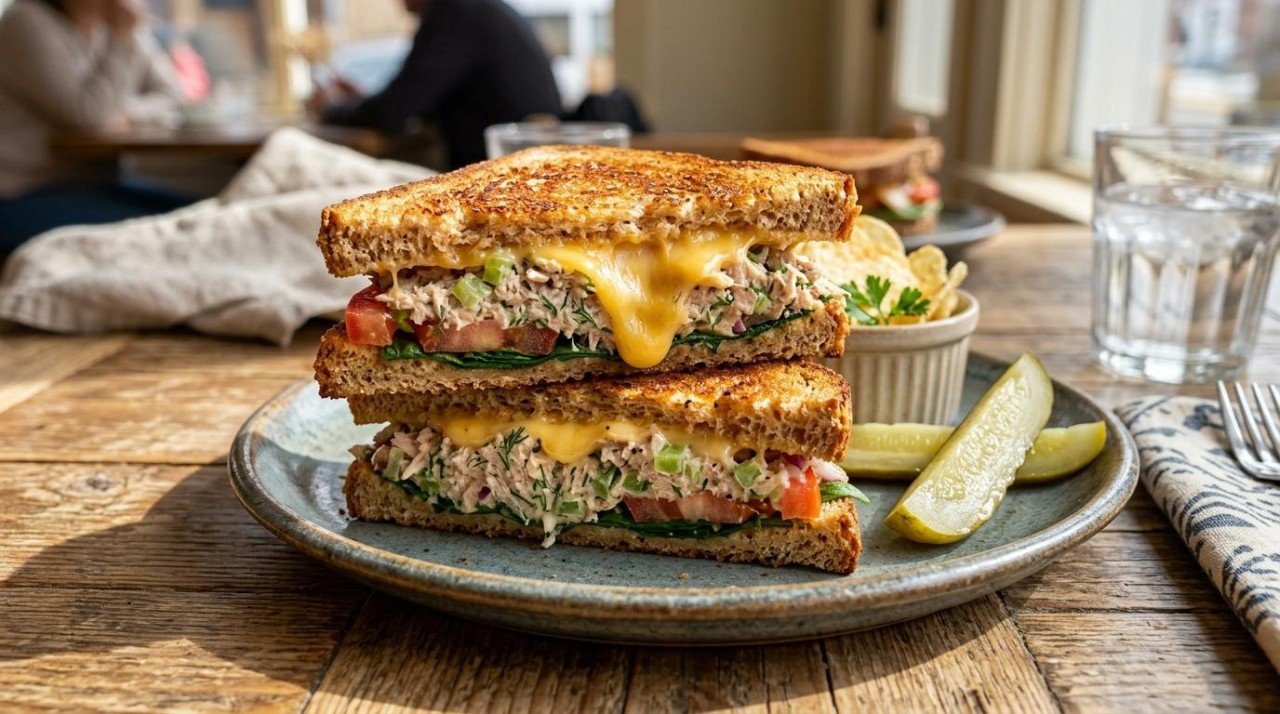
The tuna melt is a lunch-counter sandwich that has never needed a marketing campaign. Tuna salad, a slab of cheese, two slices of bread, a hot buttered griddle. It is cheap, it is fast, it uses a can you already own, and when the cheese has gone properly molten it is one of the most satisfying things you can make in ten minutes.
We scored the diner standard version with our Nutrition Score. It came back at 39 out of 100, with two flags: saturated fat and sodium. What makes this one unusual is that the ingredient everyone assumes is the problem — the tuna — is the single best thing in the sandwich, and the ingredient nobody thinks about is what is actually holding the score down.
We rebuilt it to 72. The cheddar is still real cheddar. The mayonnaise is still in the salad. It still pulls, and it still gets that lacquered brown crust. Here is every swap, what each one was worth, the one that scored exactly zero points and had to be made anyway, and the version that scored 93 that we turned down on purpose.
The diner standard: what is in it and how it scores
The version we scored is the one most recipes and most lunch counters converge on, built to make two sandwiches:
- One 5-ounce can of light tuna, drained (about 120 g)
- 1/4 cup mayonnaise (55 g)
- 4 slices white sandwich bread (about 104 g)
- 4 ounces cheddar, sliced (113 g, two ounces per sandwich)
- 2 tablespoons butter for the griddle (28 g)
Per sandwich that is 714 calories, 30 g of protein, 54 g of total fat, 20.8 g of saturated fat, about 980 mg of sodium, and 1.4 g of fiber. The score flags the first two: saturated fat at 89% of a day's value, marked very high, and sodium at 43%, marked high.
Those numbers deserve context rather than scolding. The Dietary Guidelines put saturated fat at less than 10% of daily calories, roughly 22 g on a 2,000-calorie day. One sandwich is 20.8 g. The sodium limit is less than 2.3 grams a day for most adults, and one sandwich spends 980 mg of it. On fiber, adults are advised to get 21 to 38 g a day, against a US average of about 16 g; this sandwich contributes 1.4 g. It also scores zero plant points, which is the app's way of saying there is not one identifiable plant food in it.
Now the part worth saying before we change anything, because the original is doing more than its reputation suggests. Per sandwich it is an excellent source of omega-3 ALA (93% DV), vitamin B12 (86% DV), omega-3 EPA and DHA (58% DV), phosphorus, niacin, calcium, and protein. That is almost entirely the tuna, which is a genuinely good ingredient: the EPA and FDA advice is to eat 2 to 3 servings a week from their Best Choices list, and canned light tuna is on it — we went through the mercury numbers and where canned tuna actually sits in a separate post. The ALA, oddly, is the mayonnaise: American-style mayo is mostly soybean oil, which carries a meaningful amount of plant omega-3. Remember that, because it matters at the end.
So what drags it to 39? Four ounces of cheese and two tablespoons of butter, and almost nothing else. Between them they account for the great majority of that 20.8 g of saturated fat. The white bread contributes the missing fiber, and the sodium is spread thinly across all five ingredients. The tuna is innocent.
The upgrades: seven swaps, 33 points
Each swap below is scored on top of the one before it, in the order we made them, so the deltas are the real thing this sandwich did rather than a theoretical sum. Order matters more here than in most makeovers, and one swap below is worth minus one point in the wrong position and plus five in the right one. If you want the single best one-change move, it is not the first swap on this list: applying only swap 4 and swap 5 to the untouched original — the vegetables, nothing else — takes it from 39 to 46 without removing anything.
1. Half the cheese, twice the sharpness
- Swap: 4 oz mild cheddar, in the middle → 2 oz sharp cheddar, in one layer
- Score impact: +0 points (39 to 39)
- What it changes: 116 calories off, saturated fat from 20.8 g to 15.4 g, sodium from 980 mg to 790 mg
- What it costs you: Nothing on flavor if you go sharp. A thinner pull, which is the honest trade.
Read that score impact again. We cut the cheese in half, took a quarter of the saturated fat and 190 mg of sodium out of the sandwich, and the score did not move a single point. That is not a bug — it is the most useful thing in this post. Saturated fat went from 89% of a day's value to 66%, which is still flagged very high. The caution was still standing, so the score stayed put. This swap is the setup. The next one collects.
Sharpness is what makes it survivable. Aged cheddar carries far more flavor per gram than a mild block, so an ounce of a good sharp cheddar reads as more cheese than an ounce of the yellow stuff does. Slice it thin and put all of it in one layer against the top slice rather than splitting it across both faces — a single continuous sheet gives you a real pull, two thin films give you neither. Our cheddar substitutes guide covers what else melts like this if sharp is not in the fridge.
2. Griddle in olive oil instead of butter
- Swap: 2 tablespoons butter → 1 tablespoon olive oil
- Score impact: +7 points (39 to 46)
- What it changes: Saturated fat from 15.4 g to 10.1 g, dropping the caution from very high to high; another 41 calories off
- What it costs you: The specific dairy sweetness butter gives a crust. The crunch is if anything better.
Seven points for a tablespoon of fat, and it only pays because of swap 1. Alone, on the original sandwich, the same butter-to-oil change is worth a single point — the cheese had to come down first for this one to clear the threshold. Together they are worth seven. Neither is worth much apart.
The health case is not just arithmetic. In a Nurses' Health Study and Health Professionals Follow-up Study analysis of nearly 100,000 US adults tracked from 1990 to 2014, replacing a teaspoon a day of butter, margarine, mayonnaise, or dairy fat with olive oil was associated with 5% lower cardiovascular disease risk and 7% lower coronary heart disease risk. That is observational and modest, but it points the same direction the score does. Practically: brush the oil onto the outside of the bread rather than pouring it into the pan, which is how one tablespoon covers four slices instead of soaking into the first one. Our butter substitutes guide has the ratios for other jobs where butter is doing more than greasing a pan.
3. White bread becomes 100% whole wheat
- Swap: 4 slices white sandwich bread → 4 slices 100% whole wheat
- Score impact: +6 points (46 to 52)
- What it changes: Fiber from 1.4 g to 3.1 g per sandwich, plus B vitamins, magnesium, and the first plant point on the board
- What it costs you: A nuttier, slightly denser bite. Most people stop noticing by the second sandwich.
This is the swap with the best evidence behind it of anything in the post. A meta-analysis of prospective studies found that each 90 g a day of whole grains — about three servings — was associated with 19% lower coronary heart disease risk, 22% lower cardiovascular disease risk, 15% lower total cancer risk, and 17% lower all-cause mortality, across studies covering hundreds of thousands of people.
There is a practical bonus specific to this sandwich. Tuna salad is wet, and white sandwich bread surrenders to it. Whole wheat has more structure and holds up to a damp filling and a hot pan without going pasty. The catch is the label: a lot of bread sold as wheat bread is mostly refined flour with caramel color, so check that the first ingredient says whole. We wrote a whole guide on how to read a bread label, because the front of the bag is close to useless.
4. Celery, red onion, and dill into the salad
- Swap: Add 1 large rib of celery, 1/4 cup diced red onion, and 1 tablespoon chopped dill to the tuna
- Score impact: +3 points (52 to 55)
- What it changes: Fiber from 3.1 g to 4.0 g, potassium from 260 mg to 380 mg, plant points from 1 to 3.25
- What it costs you: Two minutes of knife work. Nothing else — this is pure addition.
Three points is an honest, unglamorous number, and worth explaining. Celery and onion are mostly water, so they do not move the nutrient columns much. What they do is add crunch and volume, and volume is the reason this swap belongs at number 4 rather than in the skipped pile: a salad bulked out with vegetables needs less dressing to feel dressed, which is what makes swap 7 possible without the sandwich tasting dry.
Dice the celery small — pea-sized, not crescents — so it distributes instead of sitting in the sandwich as a wet plank. If raw red onion is too sharp for you, soak the dice in cold water for ten minutes and drain; it stays crisp and loses most of the bite.
5. Tomato and spinach into the sandwich
- Swap: Add 3 or 4 tomato slices and a packed cup of baby spinach, split between the two sandwiches
- Score impact: +9 points (55 to 64)
- What it changes: Potassium from 380 mg to 560 mg, plant points from 3.25 to 5.25, vitamin K to 113% DV, and vitamin C onto the board for the first time
- What it costs you: Nothing, if you handle the tomato correctly. Everything, if you do not.
The biggest single swap in the build, and it is two vegetables that were never in the sandwich to begin with. Plant variety is scored on its own terms here — the 30 different plants a week idea from gut microbiome research — and going from three plants to five in one move is most of the nine points.
The technique is not optional. Salt the tomato slices lightly, lay them on paper towel for five minutes, and pat the tops dry before they go in; an unblotted tomato releases enough water on the griddle to steam the bread from the inside and undo everything swap 3 bought you. The spinach goes directly under the cheese, where it wilts into the melt and gets glued in place rather than sliding out on the first bite.
6. Switch to no-salt-added tuna
- Swap: Canned light tuna → no-salt-added canned tuna in water
- Score impact: +3 points (64 to 67)
- What it changes: Sodium from 750 mg to 650 mg per sandwich; the pack we scored also came in higher in protein (26 g to 29 g) and EPA and DHA (140 mg to 180 mg)
- What it costs you: Seasoning you now have to add back yourself, which is the whole point.
Most canned tuna is packed in salted water, and the salt is in the liquid as much as in the fish. No-salt-added cans sit on the same shelf and cost about the same. The protein and omega-3 differences above are a real difference between the products we scored rather than a general rule about salt, so treat the sodium as the reliable part of this swap.
If your store does not carry it, drain the regular can thoroughly and rinse the fish in a fine strainer under cold water before you dress it — the packing brine is where a good share of that sodium lives. Then season the salad with black pepper, the lemon, and the Dijon rather than with more salt.
7. Half the mayonnaise becomes Greek yogurt, Dijon, and lemon
- Swap: 1/4 cup mayonnaise → 2 tablespoons mayonnaise, 2 tablespoons plain nonfat Greek yogurt, 2 teaspoons Dijon, 2 teaspoons lemon juice
- Score impact: +5 points (67 to 72)
- What it changes: 78 calories off, total fat from 40 g to 30 g, saturated fat from 10.3 g to 8.8 g, protein up to 30.9 g
- What it costs you: A tang on the first bite. The Dijon and lemon are there to make it read as intentional.
Here is the order-dependence problem, stated plainly. We also tested this exact swap early, straight after swaps 1 and 2, and it scored minus one point. Cutting mayonnaise removes soybean oil, soybean oil was carrying the omega-3 ALA the score had listed as one of the sandwich's strengths, and at that stage there was nothing else in the sandwich to make up the loss. By the time the whole wheat, the vegetables, and the leaner tuna are in, the same swap is worth five. The lesson generalizes: a swap is not good or bad in isolation, it is good or bad given everything else on the plate.
Half, not all. The remaining mayonnaise is doing real work — fat is what makes a bound salad taste like a bound salad rather than like fish in yogurt. Use plain Greek yogurt rather than regular, because it is strained thick enough to actually stand in for mayo, and add the Dijon and lemon at the same time so the tang reads as seasoning rather than as something missing. Our mayonnaise substitutes guide has the ratios for bound salads if you want to push this further in either direction.
Take the Guesswork Out of Eating Well
Eat Well Planner helps you organize your favorite recipes, plan balanced meals, and automatically generate shopping lists — all in one place. Whether you're tracking macros, managing dietary restrictions, or just trying to stop asking "what's for dinner?", we've got you covered.
Our AI-powered tools can adapt any recipe to your dietary needs, help you discover new meals you'll love, and even log your nutrition effortlessly. It's meal planning made simple.
Start Organizing Your Meals — FreeWhat we kept, and where we stopped
Real cheddar, not a low-fat block. Real mayonnaise, half of it. Four slices of bread, not two. Fat on the griddle. Every one of those was tested against a leaner alternative and kept on purpose.
The stopping point is worth stating outright, because the score will happily keep climbing past the point where the sandwich stops existing. Take the cheese out of the finished version entirely and it scores 93 — twenty-one points higher than what we published, with no caution flags left at all. It is also, at that point, a tuna sandwich. The two ounces of sharp cheddar are the difference between this recipe and a completely different lunch, so they stay, and the two remaining flags stay with them: saturated fat at 37% of a day's value and sodium at 27%, both still marked high. We are not pretending those are gone. We are saying the sandwich is worth them.
The healthier tuna melt: 72/100
Serves 2. About 15 minutes start to finish.
- One 5-ounce can no-salt-added tuna in water, drained well (about 120 g)
- 2 tablespoons mayonnaise (28 g)
- 2 tablespoons plain nonfat Greek yogurt (30 g)
- 2 teaspoons Dijon mustard
- 2 teaspoons fresh lemon juice
- 1 large rib celery, finely diced (60 g)
- 1/4 cup finely diced red onion (30 g)
- 1 tablespoon chopped fresh dill
- Black pepper
- 4 slices 100% whole wheat sandwich bread (about 104 g)
- 2 ounces sharp cheddar, thinly sliced (56 g)
- 1 small tomato, sliced (80 g)
- 1 packed cup baby spinach (30 g)
- 1 tablespoon olive oil (14 g)
- Lay the tomato slices on a paper towel, salt them very lightly, and leave them while you make the salad. Pat the tops dry before using.
- Drain the tuna hard, pressing it against the lid to get the liquid out, then flake it into a bowl with a fork.
- Add the mayonnaise, Greek yogurt, Dijon, lemon juice, celery, red onion, dill, and a good grind of black pepper. Stir until everything is coated. Taste it now and adjust the lemon rather than reaching for salt.
- Build both sandwiches: bread, half the tuna salad spread to the edges, half the spinach, half the tomato, then all the cheese for that sandwich in one layer against the top slice. Close.
- Brush the outside faces of the bread with the olive oil. Set a skillet over medium heat and griddle the sandwiches for 3 to 4 minutes a side, pressing lightly with a spatula, until deep golden.
- Cover the pan for the last minute if the cheese is lagging behind the crust. Rest for a minute before cutting, or the filling slides out.
Per sandwich, original against improved:
- Nutrition Score: 39 → 72
- Calories: 714 → 511
- Protein: 30 g → 31 g
- Fiber: 1.4 g → 4.9 g
- Total fat: 54 g → 30 g
- Saturated fat: 20.8 g (89% DV) → 8.8 g (37% DV)
- Sodium: 980 mg → 620 mg
- Potassium: 220 mg → 620 mg
- Plant points: 0 → 5.25
The finished sandwich is an excellent source of vitamin K (95% DV), vitamin B12 (90%), omega-3 EPA and DHA (74%), phosphorus, niacin, omega-3 ALA, protein, calcium, iron, and vitamin B6. Its gut health sub-score goes from 22 to 62 and its heart health sub-score from 35 to 70.
Swaps we tested and skipped
Going open-faced. Scored 67, five points down. This is the advice everyone gets, and on this sandwich it is wrong. Dropping to two slices of bread instead of four cuts 66 calories and 110 mg of sodium, but it also drops the fiber from 4.9 g to 3.4 g and halves the whole grain, which the score was rewarding more than it was punishing the bread. The classic diet move made the sandwich measurably worse.
Part-skim mozzarella instead of sharp cheddar. Scored 80, eight points up. The highest-scoring cheese swap we found, and we said no. At two ounces across two sandwiches there is no room for a mild cheese — mozzarella at that quantity reads as texture with no flavor attached, and the entire argument of swap 1 was that sharpness is what lets you use half as much. If you genuinely like mozzarella here, the eight points are real and yours to take.
Dropping the mayonnaise entirely for all Greek yogurt. Scored 76, four points up. Not a rejection so much as a fork in the road. It is 86 calories lighter and noticeably leaner and tangier, and if you already like yogurt-based tuna salad it is the better choice. We kept the half-and-half version because it is the one that tastes like the sandwich people came for.
Griddling in a dry nonstick pan with no fat at all. Scored 72, exactly the same. It saves 63 calories per sandwich and buys nothing on the score, while giving up the crust. There is no reason to do it.
Make it fit other diets
- Gluten-free: Use a whole-grain gluten-free bread rather than a white one, or you give back most of swap 3 — many gluten-free loaves are starch-based and carry under 1 g of fiber a slice.
- Dairy-free: A plant-based cheddar-style slice plus dairy-free unsweetened yogurt for the salad. Expect a softer melt and check the sodium, which runs high on most vegan slices.
- Egg-free: Vegan mayonnaise, everything else unchanged. The Dijon and lemon carry the seasoning either way.
In the app you can skip the guesswork: open any recipe, ask AI Recipe Chat to make it dairy-free or gluten-free, and Recipe Variations writes the whole thing out with the substitutions already worked in — then rescores it so you can see exactly what the swap cost.
Do this to your own recipes
None of this took nutrition expertise. It took knowing which number moved when — and, more than once, being willing to publish the swap that moved nothing. Import a recipe into Eat Well Planner from a website, an Instagram reel, a YouTube video, or a photo of a card in somebody's handwriting, and it comes back with a Nutrition Score and the specific things holding it back named out loud. Make It Healthier then proposes swaps like these, with a calculator verifying the real nutritional gain before a suggestion is ever shown to you, so nothing reaches you that merely sounds healthier.
And if you want to argue with the result, the Recipe Playground is where every number in this post came from. Change one ingredient, watch the score move, keep what you can live with. Want the full four ounces of cheese back? Put it in and see what it costs — then decide whether the spinach and the tomato are enough to pay for it.