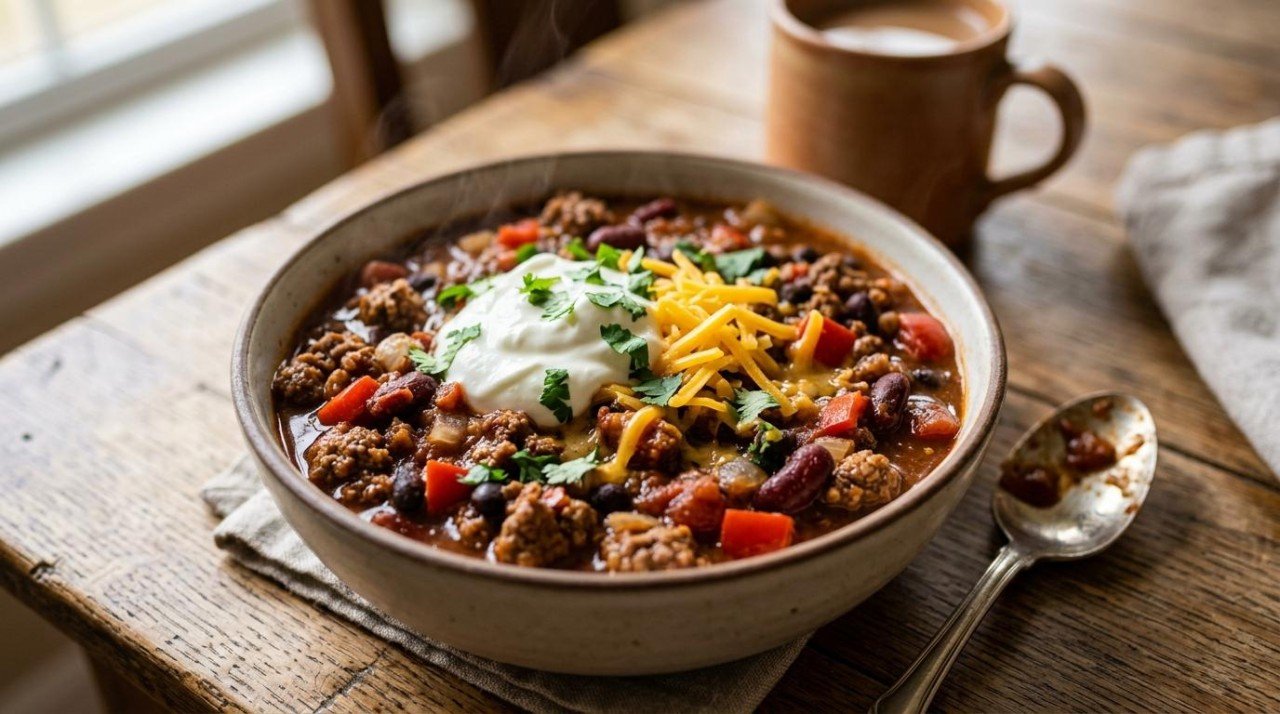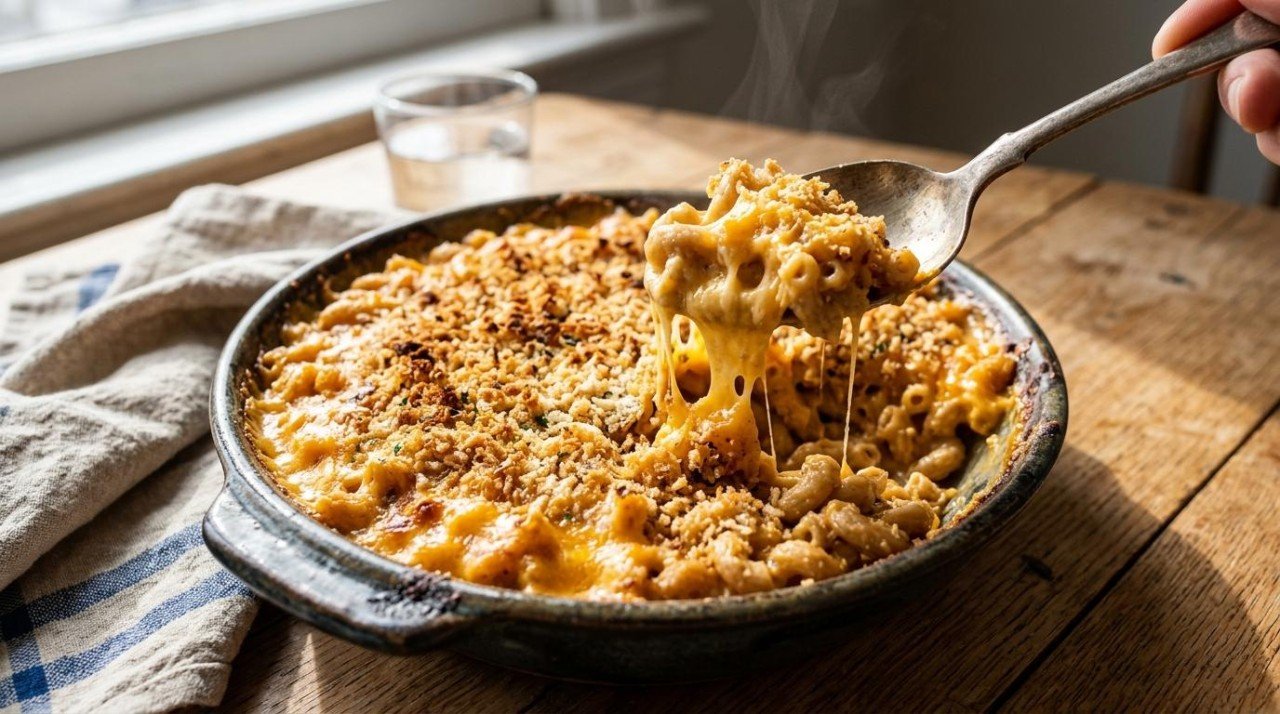
Baked mac and cheese is the dish everyone has an opinion about and nobody actually wants to change. The elbow noodles, the sharp cheddar sauce, the crackly crumb top that shatters under a spoon. It is the pan that disappears first at the potluck, the thing you make when someone needs cheering up. This is not a recipe anyone is looking to fix.
But we were curious what the numbers said. So we built a standard baked mac and cheese, ran it through the Eat Well Planner Nutrition Score, and it came back at 34 out of 100. Not a disaster, but there is real room to move, and most of it comes from a few ingredients doing more damage than they need to.
So we kept going. Same creamy, golden, spoon-cracking mac and cheese, one swap at a time, checking the score after each one. The finished version scores 53 - nineteen points higher - with half the saturated fat, a third less sodium, and nearly triple the fiber. Here is every change and exactly what it was worth.
The original: what's in it and how it scores
The version we scored is the classic: 1 pound of elbow macaroni, a roux of butter and flour whisked into whole milk, about 12 ounces of sharp cheddar melted in, and a buttered bread crumb topping baked until golden. Six servings. It is a genuinely good recipe. Here is what it looks like on the numbers, per serving:
- Nutrition Score: 34 / 100
- Calories: about 748
- Saturated fat: about 20 g
- Sodium: about 1,250 mg
- Fiber: about 2.9 g
- Protein: about 29 g
- Plant points: 0
The score flags two things hard, and they are the real story. The first is saturated fat. At roughly 20 g a serving, one bowl carries the entire FDA Daily Value in a single sitting - and the American Heart Association's tighter target of under about 13 g a day is gone before you reach the crust. That comes almost entirely from the butter roux and 12 ounces of cheese. Saturated fat is what raises LDL cholesterol, so this is the lever with the most health behind it.
The second is sodium: about 1,250 mg a serving, more than half a day's worth against the AHA's 2,300 mg limit. Cheese is salty by nature and the recipe adds a full teaspoon on top. Then there is what is missing: only 2.9 g of fiber (refined pasta gives almost none), and zero plant diversity - it is dairy and wheat flour, full stop.
What is already fine is worth saying, because it is why people are right to love this dish. Mac and cheese is a real source of protein (about 29 g a serving) and, thanks to all that dairy, it scores well for calcium, riboflavin, and vitamin B12. We are not rescuing a junk food here. We are keeping a good thing and taking the sharp edges off two numbers.
The upgrades
Five swaps, ordered from the biggest, easiest win downward. A reader who makes only the first one still comes out ahead. Every score change below is cumulative - each swap stacked on top of the last, in this order, and re-scored against production nutrition data.
1. Whole wheat macaroni instead of white
- Swap: Regular elbow macaroni to 100% whole wheat elbow macaroni
- Score impact: +8 points (34 to 42)
- What it changes: Fiber jumps from 2.9 g to 7.6 g a serving, and it adds the first plant point
- What it costs you: A slightly nuttier, firmer noodle - buried under cheese sauce, most people never clock it
This is the closest thing to a free upgrade in the whole post, which is why it goes first. Whole wheat pasta swaps in one for one and roughly triples the fiber, and fiber is the nutrient most Americans fall short on - it keeps you full, feeds your gut bacteria, and helps steady blood sugar. The one technique note: whole wheat pasta plus a second bake in the oven can go soft, so boil it two minutes shy of the package time and let the oven finish it. If you want to weigh other noodle options, our guide to pasta substitutes ranks them from easiest swap to biggest upgrade.
2. Blend cottage cheese into the sauce, ease off the butter
- Swap: Cut the butter roux from 6 tablespoons to 2, and blend 1 cup of low-fat cottage cheese into the sauce base
- Score impact: +1 point (42 to 43)
- What it changes: Saturated fat drops from about 20 g to 15.5 g a serving, protein climbs, and calories fall by roughly 67
- What it costs you: Almost nothing, if you blend the cottage cheese completely smooth first
This is the most important swap in the post, and the score barely moved. That gap is worth understanding, because it teaches you how to read your own recipes. We cut saturated fat by four and a half grams a serving - a real, meaningful change - but the score only ticked up one point, because at 15.5 g the dish is still flagged "very high" for saturated fat. You do not get rewarded until you cross the line, which the next swap does. The number that matters is the nutrition, not always the immediate score bump.
Blended smooth in a blender or with an immersion blender, low-fat cottage cheese melts into a creamy, neutral base that carries the cheddar flavor without the saturated fat load of a butter-and-cream sauce, and it quietly adds protein. Greek yogurt can do a similar job, but it is prone to splitting into a grainy curdle under a hot oven's dry heat as its proteins tighten; cottage cheese, blended and buffered by the flour in the sauce, stays creamy. Keep the butter you do use - 2 tablespoons still flavors the sauce and browns the top. Our butter substitutes guide covers where trimming or swapping it works and where it does not.
3. Stir in butternut squash, pull back the cheddar
- Swap: Add 1 1/2 cups butternut squash puree and drop the cheddar from 12 ounces to 8
- Score impact: +4 points (43 to 47)
- What it changes: Saturated fat falls to about 11.9 g, Vitamin A jumps to 57% of the Daily Value, and it adds a second plant point
- What it costs you: A faint sweetness and an even deeper orange color - genuinely hard to notice, and arguably an improvement
This is the swap that finally tips saturated fat under the "very high" line, which is why the points show up here. Butternut squash puree is the trick that lets you use a third less cheese without a thinner, less creamy sauce - it brings body, natural creaminess, and that classic orange color that cheddar alone is often faked up to with food dye. It also turns the dish into a real source of Vitamin A (from beta-carotene) and pushes it toward the kind of plant variety your gut wants. The cheese you keep is real, sharp cheddar, so the flavor still reads as mac and cheese, not squash casserole.
4. Whole wheat panko on top
- Swap: Regular buttered bread crumbs to whole wheat panko
- Score impact: +1 point (47 to 48)
- What it changes: Nudges fiber to about 8.2 g and adds the third plant point
- What it costs you: Nothing - panko bakes up crispier than standard crumbs, if anything
A small one, but the crust is non-negotiable in baked mac and cheese, so it may as well pull a little weight. Whole wheat panko gives you a lighter, crunchier top than fine dry crumbs, plus a bit more fiber and a whole-grain plant point. Toss it with a tablespoon of melted butter so it browns. For a coating swap in any dish, our bread crumb substitutes guide runs through the options.
5. Halve the added salt
- Swap: Drop the added salt from 1 teaspoon to 1/2 teaspoon
- Score impact: +5 points (48 to 53)
- What it changes: Sodium falls from about 1,180 mg to 820 mg a serving, out of the "very high" tier
- What it costs you: Surprisingly little, because the cheese was doing the salting all along
The best-value swap in the post is the one that costs a pinch of salt. Between the cheddar and the blended cottage cheese, the dish already carries plenty of sodium, so the full teaspoon of added salt was piling onto a pile. Cutting it in half took a serving from about 1,180 mg down to 820 mg and crossed the threshold out of "very high," which is why the score jumps five points for almost no effort. The AHA notes that cutting 1,000 mg of sodium a day measurably improves blood pressure. Salt the pasta water, go easy on the sauce, and taste before you add more.
Take the Guesswork Out of Eating Well
Eat Well Planner helps you organize your favorite recipes, plan balanced meals, and automatically generate shopping lists — all in one place. Whether you're tracking macros, managing dietary restrictions, or just trying to stop asking "what's for dinner?", we've got you covered.
Our AI-powered tools can adapt any recipe to your dietary needs, help you discover new meals you'll love, and even log your nutrition effortlessly. It's meal planning made simple.
Start Organizing Your Meals — FreeWhat we kept (on purpose)
A makeover that guts the dish is a failed makeover, so some things did not move. The real, sharp cheddar stays - 8 ounces of it - because the melt and the tang are the entire point, and no low-fat imitation delivers either. The butter stays, just less of it. The crumb crust stays. And we stopped at 53 rather than chasing a bigger number, because the next round of swaps starts trading away the things that make this mac and cheese worth eating. It still bakes up creamy under a golden top. It is still, unmistakably, baked mac and cheese - just with the two worst numbers cut roughly in half and a real vegetable folded in where you cannot see it.
The healthier version: full recipe
Final score: 53 / 100, up from 34. Serves 6.
- 1 pound whole wheat elbow macaroni
- 2 tablespoons butter, divided
- 3 tablespoons all-purpose flour
- 2 cups whole milk
- 1 cup low-fat cottage cheese, blended smooth
- 8 ounces sharp cheddar cheese, shredded (about 2 cups)
- 1 1/2 cups butternut squash puree (from about 1 pound squash, or use canned or thawed frozen)
- 1 cup whole wheat panko bread crumbs
- 1/2 teaspoon salt, plus black pepper to taste
- Heat the oven to 375 degrees F. Bring a large pot of salted water to a boil and cook the whole wheat macaroni 2 minutes short of the package directions, since it bakes again. Drain.
- Blend the cottage cheese until completely smooth in a blender or with an immersion blender, so it melts into the sauce instead of staying curdy.
- In a saucepan over medium heat, melt 1 tablespoon of the butter. Whisk in the flour and cook 1 minute, then gradually whisk in the milk. Simmer, whisking, 3 to 4 minutes until the sauce coats the back of a spoon.
- Off the heat, stir in the butternut squash puree, the blended cottage cheese, most of the cheddar (reserve a small handful for the top), the salt, and pepper. Stir until the cheddar melts into a smooth orange sauce.
- Fold in the drained macaroni and taste, adjusting pepper. Transfer to a lightly greased baking dish and scatter the reserved cheddar over the top.
- Melt the remaining 1 tablespoon butter and toss it with the panko, then scatter the crumbs over the dish.
- Bake 20 to 25 minutes, until the sauce bubbles at the edges and the crust is deep golden. Rest 5 minutes before serving.
Per serving, here is the before and after:
- Nutrition Score: 34 to 53
- Calories: about 748 to about 612
- Saturated fat: about 20 g to about 12 g (85% to 50% of the Daily Value)
- Sodium: about 1,250 mg to about 820 mg (55% to 36% of the Daily Value)
- Fiber: about 2.9 g to about 8.2 g (10% to 26% of the Daily Value)
- Protein: about 29 g to about 28 g (holds steady, roughly a third of a day's worth)
- Vitamin A: 33% to 57% of the Daily Value
- Plant points: 0 to 3
Swaps we tested and skipped
Not everything earned a place. A few common "healthy mac" moves got tested and cut:
- Chickpea pasta. It looks like the obvious protein-and-fiber upgrade, but bean pastas turn to mush when you cook them twice, and baked mac cooks the noodles a second time. Whole wheat pasta gets you most of the fiber win (7.6 g versus 2.9 g) and holds its bite through the oven.
- Fat-free cheddar. Swapping the remaining real cheddar for fat-free actually scores higher - 62, nine points above our final. We said no anyway. Fat-free cheese will not melt into a smooth sauce; without fat to lubricate the casein protein matrix, it stays rubbery and grainy no matter how you coax it. The melt is the entire reason this dish exists. A higher score is not worth a mac and cheese nobody wants a second helping of.
- All-cauliflower "mac." Replacing the pasta entirely with cauliflower makes a fine cheesy cauliflower bake. It does not make mac and cheese, and pretending otherwise is how you end up with a pan of leftovers nobody touches.
Make it fit other diets
Two quick adaptations for the most-asked variations. For gluten-free, use a brown rice or chickpea elbow pasta (undercooked, as above), swap the flour for cornstarch or a gluten-free blend, and top with gluten-free panko or crushed gluten-free crackers. For vegetarian, you are already there - everything here is meat-free. A fully dairy-free version is the hard one, because the dish is fundamentally cheese; it is less a swap than a rebuild around a cashew or fortified plant-based cheese sauce. Rather than eyeball any of these, you can open this recipe in Eat Well Planner and ask its AI to generate the full gluten-free or dairy-free version in one step, with the substitutions already worked in.
Do this to any recipe you love
None of these numbers were guessed. Every score and delta came from importing the recipe into Eat Well Planner and running its Make It Healthier tool, which proposes swaps like these and has a calculator verify the real nutritional gain before it ever shows you the suggestion - so you are never trading flavor for a change that does not actually move the needle. The per-swap score changes came from the Recipe Playground, where you can tweak an ingredient and watch the score and the fiber, sodium, and saturated fat update live.
You can do the exact same thing to the recipe you already make. Import it from any website, screenshot, or video, see its honest score, and let the app show you which swaps are worth it and which just wreck the dish. Keep the mac and cheese you love. Make the two worst numbers behave. That is the whole idea.