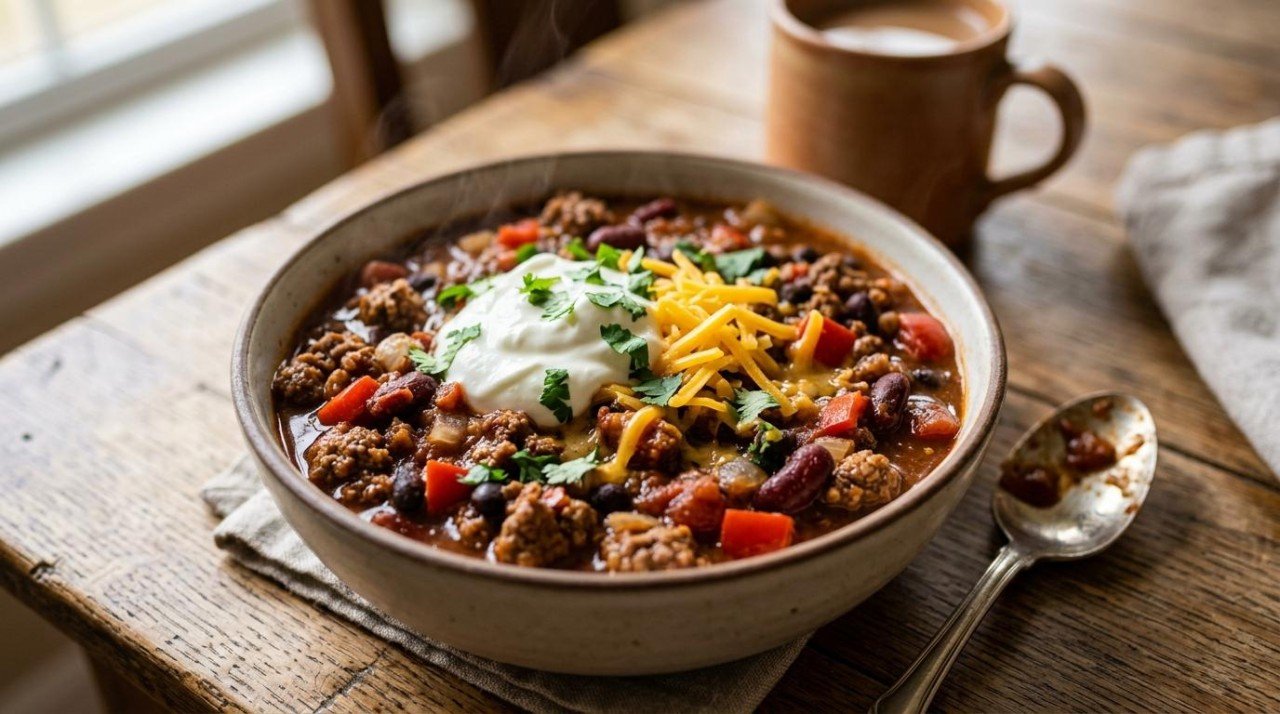
A pot of beef chili is one of the great low-effort dinners: brown some meat, open a few cans, let it bubble while you do something else, then bury a bowl of it under cheese. It stretches, it freezes, it feeds a crowd, and almost nobody dislikes it. So when we ran a standard version through our Nutrition Score, we expected the usual comfort-food verdict in the 40s.
It scored 54 out of 100. For a beef-and-cheese dish, that is genuinely good, and it is the whole story of this makeover: chili is closer to healthy than its reputation suggests. All those beans and tomatoes are doing real work, and the meat brings a stack of minerals with it. There are only two things dragging the number down, and neither one requires you to give up what makes chili chili.
So this is not a rescue. It is a tune-up. We made five small changes, checked each one against the score, and landed at 64 without touching the beef, the spice, or the melt. Along the way the saturated fat got cut by more than half and the sodium dropped by about 1,150 mg a serving. Here is exactly what moved the needle, and what each change costs you at the table.
The classic bowl: what is in it and how it scores
The version we scored is the one most people actually make, built to serve six:
- 1 lb 80/20 ground beef
- Two 15-oz cans of kidney beans
- One 28-oz can of diced tomatoes, plus 2 tablespoons of tomato paste
- An onion, a few cloves of garlic, and 1 cup of beef broth
- Chili powder, cumin, and about 1.5 teaspoons of salt
- Topped with a generous handful of shredded cheddar and a spoon of sour cream
Per serving, that comes out to about 513 calories, 29 g of protein, and a real strength the score rewards: nearly 8 g of fiber, most of a day's vitamin B12, and about two-thirds of a day's iron and zinc, all from the beef and beans working together. That is why it starts at 54 instead of the 40s. The beans are not garnish here; they are pulling their weight.
What holds it back is short and specific:
- Sodium: about 1,860 mg per serving (81% of the daily limit). This is the biggest problem by a wide margin, and most of it is added salt plus the brine in canned beans and tomatoes, not the chili itself.
- Saturated fat: about 13.6 g per serving (58% of a day's worth). Almost all of it comes from two places: the fatty 80/20 beef and the pile of cheese and sour cream on top.
That is the entire diagnosis. The fiber is already good, the protein is already high, the micronutrients are excellent. We are not rebuilding this dish. We are fixing two numbers.
The upgrades: five swaps, ten points
Each change below is scored on top of the one before it, in the order we made them, so the deltas add up to the real total. If you only make two of them, make the first and the last, which is where most of the saturated fat lives.
1. Lean the beef: 80/20 to 93% lean
- Swap: 80/20 ground beef → 93% lean ground beef
- Score impact: +2 points (54 to 56)
- What it changes: Cuts saturated fat from 13.6 g to 9.5 g per serving, and about 80 calories
- What it costs you: Almost nothing in a spiced, simmered dish
Fat carries flavor, which is why 80/20 is the default for burgers, where the beef is the entire show. Chili is not that dish. The flavor here comes from chili powder, cumin, browned onions, and tomato, and the meat is a background player. Swapping to 93% lean loses very little you would notice under all that spice, and it is the single biggest cut to the saturated fat in the whole recipe. Brown it hard so you still get those crusty, savory bits, and you will not miss the grease. (If you want to go leaner still, or meatless, our guide to ground beef substitutes walks through turkey, lentils, and mushrooms and what each one does to the dish.)
2. Take control of the sodium
- Swap: Regular canned beans and tomatoes, full salt → no-salt-added cans, rinsed beans, low-sodium broth, and half the added salt
- Score impact: +1 point (56 to 57)
- What it changes: Drops sodium from about 1,860 mg to about 780 mg per serving
- What it costs you: You season at the end instead of the front, and lean harder on spice and acid
This is the change with the smallest score bump and the biggest health payoff, which is worth sitting with for a second. The score only moves a point because the recipe was already scoring well and other factors cap it, but the sodium itself falls by more than half. That matters: the American Heart Association notes that cutting about 1,000 mg of sodium a day improves blood pressure, and this one move gets you most of the way there in a single meal.
Three things do the work. Buy no-salt-added canned tomatoes and beans (they cost the same and you add salt on your terms). Drain and rinse the beans, which washes away up to 40% of their sodium and, as a bonus, some of the carbohydrates that cause gas. Use low-sodium broth, and cut the added salt from about 1.5 teaspoons to half a teaspoon, adding a little more only after tasting at the end. To keep it from tasting flat, finish with a squeeze of lime, which fools your palate into reading the dish as fully seasoned. Sodium and potassium are two halves of the same equation, and most of us are short on the second one; if that is new to you, we get into it in potassium, the other half of the salt equation.
3. Two beans and a pile of peppers
- Swap: Two cans of kidney beans → one can kidney, one can black, plus two diced red bell peppers
- Score impact: +3 points (57 to 60)
- What it changes: Pushes fiber to about 9.9 g per serving, adds vitamin C (to 86% of a day's worth), and raises the plant variety
- What it costs you: Nothing. It arguably makes the chili better.
Using two different beans instead of a double dose of one is free, and it is the kind of small diversity move your gut actually rewards. The research on the microbiome keeps pointing at the number of different plants you eat, not the amount, as the thing that builds a resilient gut; the working target a lot of researchers use is 30 different plants a week. This one swap takes the recipe from under 5 to nearly 7 different plants in a single bowl. We wrote up why that number matters in what happens inside your body when you eat 30 plants a week, and it is exactly what our Plant Points tracker is built to count.
The red bell peppers do double duty: they melt into the chili, add a gentle sweetness that balances the acid, and bring a big hit of vitamin C. Dice them and cook them down with the onion. If your crowd likes heat, a diced jalapeno counts as one more plant, too.
4. Less cheese, sharper cheese
- Swap: A big handful of mild cheddar → a smaller amount of sharp cheddar (about 4 oz total for the pot)
- Score impact: +2 points (60 to 62)
- What it changes: Trims saturated fat from 9.4 g to 7.6 g per serving
- What it costs you: A little less cheese, but you will not feel shortchanged
The cheese stays. It is half of what makes chili night feel like chili night, and we are not taking it away. But sharp cheddar has more flavor per ounce than mild, so a slightly smaller amount lands with the same impact. Grate it yourself and let it melt into the hot chili rather than sitting in a cold clump on top, and a modest handful reads as plenty.
5. Swap the sour cream for Greek yogurt
- Swap: Sour cream → plain 2% Greek yogurt (and cook in olive oil instead of a neutral oil)
- Score impact: +2 points (62 to 64)
- What it changes: Cuts more saturated fat and nudges protein up to about 32 g per serving
- What it costs you: A slightly tangier dollop, which honestly suits chili
This is the swap people brace for and then forget about. A cool, tangy spoon of plain Greek yogurt does the exact job sour cream does on a bowl of chili: it cools the heat and adds a creamy contrast. It just brings more protein and less saturated fat along with it. The tang is a touch brighter than sour cream, which plays nicely against the smoky spice. Use plain, not vanilla, and full-fat or 2% if you want it richer. If you are yogurt-skeptical, our sour cream substitutes guide covers how to make the swap without anyone at the table noticing.
That is the full ladder: 54 to 64, ten points, with the saturated fat cut by more than half and the sodium down by nearly two-thirds. Every number here came from the same tool you can point at your own recipes.
Take the Guesswork Out of Eating Well
Eat Well Planner helps you organize your favorite recipes, plan balanced meals, and automatically generate shopping lists — all in one place. Whether you're tracking macros, managing dietary restrictions, or just trying to stop asking "what's for dinner?", we've got you covered.
Our AI-powered tools can adapt any recipe to your dietary needs, help you discover new meals you'll love, and even log your nutrition effortlessly. It's meal planning made simple.
Start Organizing Your Meals — FreeWhat we kept on purpose (and the cheese question)
A makeover that guts the dish is a failed makeover, so here is where we stopped and why. We kept real beef, not a bean-only substitute, because a big part of chili's appeal and its impressive iron, zinc, and B12 numbers come from the meat. We kept the full amount of beans and tomatoes. We kept the cheese and the creamy dollop, because a bowl of chili without them is a different, sadder dinner.
We want to be straight with you about that last one, because the score makes the trade-off visible. The cheese is the single biggest thing still holding the number at 64. Drop it entirely and the chili jumps to 73, with the saturated fat falling to about 2.5 g a serving and dropping off the caution list altogether. That is a real, verified nine points. We left the cheese in anyway, because we think a modest amount of sharp cheddar is worth it on chili night for most people. But now you know the exact price, and you get to decide. Want the melt tonight and the higher number on a Tuesday? Both are the same recipe with the cheese dialed up or down.
The healthier beef chili: full recipe
Final Nutrition Score: 64/100. Serves 6. About 15 minutes of prep and 40 minutes on the stove.
- 1 tablespoon olive oil
- 1 lb 93% lean ground beef
- 1 medium yellow onion, diced
- 2 medium red bell peppers, diced
- 3 cloves garlic, minced
- 2 tablespoons chili powder
- 1 tablespoon ground cumin
- 2 tablespoons tomato paste
- 1 can (28 oz) no-salt-added diced tomatoes, with their juice
- 1 can (15 oz) no-salt-added kidney beans, drained and rinsed
- 1 can (15 oz) no-salt-added black beans, drained and rinsed
- 1 cup low-sodium beef broth
- 1/2 teaspoon salt, plus more to taste
- To serve: 4 oz sharp cheddar, shredded (about 1 cup), and 6 tablespoons plain 2% Greek yogurt
- Optional: lime wedges, chopped cilantro, sliced scallions
- Heat the olive oil in a large pot or Dutch oven over medium-high. Add the ground beef and cook, breaking it up, until well browned, 6 to 8 minutes. With lean beef there is little fat to pour off; leave those browned bits in the pot.
- Add the onion and bell peppers and cook until softened, 5 to 6 minutes. Stir in the garlic, chili powder, and cumin and cook until fragrant, about 1 minute.
- Stir in the tomato paste and cook 1 minute, until it darkens slightly. Add the diced tomatoes and their juice, both beans, the broth, and the salt.
- Bring to a simmer, then lower the heat and simmer uncovered, stirring now and then, until thickened, 25 to 30 minutes. Taste and adjust the salt and a squeeze of lime at the very end.
- Serve topped with the shredded sharp cheddar and a spoon of Greek yogurt, plus cilantro or scallions if you like.
Here is how a serving compares, original versus this version:
- Nutrition Score: 54 → 64
- Calories: about 513 → 389
- Saturated fat: 13.6 g → 6.1 g (58% → 26% of a day's worth)
- Sodium: about 1,860 mg → 710 mg (81% → 31% of the daily limit)
- Fiber: 7.9 g → 9.9 g (a good source becomes an excellent one)
- Protein: 29 g → 32 g
- Different plants: under 5 → nearly 7
Both saturated fat and sodium started as high cautions and finished comfortably in the moderate range, while the fiber, protein, and mineral strengths the original already had got even better. More food, more plants, fewer of the two things that were holding it back.
Swaps we tested and skipped
Going all turkey. Swapping the beef for 99% lean ground turkey does score higher, landing at 69. We left it out of the main recipe on purpose: this is a beef chili, and turkey chili is a genuinely different, lighter-tasting dish with a fraction of the iron and zinc. It is a great option if you want it, but it is not a healthier version of the same bowl, so we are calling it what it is rather than pretending you would not notice.
Blending mushrooms into the meat. Finely chopping cremini mushrooms and cooking them in with the beef is a legitimate trick that stretches the meat, adds a plant, and cuts the saturated fat a little further. But when we scored it, the overall number did not move, because at that point sodium was the ceiling, not fat. It is a nice optional upgrade for texture and cost, not a score lever, so we left it as a note rather than a step.
Chasing the number by cutting everything. You can push chili well into the 70s by dropping the cheese, going meatless, and thinning it out, but at some point it stops being the dish you searched for. We stopped at the last change that still gives you a real bowl of beef chili.
Make it fit other diets
The bones of this recipe flex easily. For a vegetarian or vegan chili, drop the beef and add a third bean or a cup of cooked lentils, use vegetable broth, and finish with a dairy-free yogurt or sliced avocado instead of cheese and sour cream; the plant count goes up and the dish holds together fine. For dairy-free, just skip the cheese and use the avocado or a dollop of dairy-free yogurt. It is already naturally gluten-free as written, but double-check your broth and chili powder, which occasionally hide gluten. In Eat Well Planner, you do not have to work any of this out by hand: ask the AI to make this recipe vegan or dairy-free and it rewrites the full ingredient list and steps with the swaps already worked in.
Do this to any recipe you love
The point of this post is not really chili. It is the process. Every score and every delta here came from Eat Well Planner's Make It Healthier tool, which proposes ingredient swaps for any recipe and runs a calculator to verify the actual nutritional gain before it shows you the suggestion, so you are never guessing whether a change was worth it. We watched the per-swap numbers move in the Recipe Playground, where you can tweak an ingredient and see the score update live.
You can do the same with your own recipes. Import a recipe from any website, a photo of a handwritten card, or even a video you saw online, and the app scores it and shows you where it stands, cautions and strengths and all. Then it tells you, with the math checked, exactly which small changes would move it and what each one is worth. Chili turned out to be closer to healthy than it looks. A lot of the food you already love probably is too. Hungry for the next one? We gave sloppy joes the same treatment.