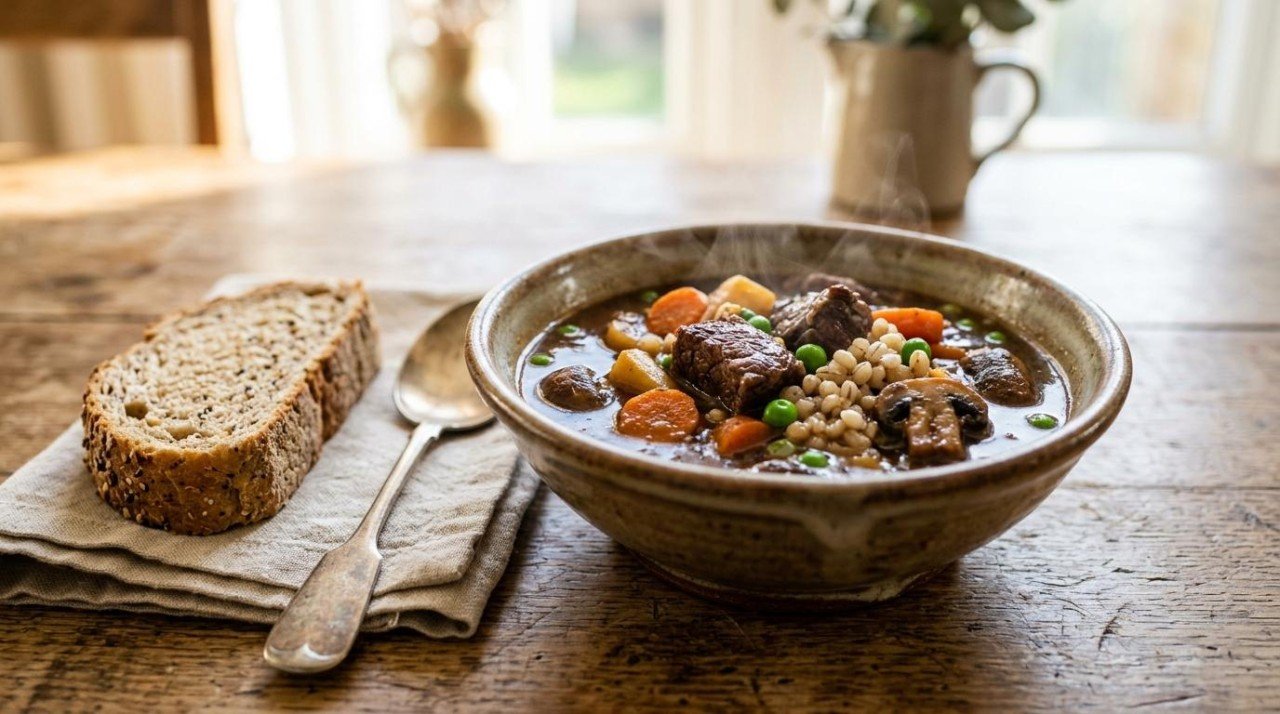
Beef stew is the dish you make when the weather turns and you want the house to smell like something. Chuck browned in a heavy pot, wine scraped up off the bottom, carrots and potatoes going soft in the broth, two hours of doing nothing while it takes care of itself. It is one of the few dinners that genuinely improves the next day.
So we ran a standard version through Eat Well Planner's Nutrition Score, the same number a visitor sees on any public recipe page. It came back 52 out of 100 — one of the highest starting scores we have recorded in this series, well ahead of shepherd's pie (47) and in the same territory as beef chili (54). Meat, root vegetables, and stock turns out to be a genuinely sound way to build a dinner.
We still got it to 75. But the interesting part is where the points came from: not the beef, not the potatoes, and not the swap everyone assumes. The single biggest change was a tablespoon measurement, and the biggest remaining lever is not in the pot at all — it is the bread you put next to it.
The original: what's in it and how it scores
Here is the standard version we scored, for six people:
- 2 lb beef chuck, cubed, dredged in 1/4 cup all-purpose flour
- 3 tablespoons vegetable oil and 2 tablespoons butter, for browning
- 1 large onion, 3 carrots, 2 celery stalks, 4 cloves garlic
- 2 tablespoons tomato paste, 1 cup red wine
- 6 cups beef broth, 2 tablespoons Worcestershire sauce
- 1 1/2 lb russet potatoes
- 1 teaspoon salt, 1/2 teaspoon pepper, 1 teaspoon dried thyme
Nutrition Score: 52/100. Per serving that is about 509 calories, 38.3 g protein, 7.0 g saturated fat, 1,560 mg sodium, and 3.9 g fiber.
Start with what is already good, because it is most of the dish. One bowl is an excellent source of vitamin B12 (159% of a day's value), zinc (120%), vitamin B6 (90%), iron (77%), niacin (69%), and phosphorus (65%), with 38 g of protein and 44% of a day's potassium. That is the chuck and the vegetables doing real work, and it is exactly why beef stew starts at 52 while a plate of cinnamon rolls starts at 20. Nobody needs to feel clever about improving this dish. It was already most of the way there.
Two things hold it back, and one of them is not what you would guess:
- Sodium, flagged very high at 68% of a day's value in one bowl — 1,560 mg, from regular broth, a teaspoon of added salt, and two tablespoons of Worcestershire. Americans already average about 3,400 mg a day against a limit of less than 2,300 mg in the 2025-2030 Dietary Guidelines.
- Saturated fat, flagged high at 30% DV — and here is the surprise. It is not mainly the beef. Five tablespoons of added browning fat, three of oil plus two of butter, is 69 g of pure fat spread across six bowls before a single piece of chuck goes in.
- Almost no fiber. 3.9 g per serving, 13% DV, from a dish that contains five different vegetables. Potatoes, carrots, celery, and onion are mostly water. Harvard's Nutrition Source puts the target at 25 to 35 g a day, against the roughly 15 g most Americans actually eat.
The upgrades
Four changes, scored cumulatively in this order, each one built on the last. If you only make one, make the first — it is worth more than the other three put together.
1. Brown in 1 tablespoon of olive oil instead of 3 tablespoons of oil and 2 of butter
- Swap: 3 tablespoons vegetable oil + 2 tablespoons butter → 1 tablespoon olive oil
- Score impact: +10 points (52 → 62)
- What it changes: Total fat from 20.9 g to 12.6 g per serving and saturated fat from 7.0 g to 4.3 g, clearing the saturated-fat flag outright
- What it costs you: Nothing, if you brown in batches. Everything, if you dump the beef in all at once.
This was the biggest single result of the whole test, and it is a measurement, not an ingredient. Chuck is a well-marbled cut — it renders its own fat as it browns, and by the second batch the pot has more fat in it than you started with. The five tablespoons in most published recipes are insurance against sticking, and a heavy pot brought properly to temperature does not need them.
The technique is the whole swap. Pat the beef dry, get the pot hot before the oil goes in, and brown in three batches with space between the cubes. Crowd the pot and the meat releases water faster than it can evaporate, so it steams grey instead of browning — and then you really will need more fat. Everything you gave up in butter comes back as fond on the bottom of the pot, which the wine lifts off thirty seconds later. Our butter substitutes guide covers where butter is doing structural work and where, as here, it is optional.
One free bonus the score cannot see: after the stew comes off the heat, let it sit ten minutes, then tilt the pot and spoon the fat off the surface. That is rendered chuck fat, not anything you added, and it is not counted in any number on this page.
2. Trade a third of the potatoes for mushrooms, peas, and a parsnip
- Swap: Potatoes from 1 1/2 lb down to 14 oz, plus 8 oz cremini mushrooms, 1 cup frozen peas, and 1 large parsnip
- Score impact: +9 points (62 → 71)
- What it changes: Fiber from 3.9 g to 6.7 g, protein up to 40.2 g, and plant points from 5.75 to 8.75
- What it costs you: Nothing. The parsnip makes it sweeter and the mushrooms make it beefier.
Nine points for adding three things and removing almost nothing. The pattern we keep hitting in these makeovers holds here too: a new plant is worth far more than more of a plant already in the pot. Doubling the carrots would have moved almost nothing. Adding a parsnip moved the needle.
Mushrooms earn their place twice. Harvard's Nutrition Source describes them as one of the few plant foods with strong umami flavor, from the same glutamate that makes meat taste like meat — so they deepen the stew rather than diluting it. Peas go in at the very end, three minutes before serving, so they stay bright green and pop instead of turning to khaki. And the parsnip is the one people forget: it collapses into the broth the way potato does but tastes sweeter and more aromatic, so it reads as an upgrade rather than a substitution.
That is three new plants toward the 30-a-week target — the American Gut Project found that the number of unique plant species a person eats predicts gut microbial diversity better than any diet label, with people eating more than 30 types a week showing more short-chain-fatty-acid-producing bacteria than those eating fewer than 10. We wrote about what that actually does inside your body here.
3. Add 3/4 cup of pearl barley
- Swap: Nothing removed — stir in 3/4 cup pearl barley for the last 45 minutes
- Score impact: 0 points on its own (71 → 71). Read the next section before you skip it.
- What it changes: Fiber from 6.7 g to 10.6 g per serving — 13% to 36% of a day's value against where we started
- What it costs you: About 90 calories a bowl, and a thicker stew that needs watching
Here is a swap that scored zero and we kept anyway, because zero is not the same as nothing. Barley nearly triples the fiber of the original recipe and turns a thin stew into something you can eat with a fork. The score did not pay for it at this point in the build, and we are not going to pretend otherwise.
Barley also carries beta-glucan, the soluble fiber behind an FDA-authorized health claim linking 3 g a day from oats or barley to reduced heart disease risk. A serving of this stew contains about 25 g of dry pearl barley, which at the 4% minimum that rule specifies puts you somewhere around a gram — a third of the daily amount the claim is built on, from one bowl of dinner. Whole grains are worth the trouble more broadly: Harvard's Nutrition Source reports Nurses' Health Study participants eating two to three servings a day were 30% less likely to have a heart attack or die of heart disease over ten years than those eating less than one a week. If barley is not in your rotation yet, we made the case for it and its cousins in the whole grains you're missing.
Practical note: barley drinks liquid, roughly three times its volume. Stir it in with the potatoes, keep the lid off, and have extra broth on hand — a stew that looked perfect at 40 minutes can be a solid mass at 50.
4. Low-sodium broth, half the salt, half the Worcestershire
- Swap: Regular beef broth → low-sodium; 1 teaspoon salt → 1/2; 2 tablespoons Worcestershire → 1
- Score impact: +4 points (71 → 75)
- What it changes: Sodium from 1,530 mg to 1,030 mg per serving, 67% DV down to 45%, dropping the flag from "very high" to "high"
- What it costs you: Genuinely less salty. You will want to taste and adjust at the end.
Now the honest complication, because it is the most interesting thing the numbers told us. We also ran this chain in the other order — sodium cut third, barley fourth. Run that way, the sodium cut is worth 0 points and the barley is worth 4. Both orders finish at exactly 75.
Neither swap is worth 4 points by itself. Together they are worth 4, and the score only pays out once both are in. That is what a threshold-based score looks like from the inside, and it is why we score cumulatively rather than adding up a list of standalone claims. It is also the argument for doing both: whichever one you skip, you lose the same four points.
The sodium is worth cutting on its own terms regardless. Six cups of regular broth is the bulk of it, and low-sodium broth in a stew that simmers for two hours with wine, tomato paste, thyme, and browned fond in it is not a flavor sacrifice — there is plenty else going on. Salt at the end, off the heat, after skimming, when you can actually taste what you have. Our broth substitutes guide covers what to do when you have no low-sodium carton and no time. And if sodium is on your mind, the potassium side of that equation matters as much — this stew delivers 49% of a day's worth.
Take the Guesswork Out of Eating Well
Eat Well Planner helps you organize your favorite recipes, plan balanced meals, and automatically generate shopping lists — all in one place. Whether you're tracking macros, managing dietary restrictions, or just trying to stop asking "what's for dinner?", we've got you covered.
Our AI-powered tools can adapt any recipe to your dietary needs, help you discover new meals you'll love, and even log your nutrition effortlessly. It's meal planning made simple.
Start Organizing Your Meals — FreeWhat we kept (on purpose)
Four things stayed, and each one was tested rather than assumed:
- All 2 lb of the beef. Cutting it to 1 1/2 lb and adding more mushrooms dropped the score to 73 and took protein from 42.3 g to 35.3 g. The chuck is carrying the B12, the zinc, and the iron. It stays.
- The full cup of red wine. Replacing it with more broth cost 4 points. See below — this one genuinely surprised us.
- The potatoes. Reduced, not removed. Cooled leftover potato also develops resistant starch, which is a quiet argument for making stew a day ahead anyway.
- The flour dredge. Skipping it scored 74, one point lower, and costs you the body of the gravy. Not a trade.
And here is where we stopped: at 75, the only remaining flag is sodium at 45% DV, and getting meaningfully below that means a stew that tastes underseasoned. The other listed weakness is low omega-3 ALA, which you do not fix in a beef and root vegetable dish without making it a different dinner. This is the ceiling for something that is still recognizably beef stew.
The bread matters more than any swap in the pot
This is the finding worth taking away even if you cook the original exactly as written. We scored the improved stew as a meal with two slices of bread alongside, which is how most people actually eat it:
- Improved stew + 2 slices white bread: 69
- Improved stew + 2 slices whole wheat bread: 76
Seven points, decided entirely by which loaf is on the counter — more than the vegetable overhaul was worth, and more than the sodium and barley changes combined. White bread pulled the finished meal below the stew's own score of 75. Whole wheat nudged it above.
The catch is that "wheat bread," "multigrain," and "made with whole grains" on a package mean approximately nothing. The first ingredient has to read whole wheat flour, and we walked through how to read the label in how to buy bread that's actually whole grain.
The healthier version: full recipe
Nutrition Score: 75/100. Serves 6. Prep 25 minutes, then about 2 hours 15 minutes mostly unattended.
- 2 lb beef chuck roast, trimmed and cut into 1 1/2-inch cubes
- 1/4 cup all-purpose flour
- 1 tablespoon olive oil
- 1 large yellow onion (about 7 oz), diced
- 3 medium carrots (about 6 oz), cut into thick coins
- 2 celery stalks (about 4 oz), sliced
- 4 cloves garlic, minced
- 2 tablespoons tomato paste
- 1 cup dry red wine
- 6 cups low-sodium beef broth, plus more if needed
- 1 tablespoon Worcestershire sauce
- 1 teaspoon dried thyme
- 2 bay leaves
- 1/2 teaspoon salt
- 1/2 teaspoon black pepper
- 3/4 cup pearl barley
- 2 medium russet potatoes (about 14 oz), in 1-inch chunks
- 1 large parsnip (about 5 oz), in thick coins
- 8 oz cremini mushrooms, halved
- 1 cup frozen green peas
- Pat the beef very dry, season with the pepper, and toss with the flour until lightly coated, shaking off the excess.
- Heat a heavy Dutch oven over medium-high until hot, then add the olive oil. Brown the beef in three batches with space between the cubes, about 3 minutes a side, and do not crowd the pot. The chuck will render its own fat as you go. Transfer each batch to a plate.
- Add the onion, carrots, and celery to the pot and cook 5 to 6 minutes, scraping up the browned bits as they soften.
- Stir in the garlic for 30 seconds, then the tomato paste, and cook 1 to 2 minutes until it darkens and smells sweet.
- Pour in the wine, scrape the bottom of the pot completely clean, and simmer 2 to 3 minutes until reduced by about half.
- Return the beef and any juices. Add the broth, Worcestershire, thyme, bay leaves, and salt. Bring to a bare simmer, cover, and cook 1 hour 15 minutes.
- Stir in the barley, potatoes, parsnip, and mushrooms. Simmer uncovered about 45 minutes, until the barley is tender and the beef pulls apart with a spoon. Add broth or water if it thickens faster than the barley cooks.
- Stir in the peas and cook 3 minutes more.
- Take the pot off the heat and rest 10 minutes, then tilt it and spoon the fat off the surface. Remove the bay leaves, taste, and adjust the pepper and salt now rather than earlier.
Per serving, original versus improved:
- Nutrition Score: 52 → 75
- Calories: 509 → 530
- Protein: 38.3 g → 42.3 g
- Fiber: 3.9 g → 10.6 g (13% → 36% DV)
- Total fat: 20.9 g → 13.1 g
- Saturated fat: 7.0 g → 4.3 g (flagged high → not flagged)
- Sodium: 1,560 mg → 1,030 mg (68% → 45% DV)
- Plant points: 5.75 → 8.75
Note the calories went slightly up. That is the barley, and it buys you a bowl with nearly three times the fiber and 4 g more protein in it. This was never a calorie-cutting exercise.
Swaps we tested and skipped
- Dropping the red wine for more broth: 71, a 4-point loss. The most surprising result of the day. The wine is not a rounding error — it is a genuine contributor, and swapping it out costs more than the entire sodium reduction gained. If you skip alcohol, our red wine substitutes guide covers stand-ins that keep the acidity and depth rather than just adding liquid.
- All the potato swapped for turnip: 73, a 2-point loss. The low-carb instinct backfires here. Potatoes are carrying potassium and vitamin C, and turnip does not replace them.
- Beef cut to 1 1/2 lb with more mushrooms: 73, a 2-point loss. Protein fell from 42.3 g to 35.3 g and B12 from 159% DV to 119%. Mushrooms are a fine partner for beef and a poor replacement for it.
- Skipping the flour dredge: 74, a 1-point loss. Saves about 19 calories a serving and costs you the gravy. Our flour substitutes guide has the gluten-free options if you need one.
Make it fit other diets
Gluten-free: two changes, not one. Skip the flour dredge and thicken at the end with a cornstarch slurry, and swap the barley for brown rice or buckwheat, since barley is a gluten grain. Check the Worcestershire label too — many brands contain malt vinegar.
Alcohol-free: the wine is worth 4 points, so replace it rather than deleting it — an extra cup of broth with a tablespoon of red wine vinegar stirred in at the end gets closer than broth alone.
Meatless: this becomes a different dish, and a good one. Double the mushrooms, add a cup of brown lentils with the barley, and use a dark vegetable broth. In Eat Well Planner you can ask the AI recipe chat for any of these in one step — Recipe Variations rewrites the whole recipe with the swaps worked in rather than leaving you to guess at the amounts.
Do this to your own recipes
Nothing here required special knowledge about beef stew. We imported a recipe, read its Nutrition Score, and let Make It Healthier propose changes — where a calculator verifies the actual nutritional gain before a suggestion is ever shown, so nothing on that list is a guess. Then we tested each one in the Recipe Playground, watching the score move per edit, which is how we found out the wine was worth keeping and the browning fat was worth ten points.
You can run the same process on the stew your grandmother made. Import it from a URL, a photo, or a video, look at what the score flags, and try the swaps — including the ones you are sure will not work. Ours told us to leave the beef alone and rethink the frying pan, which is not the advice anybody expects from a healthy-eating app. That is rather the point.