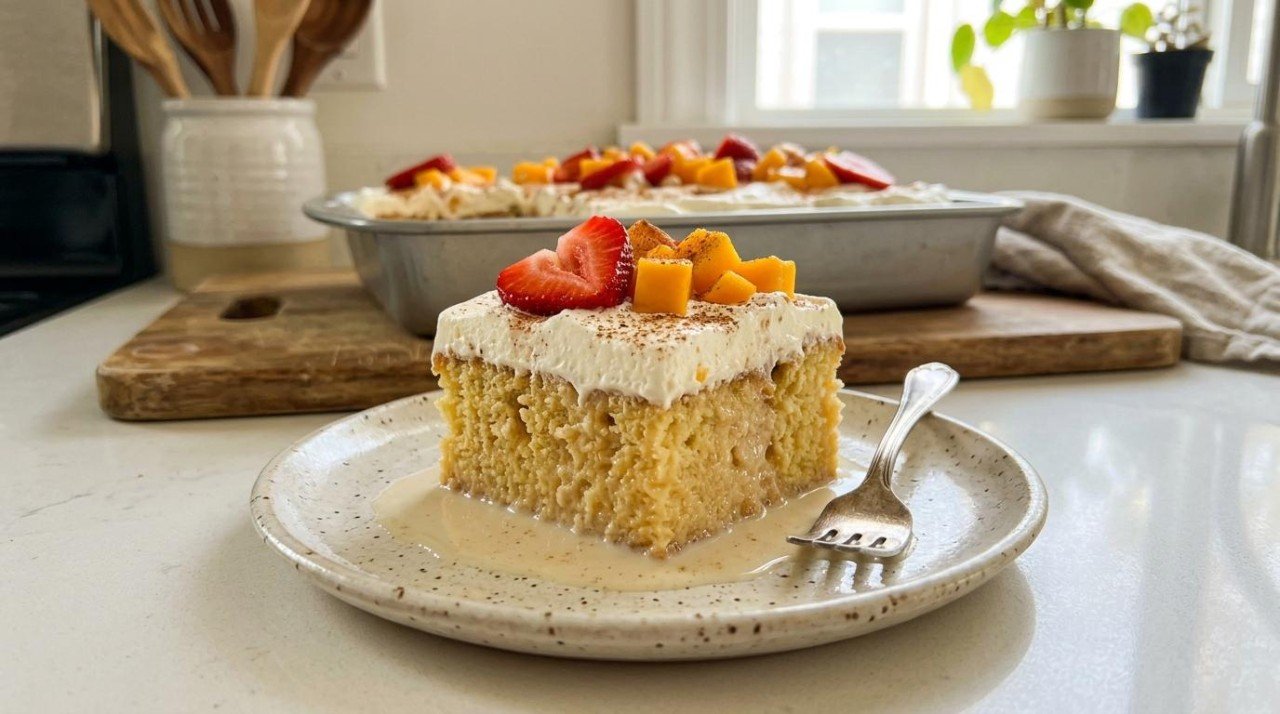
Tres leches is the cake that gets requested by name at birthdays, quinceañeras, and office parties, and it is the one people go back for a second slice of when they think nobody is looking. A light sponge, soaked through with three kinds of milk, cold from the fridge, under a thick layer of whipped cream. Every forkful is half cake, half cream.
We ran a classic version through the app's Nutrition Score and it came back at 21 out of 100. Then we rebuilt it one swap at a time, scoring every change against the same production nutrition data, and finished at 45: 24 points higher, with about half the added sugar, less than a third of the saturated fat, and 40 percent fewer calories per slice.
It is still tres leches. It still uses three milks, it is still soaked until it's almost pudding, and it still gets a cold, creamy topping. The fun part is that the soaking method stays exactly the same. We only changed what goes into the soak and what goes on top.
The classic tres leches: what is in it, and why it scores 21
Nobody fully agrees on where tres leches comes from. As Tasting Table lays out, Nicaragua and Mexico both claim it. Many Nicaraguans remember it as a popular dessert by the 1940s and '50s, while the Mexican story credits Nestlé Mexico with printing the recipe on condensed milk cans in the 1940s. What everyone agrees on is that the cake depends on canned milk, and soaked cakes like it go back centuries.
The version we scored is a popular American take, adapted from Ree Drummond's recipe. For a 9x13 pan, cut into 15 slices:
- Cake: 1 cup all-purpose flour, 5 eggs, 1 cup sugar, 1/3 cup whole milk, baking powder, salt, and vanilla
- Soak: 1 can (12 oz) evaporated milk, 1 can (14 oz) sweetened condensed milk, and 1/4 cup heavy cream
- Topping: 1 pint (2 cups) heavy cream whipped with 3 tablespoons sugar
That scores 21 out of 100. Here is what pulls it down, per slice:
- Added sugar: 27 g. That is more than half of the FDA's 50 g Daily Value for added sugars in one slice. About 40 percent of it comes from the can of condensed milk, and most of the rest from the cup of sugar in the cake.
- Saturated fat: 10.4 g. That is about half of the 20 g Daily Value. Most of it comes from the pint of whipped cream on top, which we expected. What we didn't expect was how much of the slice that topping is: about a quarter of each piece, by weight, is whipped cream.
- Fiber: 0.2 g, and zero plants. Flour, eggs, sugar, milk, cream. There is nothing in it that grew in a field except the wheat, and that wheat is refined.
Now the part that is already fine. It brings real protein (7.9 g per slice) from the eggs and milk, and it's a good source of calcium, riboflavin, and vitamin A. Sodium is low at 160 mg. This isn't a junk-food cake. It's a dairy dessert with too much sugar and cream piled onto a cake that has no fruit at all.
The upgrades
We applied these in order and re-scored after each one, so every point value is what that change was worth at that stage of the build. The six deltas add up exactly to the 24-point total.
1. Fresh strawberries and mango on top (+7 points)
- Swap: Nothing → about 1 1/2 cups sliced strawberries and 1 1/2 cups diced mango (250 g each) on top of the cake
- Score impact: +7 points (21 to 28), the biggest single move
- What it changes: Fiber more than triples (0.2 g to 0.8 g per slice), plus vitamin C, folate, potassium, and two new plants
- What it costs you: Nothing. Fruit on tres leches is traditional, and strawberries are the classic garnish
The first change doesn't take anything away. Fruit is the one thing this cake is missing, and a lot of bakeries already put strawberries on top. Mango is our addition: it's sweet, a little tropical, and its color looks great against the white topping. Using two fruits instead of one also mattered. All strawberries, same total weight, scored 2 points lower at the end, because the score rewards variety.
Here is the most surprising number from this whole makeover: when we took the fruit back off the finished cake, the score dropped by 10 points, not 7. The cleaner the rest of the recipe gets, the more the fruit is worth. Don't skip it.
2. Half whipped cream, half Greek yogurt on top (+5 points)
- Swap: 2 cups heavy cream + 3 tablespoons sugar → 1/2 cup heavy cream whipped with 1 tablespoon sugar, then 1 1/2 cups plain nonfat Greek yogurt folded in
- Score impact: +5 points (28 to 33)
- What it changes: Saturated fat drops from 10.4 g to 5.6 g per slice, calories from 379 to 305, and protein goes up
- What it costs you: A clear tang, and a softer topping. It spreads beautifully but won't pipe, and it should go on the day you serve it
The topping is where most of the saturated fat lives, so this is the swap that cuts the most. Whip the cream first, to firm peaks, then gently fold in the yogurt. The whipped cream keeps it light and the yogurt gives it body. The result tastes like a cross between whipped cream and cheesecake filling, which goes really well with the sweet, milky cake under it. For other ways to use each, see our heavy cream and Greek yogurt substitution guides.
Being honest about the trade-off: this topping is softer than a full pint of whipped cream and it can start to weep after a day. Spread it on shortly before serving, and it holds up fine through the party.
3. A lighter soak: half the condensed milk, plus cinnamon milk (+3 points)
- Swap: 1 can condensed milk + 1/4 cup heavy cream → 1/2 can condensed milk + 1 1/4 cups 2% milk, warmed with a cinnamon stick
- Score impact: +3 points (33 to 36)
- What it changes: Added sugar drops from 25.4 g to 19.8 g per slice
- What it costs you: The soak is less sweet and less thick. The cinnamon covers most of that, and the cake still soaks through completely
This is the swap the whole recipe is built around, so we kept it gentle. The three milks are still evaporated, condensed, and fresh milk, and plenty of recipes already use plain milk as the third one. Half a can of condensed milk still gives the soak its caramel-like flavor. The extra milk replaces the volume you took away, so the cake absorbs just as much liquid and stays just as wet.
The cinnamon is the trick. Heat the milk until it steams, drop in a cinnamon stick, and let it steep for 15 minutes before you mix the soak. Cinnamon adds a warmth that makes a less-sweet soak taste full instead of thin, and it's a classic flavor with tres leches. (Our sweetened condensed milk substitutes guide covers other ways to sweeten the soak.)
4. Half whole wheat pastry flour in the sponge (+3 points)
- Swap: 1 cup all-purpose flour → 1/2 cup all-purpose + 1/2 cup whole wheat pastry flour
- Score impact: +3 points (36 to 39)
- What it changes: Fiber goes from 0.8 g to 1.2 g per slice, plus a third plant and more minerals from the whole grain
- What it costs you: Very little. The sponge is slightly tan, and once it's soaked nobody can tell
Whole wheat pastry flour is milled from soft wheat, finer and lower in protein than regular whole wheat flour, so it stays tender in cakes. Half is the sweet spot. Pastry chef Fran Costigan makes most of her cakes with a 50/50 mix of all-purpose and whole wheat pastry flour. Going all the way to 100 percent scored 2 points higher in our tests, but a sponge needs to rise tall and stay open to soak up three milks, and a heavier, denser cake would undo the whole point. More in our all-purpose flour guide.
5. Fat-free evaporated milk (+3 points)
- Swap: 1 can (12 oz) evaporated milk → 1 can (12 oz) fat-free evaporated milk
- Score impact: +3 points (39 to 42)
- What it changes: Saturated fat drops from 4.4 g to 3.3 g per slice, and protein goes up a little
- What it costs you: Nothing you can taste. Once it's mixed with condensed milk and soaked into the cake, the difference disappears
Fat-free evaporated milk sits right next to the regular cans in most stores, and it's the easiest swap on this list. Evaporated milk is milk with about 60 percent of its water cooked off, so the skim version still tastes rich and creamy. The condensed milk and the cream in the topping already bring plenty of fat to the cake. Our evaporated milk guide has more ideas.
6. Half the sugar in the cake (+3 points)
- Swap: 1 cup (200 g) sugar in the sponge → 1/2 cup (100 g)
- Score impact: +3 points (42 to 45)
- What it changes: Added sugar drops from 19.8 g to 13.1 g per slice, and calories from 244 to 217
- What it costs you: A plainer sponge on its own, which doesn't matter, because nobody eats it on its own
In tres leches, the sponge is a carrier. Its job is to be airy enough to soak up liquid, and the soak and topping bring the sweetness. The 2 tablespoons that go into the egg whites still help them whip up glossy and stable, which is what makes the cake rise. Taste a finished slice, not a dry corner, before you decide it needs more.
What we kept (on purpose)
All three milks stay, including half a can of condensed milk, because without it this becomes a different cake. We tested the "dos leches" version with no condensed milk at all and it scored only 3 points higher (48). We tried a quarter can, and that was only +2. That's not worth losing the flavor that makes it tres leches. Real whipped cream stays in the topping too. All five eggs stay, because the whipped whites are what make the sponge light enough to soak.
And here is the honest ceiling: even at 45, the app still flags this cake for added sugar. A soaked dessert built on sweetened milk will always carry some. We stopped here because the next swaps either barely moved the score or turned it into a different dessert.
Take the Guesswork Out of Eating Well
Eat Well Planner helps you organize your favorite recipes, plan balanced meals, and automatically generate shopping lists — all in one place. Whether you're tracking macros, managing dietary restrictions, or just trying to stop asking "what's for dinner?", we've got you covered.
Our AI-powered tools can adapt any recipe to your dietary needs, help you discover new meals you'll love, and even log your nutrition effortlessly. It's meal planning made simple.
Start Organizing Your Meals — FreeThe healthier tres leches cake: full recipe
This version scores 45 out of 100, up from 21. Makes one 9x13 cake, 15 slices.
For the cake:
- 1/2 cup (63 g) all-purpose flour
- 1/2 cup (62 g) whole wheat pastry flour
- 1 1/2 teaspoons baking powder
- 1/4 teaspoon fine salt
- 5 large eggs, separated
- 1/2 cup (100 g) granulated sugar, divided
- 1/3 cup (80 ml) whole milk
- 1 teaspoon vanilla extract
For the soak:
- 1 1/4 cups (300 ml) 2% milk
- 1 cinnamon stick
- 1 can (12 oz) fat-free evaporated milk
- 1/2 can (7 oz, about 2/3 cup) sweetened condensed milk
For the topping:
- 1/2 cup (120 ml) cold heavy cream
- 1 tablespoon granulated sugar
- 1 1/2 cups (340 g) plain nonfat Greek yogurt
- About 1 1/2 cups (250 g) sliced strawberries
- About 1 1/2 cups (250 g) diced mango, from 1 large mango
- Heat the oven to 350°F and grease a 9x13 baking pan.
- In a large bowl, whisk together both flours, the baking powder, and the salt.
- In another bowl, beat the egg yolks with 6 tablespoons of the sugar until pale and thick, about 2 minutes. Beat in the whole milk and vanilla, then stir this into the flour mixture until just combined.
- In a clean bowl, beat the egg whites to soft peaks. Add the remaining 2 tablespoons of sugar and beat until stiff and glossy. Fold the whites into the batter in three additions, gently, so you don't knock the air out.
- Spread the batter in the pan and bake for 30 to 40 minutes, until golden and a toothpick comes out clean. Let the cake cool completely in the pan.
- While the cake bakes, heat the 2% milk in a small saucepan until it steams. Take it off the heat, add the cinnamon stick, and let it steep for 15 minutes. Remove the stick and let the milk cool, then whisk it together with the evaporated milk and condensed milk.
- Poke holes all over the cooled cake with a fork. Pour the soak over it slowly, in three or four rounds, letting it sink in between pours. Cover and refrigerate for at least 4 hours, or overnight.
- Shortly before serving, whip the cream with the 1 tablespoon of sugar to firm peaks. Gently fold in the Greek yogurt until smooth. Spread it over the cake, then top with the strawberries and mango.
- Serve cold. Leftovers keep for 2 to 3 days covered in the fridge, though the topping softens after the first day.
Per slice, original vs. healthier:
- Nutrition Score: 21 → 45
- Calories: 363 → 217
- Added sugar: 27.0 g → 13.1 g
- Saturated fat: 10.4 g → 3.3 g
- Fiber: 0.2 g → 1.2 g
- Protein: 7.9 g → 9.5 g
- Potassium: 250 mg → 310 mg
- Calcium: 210 mg → 220 mg
- Plants: 0 → 3
Unlike most dessert makeovers, the calories drop a lot here (about 40 percent), because most of the original's calories came from the pint of whipped cream. Fiber is still modest at 1.2 g. It's a cake, not a salad. But it's a cake with fruit on it now.
Swaps we tested and skipped
- The original whipped cream topping put back: −8. With every other upgrade in place, going back to a full pint of sweetened whipped cream took the cake from 45 to 37. That topping was the second-biggest problem in the original.
- All Greek yogurt on top, no cream: +3. It scored 48. But yogurt alone doesn't whip, so you get a tangy, dense layer instead of a cloud. A little real cream is what keeps it light.
- 100% whole wheat pastry flour: +2. A 47, but we'd rather keep a sponge light enough to soak up the milk. Fifty-fifty is the safe limit for a cake that has to stay this airy.
- A quarter can of condensed milk: +2. A 47, with a noticeably thinner, less caramel-flavored soak. Half a can is where it still tastes like tres leches.
- No condensed milk at all: +3. A 48, and it's no longer tres leches. Even this version still gets flagged for added sugar from the cake and topping.
- Strawberries only, no mango: −2. Same weight of fruit, one fewer plant, 43 instead of 45.
Make it fit other diets
- Gluten-free: Swap both flours for a cup of a 1:1 gluten-free baking blend. The whipped egg whites do most of the structural work in a sponge, so it holds up well.
- Dairy-free: Coconut-based condensed milk and unsweetened oat milk (simmered to reduce by about half, in place of evaporated milk) make the soak, with whipped coconut cream folded with dairy-free yogurt on top. Expect a coconut flavor and a different score.
For either one, the app's Recipe Variations can rewrite this exact recipe in one step, with the swaps already worked in.
Do this to any recipe
Every number on this page came from the same tools you can use on your own recipes. Import your family's tres leches into Eat Well Planner from a website, Instagram, or YouTube, and it gets a Nutrition Score right away. Tap Make It Healthier and the app suggests swaps like these, each one checked by a calculator before you see it. Can't give up the full can of condensed milk? Open the recipe in the Playground, see what keeping it costs, and earn the points back with more fruit and a lighter topping.