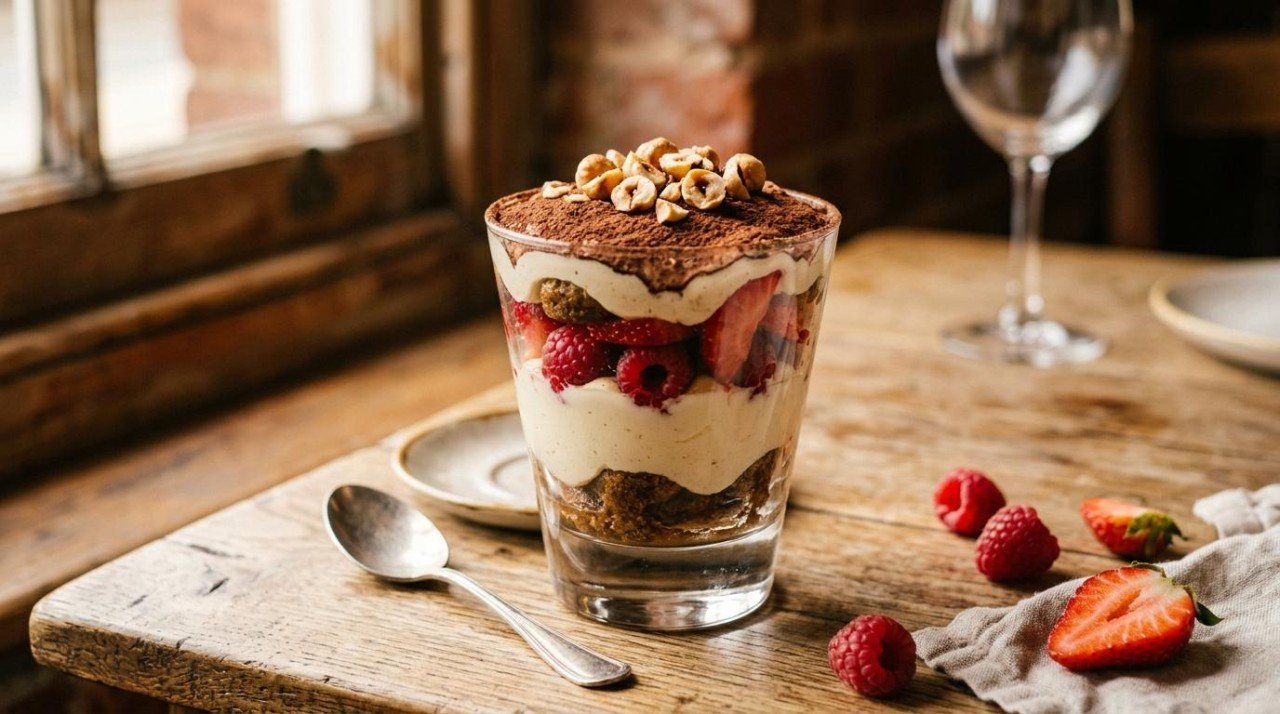
Tiramisu is the dessert that gets ordered by the table. Coffee-soaked ladyfingers, a cloud of mascarpone, a dusting of bitter cocoa on top, and nothing about it that needs explaining. It is also younger than most people assume: the modern version was worked out at Le Beccherie in Treviso by Alba Campeol and pastry chef Roberto Linguanotto, and first appeared on the restaurant's menu as Tiramesu in 1972.
We built the version most American recipes describe in Eat Well Planner and ran the app's Nutrition Score on it. It came back at 22 out of 100. One serving carries more saturated fat than a whole day's reference intake, and there is essentially no fiber anywhere in the dish.
Then we rebuilt it one verified swap at a time and got it to 48. This post is the receipt for all 26 points - including the swap that took a whole cup of heavy cream out of the recipe, which turned out not to be a health swap at all but a return to how Italians actually make tiramisu. Meanwhile, two of the changes most often recommended for lightening this dessert made our score go down.
The original: what's in it and how it scores
We scored the standard American version, made in an 8x12 inch dish and cut into 8 servings. Four large egg yolks and 1/2 cup (100 g) granulated sugar beaten into 16 oz (454 g) of mascarpone, folded with 1 cup (232 g) of whipped heavy cream, layered with about 24 ladyfingers (200 g) soaked in 1 1/2 cups (360 ml) of espresso and 2 tablespoons of Marsala, finished with 2 tablespoons of unsweetened cocoa. Every number below is one of those eight servings.
Nutrition Score: 22/100. Per serving: 529 calories, 7.6 g protein, 0.7 g fiber, 70 mg sodium, 23.8 g saturated fat (101% of the daily reference, flagged very high) and 19.0 g added sugar (72%, also flagged very high).
The saturated fat is the headline. The Dietary Guidelines cap saturated fat at less than 10 percent of daily calories, and the American Heart Association at 7 percent, which for most adults lands somewhere between 13 and 22 g a day. One serving of tiramisu is the entire allowance and then some, and it gets there through two ingredients doing the same job: mascarpone is roughly 28 g of saturated fat per 100 g, and there is a full cup of heavy cream stacked on top of it.
The added sugar is the other half. The AHA's daily limit is 24 g for women and 36 g for men. At 19 g a serving, tiramisu uses most of a woman's day on dessert - and roughly a third of that sugar is not from the sugar jar at all, it is baked into the ladyfingers.
Then there is the number that decided the whole post. The app scored this recipe at zero plant points, with 0.7 g of fiber a serving. Not one ingredient in a dessert built on coffee beans and cocoa counted as a plant, because the amounts of both are tiny - 45 g of brewed espresso and about a gram of cocoa per serving. That matters, because adults need 25 to 35 g of fiber a day and most Americans get about 15.
Now the honest other side, because tiramisu deserves it. This is real food - eggs, cheese, coffee, cocoa, sugar - with nothing in it that needs a label decoder. It is already an excellent source of vitamin A (43% DV), riboflavin (31%), phosphorus (21%) and choline (20%), all from the dairy and the yolks. And at 70 mg of sodium a serving it is remarkably low in salt for a dessert - a slice of New York cheesecake carries nearly seven times as much. The problem is not that tiramisu is fake or junk. It is that two very rich dairy ingredients are doing one ingredient's job, and nothing in the dish brings any fiber to the party.
The upgrades
We applied these in order and re-scored after each one, so every delta below is what that swap was worth at that point in the build. The five deltas sum to exactly 26, which is the whole movement. If you only make one change, make the first one.
1. A berry layer
- Swap: Add 2 cups (250 g) raspberries and 1 1/2 cups sliced strawberries (250 g), layered in and scattered on top
- Score impact: +10 points (22 to 32)
- What it changes: Fiber goes from 0.7 g to 3.3 g a serving, plant points from 0 to 2, and vitamin C from nothing worth counting to 30% DV
- What it costs you: It is no longer a plain coffee tiramisu. This is the one swap that changes what the dessert is.
Nothing else we tested came close, and it is not because berries are magic - it is because the original recipe has a genuine hole in it. Adding 500 g of fruit to a dish that contained none is the only move available that adds fiber and plant diversity at the same time, and raspberries are unusually good at it - 6.5 g of fiber per 100 g, which is why raspberries on their own score 91 out of 100.
Be honest with yourself about what you are making, though. Berry tiramisu is a real and respectable thing - Lidia Bastianich's version layers strawberries and blueberries through a mascarpone-and-ricotta cream - but it is a variation, not the classic. Coffee and raspberry get along beautifully; if you want the fruit to argue less with the espresso, mash half a cup of the raspberries into a rough puree for the middle layer and keep the rest whole for the top. The plant points feed straight into the gut-health side of the score, which we covered in 30 plants a week.
2. Half the mascarpone becomes whipped whole-milk ricotta
- Swap: 16 oz mascarpone → 8 oz (227 g) mascarpone + 1 2/3 cups (400 g) whole-milk ricotta, blended silky
- Score impact: +7 points (32 to 39)
- What it changes: Saturated fat falls from 23.8 g to 16.4 g a serving, calories from 558 to 465, protein climbs from 8.1 g to 10.4 g
- What it costs you: Slightly less of that dense, buttery mascarpone coating. Blend it badly and it is grainy.
Mascarpone is essentially cream that has been set with acid, which is why it reads as luxurious and why it carries so much saturated fat. Ricotta is the leftovers of cheesemaking - much lower in fat, higher in protein per calorie, and already at home in Italian desserts. Swapping half of it out took nearly a third of the saturated fat out of the dish and did not touch the coffee, the cocoa, or the ladyfingers.
Technique decides whether this works. Blend the ricotta alone in a food processor for a full minute or two, until it is completely silky with no visible curd, before anything else joins it - and use whole-milk ricotta, because the low-fat versions turn watery and can split. Then add the mascarpone and pulse only until combined; mascarpone breaks if you beat it hard. If ricotta is not in your fridge, our ricotta substitutes guide covers what else blends this smooth, and blended cottage cheese actually scored a point higher than ricotta in our tests - it is just saltier and tangier, which is a bigger ask in a dessert.
3. Whipped egg whites instead of the heavy cream
- Swap: 1 cup heavy cream → the 4 egg whites you already have left over, whipped to firm peaks
- Score impact: +4 points (39 to 43)
- What it changes: Saturated fat drops another 3.1 g a serving, calories fall by 43, protein rises to 11.9 g, and you stop throwing away four egg whites
- What it costs you: Nothing. It is arguably more correct than what you were doing.
This is the swap we did not expect to find. Heavy cream is an American addition to tiramisu; the original Italian recipe uses no cream at all and gets its lift from whipped egg whites folded into the mascarpone. So the change that took a whole cup of cream out of the recipe was not a diet swap at all. It was the traditional method.
Whip the whites with 1/4 teaspoon of cream of tartar and a teaspoon of the sugar to firm - not dry - peaks, and fold them in in three additions so you do not knock the air back out. If you would rather keep the cream, the heavy cream substitutes guide covers the lighter options, but in this specific dessert the whites genuinely win.
4. Double the cocoa, add toasted hazelnuts
- Swap: 2 tablespoons cocoa → 1/4 cup (25 g) unsweetened cocoa, plus 1/3 cup (50 g) toasted chopped hazelnuts
- Score impact: +3 points (43 to 46)
- What it changes: Fiber 3.3 g to 4.5 g, plant points 2 to 3, magnesium up to 22% DV, and it adds unsaturated fat rather than saturated
- What it costs you: A more bitter top and a bit of crunch in a famously soft dessert. Some people love this; some want their tiramisu silent.
A heavier cocoa dusting is the cheapest upgrade in the post. Cocoa is almost all fiber and minerals with no sugar attached, and the bitterness is what makes a less-sweet cream taste finished rather than flat - which is exactly what buys us the sugar cut in the next step. The hazelnuts are a nod to nocciola tiramisu and the only ingredient in the dish contributing meaningful unsaturated fat, which is what the saturated fat guidance actually asks you to swap toward. Toast them until they smell like toast, rub off the skins, chop coarsely, and add them at the table so they stay crisp.
5. Nearly half the sugar
- Swap: 1/2 cup (100 g) granulated sugar → about 1/4 cup (55 g)
- Score impact: +2 points (46 to 48)
- What it changes: Added sugar per serving falls from 19.0 g to 13.3 g, and calories from 465 to 443
- What it costs you: Genuinely less sweet. With the berries and the extra cocoa in place, we could not tell - without them, you would.
Two points for halving the sugar looks small, and it is, because most of what the score objects to was never in the sugar jar: the ladyfingers bring their own, and 13.3 g of added sugar a serving is still more than half a woman's daily AHA allowance. This is also the swap that has to come last. Cut the sugar first and you get a bland dessert; cut it after the fruit and the bitter cocoa are doing flavor work, and the cream tastes balanced instead of thin. Our white sugar substitutes guide makes the same point at length: using about 25 percent less sugar usually beats swapping in something else.
Take the Guesswork Out of Eating Well
Eat Well Planner helps you organize your favorite recipes, plan balanced meals, and automatically generate shopping lists — all in one place. Whether you're tracking macros, managing dietary restrictions, or just trying to stop asking "what's for dinner?", we've got you covered.
Our AI-powered tools can adapt any recipe to your dietary needs, help you discover new meals you'll love, and even log your nutrition effortlessly. It's meal planning made simple.
Start Organizing Your Meals — FreeWhat we kept (on purpose)
8 oz of real mascarpone. This is where we stopped. Dropping to 6 oz and topping up with more ricotta scored 49 instead of 48 - one point - and mascarpone is the ingredient that makes tiramisu taste like tiramisu rather than like a ricotta parfait. One point is not worth the dish.
Real ladyfingers. Savoiardi are a sponge cookie and they are the structure. There is no whole-grain version at the supermarket, and using fewer of them bought nothing at all (see below).
The egg yolks and the Marsala. The yolks carry most of the choline and vitamin A, and the zabaglione they make is the backbone of the cream. The Marsala is 2 tablespoons across 8 servings; removing it changed the score by zero, so keep it or skip it purely on taste.
The coffee, brewed stronger. We kept the same 1 1/2 cups of liquid but pulled it as real, strong espresso rather than weak drip coffee. That is a flavor decision, not a nutrition one - the score does not move - but a less sweet cream needs a more assertive soak.
The raw egg question
Classic tiramisu is built on raw yolks and raw whites, and it is worth one straight paragraph. The FDA's guidance is that for recipes where the eggs are raw or undercooked when served, you should use in-shell pasteurized eggs or pasteurized egg products, and its retail guidance names this style of dish specifically. The recipe below sidesteps the yolks entirely by cooking them into a zabaglione over a water bath. For the whites, buy pasteurized - carton whites or in-shell pasteurized eggs both work, though pasteurized whites will not whip to a stiff meringue without cream of tartar or lemon juice and take noticeably longer to get there. The traditional Italian fix is to pasteurize both at home by beating in a hot sugar syrup cooked to 250F.
The healthier version: full recipe
Nutrition Score: 48/100. Makes 8 glasses. Assembling in individual glasses is not a scoring trick - the servings are identical to the original - but it puts a lid on the second helping that a big dish sitting in the fridge does not.
Ingredients
- 4 large egg yolks
- 1/4 cup (50 g) granulated sugar, plus 1 teaspoon for the whites
- 2 tablespoons Marsala wine
- 1 2/3 cups (400 g) whole-milk ricotta
- 8 oz (227 g) mascarpone, cold
- 4 large egg whites, pasteurized
- 1/4 teaspoon cream of tartar
- 24 crisp Italian ladyfingers (savoiardi), about 200 g
- 1 1/2 cups (360 ml) strong espresso, cooled completely
- 2 cups (250 g) raspberries
- 1 1/2 cups sliced strawberries (250 g)
- 1/4 cup (25 g) unsweetened cocoa powder
- 1/3 cup (50 g) hazelnuts, toasted and coarsely chopped
Instructions
- Brew the espresso strong, pour it into a shallow bowl, and let it cool completely. Warm coffee turns ladyfingers to mush.
- Toast the hazelnuts in a dry skillet over medium heat until fragrant, rub off the skins in a towel, and chop coarsely. Set aside.
- Make the zabaglione: whisk the yolks, 1/4 cup sugar and Marsala in a heatproof bowl set over barely simmering water, whisking constantly for 6 to 8 minutes, until thick, pale and ribbony. Take it off the heat and cool to room temperature.
- Blend the ricotta on its own in a food processor for 1 to 2 minutes, until completely silky with no visible curd. Add the mascarpone and pulse just until combined - do not overwork it or the mascarpone will break. Fold this mixture into the cooled zabaglione.
- Whip the egg whites with the cream of tartar and 1 teaspoon sugar to firm, glossy peaks. Fold them into the cream in three additions, keeping as much air in as you can.
- Mash 1/2 cup of the raspberries with a fork into a rough puree; leave the rest whole.
- Assemble in 8 glasses. Dip each ladyfinger in the espresso for about one second per side, break it to fit, and lay it in the bottom. Spoon over cream, then some mashed and whole berries and sliced strawberries. Repeat, finishing with a layer of cream.
- Cover and chill for at least 6 hours, ideally overnight. This is not optional - it is when the cookies turn into cake.
- Just before serving, dust generously with the cocoa and scatter over the hazelnuts and the remaining berries.
Per serving, original vs. improved
- Nutrition Score: 22 → 48
- Calories: 529 → 443
- Saturated fat: 23.8 g (101% DV) → 13.7 g (58% DV)
- Added sugar: 19.0 g (72% DV) → 13.3 g (51% DV)
- Fiber: 0.7 g → 4.5 g
- Protein: 7.6 g → 13.1 g
- Sodium: 70 mg → 140 mg
- Plant points: 0 → 3
The finished dessert is an excellent source of riboflavin (43% DV), biotin (41%), phosphorus (35%), vitamin C (31%), iron (27%) and vitamin A (26%). It is still a dessert - 58 percent of a day's saturated fat reference is not a health food, and we are not going to pretend otherwise. It is a dessert that costs you about half of what the original did, in a dish you would still serve to Italian relatives.
Swaps we tested and skipped
- Dropping the egg yolks (48 to 45, -3 points). The most commonly suggested lighter-tiramisu move made the score worse. The yolks are where the choline, the vitamin A and a good share of the protein live, and without them there is no zabaglione and no structure. The answer to the raw egg worry is to cook them, not to delete them.
- Part-skim ricotta instead of whole-milk (48 to 46, -2 points). It saves about a gram of saturated fat a serving and gives up more than that in what the score rewards - and it whips watery and grainy, which is the one thing this cream cannot be.
- Fewer ladyfingers, 24 down to 18 (48 to 48, no change). Zero points, less dessert. The ladyfingers are not the problem.
- Cutting the sugar further, to 35 g (48 to 48, no change). Worth knowing: the score did not move, but the added sugar warning did drop from very high to high. If you like your desserts less sweet, take it - just do not expect the number to applaud.
Make it fit other diets
For a gluten-free version, gluten-free savoiardi exist and behave the same in the soak; nothing else in the recipe contains wheat. For alcohol-free, leave the Marsala out - it scored identically - and add an extra splash of espresso plus a little orange zest to replace the aromatic lift. A fully dairy-free tiramisu is a rebuild rather than a swap, since mascarpone and ricotta are the entire cream. In Eat Well Planner, the AI Recipe Chat will work any of these out with the whole recipe in context, and Recipe Variations produces the full adapted version in one step.
Do this to any recipe you love
Nothing in this post required guessing. We imported a standard tiramisu, scored it, changed one thing, scored it again, and repeated that a dozen times over, letting the numbers decide which changes made the post and which ones got a line in the skipped list. That is the app's Make It Healthier feature working exactly as it does for anyone: it proposes swaps for your recipe, and a calculator verifies the real nutritional gain before you ever see the suggestion. The Recipe Playground is where you can do by hand what we did here - change one ingredient, watch the score and the per-edit delta move, and decide for yourself whether a point is worth it.
Import the recipe you actually cook, from a website, an Instagram reel or a YouTube video, and find out what it scores before you change anything. Sometimes the answer is that it is fine as it is. Sometimes, as with our New York cheesecake makeover, the fix turns out to be the thing you were about to throw away.