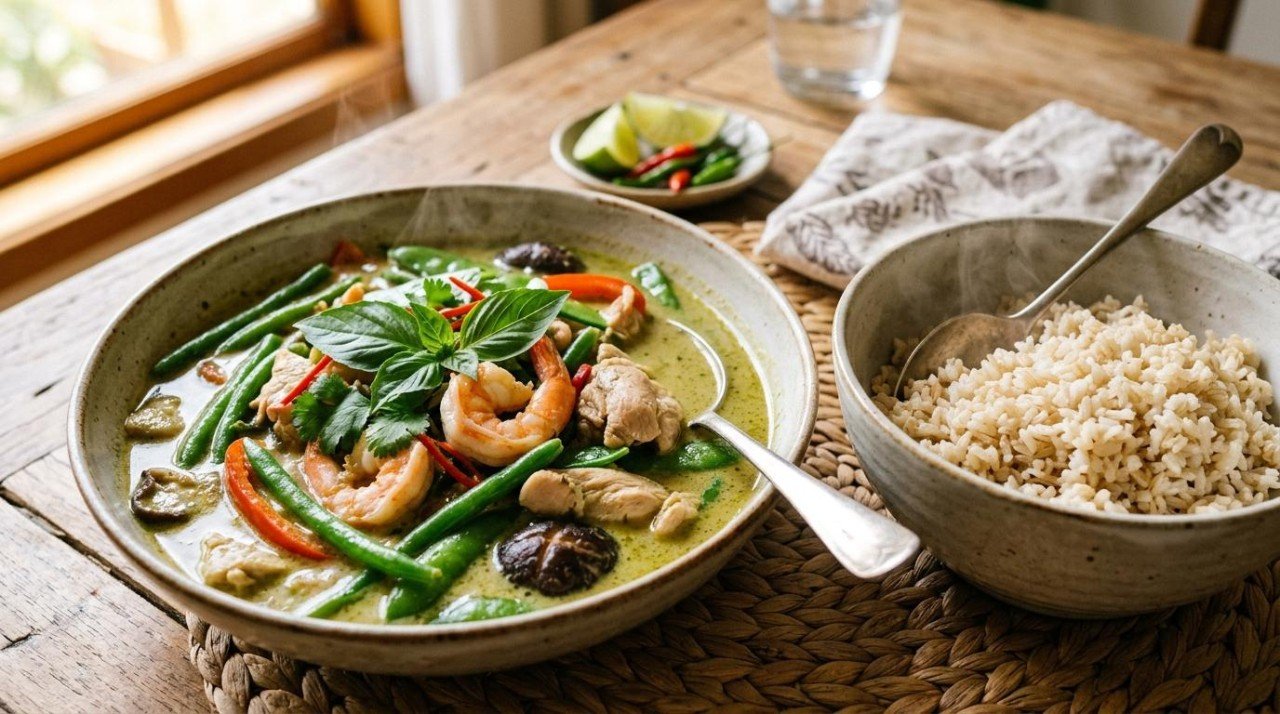
Green curry is the dish people order without reading the rest of the menu. Sweet, salty, coconut-rich, hot in a way that arrives late, and served with a bowl of rice that exists specifically to be flooded.
So we built a standard version — the kind most home cooks make from a jar of paste and a can of coconut milk, with chicken, bamboo shoots and basil over jasmine rice — and ran it through Eat Well Planner's Nutrition Score, the same number that shows on any public recipe page. It came back 34 out of 100. One bowl carried 95% of a day's saturated fat.
We got it to 77, and it is still a coconut curry: still fried in real coconut cream, still finished with a fistful of Thai basil. The most instructive thing we found was this — the coconut milk swap everyone assumes is the answer was worth one point when we tested it first, and sixteen when we moved it last. Every number below is a real, verified score change.
The original: what's in it and how it scores
Here is the version we scored, for four people:
- 1 can (13.5 oz) full-fat coconut milk
- 3 tablespoons store-bought green curry paste
- 1 lb chicken breast, sliced
- 1 can (8 oz) bamboo shoots, drained
- 2 tablespoons fish sauce, 1 tablespoon palm sugar, 1 tablespoon oil
- A small handful of Thai basil
- Served over about 4 cups of cooked white jasmine rice, salted
Nutrition Score: 34/100. Working out why a recipe scores the way it does is the part that transfers to everything else you cook. Three things hold this one down:
- Saturated fat, overwhelmingly. 22.4 g per serving — 95% of a day's value in one bowl. A can of coconut milk is mostly saturated fat, and the whole can goes to four people. Harvard's Nutrition Source notes the American Heart Association advises anyone at risk for heart disease to stay under about 13 grams a day.
- Sodium from three directions at once. 1,560 mg per serving, 68% of a day's value, against Harvard's chronic-disease-reduction ceiling of 2,300 mg a day. Fish sauce and curry paste are both concentrated salt — the Mae Ploy paste most supermarkets carry lists about 6 g of sodium per 100 g — and the salted rice adds a third source nobody counts.
- There are barely any vegetables in it. 4.3 g of fiber per serving against the 25 to 35 g a day Harvard says adults need, and 1.25 plant points against a weekly target of 30. A drained can of bamboo shoots is not a vegetable course.
Notice what is not on that list. Protein is 34.7 g per serving, which is genuinely good. The palm sugar works out to about 3 g of added sugar, which is trivial. And the tablespoon of oil is doing real work — we tested cutting it and it made things worse. Green curry has a fat problem and a vegetable problem. It does not have a sugar problem.
The upgrades
Five changes, applied in this order, each scored on top of the last. Order matters more here than in almost any recipe we have rebuilt — read the last one before deciding what to do first.
1. Make it a vegetable curry that happens to have chicken in it
- Swap: One can of bamboo shoots → the bamboo shoots plus 9 oz eggplant, 7 oz green beans, 1 large red bell pepper, 3 1/2 oz snow peas, 5 oz shiitake mushrooms, and double the basil
- Score impact: +14 points (34 → 48)
- What it changes: Fiber more than doubles (4.3 g → 9.3 g per serving) and plant points go from 1.25 to 6.25
- What it costs you: Ten minutes of knife work and a bigger pan. Nothing at all in flavor
The biggest single change you can make, and also the most authentic one. Thai green curry is traditionally loaded with vegetables — the version cooked by a Thai home cook for Eating Thai Food uses six to ten Thai eggplants and a bundle of sweet basil for one chicken. The bamboo-shoots-only version is a restaurant simplification.
Each vegetable has a job. Eggplant drinks up the sauce and goes silky. Green beans and snow peas stay squeaky, which the curry needs. Red bell pepper brings vitamin C and color against all that green. Shiitake adds a savory depth that lets you use less paste later, and mushrooms are worth knowing about for another reason entirely. That spread is why plant points jump fivefold, which is the logic behind the 30 plants a week target.
2. Brown jasmine rice — and stop salting the water
- Swap: Salted white jasmine rice → unsalted brown jasmine rice
- Score impact: +4 points (48 → 52)
- What it changes: Sodium drops from 1,570 mg to 1,080 mg per serving, fiber goes to 10.6 g, and it adds a plant point
- What it costs you: Brown jasmine takes about 35 minutes instead of 15, and it is chewier. Unsalted rice tastes flat on its own — but this rice is not eaten on its own
We scored the two halves of this swap separately, and the grain was the smaller half. White to brown was worth +1. Leaving the salt out of the cooking water was worth +3 on its own — the rice had been contributing roughly 490 mg of sodium per serving, more than the curry paste was adding and nearly as much as the fish sauce. Nobody thinks of plain rice as a salty food. In a bowl where something intensely seasoned goes on top, salting the water is pure waste.
The brown grain is still worth taking: Harvard's whole grains review reports that swapping white rice for brown is associated with 36% lower type 2 diabetes risk. Brown jasmine keeps the floral aroma this dish wants — our white rice substitutes guide ranks the other options.
3. Add shrimp alongside the chicken
- Swap: 1 lb chicken breast → 1 lb chicken breast plus 7 oz raw shrimp
- Score impact: +4 points (52 → 56)
- What it changes: Protein goes from 37.7 g to 45.5 g per serving, and long-chain omega-3s go from zero to 30% of a day's value in the finished recipe
- What it costs you: Shrimp is naturally salty — sodium climbs back about 180 mg per serving, which the next swap gives back with interest
Chicken and shrimp together is a normal Thai combination, not a Western invention, and it fixes the one hole vegetables cannot touch. The original had no EPA or DHA at all, and Harvard's Nutrition Source is direct that plant omega-3s do not fill that gap: "the evidence does not support eating ALA as a replacement for seafood consumption." The same page recommends seafood twice a week and lists shrimp among the low-mercury choices. Add it in the last two minutes, off the boil — it is the one ingredient here you can ruin by being early.
4. Rebuild the seasoning instead of just using less of it
- Swap: 3 tablespoons curry paste and 2 tablespoons fish sauce → 2 tablespoons paste, 1 tablespoon fish sauce, plus 1 stalk lemongrass, 1 tablespoon grated ginger and 2 tablespoons lime juice
- Score impact: +5 points (56 → 61)
- What it changes: Sodium falls from 1,260 mg to 830 mg per serving — 55% of a day's value down to 36%, and out of the very high caution band
- What it costs you: Nothing, if you actually add the aromatics. Skip them and the curry tastes washed out
The mistake is using less paste and stopping there. Paste is not just salt; it is the galangal, lemongrass, kaffir lime and green chili that make the dish taste like itself, so taking a third of it away takes a third of the flavor — unless you put fresh versions of the same aromatics back. Lemongrass and ginger cover the citrusy top end that goes dull in a jar, and lime juice at the finish does what salt was doing: it makes everything taste sharper.
Halve the fish sauce rather than dropping it, because the funk is load-bearing — our fish sauce substitutes guide covers avoiding it entirely, and the fresh ginger guide has the ratio if you are working from ground. Check your own jar of paste too: brands vary by a factor of two on salt.
5. Split the coconut milk — but only now
- Swap: 1 can full-fat coconut milk → a scant 1/2 cup full-fat plus 1 1/4 cups lite coconut milk
- Score impact: +16 points (61 → 77)
- What it changes: Saturated fat drops from 23.2 g to 11.9 g per serving — 99% of a day's value down to 51% — and takes 120 calories with it
- What it costs you: A slightly thinner sauce. Keeping the full-fat splash for frying the paste is what stops it costing more than that
This is the swap the whole post turns on. We tested it first, on the original with nothing else changed, and it was worth one point. Halving the saturated fat in a bowl that also had 1,560 mg of sodium, 4 g of fiber and no omega-3s barely moved the number, because saturated fat was only one of several things wrong. Applied last, after the vegetables and the rice and the sauce were fixed, the identical change was worth sixteen — by then it was the only thing left holding the score down.
Technique is what keeps it tasting right. Lite coconut milk is simply "made the same way as full-fat coconut milk but diluted with more water," as America's Test Kitchen puts it — less of the fat that carries the flavor, and it will not crack the way a curry needs. So keep a scant half cup of the real thing, fry the paste in it until the oil separates and the kitchen smells like a Thai restaurant, then pour in the lite. Depth from the full-fat, volume from the lite. Our coconut milk substitutes guide helps if your store stocks only one kind.
Take the Guesswork Out of Eating Well
Eat Well Planner helps you organize your favorite recipes, plan balanced meals, and automatically generate shopping lists — all in one place. Whether you're tracking macros, managing dietary restrictions, or just trying to stop asking "what's for dinner?", we've got you covered.
Our AI-powered tools can adapt any recipe to your dietary needs, help you discover new meals you'll love, and even log your nutrition effortlessly. It's meal planning made simple.
Start Organizing Your Meals — FreeWhat we kept (on purpose)
The tablespoon of oil, which we tested cutting and which cost a point and most of the recipe's plant omega-3. The palm sugar, 3 g per serving and the wan in gaeng keow wan. Real fish sauce, halved rather than replaced. Real coconut cream for frying the paste. And white-meat chicken — if you would rather have thigh, take it; we scored that too and it costs 5 points, a fair price for what thigh does to a curry. We stopped at 77 because the next swap would have taken the coconut out of a coconut curry.
Swaps we tested and skipped
- All lite coconut milk, no full-fat at all: 77 → 87. The highest score we recorded, and the honest problem in this post. We did not take it because you cannot crack lite coconut milk, so the paste never fries properly and the curry stays thin. RecipeTin Eats says it plainly: "Fat is where the flavour is, if you use low fat coconut milk the sauce will lack flavour." If saturated fat is your main concern, take the 87 — but fry the paste in a tablespoon of oil first. There is a whole ladder here, all scored on the finished recipe: a full can of full-fat scores 61, half and half scores 68, our split scores 77, all lite scores 87. Pick your point on it.
- Cauliflower rice instead of brown rice: 77 → 65. Twelve points worse. Once the curry itself carries that much produce, the rice is not the problem, and losing the grain loses fiber, minerals and the entire reason the sauce exists.
- Skipping the rice altogether: 77 → 64. Thirteen points worse, and it stops being a meal.
- Greek yogurt in place of the coconut milk: 77 → 83. Better on paper, rejected on two grounds. It is not green curry — it is a green-spiced yogurt sauce. And it does not survive the pan: America's Test Kitchen notes that "curdling occurs when excessive heat causes the whey proteins in dairy to denature (unfold) and bind with casein proteins, forming clumps," and yogurt's roughly 4% butterfat is nowhere near enough to protect it.
- Doubling the shrimp to 14 oz: 77 → 76. More protein, more sodium, no gain.
- Dropping the palm sugar: 77 → 76. One point worse. Leave it in.
The healthier version: full recipe
Nutrition Score: 77/100. Serves 4.
Ingredients
- Scant 1/2 cup (100 ml) full-fat coconut milk, preferably the thick cream from the top of the can
- 1 1/4 cups (300 ml) lite coconut milk
- 2 tablespoons green curry paste
- 1 tablespoon vegetable oil
- 1 lb chicken breast, thinly sliced
- 7 oz raw shrimp, peeled and deveined
- 9 oz eggplant (1 large Japanese eggplant, or 6 Thai eggplants), cut into chunks
- 7 oz green beans, trimmed and halved
- 1 large red bell pepper, sliced
- 5 oz shiitake mushrooms, stemmed and sliced
- 3 1/2 oz snow peas
- 1 can (8 oz) bamboo shoots, drained and rinsed
- 1 stalk lemongrass, tender core finely minced
- 1 tablespoon grated fresh ginger
- 1 tablespoon fish sauce
- 1 tablespoon palm sugar or light brown sugar
- 2 tablespoons lime juice
- 1 cup loosely packed Thai basil leaves
- 4 cups cooked brown jasmine rice (about 1 1/3 cups uncooked), cooked in unsalted water
Instructions
- Start the brown jasmine rice in unsalted water. It needs about 35 minutes, so it goes on first.
- Heat the full-fat coconut milk and the oil in a wide pan or wok over medium heat. Simmer, stirring, for 3 to 5 minutes until it thickens and the oil separates and pools at the edges. This is cracking the cream, and it is the step that makes the curry taste like a restaurant.
- Add the curry paste, lemongrass and ginger to the cracked cream and fry for 2 minutes, pressing it around the pan, until it darkens and smells strongly aromatic.
- Add the chicken and stir to coat every piece in paste. Cook for 2 minutes.
- Pour in the lite coconut milk, add the fish sauce and sugar, and bring to a gentle simmer.
- Add the eggplant and green beans. Simmer for 8 minutes, until the eggplant gives under a spoon.
- Add the bell pepper, shiitake and bamboo shoots. Simmer for 4 minutes more.
- Add the snow peas and shrimp. Cook for 2 minutes, just until the shrimp turn opaque, then take the pan off the heat.
- Stir in the lime juice and Thai basil, letting the basil wilt in the residual heat rather than cooking it. Taste and adjust with more lime or a few drops of fish sauce.
- Serve over the brown rice.
Per serving, original vs. improved
- Nutrition Score: 34 → 77
- Calories: 743 → 759, for a substantially larger plate
- Saturated fat: 22.4 g (95% DV) → 11.9 g (51% DV)
- Sodium: 1,560 mg (68% DV) → 830 mg (36% DV)
- Fiber: 4.3 g → 9.7 g (33% DV)
- Protein: 34.7 g → 44.2 g
- Plant points: 1.25 → 7.75
The improved version comes back as an excellent source of niacin (152% DV), vitamin B6 (110%), phosphorus (109%), vitamin C (90%), vitamin K (55%), magnesium (52%), iron (51%), potassium (47%), fiber (33%) and long-chain omega-3s (30%). Vitamin C and long-chain omega-3s do not appear on the original's list at all.
Make it fit other diets
For a vegan version, swap the chicken and shrimp for firm tofu and a can of chickpeas, replace the fish sauce with light soy sauce plus a teaspoon of miso, and check the paste label — many contain shrimp paste. For gluten-free, it already is, provided your fish sauce and paste are certified. For lower carb, halve the rice rather than replacing it with cauliflower; we scored that and it went the wrong way. In Eat Well Planner you can skip the working out — ask the AI recipe chat to make this vegan and it rewrites the whole recipe with the substitutions in place, then rescores it so you can see what the change cost.
Do this to your own recipes
Nothing here required guessing. Import a recipe from any URL, Instagram reel or YouTube video and Eat Well Planner scores it against the same nutrition data we used. Make It Healthier then proposes swaps like these, with a calculator verifying the real nutritional gain before a suggestion is ever shown to you. The per-swap numbers above came from the Recipe Playground, where you change one ingredient and watch the score move — which is where you would go to find out what keeping the whole can of coconut milk costs, and what to add elsewhere to pay for it.
That is worth doing for the reason this curry demonstrates so well. The same swap was worth 1 point and 16 points depending on when we made it, and no amount of nutritional intuition would have predicted that. The right order for your fixes depends on what your particular recipe is missing — which is the thing a score can tell you and a rule of thumb cannot.