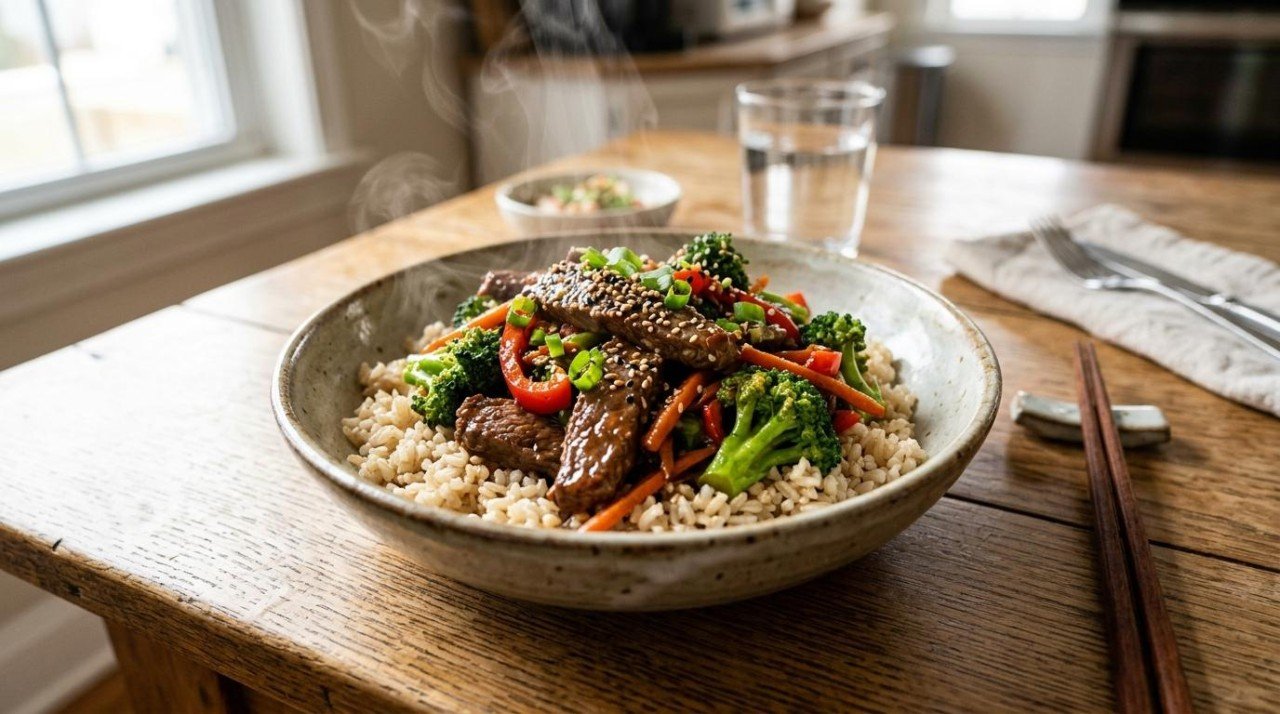
Beef and broccoli is one of the most-ordered dishes on any Chinese-American takeout menu, and it is easy to see why. Tender slices of beef, crisp-tender broccoli, and a glossy, savory brown sauce spooned over rice is comfort food that also looks, at a glance, like the healthy option on the menu. It is a plate of beef and vegetables. How bad could it be?
So we built the standard takeout version and ran it through Eat Well Planner's Nutrition Score, the same at-a-glance number that shows up on any public recipe page. It came back 49 out of 100. Not terrible, and honestly better than a lot of takeout, but with real room to move. And the interesting part is where the room is: it is not where most people assume.
Here is the promise. We kept the beef, kept the oyster-sauce backbone that makes this dish taste like this dish, and still got it to 68 out of 100. That is a 19-point jump, and every swap below carries the real, verified score change it earned. Same beef and broccoli, much better numbers.
The original: what's in it and how it scores
Here is the standard takeout-style version we scored, for four people, served over white rice:
- 1 lb flank steak, thinly sliced
- 3/4 lb (about 12 oz) broccoli florets
- 1/3 cup regular soy sauce
- 1/4 cup oyster sauce
- 2 tablespoons brown sugar
- 2 tablespoons cornstarch
- 3 tablespoons vegetable oil
- 3 cloves garlic and 1 tablespoon fresh ginger
- 1 cup white rice (dry), cooked to serve
Nutrition Score: 49/100. Now the diagnosis, because knowing why it scores that way is what lets you fix your own recipes. And the first thing to say is that this dish already does a lot right. The flank steak makes it a genuinely excellent source of protein (about 30 g per serving), iron, zinc, and vitamin B12, and the broccoli brings a wall of vitamin C, vitamin K, and vitamin B6. This is not a junk plate. Three specific things are holding the score down:
- Sodium is very high — about 1,900 mg per serving, roughly 83% of a full day's worth in one bowl. This is the single biggest problem, and it comes almost entirely from the sauce. The American Heart Association puts the daily limit at 2,300 mg, with an optimal goal closer to 1,500 mg, so a single serving of takeout beef and broccoli spends most of your day's budget before you have touched anything else.
- Not much fiber, and not many plants. Fiber comes in at just 2.8 g per serving, and the plant-diversity count is low. Broccoli is doing all the vegetable work by itself, and the white rice underneath contributes almost nothing but starch.
- Added sugar and refined carbs. The 2 tablespoons of brown sugar in the sauce and the white rice base add up to a fast-digesting foundation with a little caution-level added sugar on top.
Notice what is not on that list: saturated fat. At about 4.9 g per serving, it is already in reasonable territory, because flank steak is a lean cut. That matters, because it tells us where not to waste effort. This is a sodium-and-plants problem, not a fatty-meat problem, so we are not going to touch the beef.
The upgrades
Four swaps, ordered from the biggest score mover down to the finishing touch. If you only make one change, make the first one.
1. Double the vegetables (and add color)
- Swap: 3/4 lb broccoli only → over 1 lb broccoli plus 2 carrots and 1 red bell pepper
- Score impact: +12 points (49 → 61)
- What it changes: Nearly doubles the fiber (2.8 g → 5.1 g), takes vitamin A from essentially nothing to 39% of a day's value, and triples the plant variety on the plate
- What it costs you: Nothing but a few extra minutes of chopping — and it makes the dish look and taste better
This is the highest-impact, lowest-effort move in the whole makeover, which is why it leads. A takeout portion is mostly beef and sauce with a modest handful of broccoli for show. Flipping that ratio so vegetables are the bulk of the plate is what a stir-fry is supposed to be in the first place. More broccoli brings more fiber and more vitamin C, and adding carrots and red bell pepper fixes the one real nutrient gap the original had: vitamin A, which the beef-and-broccoli-only version has almost none of. The peppers and carrots also add natural sweetness and crunch that let you lean on less sugar in the sauce later.
Broccoli is worth loading up on for more than its fiber. It is one of the best dietary sources of sulforaphane, a compound in cruciferous vegetables that research links to reduced inflammation and cancer-protective effects. To keep it intact, cook the broccoli crisp-tender, not gray and soft — a quick, high-heat stir-fry is close to ideal, and we get into the details in our guide to cooking broccoli so it actually helps you.
2. Rebuild the sauce with less sodium
- Swap: Regular soy sauce → low-sodium soy sauce, half the oyster sauce, half the sugar
- Score impact: +1 point (61 → 62)
- What it changes: Cuts sodium roughly in half (about 1,940 mg → 1,010 mg per serving) and halves the added sugar, with no loss of savory depth
- What it costs you: Almost nothing — cornstarch keeps the sauce glossy and clingy, so you never notice the missing salt
This is the swap to pay attention to, and it is deliberately placed second even though its score bump is the smallest in the post. The plus-one is not the story. The story is that this single change is the biggest health win in the whole makeover: it cuts the dish's defining problem — that enormous slug of sodium — roughly in half, without changing how it tastes. Sodium is the one number your blood pressure actually responds to, and beef and broccoli is one of the saltiest things on the takeout menu.
The trick is that you can lose a lot of the sodium without losing the flavor. Low-sodium soy sauce has about 40% less sodium than regular (roughly 600 mg per tablespoon instead of 1,000) while tasting almost identical in a cooked sauce. Cutting the oyster sauce from 1/4 cup to 2 tablespoons trims more salt, and the cornstarch slurry does the real work of making the sauce cling to the beef and broccoli so every bite still tastes seasoned. If you want to push the sodium down even further, our soy sauce substitutes guide and oyster sauce substitutes guide walk through lower-sodium options like coconut aminos. This is the DASH approach in miniature — same food, far less salt — the same idea behind our DASH diet primer.
Take the Guesswork Out of Eating Well
Eat Well Planner helps you organize your favorite recipes, plan balanced meals, and automatically generate shopping lists — all in one place. Whether you're tracking macros, managing dietary restrictions, or just trying to stop asking "what's for dinner?", we've got you covered.
Our AI-powered tools can adapt any recipe to your dietary needs, help you discover new meals you'll love, and even log your nutrition effortlessly. It's meal planning made simple.
Start Organizing Your Meals — Free3. Swap white rice for a whole grain
- Swap: White rice → brown rice
- Score impact: +4 points (62 → 66)
- What it changes: Adds fiber and magnesium, and turns the beige, empty base into one that actually contributes nutrition
- What it costs you: A nuttier, chewier bite and a longer cook time — the one real texture change in the makeover
The rice under beef and broccoli is easy to ignore, but it is a quarter of what you eat, and white rice gives you little beyond fast starch. Brown rice keeps the bran and germ that milling strips away, which is where the fiber, the magnesium, and most of the B vitamins live. Harvard's nutrition researchers note that swapping whole grains in place of even some white rice could lower type 2 diabetes risk by 36%, and that eating whole instead of refined grains lowers LDL cholesterol and triglycerides.
Brown rice is the familiar, no-argument choice, but it is not the only one. Farro and barley are chewier, more forgiving whole grains that hold up beautifully under a saucy stir-fry, and they bring even more fiber to the plate — our guide to the whole grains you are missing makes the case for rotating them in. If you are not ready to give up white rice entirely, our white rice substitutes guide covers halfway options, like cutting it 50/50 with brown, that still move the needle.
4. Lighten the oil and finish with sesame
- Swap: 3 tablespoons vegetable oil → 1 tablespoon for the stir-fry plus 1 teaspoon toasted sesame oil to finish
- Score impact: +2 points (66 → 68)
- What it changes: Drops about 50 calories per serving and trims total fat, and clears the last caution flag on the score
- What it costs you: Nothing — you gain flavor, because toasted sesame oil tastes like more than plain oil ever did
Takeout stir-fries swim in oil. A hot wok or skillet needs far less than you would think — 1 tablespoon is plenty to sear a pound of beef and a pile of vegetables in batches. Cutting the oil back is a quiet way to shed calories without touching anything you can taste. Then a single teaspoon of toasted sesame oil stirred in at the very end adds a deep, nutty aroma that makes the whole dish smell like the restaurant version. Sesame oil is a finishing oil, not a cooking one — its flavor burns off over high heat, so it goes in last, off the heat.
What we kept (on purpose)
A makeover that guts the dish is a failed makeover, so a few things stayed put. We kept the flank steak, full stop — it is lean, it is the point of the dish, and it is a powerhouse of iron, zinc, and B12. We kept real oyster sauce, just less of it, because oyster sauce is the savory backbone that makes beef and broccoli taste like beef and broccoli. You could drop it entirely and push the sodium down a little further, but then you would have beef and broccoli in gravy, not the dish you actually wanted. And we kept a touch of brown sugar, because that whisper of sweetness balancing the salt and the ginger is part of the flavor, not a flaw. We stopped at 68 because the next honest change would start subtracting from the dish instead of adding to it.
The healthier version: full recipe
Nutrition Score: 68/100. Serves 4.
For the beef and marinade:
- 1 lb flank steak, thinly sliced against the grain
- 1 tablespoon low-sodium soy sauce
- 1 tablespoon cornstarch
For the sauce:
- 3 tablespoons low-sodium soy sauce
- 2 tablespoons oyster sauce
- 1 tablespoon brown sugar
- 1 tablespoon cornstarch
- 1/3 cup water
For the stir-fry:
- 1 tablespoon vegetable oil
- Over 1 lb broccoli florets (about 6 cups)
- 2 medium carrots, sliced on the diagonal
- 1 large red bell pepper, sliced
- 3 cloves garlic, minced
- 1 tablespoon fresh ginger, grated
- 1 teaspoon toasted sesame oil
- 1 cup brown rice (dry), cooked, to serve
- Get the brown rice cooking first, since it takes the longest. Toss the sliced beef with 1 tablespoon low-sodium soy sauce and 1 tablespoon cornstarch and set aside to marinate while you prep everything else.
- Stir the sauce ingredients together in a small bowl: the low-sodium soy sauce, oyster sauce, brown sugar, cornstarch, and water. Whisk until smooth and set aside.
- Heat the vegetable oil in a large skillet or wok over high heat. Sear the beef in a single layer, in two batches so it browns rather than steams, about 2 minutes per batch. Remove to a plate.
- Add the broccoli, carrots, and red bell pepper to the hot pan with a splash of water. Stir-fry until crisp-tender and still bright, about 4 to 5 minutes. Add the garlic and ginger in the last 30 seconds, just until fragrant.
- Return the beef to the pan. Give the sauce a quick stir and pour it in. Toss everything together for 1 to 2 minutes, until the sauce thickens and coats the beef and vegetables in a glossy sheen.
- Turn off the heat and stir in the toasted sesame oil. Serve over the brown rice.
Per serving, here is the before and after:
- Nutrition Score: 49 → 68
- Calories: about 420 → about 384
- Sodium: about 1,900 mg → about 900 mg (down more than half, from 83% to 39% of the daily limit)
- Fiber: 2.8 g → 5.3 g (now a good source, at 18% of the daily value)
- Added sugar: 6.1 g → 3.0 g (out of caution range)
- Saturated fat: 4.9 g → 4.3 g (no longer flagged)
- Protein: about 30 g → about 31 g (held steady)
- Plants on the plate: 1.5 → 4.5 different plants
Swaps we tested and skipped
We scored a few popular swaps that did not make the cut, and here is why:
- Cauliflower rice instead of a grain (scored 67). The trendy low-carb swap actually scored one point lower than brown rice, not higher — you lose the fiber and staying power of a whole grain, and the meal stops being the comforting beef-and-broccoli-over-rice people came for. If you love cauliflower rice, use it, but do not expect it to beat the grain on the numbers.
- Dropping the oyster sauce entirely. It does nudge the sodium down further, but oyster sauce is the soul of this dish. Without it you have a generic beef stir-fry, not beef and broccoli. We reduced it instead of removing it, and think that is the right trade.
- Swapping flank steak for chicken breast. A fine dish, but a different one — and you would give up the iron, zinc, and B12 that make the beef version genuinely nutrient-dense. Flank steak is already lean, so there was no fat problem to solve by dropping it.
Make it fit other diets
This dish adapts easily. Gluten-free: use tamari or a certified gluten-free soy sauce, and a gluten-free oyster sauce (or leave it out and add a little more umami with mushrooms). Vegetarian: swap the beef for extra-firm tofu or seared mushrooms, and use a vegetarian oyster sauce made from mushrooms. Lower-carb: keep the sauce and vegetables and serve over cauliflower rice, accepting the small trade-offs above. In Eat Well Planner, you do not have to work these out by hand — ask the AI recipe chat to "make this gluten-free" or "make this vegetarian" and it rewrites the whole recipe with the swaps built in.
Do this to any recipe you love
None of this was guesswork. Every score and every point in this post came from running the recipe through Eat Well Planner's Make It Healthier tool, which proposes swaps like these and uses a calculator to verify the real nutritional gain before it shows you a suggestion — so you never chase a change that does not actually help. We tested each swap in the Recipe Playground, watching the score move in real time, which is exactly how we caught that cauliflower rice scores lower than brown rice and that the sauce rebuild was the biggest health win despite barely moving the number.
You can do the same with the food you actually cook. Import any recipe from a website, or paste in a video you saw online, score it, and let Make It Healthier show you where the easy points are hiding. Keep the dish you love. Just make the numbers better.