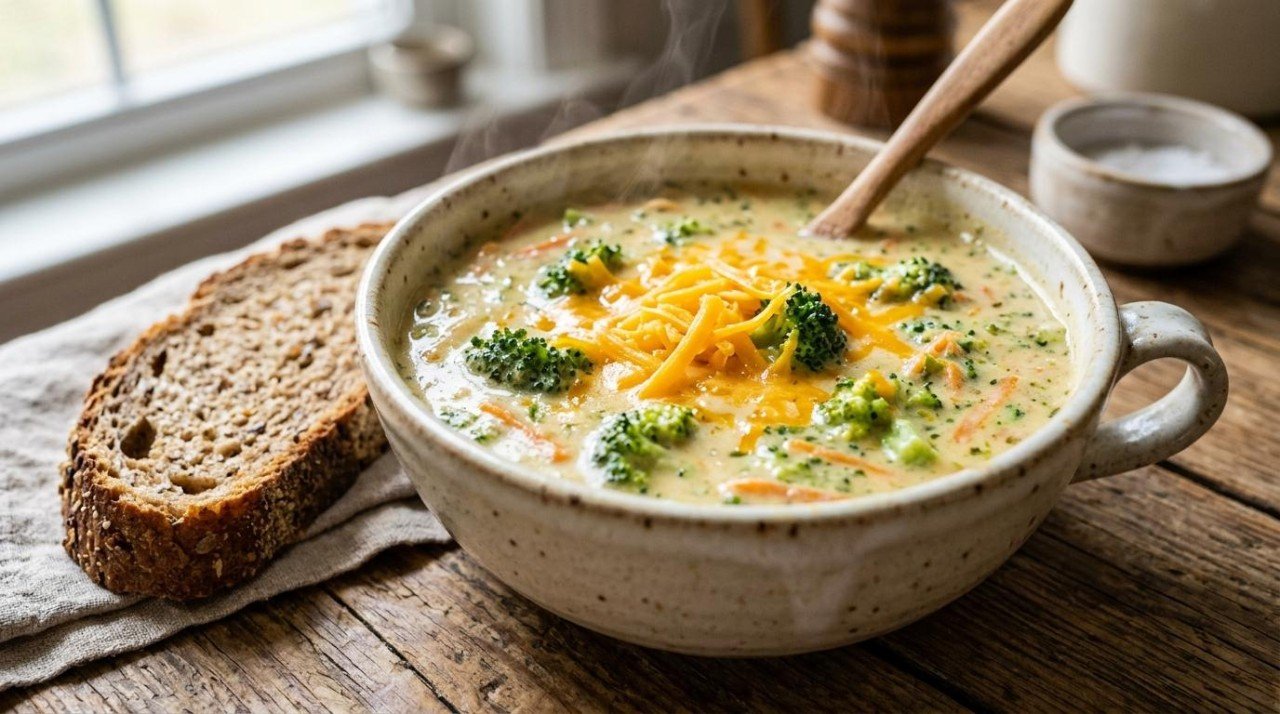
Broccoli cheddar soup is the reason a lot of people walk into a Panera. It is thick enough to coat a spoon, orange from the cheddar, flecked with shredded carrot, and it arrives hot in a hollowed-out sourdough loaf you get to eat afterward. Every copycat recipe on the internet is chasing the same three things: the body, the cheese pull, and that faint background warmth from nutmeg that most people cannot name but would miss immediately.
So we built a standard copycat — butter and flour roux, half-and-half, half a pound of sharp cheddar — and ran it through Eat Well Planner's Nutrition Score, the same number you see on any public recipe page. It came back 41 out of 100. One bowl carried 26 g of saturated fat, which is 111% of a day's worth, plus 1,590 mg of sodium.
We got it to 60 without giving up the cheddar, the creaminess, or the nutmeg. The biggest single swap was not cutting the cheese — it was replacing the half-and-half with something that thickens better than cream does. And the most interesting number in the whole test was not a swap at all. It was the bread bowl, which behaved nothing like we expected.
The original: what's in it and how it scores
Here is the version we scored, sized for four bowls (about 12 oz each, the same as a Panera bowl):
- 1/4 cup butter, 1 small onion, 1 celery stalk
- 1/4 cup all-purpose flour, for the roux
- 2 cups half-and-half
- 2 cups chicken broth
- 3 cups broccoli florets, 1 cup shredded carrot
- 8 oz sharp cheddar, grated
- 1/4 teaspoon nutmeg, 1 teaspoon salt, 1/2 teaspoon black pepper
Nutrition Score: 41/100. Per bowl that is about 576 calories, 21.8 g protein, 45.4 g total fat, 26.0 g saturated fat, 1,590 mg sodium, and 3.4 g fiber.
Start with what is already working, because there is more of it than you would guess. A bowl is an excellent source of vitamin C (72% of a day's value), vitamin K (65%), vitamin A (63%), calcium (59%), phosphorus (65%), and riboflavin (53%), and it delivers 21.8 g of protein. That is real food doing real work — actual broccoli, actual carrots, actual cheese. This is not a dish that needs rescuing from itself.
Two things drag it down, and one of them accounts for most of the gap:
- Saturated fat, flagged very high at 111% of a day's value in a single bowl. Between 1/4 cup of butter, 2 cups of half-and-half, and 8 oz of cheddar, there are three separate sources of dairy fat stacked on top of each other. Harvard Health puts a sensible daily budget at roughly 16 to 19 g, or about 7% of calories. One bowl is 26 g.
- Sodium, flagged very high at 69% DV — 1,590 mg, mostly from regular chicken broth, a teaspoon of added salt, and the cheese. Most Americans already eat about 3,400 mg a day against a 2,300 mg limit.
- Barely any fiber — 3.4 g, from a soup that is nominally a vegetable soup. Average US intake sits around 16 g a day against a 28 g Daily Value. Three cups of broccoli sounds like a lot until you divide it by four and remember broccoli is mostly water.
Notice what is not on that list: calories, in isolation, and the cheese as a category. The score does not object to cheddar existing. It objects to how much fat is arriving from three directions at once while the vegetables stay a garnish.
The upgrades
Five changes, scored cumulatively in this order, each built on the one before. If you only make one, make the first — it is worth nearly half the total gain on its own, and it is the one that improves the texture rather than compromising it.
1. Half-and-half out, whole milk plus pureed cauliflower in
- Swap: 2 cups half-and-half → 2 cups whole milk + 2 cups cauliflower florets, simmered soft and blended into the base
- Score impact: +9 points (41 → 50)
- What it changes: Saturated fat 26.0 g → 19.9 g per bowl, calories 576 → 504, and it adds a new plant to the pot
- What it costs you: Nothing you will taste. Under the cheddar, blended cauliflower is undetectable — but it does add a blender step
This is the swap that makes the whole makeover work, and the reason is textural, not nutritional. Cream thickens a soup by being fatty. Cauliflower thickens it by being dense — cooked and pureed, it is low enough in insoluble fiber to blend to a genuinely smooth paste that adds heft to a liquid. Swap to milk alone and you get a thin, sad soup: we scored that too, and it only reached 46. The cauliflower is worth 4 of the 9 points, and all of the body.
We also tested 2% milk instead of whole. It scored identically — 50 either way — so keep the whole milk. It buys you richness for free. If you want to go further on the dairy side, our half-and-half substitutes guide covers what each option actually does to a hot sauce.
2. Double the broccoli, and use the stems
- Swap: 3 cups broccoli → 1 1/4 lb (florets and peeled stems), and 1 cup shredded carrot → 3 carrots
- Score impact: +4 points (50 → 54)
- What it changes: Fiber 4.4 g → 6.5 g per bowl; vitamin C climbs past 170% DV
- What it costs you: Genuinely nothing — it makes it taste more like broccoli soup, which is the point
Most copycat recipes treat the broccoli as texture rather than substance. Doubling it turns a cheese soup with broccoli in it into a broccoli soup with cheese in it, and the cheddar still reads loud and clear because sharp cheddar is not shy.
Use the stems. They are nutritionally the same vegetable as the florets — peel the woody outer layer, chop them small, and give them a two-minute head start in the pot. It is free volume you were already paying for.
3. Butter out, one tablespoon of olive oil in
- Swap: 1/4 cup butter → 1 tablespoon olive oil for the roux
- Score impact: +4 points (54 → 58)
- What it changes: Saturated fat 19.9 g → 14.0 g per bowl, calories 533 → 458
- What it costs you: A little of the buttery top note. The cheddar covers it almost entirely
Four tablespoons of butter is what the roux calls for by tradition, not by necessity. A roux only needs enough fat to coat the flour, and one tablespoon does that for 1/4 cup of flour. In a soup that already gets fat from whole milk and half a block of cheddar, the butter is the most replaceable of the three — see our butter substitutes guide for how the swap behaves in other cooking.
4. Cut the cheddar in half — but keep it sharp
- Swap: 8 oz sharp cheddar → 4 oz sharp cheddar
- Score impact: +2 points (58 → 60)
- What it changes: Saturated fat 14.0 g → 8.5 g per bowl, calories 458 → 343
- What it costs you: This is the real trade. Protein drops from 24.7 g to 17.9 g, and you can tell it is less cheese
An ounce of sharp cheddar per bowl, down from two, still tastes unmistakably of cheddar, because sharpness is concentration — an aged cheddar carries more flavor per gram, which is exactly why you can use less of it. Grate it yourself from a block. Pre-shredded cheese is dusted with anti-caking starch and melts worse for it.
Add it off the heat, in handfuls, stirring until each one disappears. Cheese sauces break when they get too hot: the proteins clump together and squeeze the fat out as a greasy layer. The flour roux is what keeps this one stable, which is another reason not to skip it. Our cheddar substitutes guide covers which cheeses melt cleanly if you want to swap rather than reduce.
5. Low-sodium broth and a third of the salt
- Swap: Regular chicken broth → low-sodium; 1 teaspoon salt → 1/3 teaspoon
- Score impact: +0 points (60 → 60)
- What it changes: Sodium 1,340 mg → 850 mg per bowl, from 58% of a day's value to 37%
- What it costs you: Almost nothing, because the cheddar is already salty
Worth zero points, worth making anyway. By this stage in the build the score has already stopped flagging sodium as critical, so the threshold that would have paid out has moved past — but 490 mg is 490 mg, and this is a soup people eat with bread and a sandwich. Salt at the end, after the cheese has gone in, or you will oversalt it. Our chicken broth substitutes guide has the low-sodium options worth buying.
We also throw in three cloves of garlic, which scores zero points but adds a plant to your weekly plant count and costs nothing. Total: 41 to 60, +19 points.
Take the Guesswork Out of Eating Well
Eat Well Planner helps you organize your favorite recipes, plan balanced meals, and automatically generate shopping lists — all in one place. Whether you're tracking macros, managing dietary restrictions, or just trying to stop asking "what's for dinner?", we've got you covered.
Our AI-powered tools can adapt any recipe to your dietary needs, help you discover new meals you'll love, and even log your nutrition effortlessly. It's meal planning made simple.
Start Organizing Your Meals — FreeWhat we kept, and where we stopped
The cheddar stays, at a real quantity — 4 oz across four bowls is not a token. The nutmeg stays. The flour roux stays, because it is doing structural work. The whole milk stays instead of 2%, because the score could not tell the difference and your mouth can.
We stopped at 60 because the next moves all cost more than they return. Cutting the cheddar to 3 oz scored 60 — identical — so there is no reason to do it. The two remaining flags are saturated fat (37% DV) and sodium (37% DV), both of which are now in "high" rather than "very high" territory, and both of which are what a cheese soup is. You cannot take a dish named after cheddar much below that and still have people order it twice.
The bread bowl is a separate decision, and the score cannot help you
This is the part of the test that surprised us. We assumed the bread bowl would be the villain. It is not, at least not in a way the score can see.
Scored with a Panera-sized 8 oz sourdough bread bowl, the original soup went from 41 to 40. The improved soup went from 60 to 58. One or two points. The score is a per-serving measure of nutritional quality, and a sourdough bread bowl is roughly average-quality food — it dilutes the concentration of everything, good and bad, and lands you back near where you started.
The calories tell a completely different story. Adding the bread bowl took the improved soup from 349 calories to 975, and the sodium from 850 mg to 2,230 mg — a day's worth, in one lunch. CalorieKing lists Panera's own broccoli cheddar bread bowl at 900 calories and 2,000 mg of sodium, which lines up closely with what we scored.
So here is the honest version: the bread bowl is not a nutritional disaster, it is a second meal. If you want bread with your soup, two slices of whole wheat scored 59 and brought fiber to 10.0 g a serving; two slices of sourdough scored 58 with 7.8 g. Whole wheat wins by a point and by 2 g of fiber, which is the same result we keep getting — the loaf on your counter matters more than most people assume.
The healthier version: full recipe
Nutrition Score: 60/100. Serves 4.
- 1 tablespoon olive oil
- 1 small yellow onion (about 3 1/2 oz), finely diced
- 1 celery stalk (about 1 oz), finely diced
- 3 cloves garlic, minced
- 1/4 cup all-purpose flour
- 2 cups low-sodium chicken broth
- 2 cups whole milk
- 2 cups cauliflower florets (about 7 oz)
- 1 1/4 lb broccoli, florets chopped small and stems peeled and diced
- 3 medium carrots (about 6 oz), coarsely shredded
- 4 oz sharp cheddar, grated from a block
- 1/4 teaspoon ground nutmeg
- 1/3 teaspoon salt
- 1/2 teaspoon black pepper
- Heat the olive oil in a large pot over medium. Add the onion and celery and cook 5 to 6 minutes, until soft and translucent. Stir in the garlic for 30 seconds.
- Sprinkle in the flour and stir constantly for 1 to 2 minutes, until it smells toasty and coats the vegetables.
- Pour in the broth a splash at a time, whisking smooth after each addition, then whisk in the milk the same way. Rushing this is how you get lumps.
- Add the cauliflower and the salt. Bring to a bare simmer — never a boil — and cook 12 to 15 minutes, until the cauliflower is completely tender.
- Blend the pot smooth with an immersion blender, or transfer about half of it to a countertop blender and stir it back in. This is the step that replaces the cream, so take it all the way to silky.
- Add the broccoli stems first, then the florets and the shredded carrot after 2 minutes. Simmer gently 8 to 10 minutes, until the broccoli is tender but still bright green.
- Take the pot off the heat and let it stop bubbling. Stir in the cheddar a handful at a time, letting each one melt before adding the next.
- Stir in the nutmeg and pepper, taste, and adjust the salt now rather than earlier. Serve with a slice of whole grain bread.
Per serving, original versus improved:
- Nutrition Score: 41 → 60
- Calories: 576 → 349
- Saturated fat: 26.0 g (111% DV) → 8.6 g (37% DV)
- Sodium: 1,590 mg (69% DV) → 850 mg (37% DV)
- Fiber: 3.4 g → 6.6 g (22% DV)
- Protein: 21.8 g → 18.8 g — the one number that moved the wrong way, and it is the halved cheddar
- Vitamin C: 72% DV → 177% DV
- Vitamin K: 65% DV → 129% DV
- Plant points: 4.5 → 5.75
Swaps we tested and skipped
- Pureed white beans in the base. The obvious fix for the protein loss, and it works nutritionally — fiber jumped from 6.5 g to 11.0 g and protein from 18.6 g to 23.4 g. The score still went down, 60 to 59, because a drained can also brings 75 calories and 100 mg of sodium per bowl. Add it if you want the fiber; just know it is a trade, not a free win.
- Potato instead of cauliflower for body. The classic move, and it scored 48 where cauliflower scored 50. Stirred into the finished soup it dropped us from 60 to 59. Cauliflower thickens as well and costs less.
- Cutting the cheddar to 3 oz. Scored 60 — no gain over 4 oz — for a noticeably less cheesy soup. Rejected on the grounds that a swap has to earn something.
- A whole wheat roux. Scored 60. It adds 0.6 g of fiber per bowl and a slightly grainy color to a soup whose whole appeal is smoothness. Not worth it.
- Two tablespoons of nutritional yeast for extra savoriness. Scored 60. Harmless, and it does add a savory edge, but the numbers do not move.
Make it fit other diets
For gluten-free, skip the roux entirely and lean on the cauliflower — blend an extra cup into the base and thicken with a cornstarch slurry at the end if it needs it. For vegetarian, low-sodium vegetable broth swaps in one for one with no other changes. Fully dairy-free is the hard one: this soup is defined by cheddar, and a plant-based version is a different dish rather than a swap, so treat it as its own recipe. In the app, Recipe Variations will rewrite the whole thing for any of these in one step, with the substitutions already worked into the instructions.
Do this to your own recipes
Nothing here required guessing. We imported a copycat recipe, looked at the score and the flags behind it, and then tested one change at a time in the Recipe Playground — which shows the score updating live and the delta for each individual edit. That is how we knew the cauliflower was worth 4 points, the beans were worth minus 1, and the third ounce of cheddar was worth nothing at all.
Eat Well Planner does this for any recipe you bring it. Paste a URL, an Instagram reel, or a YouTube video, and it pulls out the ingredients and nutrition automatically. Hit Make It Healthier and the AI proposes swaps like these — with a calculator verifying the real nutritional gain before a suggestion is ever shown to you, so nothing lands in front of you that does not actually improve the numbers. Then save it as a new variation and keep the original exactly as it was.
Your favorite recipe probably has a 19-point version hiding in it too. It is free to find out.