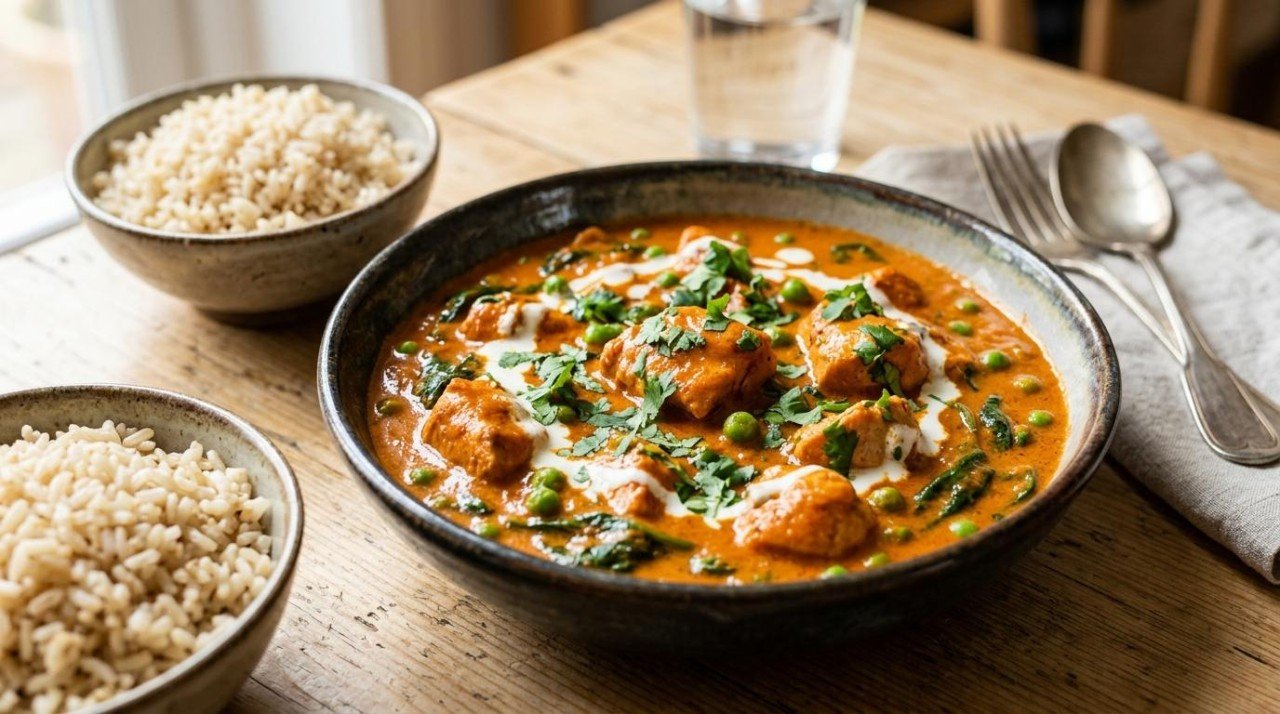
Butter chicken is one of those dishes that ruins you for the jarred sauce version forever. Tender spiced chicken in a tomato gravy so silky and rich it looks lacquered, the whole thing built on butter and cream and a spice blend that hums. It is widely credited to the kitchen of Moti Mahal in Delhi in the 1950s, where cooks reportedly rescued leftover tandoori chicken by simmering it in a buttery tomato gravy (makhani) so it would not dry out. That accident became one of the most-loved dishes on earth, and for good reason.
So this is not a post about how butter chicken is bad for you. It is beloved, and the version that made it famous earned every bit of that love. This is a post about what happens when you run a classic homemade butter chicken through our Nutrition Score and it comes back at 35 out of 100 — and then rebuild it, one verified swap at a time, into a version that scores 67 and still tastes like butter chicken. Same creamy makhani, same bold spice, nearly half the saturated fat, double the fiber. Here is every swap and exactly what it is worth.
The original: what is in it and how it scores
A standard homemade or restaurant-style butter chicken for four looks roughly like this: about 1.5 pounds of chicken thighs marinated in yogurt and spice, then simmered in a sauce of 3 tablespoons of butter, a full cup of heavy cream, a cup of tomato puree, onion, garlic, ginger, garam masala, cumin, turmeric, chili, a spoon of sugar, and a generous amount of salt. Serve it over a mound of white rice, the way almost everyone does.
Scored per serving against our default nutrition profile, that plate comes in at 35 out of 100. Here is what the score sees, per serving:
- 972 calories
- 21.2 g saturated fat — 90% of a day's worth in one meal, flagged "very high"
- 1,360 mg sodium — 59% of a day's worth, also flagged "very high"
- 3 g fiber — only 10% of the Daily Value
- 43 g protein — genuinely excellent, and worth saying out loud
Notice what is not the problem. This is not a protein-poor dish, and it is not drowning in added sugar (just 3 g a serving). The chicken is doing real work. What drags the score down is concentrated in two places: the saturated fat from a cup of cream plus butter, and the sodium from restaurant-level salting. The white rice is the third weak spot — not because rice is evil, but because a big pile of it adds calories and almost no fiber, so the whole plate lands at just 3 g. The dish also counts only about 3.5 different plants for the week, which matters for your gut (more on that below).
The good news buried in that diagnosis: the two big problems, saturated fat and sodium, are both fixable without touching the things that make butter chicken butter chicken. The spices stay. The tomato stays. The tenderness stays. We are going after the cream and the salt.
The upgrades
Four swaps, scored cumulatively in the order below. If you only make one, make the first — it fixes the dish's actual weak point and costs you almost nothing.
1. Rebuild the makhani with cashew cream
- Swap: 1 cup heavy cream + 3 tbsp butter → 1/3 cup cream + 1/3 cup blended cashews + 1.5 tbsp butter
- Score impact: +11 points (35 to 46)
- What it changes: Cuts saturated fat from 21.2 g to 11.8 g per serving — nearly in half — in one move
- What it costs you: Almost nothing. The sauce is arguably silkier, and cashews are traditional in plenty of authentic recipes anyway
This is the swap that matters. Butter chicken's whole nutrition problem lives in that cup of cream and the butter, which together supply nearly all of the saturated fat. The American Heart Association suggests keeping saturated fat under about 13 g a day; the original butter chicken hands you 21 g in a single serving, because saturated fat raises LDL cholesterol, the kind tied to heart disease.
Soak a third of a cup of raw cashews in hot water for 15 minutes, then blend them smooth with a third of a cup of cream (or water). That cashew cream does what the extra half-cup of heavy cream used to do — body, richness, that clingy texture — but the fat it brings is mostly unsaturated. Harvard's Nutrition Source notes that the unsaturated fat in nuts actually helps lower LDL and raise HDL, the opposite direction from cream, plus cashews add magnesium and a little fiber. You keep a third of a cup of real cream and 1.5 tablespoons of real butter, because a token amount of each is what makes the sauce taste like the restaurant instead of like a compromise. This is exactly the kind of trade our heavy cream substitutes and butter substitutes guides are built around: swap most of it, keep a little, lose nothing that matters.
2. Brown rice instead of white
- Swap: White rice → brown rice
- Score impact: +6 points (46 to 52)
- What it changes: More fiber, more magnesium, and a base that keeps you full longer
- What it costs you: A nuttier, chewier grain and a longer cook time — under a rich makhani, most people never look back
White rice is a blank canvas, which is exactly its weakness here: it adds calories and next to no fiber. Brown rice keeps the whole grain, which is where the fiber, the magnesium, and the slower-burning carbohydrate live. Under a sauce this bold you lose none of the comfort — the rice is a vehicle for the gravy either way. If brown rice is not your thing, our white rice substitutes guide has the full lineup, including quinoa (a complete protein) and the honest note on which swaps actually upgrade the meal versus just standing in for it.
3. Dial back the salt
- Swap: Restaurant-level salt → 1/2 teaspoon measured, plus no-salt-added tomato puree
- Score impact: +0 to the overall score — but sodium drops from about 940 mg to 560 mg per serving
- What it changes: Moves sodium out of the "very high" zone entirely
- What it costs you: Nothing you will taste, because the spices are carrying the flavor, not the salt
Here is a swap that is honest about itself: it barely moves the headline number. But it takes roughly 380 mg of sodium off your plate, and stacked with the other changes it more than halves the sodium of the original dish. The American Heart Association points out that cutting about 1,000 mg of sodium a day is enough to improve blood pressure for most people. The score cares about a lot of things at once, so one nutrient moving does not always swing the total — but your blood pressure is not scored on a curve. This one is worth doing even when the number shrugs. Because butter chicken is all garam masala, ginger, and chili, you can pull the salt way back and never notice; the spices were always the point.
4. Fill the plate with vegetables
- Swap: Add 5 oz spinach and 1 cup peas; shrink the rice from about 1 cup to 2/3 cup per serving
- Score impact: +15 points (52 to 67) — the single biggest jump in the whole makeover
- What it changes: Fiber jumps to 6.8 g, plant variety climbs, and the plate lights up with vitamin K, vitamin C, iron, and potassium
- What it costs you: Nothing structural — the curry is untouched. You are just building a better plate around it
This is the lesson hiding in the whole exercise: what is next to the curry moves the number as much as the curry itself. Wilt a couple of big handfuls of spinach into the sauce at the end (it melts in and barely changes the flavor) and stir in a cup of peas — a genuinely traditional move that home cooks have made for generations. Then swap a little of the rice mountain for those vegetables. That one change added more points than any single swap to the sauce, because it stacks fiber and a wall of micronutrients onto a plate that had almost none: this version is an excellent source of fiber, iron, magnesium, potassium, vitamin C, and vitamin K, where the original was mostly rice and cream.
It also roughly doubles the plant variety on the plate, which is its own kind of health win. Research from the American Gut Project found that people eating more than 30 different plant types a week had noticeably more diverse gut microbiomes than those eating 10 or fewer — the finding behind the "30 plants a week" idea. Spinach, peas, onion, garlic, ginger, tomato, cashews, brown rice: this single dinner now knocks out a real chunk of the week's variety.
Take the Guesswork Out of Eating Well
Eat Well Planner helps you organize your favorite recipes, plan balanced meals, and automatically generate shopping lists — all in one place. Whether you're tracking macros, managing dietary restrictions, or just trying to stop asking "what's for dinner?", we've got you covered.
Our AI-powered tools can adapt any recipe to your dietary needs, help you discover new meals you'll love, and even log your nutrition effortlessly. It's meal planning made simple.
Start Organizing Your Meals — FreeWhat we kept (on purpose)
A makeover that guts the dish is a failed makeover, so here is where we deliberately stopped. The butter and cream stayed — a third of a cup of real cream and 1.5 tablespoons of real butter — because the last little bit of dairy is what makes it read as butter chicken and not as tomato-cashew chicken. The chicken thighs stayed, even though leaner breast would score higher (more on that in a second), because thighs stay juicy in a sauce that gets reheated and never turn to string. The full spice load stayed, untouched — the garam masala, ginger, chili, and cumin are the soul of the dish, and they happen to be free of everything the score dislikes. And the yogurt marinade stayed, because it is traditional, it tenderizes the chicken, and it adds protein without adding fat. We changed what was dragging the dish down and left everything that made it worth eating.
The healthier version: full recipe
This is the version that scores 67 out of 100, up 32 points from where we started. It serves 4.
For the chicken and marinade:
- 1.5 lb boneless skinless chicken thighs, cut into large chunks
- 1/2 cup plain whole-milk yogurt
- 1 tbsp lemon juice
- 1/2 tbsp grated fresh ginger
- 2 cloves garlic, crushed
- 1 tsp garam masala
- 1/2 tsp ground turmeric
- 1/2 tsp ground cumin
- 1/2 tsp chili powder (Kashmiri, if you have it)
- 1/4 tsp salt
For the sauce:
- 1/3 cup raw cashews
- 1/3 cup heavy cream
- 1.5 tbsp butter, divided
- 1 medium onion, finely chopped
- 1 clove garlic, minced, plus 1/2 tbsp grated ginger
- 1 cup tomato puree (no salt added)
- 1 tsp garam masala
- 1/2 tsp ground turmeric
- 1/2 tsp ground cumin
- 1/2 tsp chili powder
- 1 tbsp sugar
- 1/4 tsp salt
- 5 oz baby spinach
- 1 cup peas (fresh or frozen)
To serve: about 2.5 cups cooked brown rice (roughly 3/4 cup dry)
- Combine all the marinade ingredients in a bowl, add the chicken, and turn to coat. Marinate at least 30 minutes, or overnight in the fridge.
- Cover the cashews with hot water and soak 15 minutes. Drain, then blend with the 1/3 cup cream (add a splash of water if needed) until completely smooth. Set this cashew cream aside.
- Start the brown rice cooking, since it takes the longest.
- Sear the marinated chicken in a hot skillet (or under the broiler) until it picks up some charred spots and is nearly cooked through. Set aside — it will finish in the sauce.
- Melt 1 tablespoon of the butter in a large skillet over medium heat. Add the onion and cook until soft and golden, about 6 minutes. Stir in the ginger, garlic, and the sauce spices, and cook 30 seconds until fragrant.
- Add the tomato puree, sugar, and salt. Simmer 8 to 10 minutes, until the sauce deepens in color and pulls together. For a restaurant-smooth texture, blend it and return it to the pan.
- Stir in the cashew cream, then add the chicken and any resting juices. Simmer 5 minutes. Add the spinach and peas and cook another 2 to 3 minutes, until the spinach wilts in and the peas are hot.
- Finish with the remaining 1/2 tablespoon of butter for gloss. Serve over the brown rice.
Per serving, original vs. this version:
- Nutrition Score: 35 → 67
- Calories: 972 → 864
- Saturated fat: 21.2 g → 12.0 g (about 43% less)
- Sodium: 1,360 mg → 600 mg (about 56% less)
- Fiber: 3.1 g → 6.8 g (more than double)
- Protein: 43.7 g → 46.8 g (slightly more)
- Plant variety: 3.5 → 7.5 different plants
Swaps we tested and skipped
Not every "healthier" idea earned a place, and the score is what told us so.
- Chicken breast instead of thighs. This one actually scores higher — 72 instead of 67, with less saturated fat and more protein. We kept thighs anyway, because in a sauce that gets simmered and reheated, breast dries out and thighs stay tender. If you want the extra points and you are careful not to overcook, breast is a completely legitimate choice — we are just being honest that it is a texture trade, not a free win.
- All cauliflower rice instead of brown rice. Swapping the entire rice base for cauliflower rice moved the score only 2 points, to 69, while turning a satisfying plate into a wetter, less filling one. Two points is not worth trading away the rice under butter chicken. If you want the middle ground, do half brown rice and half cauliflower rice — you get most of the calorie savings and still have real grains to soak up the sauce.
- Cutting the cream and butter entirely. Going all cashew cream with no dairy at all drops more saturated fat, but the sauce loses the specific tang and gloss that says "butter chicken," and can taste flat. The small amount of real cream and butter is punching above its weight. We left it in.
Make it fit other diets
The bones of this recipe flex easily:
- Dairy-free: Skip the yogurt marinade (use lemon juice and a spoon of oil to tenderize), go all cashew cream in place of the heavy cream, and use coconut oil instead of butter.
- Vegetarian: Swap the chicken for pan-seared paneer or a can of chickpeas — makhani gravy was made for both.
- Gluten-free: This dish is naturally gluten-free; just double-check your garam masala blend has no fillers.
You do not have to work these out by hand. In Eat Well Planner, the Recipe Variations tool and AI recipe chat can rewrite this exact recipe as dairy-free or vegetarian in one step, with the substitutions already worked into the ingredient list and method.
Do this to any recipe you love
Every number in this post came out of the app, not out of thin air. We imported a butter chicken recipe, let the Nutrition Score diagnose it, and used Make It Healthier to propose swaps — each one run through a calculator that verifies the real nutritional gain before it ever shows up as a suggestion. The per-swap deltas came from the Recipe Playground, where you can change one ingredient and watch the score move live, so you can see exactly what keeping the bacon, or the full cup of cream, actually costs you.
You can do the same thing to any recipe you love. Saw a butter chicken on Instagram or YouTube? Paste the link and Eat Well Planner imports it, scores it, and offers verified swaps before you cook it — so you keep the dish you love and quietly make the numbers better.