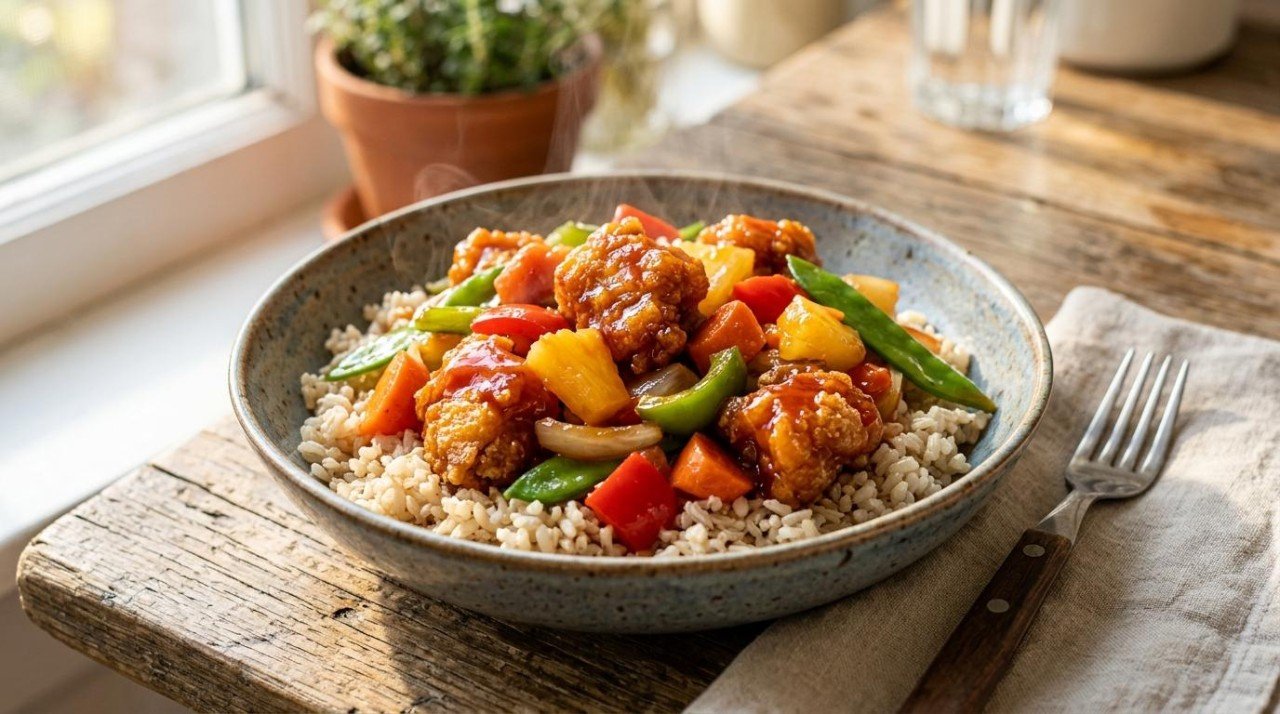
Sweet and sour chicken is the order you make when you want dinner to be fun. Craggy, crunchy nuggets of fried chicken, a glossy red-orange sauce that is somehow both candy-sweet and sharp, chunks of pineapple, a few bright pieces of pepper, all of it over rice. It is one of the most-ordered dishes in American Chinese restaurants for a reason, and nobody orders it expecting a salad.
The dish itself is much older and much less sugary than the takeout version. Sweet and sour cooking shows up in Chinese records as far back as the Tang dynasty, and the Cantonese ancestor of what we eat today got its color and its tang from vinegar, preserved plums, and hawthorn candy. Ketchup and canned pineapple are the American add-ons. So is the sugar.
We built a standard takeout-style version in Eat Well Planner and ran it through the app's Nutrition Score. It came back at 35 out of 100. Then we rebuilt it, one verified swap at a time, and landed at 73 - a 38-point jump - with the crunch and the sticky red sauce intact. The most useful thing we learned came early: we air-fried the original instead of deep-frying it, changed nothing else, and the score moved by exactly zero points.
The original: what's in it and how it scores
The version we scored is the one you know, serving four:
- 1 1/2 lb boneless skinless chicken breast, cut into chunks, dipped in egg and a 1/2 cup cornstarch plus 1/2 cup flour batter, then deep-fried (we scored 1/3 cup of oil absorbed, which is typical for battered chicken)
- A sauce of 1/2 cup granulated sugar, 1/2 cup ketchup, 1/4 cup rice vinegar, 2 tablespoons soy sauce, and 1/2 cup pineapple juice, thickened with a cornstarch slurry
- 1 green bell pepper, half an onion, and 1 cup pineapple chunks
- 4 cups cooked white rice
Nutrition Score: 35/100. Per serving, that works out to about 1,010 calories, 49 g protein, 2.4 g fiber, about 34 g of added sugar, and about 1,540 mg of sodium.
The added sugar is the headline, and it is not close. One serving carries more added sugar than the American Heart Association suggests for a whole day - about 24 g for women and 36 g for men. The app flagged it as "very high" at 130% of a day's allowance, the single biggest drag on the score. Most of it is the half cup of sugar (25 g per serving), but the ketchup is a quiet accomplice: ketchup is about 21% sugar by weight, so a half cup adds another 6 g per serving on its own.
Sodium is the second flag, at about two thirds of the 2,300 mg daily limit in one plate. That comes mostly from the soy sauce, the salt, and again the ketchup - a half cup carries roughly 1,100 mg before anything else is added.
The third problem is quieter: 2.4 g of fiber per serving, and vegetables that are basically a garnish. One bell pepper and half an onion split four ways is not a serving of vegetables, and the plate counts as just 3 plant points.
Now the part that is already fine, because manufacturing problems is how these posts go wrong. The protein is excellent at 49 g. Vitamin C is already at 81% of a day, courtesy of the pepper and the pineapple - sweet and sour chicken has more going for it than most takeout dishes. And saturated fat is a moderate 3.9 g, which brings us to the fryer.
Everyone's first instinct is to air-fry it. So we tested exactly that: same sauce, same rice, same everything, but a light cornstarch coating air-fried in 2 tablespoons of oil instead of a deep-fried batter. It cut about 190 calories a serving. The score went from 35 to 35. Not a single point. When one serving is carrying a full day of added sugar, the oil is not what is holding the number down.
The upgrades
We ordered these by what the score actually rewarded, and two things were off the table from the start: the crunchy coating and the sticky red sweet-tangy sauce. Lose either and you have made a chicken stir-fry, not sweet and sour chicken.
1. Rebuild the sauce on pineapple juice and tomato paste
- Swap: 1/2 cup sugar + 1/2 cup ketchup + 1/2 cup pineapple juice → 1 cup unsweetened pineapple juice, 2 tablespoons tomato paste, 1 tablespoon sugar, plus garlic and ginger
- Score impact: +20 points (35 to 55) - by far the biggest move in the post
- What it changes: Cuts added sugar from about 34 g to about 9 g per serving
- What it costs you: It is less candy-sweet and more fruity-tangy. This is the change you will actually taste
Ketchup is doing two jobs in the classic sauce: color and sweetness. Tomato paste does the color job better (it is more concentrated, so 2 tablespoons gives you a deeper red than a half cup of ketchup) and brings no sugar at all. The sweetness then comes from a full cup of unsweetened pineapple juice reduced down, which also tastes more like pineapple than sugar does. Garlic and ginger fill in the savory depth that all that sugar was papering over. Keep the rice vinegar exactly as it is - the "sour" half is the reason the dish works, and cutting the sugar without keeping the acid gives you a flat sauce. Our rice vinegar substitutes guide covers what to reach for if you are out.
About that one tablespoon of sugar: we tested 2 tablespoons and 1 tablespoon in the finished recipe, and the difference was 8 points (65 versus 73). We also tested zero, and it scored 73 - exactly the same as 1 tablespoon. So the tablespoon stays, because it earns its keep in the pan: sugar is what lets the sauce reduce into something glossy that clings to the chicken instead of pooling at the bottom of the bowl. If you would rather sweeten with honey or maple, our sugar substitutes guide covers how each behaves in a hot sauce.
2. Triple the vegetables
- Swap: 1 green bell pepper and half an onion → green and red bell pepper, a whole onion, 2 carrots, and 2 cups of snow peas
- Score impact: +9 points (55 to 64)
- What it changes: Nearly doubles the fiber (2.9 to 5.5 g) and takes vitamin C to 194% of a day
- What it costs you: Nothing. It is more food, not less
Takeout sweet and sour uses vegetables as decoration. Treat them as an ingredient instead and the plate changes character - the sauce has more to cling to, and every bite is not just chicken and rice. Carrots and snow peas belong here as much as peppers do, and they hold their bite. The technique that matters: cook them hot and fast in a dry-ish pan, peppers and onion first, carrots with them, snow peas in the last 60 seconds, so they stay snappy rather than stewing in the sauce.
This swap also took the plate from 3 plant points to 7.5. Eat Well Planner tracks those against the 30-different-plants-a-week target from gut microbiome research, which we wrote about in 30 plants a week - and a takeout night that quietly contributes seven of them is a good night.
3. Brown rice instead of white
- Swap: White rice → brown rice
- Score impact: +5 points (64 to 69)
- What it changes: Fiber up to 6.4 g per serving, plus magnesium and B vitamins that milling strips out
- What it costs you: A chewier, nuttier base - largely hidden under a sauce this assertive
Refining grain removes more than half of the B vitamins, 90% of the vitamin E, and virtually all of the fiber. The same page notes that swapping white rice for whole grains is associated with roughly a third lower risk of type 2 diabetes, which is a large return for a change you barely notice under sweet and sour sauce. If brown rice is not your thing, our white rice substitutes guide runs through the other whole grains that work in a saucy bowl.
4. Light cornstarch coating, air-fried or shallow-fried
- Swap: Egg-and-flour batter deep-fried → 1 egg and 1/3 cup cornstarch, air-fried or shallow-fried in 2 tablespoons of oil
- Score impact: +3 points (69 to 72)
- What it changes: Cuts about 190 calories, 12 g of total fat, and nearly half the saturated fat per serving
- What it costs you: A slightly less craggy shell - it is crisp rather than shatteringly crunchy
Here is the interesting part, and it is the reason we ran the tests in this order. This exact change, applied to the original recipe, was worth zero points. Applied here, after the sugar came out, it is worth 3. A nutrient-density score does not care much about 190 calories when the same serving is delivering a day's worth of added sugar; once that problem is gone, the calorie and fat savings actually show up. Swaps are not independent, which is why we score them cumulatively rather than adding up estimates.
Technique-wise, cornstarch on its own is the better coating for this method anyway. It has no gluten to toughen, it pulls surface moisture off the chicken, and it dries into a brittle, porous shell in dry heat - which is exactly what you want when there is no hot oil doing that work for you. Toss the chunks in beaten egg, then in cornstarch, shake off the excess, and give them room in the basket. Our cornstarch substitutes guide covers what else crisps if you are out of it.
5. Low-sodium soy sauce
- Swap: Regular soy sauce → low-sodium soy sauce
- Score impact: +1 point (72 to 73)
- What it changes: Sodium down from about 890 mg to about 720 mg per serving
- What it costs you: Nothing detectable in a sauce this tangy
A small point on the score, a real one for your blood pressure. Americans average about 3,400 mg of sodium a day against a 2,300 mg ceiling, and in the long-term TOHP trials, people who cut their sodium were 25% less likely to have a heart attack or stroke over the following 10 to 15 years. Low-sodium soy sauce tastes almost identical once it is in a garlicky, gingery, vinegary sauce. Our soy sauce substitutes guide has the full range, including coconut aminos.
Take the Guesswork Out of Eating Well
Eat Well Planner helps you organize your favorite recipes, plan balanced meals, and automatically generate shopping lists — all in one place. Whether you're tracking macros, managing dietary restrictions, or just trying to stop asking "what's for dinner?", we've got you covered.
Our AI-powered tools can adapt any recipe to your dietary needs, help you discover new meals you'll love, and even log your nutrition effortlessly. It's meal planning made simple.
Start Organizing Your Meals — FreeWhat we kept (on purpose), and where we stopped
The crunchy coating stays. We tested skipping it entirely - plain chicken chunks stir-fried and sauced - and it scored 79, six points higher than our final version. It is also not sweet and sour chicken anymore. That crunch, going soft where the sauce hits it, is the whole point of the dish, and six points is not worth trading it for.
The tablespoon of sugar stays, because removing it gained us nothing at all (73 either way) and cost us the gloss. The chicken breast stays too: we tried thighs, which score better in some dishes, and here it dropped six points to 67 without making the dish better. And the real pineapple stays - it was never the problem. Fruit sugar in whole pineapple chunks is a rounding error next to a half cup of table sugar.
We stopped at 73 because the flags that remain are not fixable by a chicken-and-rice plate: low omega-3 EPA and DHA, low vitamin D, low calcium. Added sugar and sodium have both dropped out of the "very high" band. If you want one more lever, swapping the brown rice for cauliflower rice scored 75 and about 610 calories - a genuine improvement, but it turns a rice plate into a lower-carb stir-fry bowl, so we left it as your call.
The healthier version: full recipe
Final Nutrition Score: 73/100. Serves 4.
For the chicken
- 1 1/2 lb boneless skinless chicken breast, cut into 1-inch chunks
- 1 large egg, beaten
- 1/3 cup cornstarch
- 1/2 teaspoon salt and black pepper
- 2 tablespoons neutral oil (or cooking spray, if air-frying)
For the sauce
- 1 cup unsweetened pineapple juice
- 2 tablespoons tomato paste
- 1/4 cup rice vinegar
- 2 tablespoons low-sodium soy sauce
- 1 tablespoon granulated sugar
- 3 cloves garlic, minced
- 1 tablespoon grated fresh ginger
- 2 tablespoons cornstarch mixed with 2 tablespoons cold water
For the rest
- 1 large green bell pepper, cut into 1-inch pieces
- 1 large red bell pepper, cut into 1-inch pieces
- 1 large onion, cut into wedges
- 2 medium carrots, sliced on the diagonal
- 2 cups snow peas
- 1 cup pineapple chunks (fresh, or canned in juice and drained)
- 3 1/2 cups cooked brown rice
- Start the brown rice cooking. Whisk the sauce ingredients except the cornstarch slurry together in a bowl and set aside.
- Season the chicken with the salt and pepper. Toss it in the beaten egg, then in the cornstarch until every piece is coated, shaking off the excess.
- Air-fry at 400°F for 12 to 15 minutes, shaking the basket halfway, until golden and cooked through (165°F). Or shallow-fry in the 2 tablespoons of oil in a wide skillet over medium-high heat, turning once, about 6 to 8 minutes total. Set the chicken aside on a rack, not a plate, so it stays crisp.
- In the same skillet over high heat, cook the onion, peppers, and carrots for 3 to 4 minutes, until they are blistered in spots but still firm. Add the snow peas and pineapple and cook 1 minute more.
- Pour in the sauce and bring it to a simmer. Stir in the cornstarch slurry and cook 1 to 2 minutes, until it turns glossy and thick enough to coat a spoon.
- Add the chicken back in, toss quickly to coat, and serve immediately over the brown rice. Sauce it just before it hits the table - the longer the coating sits in sauce, the softer it gets.
One note if you are using fresh pineapple: its juice contains bromelain, an enzyme that breaks down protein, so do not use it as a marinade for the chicken or the texture turns mushy. Cooked into the sauce it is harmless - heat deactivates it.
Per serving, original vs. improved:
- Nutrition Score: 35 → 73
- Calories: about 1,010 → about 770
- Added sugar: about 34 g → about 9 g
- Sodium: about 1,540 mg → about 720 mg
- Fiber: about 2.4 g → about 6 g
- Total fat: about 24 g → about 14 g
- Saturated fat: about 3.9 g → about 2.4 g
- Protein: about 49 g → about 48 g
- Vitamin C: 81% of a day → 194%
- Plant points: 3 → 8.5
Swaps we tested and skipped
- Two tablespoons of sugar instead of one. Scored 65 - eight points lower than the same recipe with one tablespoon. A single tablespoon across four servings turned out to be the difference between a good score and a mediocre one, which is not what we expected going in.
- Adding cashews. A handful of cashews is a common "healthy upgrade" for stir-fries. Here it scored 73 - identical - while adding about 57 calories a serving. Add them if you like cashews, but not for the nutrition.
- Chicken thighs instead of breast. Dropped six points to 67. Thighs are the right call in some dishes; in this one, breast chunks are both traditional and the better number.
- Cauliflower rice. Scored 75, two points up, and cut about 160 calories - but it stops being a rice plate. Worth it if that is the meal you want, not a swap we would make by default.
Make it fit other diets
This one adapts easily. For gluten-free, the coating is already pure cornstarch - just use tamari or a certified gluten-free soy sauce (or coconut aminos) in the sauce. For a vegetarian version, extra-firm tofu pressed and cut into cubes takes the same cornstarch coating and the same air-fry, and roasted cauliflower florets work too. In Eat Well Planner, you can ask the AI to rewrite this exact recipe for any of those in one step and it hands back the full version with the substitutions already worked in - then score it to see where it landed.
Do this to any recipe you love
Every number here came out of Eat Well Planner's Make It Healthier tool and Recipe Playground, not out of thin air. Import a recipe from any website, Instagram reel, or YouTube video - or the takeout copycat you have been cooking for years - and the app scores it, tells you plainly what is dragging the number down, and proposes swaps with a calculator verifying the real gain before you ever see the suggestion. In the Playground you can test changes one at a time and watch the score move, which is exactly how we found out that air-frying this dish was worth nothing on its own and 3 points after the sauce was fixed.
That is the argument for scoring your own food rather than guessing at it. The change everybody recommends for sweet and sour chicken did nothing. The one nobody mentions - putting down the ketchup bottle - was worth 20 points.