Honest part first: a sugar cookie is butter, sugar, and flour, more or less by definition. It's the cookie you roll out with kids, cut into stars, and decorate until the kitchen table is a crime scene of sprinkles. We're not trying to turn it into a granola bar.
But we wanted to know where the numbers actually come from, so we built a classic cut-out sugar cookie with royal icing in Eat Well Planner and ran it through the app's Nutrition Score. It came back at 11 out of 100, the lowest score this series has ever recorded, lower even than the chocolate chip cookie (18). Then we rebuilt it one verified swap at a time and got it to 36.
That's 25 points, and it's still a 36. We'll show you exactly where the ceiling is, every swap and what it was worth, and the swaps that scored higher that we turned down anyway.
The original: what's in it and how it scores
We scored the standard cut-out recipe that most holiday bakers use some version of: 2 1/4 cups all-purpose flour, 3/4 cup butter, 3/4 cup granulated sugar, 1 egg, 2 teaspoons vanilla, a little baking powder and salt, rolled 1/4 inch thick and cut into 24 three-inch cookies. On top: a full batch of royal icing (4 cups powdered sugar whipped with egg whites), the amount you need to outline and flood 24 cookies, plus a scattering of sprinkles. Every number below is for one decorated cookie.
Nutrition Score: 11/100. Per cookie: about 209 calories, 2.3 g protein, 0.3 g fiber, 3.5 g saturated fat, 80 mg sodium, and the number that sinks it: 27.3 g of added sugar. The app flagged that as 103% of its daily added-sugar reference, in one cookie. Even against the FDA's more generous label standard, a Daily Value of 50 g of added sugars, one cookie uses up more than half the day.
Where that sugar lives is the key to the whole makeover. The dough itself carries only about 6 g per cookie. The royal icing and sprinkles bring the other 21 g, roughly three quarters of it. The app's other two weaknesses were zero plant diversity and low vitamin E, which is a polite way of saying the flour isn't doing anything for you either.
What's not the problem: the sodium is low, the saturated fat is moderate for a butter cookie, and every ingredient is real food. It's just almost all sugar and white flour.
The upgrades
We applied these in order and re-scored after each one, so every number is what that swap was worth at that point in the build. Then we put each swap back into the finished recipe one at a time to see what it costs to skip it, which tells you which changes are actually carrying the cookie.
1. Whole wheat pastry flour instead of all-purpose
- Swap: 2 1/4 cups all-purpose flour → the same weight (281 g) of whole wheat pastry flour
- Score impact: +8 points (11 to 19). In the finished recipe, switching back to all-purpose costs 10 points, the single most expensive thing you could undo.
- What it changes: Fiber goes from 0.3 g to 1.5 g per cookie, and the cookie gets its first plant point
- What it costs you: A slightly toasty, nutty flavor and a more tender, less snappy bite
The flour is the biggest ingredient in a sugar cookie, and right now it contributes starch and nothing else, which matters when only 5% of American men and 9% of women get the recommended amount of fiber. But the type of whole wheat matters a lot here. King Arthur tested 100% white whole wheat in roll-out sugar cookies and found "some definite grit," noting that plain, crisp cookies with no chips or oats to hide behind are where whole wheat shows the most. Their fix was a 50/50 blend.
Whole wheat pastry flour is a different animal. It's milled from soft white wheat, which is considerably lower in protein and gluten than hard wheat, and it's ground fine. That's why it makes a tender cookie instead of a gritty one. Weigh it if you can (cup weights vary a lot between brands), chill the dough so the bran hydrates, and roll it a true 1/4 inch thick. If your family is suspicious, go half and half: in our build, the 50/50 version scored 31 instead of 36, which is still 20 points better than where we started. (Our all-purpose flour substitutes guide covers the other options.)
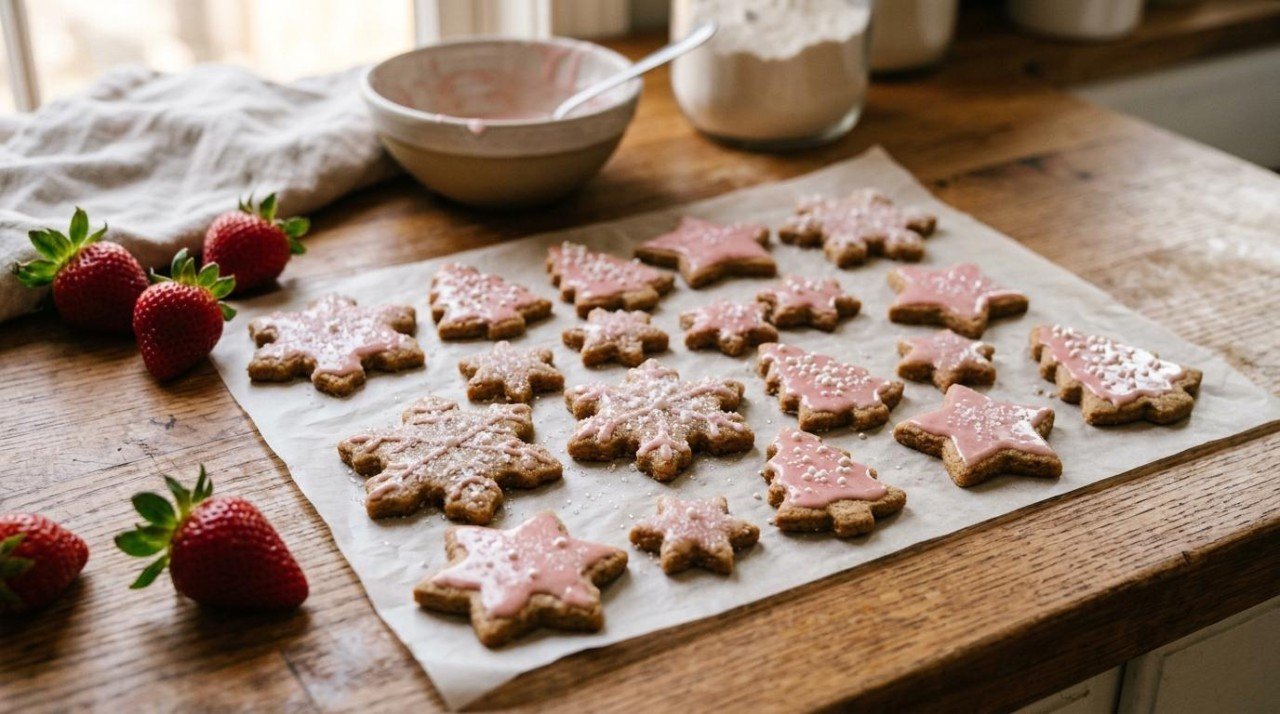
2. A thin strawberry glaze instead of royal icing and sprinkles
- Swap: Royal icing (4 cups powdered sugar + egg whites) and sprinkles → a thin glaze of 1 cup powdered sugar, ground freeze-dried strawberries, and 2 tablespoons milk
- Score impact: +12 points (19 to 31), the biggest single move in the makeover. Putting the royal icing back on the finished cookie costs 11 points.
- What it changes: Added sugar drops from 27.3 g to 11.2 g per cookie, and calories from 206 to 143
- What it costs you: The intricate piped designs. A glaze is for dipping and swooping, not for outlining snowflakes.
This is the real cost of the makeover. Royal icing lets you pipe a perfect outline, flood it smooth, and stack the cookies once they dry rock-hard. A thin glaze dries to the touch and stacks gently once set, but it's a soft, translucent coat, not a decorating canvas. What you keep: a shiny, pink-topped cookie kids can dip themselves, which is usually the part they enjoy most anyway.
Four cups of powdered sugar becomes one, and that alone cuts 16 g of added sugar from every cookie. The freeze-dried strawberries are there for color and flavor: grind them to a powder and they tint the glaze pink without any food dye and give it a real berry tang, so the cookie tastes like more than sugar. On the score they were worth a point at the end (a plain milk glaze scored 35), so skip them if you want white cookies. And don't swap in buttercream thinking it's the softer option. A soft-frosted, bakery-style buttercream topping on the finished cookie scored 24, worse than royal icing, because it adds saturated fat on top of the sugar. (Our powdered sugar guide covers alternatives if you run out.)
3. Cut the sugar in the dough by a third
- Swap: 3/4 cup granulated sugar → 1/2 cup
- Score impact: +2 points (31 to 33)
- What it changes: Added sugar from 11.2 g to 9.2 g per cookie
- What it costs you: Next to nothing once the cookie is glazed, and it actually helps the cut-outs hold their shape
On the original cookie this swap was worth just 1 point, because the icing dwarfed it. Once the icing is fixed, the dough's sugar is a bigger share of what's left. Less sugar also means a little less spread, which is a bonus for cut-outs: sharper edges on your stars and trees. We tested cutting the sugar in half too. That earned one more point (37) but made the plain cookie taste flat and pale. With a glaze on top a third is plenty. (Our white sugar guide covers swapping rather than cutting.)
4. Add 2 tablespoons of ground flaxseed
- Swap: Nothing → 2 tablespoons (14 g) ground golden flaxseed, whisked into the flour
- Score impact: +3 points (33 to 36)
- What it changes: Fiber up to 1.8 g per cookie, a third plant point, and omega-3 ALA, which the app now lists among the cookie's strengths
- What it costs you: Nothing you'll notice. Golden flax disappears into a whole wheat dough. Brown flax shows up as tiny dark flecks.
Two tablespoons across 24 cookies doesn't change the texture, and it was worth more than the sugar cut. Use it ground (whole seeds tend to pass straight through you). On the original cookie, flax alone was worth 5 points. We also tried swapping 1/2 cup of the flour for almond flour at this step. That was worth 1 point, not 3, and it costs more.
What we kept (on purpose)
All of the butter. We tested swapping a third of it for canola oil. It cut saturated fat from 3.4 g to 2.4 g per cookie, and in the finished recipe it scored exactly the same: 36 either way. Zero points for a cookie that spreads more, holds its shape worse, and loses the flavor that makes a sugar cookie taste like one. Easy call. (If you're curious anyway, our butter substitutes guide covers what works where.)
The egg, the vanilla, the rolling and cutting, and the glaze itself. A plain, undecorated cookie scored 39, 3 points higher than ours. We still think decorating is the whole point of a holiday sugar cookie.
Where we stopped: at 36, the app still flags the cookie for high added sugar, at 9.2 g each. Even the plain, unglazed version (4.2 g) still carries that flag, and the only way past it is a dough with so little sugar it tastes like a scone. That's the ceiling: 36 is about as good as a sugar cookie can score while still being a sugar cookie, and we'd rather tell you that than sell you a "healthy" sugar cookie that nobody wants a second of.
Take the Guesswork Out of Eating Well
Eat Well Planner helps you organize your favorite recipes, plan balanced meals, and automatically generate shopping lists — all in one place. Whether you're tracking macros, managing dietary restrictions, or just trying to stop asking "what's for dinner?", we've got you covered.
Our AI-powered tools can adapt any recipe to your dietary needs, help you discover new meals you'll love, and even log your nutrition effortlessly. It's meal planning made simple.
Start Organizing Your Meals — FreeThe healthier version: full recipe
Nutrition Score: 36/100 (up from 11). Makes 24 three-inch cookies.
Cookies:
- 2 1/2 cups (281 g) whole wheat pastry flour (weigh it if you can)
- 2 tablespoons (14 g) ground golden flaxseed
- 1/2 teaspoon baking powder
- 1/4 teaspoon salt
- 3/4 cup (170 g) butter, softened
- 1/2 cup (100 g) granulated sugar
- 1 large egg
- 2 teaspoons vanilla extract
Strawberry glaze:
- 1/2 cup (15 g) freeze-dried strawberries
- 1 cup (120 g) powdered sugar
- 2 tablespoons milk, plus more by the 1/2 teaspoon as needed
- Whisk together the whole wheat pastry flour, ground flaxseed, baking powder, and salt in a bowl and set it aside.
- Beat the softened butter and sugar together until light and creamy, about 2 minutes. Beat in the egg and vanilla until smooth.
- Add the dry ingredients and mix on low just until the dough comes together.
- Divide the dough in half. Roll each half between two sheets of parchment to an even 1/4 inch thick, stack the sheets on a baking sheet, and chill for at least 1 hour (or up to 2 days). Chilling firms the butter and gives the bran time to soften.
- Heat the oven to 350F and line two baking sheets with parchment. Cut out shapes, transfer them to the sheets about 1 inch apart, and re-roll the scraps once.
- Bake for 9 to 11 minutes, until the edges are just set and the bottoms are lightly golden. Cool on the sheet for 5 minutes, then on a rack until completely cool.
- For the glaze, grind the freeze-dried strawberries to a fine powder in a blender or spice grinder and sift out the seeds. Whisk the powder with the powdered sugar and milk until thick but pourable, like warm honey, adding milk a little at a time if needed.
- Dip the top of each cookie in the glaze or spread it thin with the back of a spoon. Let the cookies set at room temperature for 2 to 3 hours before stacking.
Per cookie, original vs. healthier:
- Nutrition Score: 11 → 36
- Calories: 209 → 138
- Added sugar: 27.3 g → 9.2 g
- Fiber: 0.3 g → 1.8 g
- Saturated fat: 3.5 g → 3.4 g
- Protein: 2.3 g → 1.6 g (the royal icing's egg whites are gone, and pastry flour is lower in protein)
- Sodium: 80 mg → 70 mg
- Plant points: 0 → 3
Swaps we tested and skipped
- Smaller cookies (+0). The same batch cut into 36 cookies instead of 24 scored exactly 36 again. The score measures what each bite is made of, so a smaller cookie is the same cookie with fewer calories (92 instead of 138). Cut them small if you want to eat less per cookie, but it doesn't make the recipe any healthier.
- Greek yogurt frosting (+0). The swap every healthy-cookie article suggests: Greek yogurt, a little cream cheese, and powdered sugar. With the same 1 cup of powdered sugar as the glaze, it scored 36, exactly the same, while adding saturated fat. And it never sets, so you can't stack, gift, or leave the cookies out on a platter. All the hassle, none of the points.
- No topping at all (+3). A plain cookie scored 39. It's a perfectly good cookie, and if your family is happy with plain cut-outs, take the three points. We think the topping is the point.
One swap we didn't skip, but it's optional: dip half of each cookie in 4 ounces of melted 70% dark chocolate instead of glazing it. That version scored 39, 3 points over the glaze. It has less added sugar (5.3 g per cookie) and a little more fiber, though more saturated fat. It's a more grown-up cookie, and a great one for a gift tin.
And if you want the biggest jump of all, change what's next to the cookie, not the cookie itself. Serving each cookie with a few fresh strawberries (about 50 g) took the plate to 42. It's the same lesson we found with the lava cake: when a dessert hits its ceiling, the fruit on the plate does more than anything you can do to the batter.
Make it fit other diets
- Dairy-free: Use a stick-style plant butter (not a tub spread, which is too soft for cut-outs) and make the glaze with water or oat milk.
- Gluten-free: A 1:1 gluten-free baking blend works in cut-outs, but you lose the whole grain fiber, which was this recipe's biggest win. Keep the flaxseed to claw some back.
- Egg-free: Replace the egg with a flax egg (1 more tablespoon ground flaxseed + 3 tablespoons water, rested 5 minutes). The dough will be a little more fragile, so roll it cold.
Or import this recipe into Eat Well Planner and ask Recipe Variations to make it vegan or gluten-free. It rewrites the whole recipe with the swaps already worked in.
Do this to any holiday recipe
Every number in this post came from the same tools you can use on your own recipes. Import your family's cookie recipe from a website, an Instagram reel, or a YouTube video, and Eat Well Planner gives it a Nutrition Score. Tap Make It Healthier, and it proposes swaps like these, with each gain checked by a calculator before you see it. Want to keep the royal icing for the cookie exchange? Open the recipe in the Playground, put it back, and see exactly what it costs, then decide where to make it up. That's how we got from 11 to 36 without baking a single sad cookie.