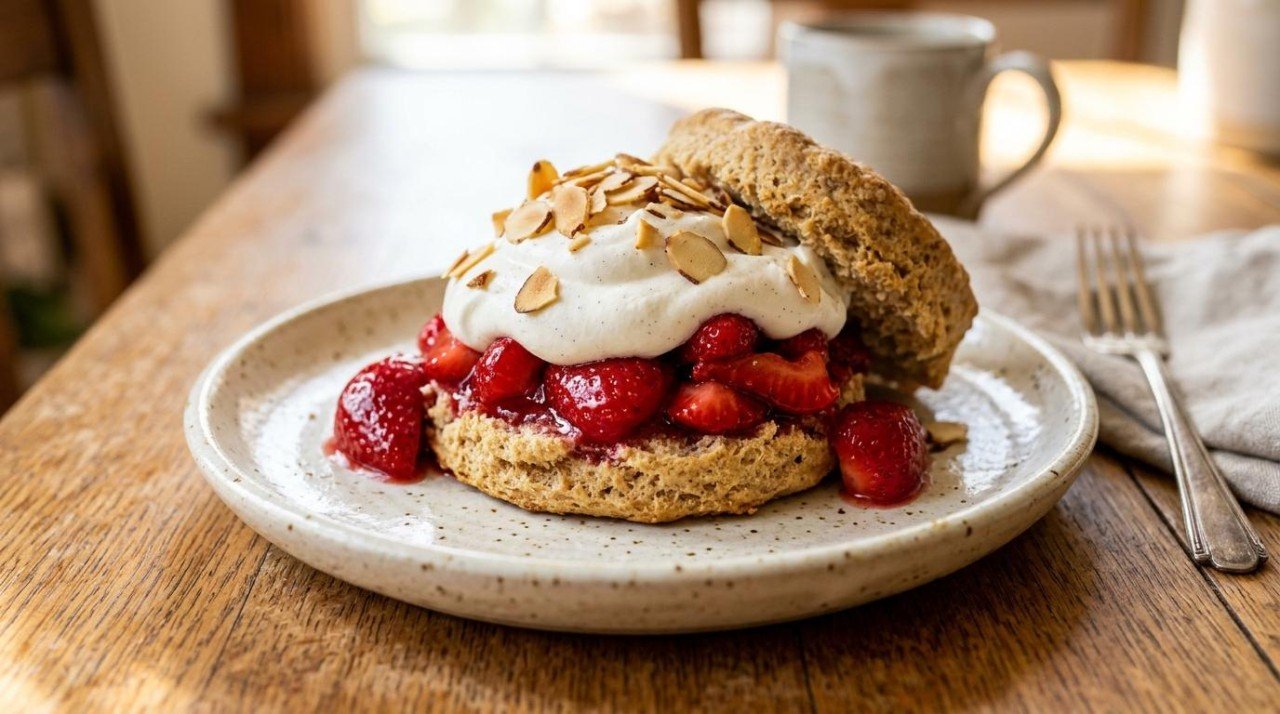
Strawberry shortcake is the dessert that tells you summer has arrived. A warm, split biscuit, a big spoonful of juicy sugared berries, and a cloud of whipped cream melting into all of it. It's simple, it's seasonal, and most of what's on the plate is fruit.
That last part is why we expected it to score well. We ran a classic version through the app's Nutrition Score and it came back at 31 out of 100. Better than most desserts we've scored, but not by much. Then we rebuilt it one swap at a time, scoring every change against the same production nutrition data, and finished at 58: 27 points higher, with about a quarter of the added sugar, 40 percent less saturated fat, and nearly twice the fiber.
It's still strawberry shortcake. Real butter biscuits, real whipped cream, and more strawberries than before. The surprise is where the points came from. We went in planning to add even more fruit. The numbers said the berries were already doing their job, and the real problem was the biscuit.
The classic strawberry shortcake: what is in it, and why it scores 31
We scored King Arthur Baking's strawberry shortcake, a well-loved version that makes 9 generous biscuits. We used the buttermilk option the recipe offers in place of its buttermilk powder and milk:
- Berries: 2 quarts of strawberries, macerated with 1/2 cup sugar and a little lemon juice
- Biscuits: 3 1/2 cups all-purpose flour, 8 tablespoons butter, 3 tablespoons sugar (plus a sprinkle on top), an egg, a cup of buttermilk, baking powder, baking soda, a teaspoon of salt, and vanilla
- Topping: 1 cup heavy cream, whipped
That scores 31 out of 100. Here is what pulls it down, per serving:
- Added sugar: 15.8 g. About a third of the FDA's 50 g Daily Value for added sugars. Two-thirds of it is the half cup of sugar poured over the berries. The rest is in the biscuits.
- Saturated fat: 12.2 g. That's 61 percent of the 20 g Daily Value, in one dessert. The stick of butter in the biscuits brings a little more of it than the cup of cream on top.
- Sodium: 490 mg. More than you'd guess from a dessert. Biscuits get it from three places: salt, baking powder, and baking soda.
- Refined flour. All 3 1/2 cups are white flour, which is the biggest single ingredient in the recipe after the berries.
Now the part that is already fine. Each serving gets about 150 g of strawberries, and those berries are why this scores 31 instead of the low 20s we saw for tres leches. One serving is already an excellent source of vitamin C, with 3.9 g of fiber. Scored alone, plain strawberries get a 91. The fruit isn't the problem here. Everything around it is.
The upgrades
We applied these in order and re-scored after each one, so each point value is what that change was worth at that stage of the build. The seven deltas add up exactly to the 27-point total.
One pattern to know before you start: on the original recipe, every single swap was worth between 0 and 7 points. Most of the gains only showed up once the sugar and fat flags had been dealt with. A change that looks small on its own can be worth a lot more at the end, so the order below matters.
1. Half whole wheat pastry flour in the biscuits (+7 points)
- Swap: 3 1/2 cups all-purpose flour → 1 3/4 cups all-purpose + 1 3/4 cups whole wheat pastry flour
- Score impact: +7 points (31 to 38), the biggest single move
- What it changes: Fiber goes from 3.9 g to 6.4 g per serving, plus more potassium and a second plant
- What it costs you: A slightly tan, nuttier biscuit, which goes well with berries and cream
The biscuit is the biggest thing on the plate after the fruit, so this is where the most points were. Whole wheat pastry flour is milled from soft wheat, with less protein than regular whole wheat flour, so it stays tender in baking. Pastry chef Fran Costigan makes most of her cakes with a 50/50 mix of all-purpose and whole wheat pastry flour, and the same split works here. Refining wheat strips out the bran and germ, which, as Harvard's Nutrition Source puts it, removes "virtually all of the fiber." More ideas in our all-purpose flour substitutes guide.
Putting the white flour back into the finished recipe cost 6 points. (One note: the catalog's whole wheat pastry flour entry runs a little high on fiber, so read the fiber number as close to the top of the real range.)
2. Lighter topping: a little cream, a lot of Greek yogurt (+4 points)
- Swap: 1 cup heavy cream, whipped → 1/3 cup heavy cream whipped to firm peaks, with 1 cup plain nonfat Greek yogurt folded in
- Score impact: +4 points (38 to 42)
- What it changes: Saturated fat drops from 12.3 g to 8.7 g per serving, and protein goes up by 2 g
- What it costs you: A gentle tang and a softer topping. It spoons well but won't pipe
Whip the cream first, then fold in the yogurt gently so you keep the air. The cream keeps it light and the yogurt gives it body, a bit like a cross between whipped cream and cheesecake filling. The tang works especially well against sweet berries. See our heavy cream and Greek yogurt guides for more ways to use each.
This swap looks modest here, but going back to the full cup of whipped cream on the finished recipe cost 10 points (58 to 48). The cream was one of the main things holding the saturated fat flag in place.
3. Two tablespoons of sugar on the berries, not half a cup (+2 points)
- Swap: 1/2 cup sugar → 2 tablespoons sugar, plus the same lemon juice
- Score impact: +2 points (42 to 44)
- What it changes: Added sugar is cut in half, from 15.8 g to 7.6 g per serving, and the "High Added Sugar" flag clears
- What it costs you: A little less syrup in the bowl. Ripe berries still release plenty of juice
Only 2 points here, but this is the one we'd least want you to skip. When we put the half cup back at the end, the score dropped by 14 points, the biggest drop we measured. Sugar pulls juice out of cut strawberries, which is what makes the syrupy sauce. Two tablespoons still does that. It just takes a bit longer, so give the berries 30 minutes to an hour. Mashing a quarter of them with a fork, as the King Arthur recipe does, makes the sauce fast. The riper your berries, the less sugar they need, which is why in-season strawberries matter here. Our white sugar guide covers other options.
4. One tablespoon of sugar in the biscuits (+4 points)
- Swap: 3 tablespoons sugar in the dough + 2 teaspoons on top → 2 teaspoons in the dough + 1 teaspoon on top
- Score impact: +4 points (44 to 48)
- What it changes: Added sugar drops from 7.6 g to 4.2 g per serving, about a quarter of the original
- What it costs you: A biscuit that tastes more like a biscuit, which it should. The berries bring the sweetness
Worth keeping the sprinkle on top: a teaspoon of sugar over the brushed tops still gives you that crackly, golden crust, and that's where you actually taste it.
5. Six tablespoons of butter instead of eight (+4 points)
- Swap: 8 tablespoons (113 g) cold butter → 6 tablespoons (85 g)
- Score impact: +4 points (48 to 52)
- What it changes: Saturated fat drops from 8.7 g to 7.1 g per serving, and the "High Saturated Fats" weakness clears
- What it costs you: A slightly less rich biscuit. It still has flaky layers
Cold pieces of butter are what make a biscuit flaky. They melt in the oven, release steam, and push the dough into layers. So the butter stays real, and it stays cold. We just use a bit less. Keep it in the fridge until the second you need it, and stop cutting it in when the pieces are about the size of peas. Putting the full stick back at the end cost 6 points. More in our butter guide.
6. Half the salt (+4 points)
- Swap: 1 teaspoon table salt → 1/2 teaspoon
- Score impact: +4 points (52 to 56)
- What it changes: Sodium drops from 490 mg to 370 mg per serving
- What it costs you: Nothing you'll notice under berries and cream
On the original recipe, this exact change was worth 0 points. With the sugar and fat flags gone, it's worth 4. That's the pattern from earlier: the score can only reward the sodium cut once the bigger problems are out of the way. The baking powder and baking soda stay. They're doing the lifting, and they bring most of the remaining sodium. (We also tried no salt at all, and it scored the same 58, so half a teaspoon is free.)
7. More strawberries (+2 points)
- Swap: 2 quarts strawberries → 2 1/2 quarts
- Score impact: +2 points (56 to 58)
- What it changes: More vitamin C, potassium, and fiber per serving
- What it costs you: Another pint of berries, and a bigger, prettier pile on every plate
This was supposed to be the big one. In other dessert makeovers, adding fruit was the most powerful single change. Not here, because this recipe was already built around fruit. Another 25 percent more strawberries is a small, nice extra. The real lesson is that the berries were never the problem.
What we kept (on purpose)
Real butter stays in the biscuits, and real whipped cream stays on top. The egg stays, because it makes these tender and rich, closer to a shortcake than a dinner biscuit. The buttermilk, baking powder, and baking soda stay, because that's what gives you a tall rise. And it's still a big, generous serving. Splitting the batch into smaller biscuits wouldn't raise the score anyway, since it rates what's in each bite, not the size of the plate.
Our finished version is still flagged for high saturated fat in the app's cautions, at about 30 percent of the Daily Value. We stopped there because the next cuts would change the biscuit into something else (see the skipped swaps below).
Take the Guesswork Out of Eating Well
Eat Well Planner helps you organize your favorite recipes, plan balanced meals, and automatically generate shopping lists — all in one place. Whether you're tracking macros, managing dietary restrictions, or just trying to stop asking "what's for dinner?", we've got you covered.
Our AI-powered tools can adapt any recipe to your dietary needs, help you discover new meals you'll love, and even log your nutrition effortlessly. It's meal planning made simple.
Start Organizing Your Meals — FreeThe healthier strawberry shortcake: full recipe
This version scores 58 out of 100, up from 31. Makes 9 shortcakes.
For the berries:
- 2 1/2 quarts (about 1,670 g) strawberries, hulled
- 2 tablespoons (25 g) granulated sugar
- 2 teaspoons lemon juice
For the biscuits:
- 1 3/4 cups (210 g) all-purpose flour
- 1 3/4 cups (210 g) whole wheat pastry flour
- 1 tablespoon (11 g) baking powder
- 1/2 teaspoon baking soda
- 1/2 teaspoon table salt
- 2 teaspoons granulated sugar, plus 1 teaspoon for sprinkling
- 6 tablespoons (85 g) cold unsalted butter, cut into small cubes
- 1 large egg
- 1 cup buttermilk, plus a little for brushing
- 2 teaspoons vanilla extract
For the topping:
- 1/3 cup (80 ml) cold heavy cream
- 1 cup (227 g) plain nonfat Greek yogurt
- Slice the strawberries into a large bowl, then mash about a quarter of them with a fork. Stir in the sugar and lemon juice. Let them sit at room temperature for 30 minutes to an hour, stirring once or twice, until they're sitting in their own syrup.
- Heat the oven to 425°F and line a baking sheet with parchment.
- In a large bowl, whisk together both flours, the baking powder, baking soda, salt, and 2 teaspoons of sugar. Add the cold butter and work it in with your fingertips or a pastry cutter until the biggest pieces are about the size of peas.
- In a measuring cup, whisk the egg, buttermilk, and vanilla. Pour it into the flour mixture and stir just until the dough comes together. It should be shaggy, not smooth.
- Turn the dough out onto a floured counter and pat it into a rectangle about 1 inch thick. Cut it into 9 squares (no scraps to re-roll), or use a round cutter and gently press the scraps together for the last biscuits. Place them on the baking sheet.
- Brush the tops with a little buttermilk and sprinkle with the remaining teaspoon of sugar. Bake for 12 to 15 minutes, until golden brown on top. Let them cool for at least 10 minutes.
- While the biscuits cool, whip the cream to firm peaks. Gently fold in the Greek yogurt until smooth.
- To serve, split each biscuit in half. Spoon berries and their juice over the bottom half, add a spoonful of topping, put the top half on, and finish with more berries and topping.
Per serving, original vs. healthier:
- Nutrition Score: 31 → 58
- Calories: 487 → 380
- Added sugar: 15.8 g → 4.2 g
- Saturated fat: 12.2 g → 7.1 g
- Fiber: 3.9 g → 7.0 g
- Protein: 9.3 g → 10.9 g
- Sodium: 490 mg → 370 mg
- Potassium: 380 mg → 520 mg
Seven grams of fiber is about a quarter of the 28 g Daily Value, which is a lot for a dessert. And at 124 percent of the vitamin C Daily Value per serving, it's an excellent source of vitamin C.
Swaps we tested and skipped
All of these were scored on the finished recipe:
- All Greek yogurt on top, no cream: +9. A 67, the biggest gain we found. But yogurt alone doesn't whip, so you lose the cloud of whipped cream, and that's half of what makes shortcake shortcake. One third of a cup of cream is a small price.
- 4 tablespoons butter + 2 tablespoons canola oil: +8. A 66. Oil makes a tender, cakey biscuit, but it can't make flaky layers the way cold butter does. If you like a softer, more cake-like shortcake, this is a fair choice. We kept the flaky one.
- 5 tablespoons butter: +4. A 62. Each tablespoon less makes the biscuit leaner and less flaky, and with half whole wheat flour, 6 felt like the right stopping point.
- 100% whole wheat pastry flour: +2. A 60, but a denser biscuit, and with 1 3/4 cups already whole grain, the trade isn't worth it.
- Honey instead of sugar on the berries: +0. A tablespoon of honey scored the same as 2 tablespoons of sugar. Use whichever you like.
- A splash of balsamic on the berries: +0. No change in the score, but it's a classic pairing that makes strawberries taste even more like strawberries. Try a tablespoon if you're curious.
Two extras did score higher, and we'd happily make them: swapping some of the strawberries for blueberries and raspberries (+3, a 61, with four plants instead of two), and a sprinkle of toasted sliced almonds on top (+4, a 62). We left them out of the main recipe because this is strawberry shortcake, but they're easy wins.
Make it fit other diets
- Gluten-free: Use a 1:1 gluten-free baking blend in place of both flours. Gluten-free biscuits spread a bit, so pat them slightly thicker.
- Dairy-free: Use cold vegan butter, a dairy-free milk with a tablespoon of lemon juice in place of the buttermilk, and whipped coconut cream folded with plain dairy-free yogurt on top. Expect a different score.
For either one, the app's Recipe Variations can rewrite this exact recipe in one step, with the swaps already worked in.
Do this to any recipe
Every number on this page came from the same tools you can use on your own recipes. Import your grandmother's shortcake into Eat Well Planner from a website, Instagram, or YouTube, and it gets a Nutrition Score right away. Tap Make It Healthier and the app suggests swaps like these, each one checked by a calculator before you see it. Not ready to give up the full stick of butter? Open the recipe in the Playground, see what keeping it costs, and earn the points back with less sugar on the berries and a lighter topping.