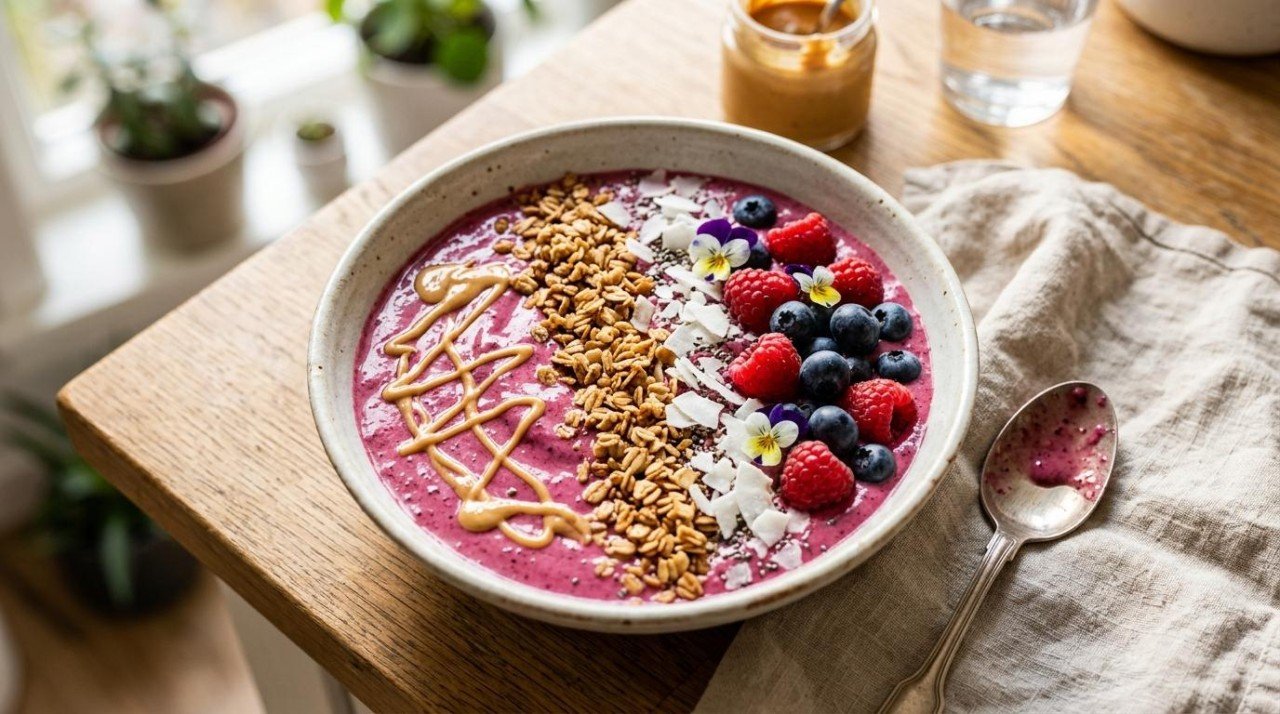
Nobody makes a smoothie bowl by accident. You do not stumble into blending four kinds of frozen fruit and arranging granola in neat rows on top. It is a dish people make on purpose, usually on a morning when they have decided to be good to themselves.
Which is why it is worth scoring. We built the standard version - frozen banana, mango and strawberries blended with apple juice, sweetened with honey, then topped with granola, a peanut butter drizzle and sweetened coconut - and ran it through Eat Well Planner's Nutrition Score. It came back at 52 out of 100: 808 calories, 34.2 g of added sugar, and 15 g of protein to hold you until lunch.
Then we rebuilt it to 93, one verified swap at a time. Two things surprised us. Cutting the granola - the swap everyone recommends first - made the score worse. And one half of the most valuable change in the build was worth exactly zero points on its own.
The original: what's in it and how it scores
There is no canonical smoothie bowl, so we scored the version that turns up most often: 1 large frozen banana (120 g), 2/3 cup (100 g) frozen mango, 2/3 cup (100 g) frozen strawberries, 1/2 cup (120 g) apple juice to get the blender moving, and 1 tablespoon (21 g) honey. On top: 1/2 cup (50 g) granola, 2 tablespoons (32 g) peanut butter, and 2 tablespoons (15 g) sweetened shredded coconut. One bowl, one person.
Nutrition Score: 52/100. Per serving: about 808 calories, 34.2 g of added sugar (129% of a day's reference, flagged very high), 8.95 g saturated fat (38% DV, flagged high), 11.6 g fiber, 15 g protein, and 4 plant points.
The added sugar is the story. The Dietary Guidelines cap added sugars at less than 10% of calories, about 50 g a day, and the American Heart Association is stricter at 24 g for women and 36 g for men. This bowl is 34 g before you have left the house. And honey counts - your body does not treat it differently because it came from a bear-shaped bottle.
But here is the diagnosis that shaped the rest of this post: the fruit is not the problem, and neither is most of the bowl. The original already lands as an excellent source of vitamin C (124% DV), vitamin B6 (50%), phosphorus (49%), biotin (46%), magnesium (44%), niacin (42%) and iron (37%), with 11.6 g of fiber - 39% of a day's reference, and most of what the average American gets in a whole day, since the recommendation is 25 to 35 g against an average intake of about 15 g. This is not junk food in a health costume. It is genuinely good food with 34 g of sugar stirred through it, and 15 g of protein trying to hold up an 808-calorie breakfast alone. The dimension scores say the same thing quietly: weight management 49, longevity 45, gut health 51. Nothing disastrous. Nothing above 60.
The upgrades
We applied these in order and re-scored after every one, so each number is what that change was worth at that point in the build. The order is not cosmetic - we tested it both ways. Until the sugar comes out, the score has one loud complaint and nothing else you do can get a word in.
1. Lose the honey, and make the coconut unsweetened
- Swap: 1 tablespoon honey → nothing; 2 tablespoons sweetened shredded coconut → 2 tablespoons (8 g) unsweetened
- Score impact: +19 points (52 to 71)
- What it changes: Added sugar from 34.2 g to 11.6 g - out of the "very high" band entirely
- What it costs you: Less sweetness, which ripe frozen fruit covers almost completely. The coconut swap costs nothing; unsweetened flakes taste more like coconut, not less.
We tested these two changes separately as well as together. Dropping the honey alone was worth 3 points. Swapping the coconut alone was worth zero. Together they are worth 19.
That is a threshold, not a rounding artifact. Neither cut on its own pulls added sugar out of the "very high" band, so the score keeps flagging it just as loudly and the improvement goes unrewarded. Do both and the flag drops a tier, and every other good thing in the bowl finally gets counted. If you take one thing from this post: partial sugar cuts often buy you nothing, and people quit right before the payoff. If honey is the part you cannot give up, our honey substitutes guide covers what actually behaves like it.
2. Build the base on Greek yogurt
- Swap: Add 3/4 cup (170 g) plain Greek yogurt to the blender
- Score impact: +9 points (71 to 80)
- What it changes: Protein from 15 g to 32.4 g, plus calcium, B12 and riboflavin
- What it costs you: A slight tang and a paler bowl. The berries in swap 6 fix the color.
This is the swap that turns a fruit dessert into a breakfast. A smoothie bowl is eaten fast, and the original had nothing in it to slow you down. For scale, the baseline recommendation is 0.8 g of protein per kilogram of body weight - roughly 50 g a day for a 140-pound adult. This bowl now covers about two thirds of that before 9 a.m. Use plain, not vanilla or fruit-on-the-bottom, which would put back the sugar you just removed; the Greek yogurt substitutes guide has the non-dairy routes.
3. Blend with milk instead of juice (worth zero points, do it anyway)
- Swap: 1/2 cup apple juice → 1/2 cup (120 g) skim milk
- Score impact: +0 points (80 to 80)
- What it changes: Protein 32.4 g to 36.4 g, calcium 27% to 42% DV, vitamin B12 49% to 78% DV
- What it costs you: Nothing detectable. Milk makes the bowl creamier, if anything.
We are publishing a zero because the reason is worth knowing. The score follows the FDA definition of added sugar, and sugar in 100% juice is not "added" - so the juice was never penalized in the first place. That is a real limit of any nutrient-based score. Harvard is blunter than our calculator here: keep juice to a small glass, four to six ounces a day, because whole fruit is lower in sugar and brings fiber that juice does not, and a 2024 review of 42 studies tied each daily serving of 100% juice to a 0.03 higher BMI in children.
We scored the alternatives at this same point: skim milk one point ahead of the juice, reduced-fat and whole milk one point behind, unsweetened almond milk two behind, since it brings no protein. The milk substitutes guide covers the rest.
4. Weigh the toppings instead of pouring them
- Swap: 1/2 cup granola → 1/4 cup (25 g); 2 tablespoons peanut butter → 1 tablespoon (16 g)
- Score impact: +3 points (80 to 83)
- What it changes: Calories from 821 down to 621 - a 200-calorie cut from two spoons
- What it costs you: Visibly less on top. This is the swap people feel most.
Granola and peanut butter are dense in a way fruit is not, and they go on last, when the bowl already looks finished. In the original, those two toppings were 400 of the 808 calories - half the breakfast, added by hand in about eight seconds. The fix is not restraint, it is a measuring cup kept in the granola jar. Scatter the granola across the whole surface instead of one corner, and warm the peanut butter for ten seconds so a single tablespoon drizzles thin rather than sitting in a lump. Same coverage, half the spoon.
5. Add a tablespoon of chia
- Swap: Add 1 tablespoon (12 g) chia seeds to the blender
- Score impact: +4 points (83 to 87)
- What it changes: Fiber from 9.4 g to 13.5 g, and omega-3 ALA up sharply
- What it costs you: A faint speckling and a thicker bowl, which is an improvement for something eaten with a spoon.
Chia earns its place on fiber and fat quality: an ounce carries 11 g of fiber, and about 60% of the oil in chia is omega-3. Worth saying plainly, since chia gets oversold - Harvard's own summary notes that controlled human trials have not shown a specific chia benefit for body weight, blood pressure, lipids or blood sugar. It is not a superfood. It is an efficient way to add fiber to something you were already eating. Blend it in rather than sprinkling it on: chia gels within minutes, which thickens the base so the toppings sit on the surface instead of sinking.
6. Spread the fruit across four species instead of three
- Swap: Half the mango → 1/3 cup (50 g) frozen blueberries + 1/3 cup (50 g) frozen raspberries
- Score impact: +3 points (87 to 90)
- What it changes: Fiber from 13.5 g to 17.2 g, plant points from 6 to 8
- What it costs you: Nothing. It also restores the color the yogurt washed out.
Raspberries are among the highest-fiber fruits in the aisle, and the swap costs no calories worth mentioning. The wider point is diversity: the American Gut Project found the number of unique plant species a person eats is associated with gut microbial diversity - more so than labels like vegan or omnivore - with people eating more than 30 different plants a week showing distinct fermentation markers. A smoothie bowl is an unusually easy place to bank four or five of those at once, which is why Plant Points lights up on breakfasts like this.
7. Half the banana becomes frozen cauliflower
- Swap: 1 whole frozen banana → 1/2 banana (60 g) + 1/2 cup (60 g) frozen riced cauliflower
- Score impact: +3 points (90 to 93)
- What it changes: Calories from 709 to 666, plant points from 8 to 9
- What it costs you: Most people will not detect it. Some will. Test this one before serving it to someone else.
We were skeptical, and it worked. One rule decides whether it works for you: the cauliflower has to be raw and frozen, never cooked. Cooked cauliflower develops sulfur notes a berry base will not hide, while raw frozen cauliflower blends into cold creaminess and reads as texture rather than flavor. Start at 1/2 cup against the rest of the frozen fruit, not more, and keep the other half of the banana - it is doing the sweetening and the body here, and removing all of it does break the bowl.
Take the Guesswork Out of Eating Well
Eat Well Planner helps you organize your favorite recipes, plan balanced meals, and automatically generate shopping lists — all in one place. Whether you're tracking macros, managing dietary restrictions, or just trying to stop asking "what's for dinner?", we've got you covered.
Our AI-powered tools can adapt any recipe to your dietary needs, help you discover new meals you'll love, and even log your nutrition effortlessly. It's meal planning made simple.
Start Organizing Your Meals — FreeWhat we kept (on purpose), and where we stopped
The peanut butter stays. We scored the finished bowl without it: 94, meaning the entire drizzle costs one point. That is not worth losing the best bite in the bowl. The granola stays too, and this number settled it - pulling the granola out of the finished bowl took added sugar down to 0.8 g, practically none, and the score fell four points, to 89. The nearly sugar-free version is the worse breakfast. That is not a defense of granola as a breakfast in its own right, which has problems of its own, but a measured 1/4 cup on top of a bowl this good earns its place.
The coconut is where we stopped. The finished bowl still carries one flag - saturated fat at 8.39 g, 36% of a day's reference - and more than half of what remains comes from those 2 tablespoons of coconut. Leaving it off scores 96 with no cautions at all, at 613 calories. So a clean 96 was available and we published the 93, because toasted coconut on top is part of what makes this dish the dish, and a makeover that quietly deletes the recognizable parts is not a makeover. Now you know the exact price - three points and one flag - and you can decide.
The healthier smoothie bowl: full recipe
Nutrition Score: 93/100. Serves 1. Every dimension above 90: gut health 91, heart health 92, brain health 92, energy and recovery 96, weight management 96, longevity 91.
For the base:
- 1/2 medium banana (60 g), frozen
- 2/3 cup (100 g) frozen strawberries
- 1/3 cup (50 g) frozen blueberries
- 1/3 cup (50 g) frozen raspberries
- 1/3 cup (50 g) frozen mango chunks
- 1/2 cup (60 g) frozen riced cauliflower, raw
- 3/4 cup (170 g) plain Greek yogurt
- 1/2 cup (120 g) skim milk
- 1 tablespoon (12 g) chia seeds
For the top:
- 1/4 cup (25 g) granola
- 1 tablespoon (16 g) peanut butter
- 2 tablespoons (8 g) unsweetened shredded coconut
- Put the milk and Greek yogurt in the blender first, then the chia seeds. Liquid on the bottom is what keeps a thick blend moving.
- Add the frozen banana, all the frozen berries, the mango and the riced cauliflower on top.
- Blend on low, then climb to high, stopping to scrape down the sides. Resist adding more liquid - the goal is a texture closer to soft-serve than to a drink. Use the tamper if your blender has one.
- Let it stand for 2 minutes so the chia can gel and thicken the base. This is what stops the toppings from sinking.
- Scrape into a bowl and flatten the surface with the back of a spoon.
- Scatter the granola across the whole surface rather than piling it in one place. Warm the peanut butter for 10 seconds in the microwave and drizzle it thin. Finish with the coconut.
- Eat immediately, while it is still cold enough to hold its shape.
Per serving, original versus improved:
- Nutrition Score: 52 → 93
- Calories: 808 → 666
- Added sugar: 34.2 g → 5.8 g
- Protein: 15 g → 33.4 g
- Fiber: 11.6 g → 17.3 g (58% of a day's reference)
- Saturated fat: 8.95 g → 8.39 g (still flagged)
- Plant points: 4 → 9
The finished bowl is an excellent source of vitamin C (157% DV), omega-3 ALA (149%), phosphorus (96%), vitamin B12 (78%), biotin (67%), riboflavin (63%), fiber (58%), vitamin B6 (52%), calcium (49%), magnesium (46%), potassium (43%), protein (41%) and iron (38%).
Swaps we tested and skipped
Cutting the granola first. Everyone's instinct, including ours. Taking the granola from 1/2 cup to a scant 1/4 cup on the original recipe moved the score down two points, to 50. Granola was carrying fiber, iron, magnesium and protein, and cutting it did nothing about the added sugar flag actually driving the score. The same trimming later in the build, after the sugar was handled, was worth +3. The swap did not change. The context did.
Replacing the granola with walnuts. Tested near the end of the build, it scored 87 against 90 for the granola version - three points worse, for an almost sugar-free bowl. The walnuts brought fat without granola's fiber and minerals. Sometimes the "cleaner" ingredient just scores lower.
A cup of spinach in the base. This one genuinely works and you cannot taste it: used in place of the cauliflower it scored 95, two points above what we published. Added alongside the cauliflower it scored 94, slightly below spinach on its own - the kind of interaction you only find by measuring. We left it out because spinach plus red berries makes a brown-gray bowl, and this is a dish people eat partly with their eyes. Add it if you do not care.
Make it fit other diets
For a vegan bowl, swap the Greek yogurt for plain unsweetened soy yogurt and the skim milk for unsweetened soy milk. We scored it: 94, a point above the dairy version. But "unsweetened" is load-bearing - the identical bowl built with a sweetened soy yogurt scored 66, a 28-point swing from one tub. For gluten-free, the granola is the only ingredient in question; use a certified gluten-free one and nothing else changes. Rather than working these out by hand, Eat Well Planner's Recipe Variations can rewrite this exact recipe as vegan or dairy-free in one step and re-score it.
Do this to any recipe you love
Nothing here required giving up the dish. The bowl still has granola, still has a peanut butter drizzle, still has coconut - and it went from 52 to 93 with 18 more grams of protein and about a sixth of the added sugar.
What it required was measuring. Every number here came from Eat Well Planner's Make It Healthier tool and the Recipe Playground, which is how we caught that cutting the granola made things worse, and that two sugar cuts worth 3 and 0 separately were worth 19 together. Nobody guesses that. You have to score it.
You can do the same to whatever you cook: import a recipe from any website, Instagram reel or YouTube video, get its Nutrition Score, and let Make It Healthier propose swaps - each verified by a calculator before you see it, so you get the real gain rather than a guess. Then take it into the Playground and argue with it. Keep the granola, keep the butter, keep the bacon, and find the points somewhere else. That is usually where the honest version lives.