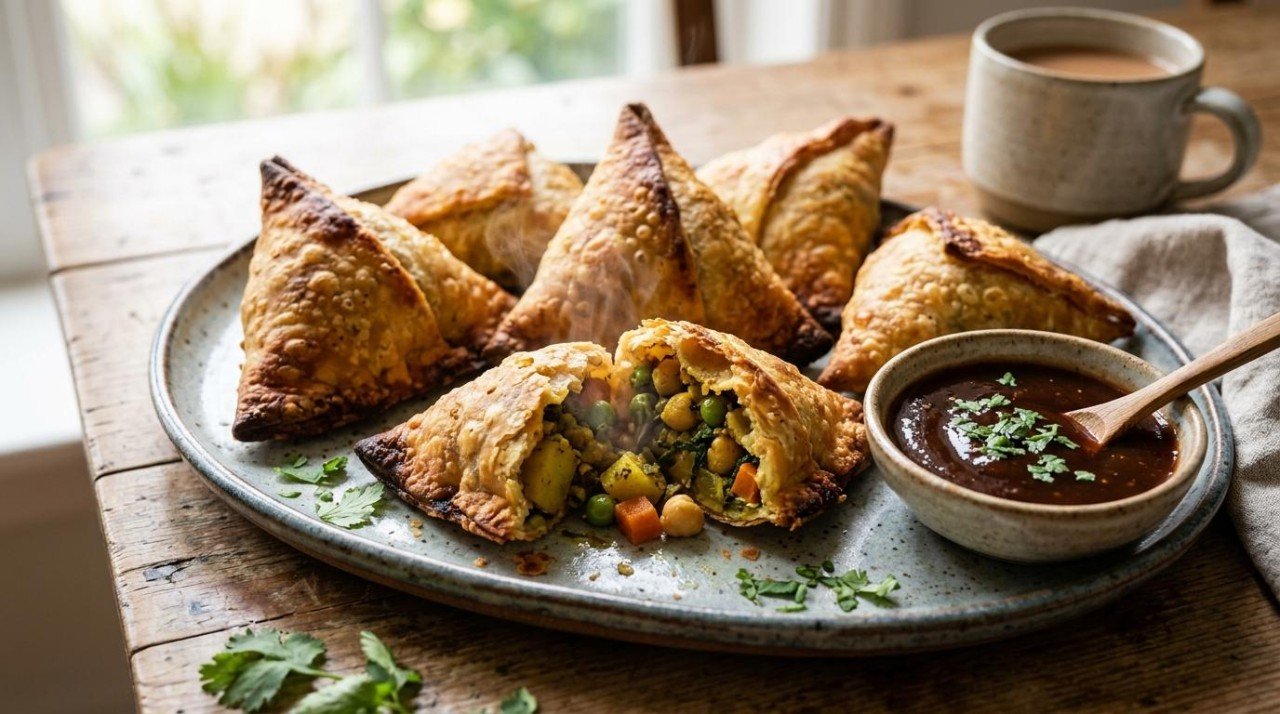
A good samosa is a small engineering marvel: a blistered, crackly pastry pyramid that shatters on the first bite, then gives way to soft, spiced potato and peas, with a spoonful of sweet-sour tamarind chutney to cut through it. The idea is old and well traveled. The name traces back to the Persian sambosag, and the pastry reached the Indian subcontinent in the 13th or 14th century with cooks from the Middle East and Central Asia working in the royal kitchens of the Delhi Sultanate. The potato filling came much later, and it is the version most of us now mean by the word.
We ran a standard Punjabi-style potato samosa through Eat Well Planner's Nutrition Score - the same number a visitor sees on any public recipe page. Two samosas with tamarind chutney, the way they are served at almost every Indian restaurant and chaat stand, came back 41 out of 100.
Then we rebuilt it to 94 out of 100. It is still a samosa: still a crisp ajwain-flecked pastry, still a spiced potato and pea filling, still the sweet-sour chutney on the side. Fifty-three points, and every swap below carries the exact score change it earned - including the biggest one, which has nothing to do with the samosa at all.
The original: what is in it and how it scores
We scored a standard home recipe modeled on Swasthi's popular Punjabi samosa, which makes 10 large samosas. We counted two samosas plus about two tablespoons of tamarind chutney as one serving:
- Dough: 2 cups (250 g) all-purpose flour, 1/4 cup melted ghee, 3/4 teaspoon ajwain (carom seeds), 3/4 teaspoon salt, water
- Filling: 500 g potatoes, 1/2 cup green peas, 1 tablespoon ghee, ginger, green chilies, cilantro, lemon juice, cumin seeds, garam masala, red chili powder, ground cumin, 1/2 teaspoon salt
- Frying: about 80 g of oil absorbed across the ten - roughly 8 g, or 70 calories, per samosa, which is a normal range for a thick deep-fried pastry
- Tamarind chutney: 40 g tamarind simmered with 75 g jaggery and a pinch of salt
Nutrition Score: 41/100. Per serving that is about 616 calories, 9 g protein, 80 g carbs, 4.4 g fiber, 30 g total fat, 9.3 g saturated fat, 13.5 g added sugar and about 760 mg sodium. Three things pull it down:
- Added sugar, flagged very high - 13.5 g per serving, 51% of the score's daily reference, and almost all of it from the chutney. The FDA sets the Daily Value for added sugars at 50 g, and two tablespoons of a jaggery-sweetened dip get a quarter of the way there. Jaggery is less refined than white sugar, but it still counts as added sugar.
- Saturated fat, flagged high - 9.3 g, 40% of the daily value. Not from the fryer, as most people would guess, but from the ghee: ghee is about 62% saturated fat, and this recipe uses it twice, rubbed into the dough and again in the filling pan.
- Sodium, flagged high - about 760 mg, or a third of the less than 2,300 mg daily value, from salt in the dough, the filling and the chutney.
The quieter problem is how little the filling brings for its size. A samosa is mostly white flour and potato, and that shows: 9 g of protein and 4.4 g of fiber in a 600-calorie serving. Most Americans already get only about 15 g of fiber a day against a need of at least 25 to 35 g.
What is already fine, and worth saying plainly: the spice blend is doing real work, peas and potatoes are genuine vegetables, and the score credits the recipe with 6.5 plant points, good iron and folate, and potassium. This is not a junk snack. It is a good snack with a sugary dip, a ghee habit and a filling that could carry far more.
The upgrades: 41 to 94
Six changes, scored cumulatively in the order below, so each delta is what that swap was worth at that point in the build. They run from highest impact and lowest flavor cost downward, which is why the one everyone expects to come first - stop frying it - comes last.
1. Sweeten the chutney with dates instead of jaggery
- Swap: 75 g jaggery in the tamarind chutney becomes 75 g pitted Medjool dates (about 3 large)
- Score impact: +17 points (41 to 58)
- What it changes: Added sugar 13.5 g to 0, the very-high sugar flag clears, a gram of fiber appears
- What it costs you: Nothing you would notice. Date-tamarind chutney is a classic in its own right.
The biggest single swap in this makeover is not in the samosa. It is in the dip. And it is not a health-food invention: khajur imli, or date and tamarind chutney, is a standard version of the sweet chutney served with samosas and chaat - Sailu's recipe grinds soaked tamarind with dates before adding jaggery on top. We simply let the dates do all of the sweetening. They blend into a thicker, glossier, caramel-dark chutney that clings to the pastry.
An honest caveat about this score jump: total sugar does not fall nearly as far as the added-sugar number suggests. Sugar in whole fruit does not count as added sugar, so the score reads the date version as having none - but 75 g of dates still carries roughly 10 g of sugar per serving, against 13.5 g from the jaggery. What you really gain is that the sugar comes packaged with fiber, potassium and magnesium. If you would rather keep jaggery, cutting it in half is nearly as good to the score (see the tested swaps below); the chutney is about sugar dose more than sugar type.
2. Rebuild the filling with chickpeas, more peas, carrot and spinach
- Swap: 500 g potato and 1/2 cup peas become 300 g potato, 1 cup peas, 1 cup chickpeas, a small carrot and 2 cups of baby spinach
- Score impact: +15 points (58 to 73)
- What it changes: Fiber 5.4 to 8.7 g, protein 9.3 to 12.6 g, plant points 7.5 to 10.5, vitamin K to 72% of the daily value
- What it costs you: A little more chopping. The filling still reads as aloo matar - potato and pea - first.
The potato stays, because a samosa without potato is a different snack. It just gets company. Chickpeas are the obvious partner: they already appear in Punjabi street food, they take the same spices, and when you crush about half of them with the potato they disappear into the texture while adding protein and fiber that potato cannot. Legumes are one of the better-studied foods in nutrition, and Harvard's summary notes that in one cohort people who ate legumes four or more times a week had a 22% lower risk of heart disease. If you need a backup, our chickpea substitutes guide covers what else holds its shape in a filling.
Use no-salt-added chickpeas, or rinse regular ones well, so the swap does not sneak sodium back in. Dice the carrot small, about the size of a pea, so it cooks through in the pan and looks like it belongs. Add the spinach last and let it wilt completely - excess moisture is what makes samosa filling burst through the dough, so cook the mixture until the pan looks dry and cool it completely before you fill anything.
3. Make the dough and the filling with oil instead of ghee
- Swap: 1/4 cup ghee in the dough and 1 tablespoon in the filling become the same amounts of canola oil
- Score impact: +11 points (73 to 84)
- What it changes: Saturated fat 9.4 g to 2.3 g per serving, and the saturated fat flag clears entirely
- What it costs you: A little of ghee's nutty, buttery aroma. The crunch stays.
The fat rubbed into samosa dough - the moyan - is what makes the crust short and blistered instead of chewy, and plenty of home cooks and recipe writers, Swasthi included, already use oil instead of ghee. The texture comes from rubbing the fat into the flour until it holds together when squeezed, not from the fat being solid. Ghee is about 62% saturated fat. Canola is 7% saturated and 29% polyunsaturated, and the same Harvard page notes that replacing saturated fat with polyunsaturated fat lowers LDL cholesterol and heart disease risk. Our vegetable oil substitutes guide covers other neutral oils if canola is not your pick.
This is the swap that most changes the profile of the finished samosa: saturated fat drops by three quarters with no change in the amount of fat, so the pastry handles exactly the same in your hands.
4. Go half whole wheat in the dough
- Swap: 2 cups all-purpose flour become 1 cup all-purpose plus 1 cup whole wheat flour (atta)
- Score impact: +4 points (84 to 88)
- What it changes: Fiber 8.7 to 10.7 g, plus magnesium and phosphorus
- What it costs you: A slightly darker, nuttier crust that is a touch less flaky
Whole wheat samosas are not a compromise in Indian home kitchens - atta is the everyday flour there, and plenty of cooks use all whole wheat, all maida, or half and half. Half and half is the sweet spot: the all-purpose flour keeps the dough pliable enough to fold into a cone without cracking, and the atta adds flavor that stands up to ajwain. Whole wheat absorbs more water, so add the water a tablespoon at a time and rest the dough for 30 minutes under a damp towel before rolling. Our all-purpose flour substitutes guide has the rest of the ladder if you want to experiment.
5. Trim the salt by 40%
- Swap: 9.5 g of salt across dough, filling and chutney becomes 5.5 g
- Score impact: +2 points (88 to 90)
- What it changes: Sodium about 780 mg to about 470 mg per serving
- What it costs you: Very little. Lemon, chili and garam masala carry the seasoning.
A small number for a meaningful change. Sodium fell by 40%, and Americans average about 3,400 mg a day, so that is worth doing regardless of the score. The trick is to keep everything else that reads as savory: a full measure of garam masala and cumin, toasted cumin seeds, the green chilies and that teaspoon of lemon juice. If you want more brightness at the table, finish with a squeeze of lemon rather than another pinch of salt. For more on the spice blend itself, see our garam masala substitutes guide.
6. Bake instead of deep-frying
- Swap: Deep-fried in oil to brushed with 1 tablespoon of oil and baked at 360F
- Score impact: +4 points (90 to 94)
- What it changes: About 115 fewer calories per serving; total fat 31.5 to 18.5 g
- What it costs you: The bubbled, blistered fried shell. You get evenly golden and crisp instead, closer to a hand pie.
It is the most famous healthy swap there is, and it is honestly the smallest change in flavor-for-points terms on this list. Baking the untouched original scored 45, four points up - real, but less than any of the first three swaps. That fits a pattern we keep finding in these makeovers: the fryer is rarely the main problem. Canola oil carries omega-3 ALA and vitamin E the score gives credit for, and the frying oil was never the source of the saturated fat - the ghee was. Taking it out mostly removes calories.
Calories matter too, though, and 115 per serving is real. Brush every surface lightly with oil - unbrushed baked dough turns pale and dry - and bake on a sheet pan in the center of the oven, turning once, until deep golden. An air fryer works too and gives you blisters closer to the fried version.
Take the Guesswork Out of Eating Well
Eat Well Planner helps you organize your favorite recipes, plan balanced meals, and automatically generate shopping lists — all in one place. Whether you're tracking macros, managing dietary restrictions, or just trying to stop asking "what's for dinner?", we've got you covered.
Our AI-powered tools can adapt any recipe to your dietary needs, help you discover new meals you'll love, and even log your nutrition effortlessly. It's meal planning made simple.
Start Organizing Your Meals — FreeWhat we kept on purpose
- The potato. Replacing all of it with chickpeas scored 94 - exactly the same. With no gain on the table, the potato stays, because it is the samosa.
- The chutney. Dropping it from the finished plate scored 95, one point more. Once it is sweetened with dates it is effectively free, and a samosa without chutney is half a snack.
- The fat in the dough. A full 1/4 cup of oil stays in the pastry, because that is what makes it short and crisp instead of tough. We did not test a lower-fat dough because we already know how it ends: cracker-hard.
We stopped at 94. Sodium is still listed as high at 20% of the daily value per serving, which is an honest place for a salted pastry to land, and the next move - cutting salt further - starts making the filling taste flat.
The healthier version: full recipe
Nutrition Score: 94/100. Makes 10 large samosas plus about 2/3 cup of chutney, serving 5 people two samosas each.
For the dough:
- 1 cup (125 g) all-purpose flour
- 1 cup (125 g) whole wheat flour (atta)
- 3/4 teaspoon ajwain (carom seeds)
- Scant 1/2 teaspoon fine salt
- 1/4 cup (52 g) canola oil
- 6 to 8 tablespoons cold water
For the filling:
- 2 medium russet potatoes (about 10 oz / 300 g), boiled until tender, peeled and cooled
- 1 tablespoon canola oil
- 3/4 teaspoon cumin seeds
- 1 tablespoon minced ginger
- 2 to 3 green chilies (about 15 g), finely chopped
- 1 small carrot (about 2 oz / 60 g), cut into pea-size dice
- 1 cup (145 g) frozen green peas
- 1 cup (165 g) no-salt-added chickpeas, drained and rinsed
- 3/4 teaspoon red chili powder
- 1 teaspoon garam masala
- 1/2 teaspoon ground cumin
- 1/3 teaspoon fine salt
- 2 packed cups (60 g) baby spinach, chopped
- 1/4 cup chopped cilantro
- 1 teaspoon lemon juice
- 1 tablespoon canola oil, for brushing
For the date-tamarind chutney:
- 1 1/2 oz (40 g) seedless tamarind block
- 3 large Medjool dates (75 g), pitted
- Pinch of salt (about 1/8 teaspoon)
- 1 cup hot water
- Make the chutney first: soak the tamarind and dates in the hot water for 20 minutes. Blend until smooth, push through a strainer, then simmer with the salt for 5 minutes until it coats a spoon. Cool.
- For the dough, whisk both flours, the ajwain and the salt. Add the oil and rub it into the flour with your fingertips for 2 to 3 minutes, until a handful holds its shape when squeezed. Add cold water a tablespoon at a time and knead into a firm, stiff dough. Cover with a damp towel and rest 30 minutes.
- Meanwhile, roughly crumble the boiled potatoes. Heat the oil in a wide pan over medium heat and add the cumin seeds. When they sizzle, add the ginger, green chilies and carrot and cook 3 minutes.
- Add the peas and chickpeas and cook 3 minutes, then lightly crush about half the chickpeas with the back of a spoon. Stir in the chili powder, garam masala, ground cumin and salt.
- Add the potatoes and spinach and cook, stirring, until the spinach has fully wilted and the pan looks dry, 3 to 4 minutes. Take off the heat, stir in the cilantro and lemon juice, and cool completely.
- Heat the oven to 360F (180C). Divide the dough into 5 balls and roll each into a 7-inch oval about 1/8 inch thick. Cut each oval in half across the middle.
- Take one half, moisten the straight edge with water, and fold it into a cone, overlapping and pressing the seam firmly. Fill with about 1/3 cup of the cooled filling, moisten the top edges and pinch shut, making sure there are no gaps. Repeat with the rest.
- Arrange the samosas on a parchment-lined sheet pan and brush all over with the remaining oil. Bake 30 to 35 minutes, turning once halfway, until golden and crisp. Serve warm with the chutney.
Per serving of two samosas with chutney, original to improved:
- Nutrition Score: 41 to 94
- Calories: about 616 to about 522
- Saturated fat: 9.3 g to 1.4 g (40% of the daily value to about 7%)
- Total fat: 30.2 g to 18.5 g
- Added sugar: 13.5 g to 0 (total sugar falls less - see swap 1)
- Sodium: about 760 mg to about 470 mg
- Fiber: 4.4 g to 10.7 g (15% of the daily value to 36%)
- Protein: 9.0 g to 13.1 g
- Plant points: 6.5 to 11.5
- New highlights: vitamin K at 71% of the daily value, iron 67%, folate 55%, vitamin C 32%
Swaps we tested and skipped
- Halving the jaggery instead of using dates - scores 93. One point below the date version, with added sugar still flagged high. A perfectly good choice if jaggery is the flavor you grew up with.
- Keeping ghee in the dough - scores 82. Twelve points lower, all from saturated fat. If ghee's aroma is non-negotiable for you, brush a little on the hot samosas after baking rather than rubbing a quarter cup into the dough.
- All whole wheat dough - scores 95. One point more and 12.8 g of fiber, but a 100% atta dough is stiffer and more likely to crack at the cone seam. Take it if you are a confident folder.
- Frying the finished version - scores 90. Only four points below baked, but about 115 more calories per serving. For a party, that is the honest price, and it is much lower than you would guess once the dough and filling are fixed.
- Cutting salt on the original - +1 point. The same salt cut was worth more once the sugar and saturated fat were fixed. Sodium matters most when it is the last flag standing, so do it, but do not expect it to rescue a recipe on its own.
Make it fit other diets
- Vegan: it already is. Oil instead of ghee took care of the only animal product.
- Gluten-free: wheat dough is hard to replace in a folded cone. The easiest route is to make the filling into aloo tikki - flattened patties pan-crisped in a little oil - and serve them with the same chutney.
- Higher protein: swap half the potato for crumbled paneer or add another 1/2 cup of chickpeas.
If you want any of these written out properly, Eat Well Planner's Recipe Variations will rewrite a saved recipe for a specific diet in one step, with the substitutions worked into the amounts and the method, and the AI recipe chat will talk through the trade-offs with the full recipe in context.
Do this to your own recipes
The lesson from these samosas is that the problem was not where anyone looked. Everyone blames the fryer. The score said the dip was the biggest lever, the ghee came next, and the fryer was worth less than either.
That is what Make It Healthier does in Eat Well Planner. Import a recipe - a URL, an Instagram reel, a YouTube video, or a family recipe typed in by hand - and you get a Nutrition Score with the same flags and highlights you have been reading all the way down this page. Ask for improvements and the AI proposes concrete swaps, but a calculator verifies the actual nutritional gain before any of them reach you. The Recipe Playground is where you test your own ideas: put the ghee back, watch the score move, and decide for yourself what it is worth. And every chickpea, carrot and spinach leaf counts toward your weekly Plant Points.
Eat Well Planner is free to use - bring the recipe you are not willing to give up.