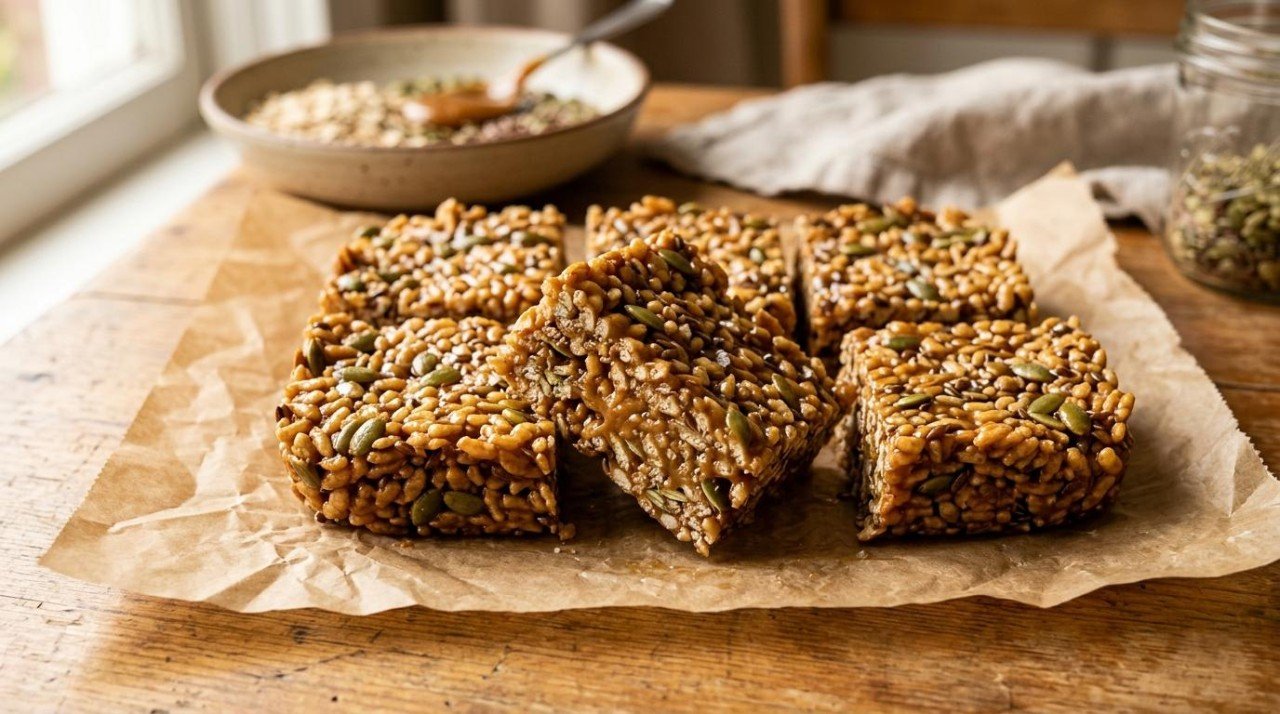
Three ingredients, one saucepan, about ten minutes. Rice Krispie treats are the first thing a lot of us ever made without a grown-up standing over the stove, and the recipe has barely changed since Kellogg's employees Malitta Jensen and Mildred Day put it together in the company's Battle Creek kitchens in 1939 as a promotional vehicle for the cereal. Melt the butter, melt the marshmallows, stir in the puffed rice, press it into a pan, ruin a spatula.
It scores 20 out of 100 on our Nutrition Score. That is the lowest opening number this series has ever put on the board.
So here is the honest promise up front: this one does not become health food. Marshmallow and puffed rice are sugar and refined starch, and no swap turns them into something else. What we can do is show you which changes are worth something and which are theater, then build a bar that scratches the same itch - snappy, sweet, cut into squares, no oven - and scores 73. Along the way, halving the marshmallows turned out to be worth exactly one point, and the swap everyone recommends first made the treats measurably worse.
The original: what is in it and how it scores
We scored the recipe printed on the box: 3 tablespoons butter, one 10-ounce package of marshmallows (about 40 regular, or 5 1/2 cups mini), and 6 cups of Rice Krispies cereal, pressed into a 13 x 9 pan and cut into 12 bars. Every score here is per bar, against the anonymous default profile - the same numbers a logged-out visitor sees on a public recipe page.
Per bar: 148 calories, 1.4 g protein, 29.6 g carbohydrate, 0.1 g fiber, 3.1 g fat (1.7 g saturated), 100 mg sodium, and 14.2 g of added sugar, 54% of a day's reference amount - flagged very high, and the recipe's only caution. Plant points: zero.
That 0.1 g of fiber is the number that explains the score. There is nothing in this recipe a gut bacterium could do anything with, so gut health comes back at 11 out of 100 and longevity at 11. Weight management lands at 14, heart health at 17.
The strange part is where the original's strengths come from. The score flags it as an excellent source of iron (44% DV), folate (32%) and vitamin B12 (28%). None of that is food. It is the fortification blend sprayed onto the cereal - ferric phosphate, folic acid, niacinamide, B6, B2, B1, D3 and B12, listed right there in the ingredients. A 1 1/2-cup serving of the plain cereal carries 60% of a day's iron, 50% of its folate, and 0 g of fiber. Hold onto that, because it comes back later and ruins a swap everyone assumes is obvious.
One note on portions, since it is the first thing people suggest. Kellogg's cuts that pan into 2-inch squares, closer to 24 pieces than 12, so we scored it that way too. The score did not move - still 20. Per square the added sugar halves to 7.1 g, but the Nutrition Score judges what the food is made of, not how much of it lands on the plate. Smaller squares are a good idea. They are not a nutritional fix.
The upgrades
Four changes, applied one on top of the next and re-scored against production data each time. Two of them do almost all the work.
1. The marshmallows become date paste (+28 points)
- Swap: 10 oz marshmallows to 6 large Medjool dates (about 4 1/4 oz), blended into a paste
- Score impact: +28 points (20 to 48)
- What it changes: Added sugar goes from 14.2 g to 0 and the caution flag clears entirely; calories drop from 148 to 101
- What it costs you: The pull. Date paste sets chewy and dense, not stretchy - this is the swap that stops it being a marshmallow treat
Marshmallow is corn syrup, sugar and gelatin whipped full of air. Take it out and the recipe's single biggest problem leaves with it. Dates are also mostly sugar - USDA puts Medjool dates at 66.5 g of sugar per 100 g - but that sugar arrives packed inside the fruit alongside 6.7 g of fiber, 696 mg of potassium and 54 mg of magnesium, which is why the score counts it as intrinsic rather than added. The finished bar still carries roughly 6.5 g of date sugar. It is not sugar-free; it is sugar that came with something attached, and that distinction holds up better than it sounds.
Dates also behave better than their sweetness suggests: a 2011 trial in Nutrition Journal put the glycemic index of five date varieties at 46 to 55 in healthy adults, all inside the low-GI range, with no significant post-meal glucose excursions in participants with type 2 diabetes. Blend the paste until it is genuinely smooth, though - grainy paste makes a grainy bar.
2. The butter becomes peanut butter (+27 points)
- Swap: 3 tablespoons butter to 1/2 cup natural peanut butter
- Score impact: +27 points (48 to 75)
- What it changes: Protein per bar goes from 1.1 g to 3.5 g; saturated fat drops from 1.7 g to 1.1 g
- What it costs you: Nothing, if you like peanut butter. If you do not, almond or sunflower seed butter does the same structural job
This one surprised us most, because it looks like an addition rather than a subtraction: the bars get richer, not leaner, and calories go back up from 101 to 138. The score climbs 27 points anyway. Butter's entire contribution to a Rice Krispie treat is saturated fat and mouthfeel, while peanut butter brings unsaturated fat, protein, niacin and magnesium - and it handles the mouthfeel better here, because it is also what holds the bars together once the marshmallow is gone. Harvard's summary of a cohort of more than 210,000 health professionals found a 14% lower risk of cardiovascular disease among people eating an ounce of nuts five or more times a week.
Buy the kind whose ingredient list reads peanuts and salt; if yours is unsalted, a pinch in the pan is free, and we scored that too. Our peanut butter substitution guide covers the nut-free stand-ins.
3. Rice Krispies become brown rice crisps (-2 points, and we did it anyway)
- Swap: 6 cups Rice Krispies to the same weight (5.5 oz) of unsweetened brown rice crisp cereal
- Score impact: -2 points (75 to 73)
- What it changes: Fiber 1.3 g to 1.7 g per bar, sodium 110 mg to 50 mg, a third plant point - and it gives up every fortified vitamin
- What it costs you: Two points on the scoreboard, and a toastier, slightly less airy snap
Here is the receipt that made this post interesting. Swapping the cereal is the change every healthy-treats article leads with, and on the untouched original it is actively harmful: 20 drops to 16. Applied at the end of our build it still costs 2 points. The reason is that fortification blend. Brown rice crisps are real whole-grain cereal with more fiber and a fraction of the sodium, but nobody sprays them with iron, folic acid and B12, so the score trades three excellent-source callouts for 0.4 g of fiber.
We made the swap anyway: the points surrendered are a vitamin premix, and the points bought are fiber and a whole grain, which Americans are badly short of at about 15 g a day against a 25 to 35 g target. But this one is your call - if you would rather have the iron, use the regular cereal and your bar scores 75.
4. Pumpkin seeds and ground flaxseed go in (+1 point)
- Swap: Add 1/4 cup pumpkin seeds and 3 tablespoons ground flaxseed
- Score impact: +1 point (73 to 74)
- What it changes: Fiber 1.7 g to 2.3 g, protein 3.5 g to 4.6 g, plant points 3 to 5, and 25% of a day's plant omega-3
- What it costs you: A bar with texture in it. Some kids will pick the seeds out
One point - and that is the honest limit of this whole exercise. Every caution flag has already cleared by now, so the seeds have nothing left to fix, and what they add (fiber, magnesium, phosphorus, ALA, the plant omega-3 the body cannot make for itself) is upside on a recipe the score already considers fine. Two swaps carried this thing from 20 to 75. Everything after that is you choosing what kind of snack you want, not the numbers pulling you along.
Take the Guesswork Out of Eating Well
Eat Well Planner helps you organize your favorite recipes, plan balanced meals, and automatically generate shopping lists — all in one place. Whether you're tracking macros, managing dietary restrictions, or just trying to stop asking "what's for dinner?", we've got you covered.
Our AI-powered tools can adapt any recipe to your dietary needs, help you discover new meals you'll love, and even log your nutrition effortlessly. It's meal planning made simple.
Start Organizing Your Meals — FreeWhat we kept, and where we stopped
The peanut butter stays at a full half cup - it is the fat, the protein and the glue at once, and cutting it back leaves you pressing a pan of loose cereal. The bars stay bars, too: pressed, cut into squares, no oven, eaten out of hand. No oats, no protein powder, nothing that would quietly turn them into a different food.
And the recipe as written scores 73, not 74, because it has a teaspoon of vanilla in it and the vanilla costs a point. That is a rounding line more than a nutritional event. Kellogg's own 1950 printing included vanilla before later versions dropped it, and we are with the 1950 version: bars with vanilla taste like something, bars without it taste like peanut butter and air.
The healthier version: peanut butter date crispy bars (scores 73)
Makes 12 bars in an 8-inch square pan. About 20 minutes of work plus an hour in the fridge.
- 6 large Medjool dates (4 1/4 oz / 120 g), pitted
- 1/2 cup (4 1/2 oz / 128 g) natural salted peanut butter
- 1 teaspoon vanilla extract
- 5 1/2 cups (5.5 oz / 156 g) unsweetened brown rice crisp cereal
- 1/4 cup (1 oz / 30 g) pumpkin seeds
- 3 tablespoons (3/4 oz / 21 g) ground flaxseed
- Line an 8-inch square pan with parchment, leaving an overhang on two sides.
- Cover the pitted dates with just-boiled water and leave them 10 minutes. Drain, keeping a few tablespoons of the soaking water.
- Blend the dates with 2 tablespoons of the soaking water into a completely smooth paste, scraping the sides down twice. It should look like thick caramel.
- Warm the date paste and peanut butter in a saucepan over low heat, stirring constantly, 2 to 3 minutes, until glossy and pourable. Do not let it bubble or it will seize. Off the heat, stir in the vanilla.
- Tip in the cereal, pumpkin seeds and flaxseed all at once and fold fast until every piece is coated. This mixture is stiffer than a marshmallow one, so work while it is warm.
- Scrape it into the pan and press down hard with a sheet of parchment and the flat bottom of a glass. Press harder than feels reasonable - compression is the only thing holding these together.
- Chill 1 hour, lift out by the parchment and cut into 12 bars. They keep a week in the fridge and freeze well.
For the version that scores 75, use 6 cups of regular Rice Krispies instead: you trade 0.4 g of fiber per bar for the cereal's fortified iron, folate and B12.
Per bar, original next to this one:
- Nutrition Score: 20 to 73
- Calories: 148 to 166
- Protein: 1.4 g to 4.6 g
- Fiber: 0.1 g to 2.3 g
- Added sugar: 14.2 g (54% DV, flagged very high) to 0 g
- Saturated fat: 1.7 g to 1.4 g
- Sodium: 100 mg to 50 mg
- Plant points: 0 to 5
- Caution flags: one to none
The finished bar is an excellent source of plant omega-3 (25% DV) and a good source of phosphorus (16%), magnesium (14%), niacin (12%) and iron (10%). Gut health goes from 11 to 80, heart health from 17 to 68.
If it has to have marshmallows
Sometimes it does - a bake sale, a birthday, a kid who will absolutely notice. The best-scoring version we found that is still recognizably a Rice Krispie treat: half the marshmallows (5 oz), no butter at all, 1/2 cup of peanut butter, the regular fortified cereal, plus the seeds. The peanut butter melts into the marshmallow and takes over the butter's job entirely.
It scores 46, a 26-point gain with the marshmallow pull intact. Added sugar per bar falls from 14.2 g to 7.1 g but stays flagged: one square is still close to a third of the 24 g a day the American Heart Association suggests as a ceiling for women. A real improvement, and not health food. Both things are true.
Swaps we tested and skipped
- Halving the marshmallows on their own: 20 to 21. One point. Added sugar drops from 14.2 g to 7.1 g and the flag stays lit, because the recipe is still refined starch with no fiber for the improvement to land on. The most-recommended fix for this recipe is worth almost nothing by itself.
- Cutting the pan into 24 squares instead of 12: 20. No change at all.
- Brown rice crisps on the untouched original: 20 to 16. You give up the fortification and gain fiber the recipe is in no position to use.
- Honey instead of date paste: 74 to 46. A quarter cup puts 5.8 g of added sugar back into every bar and relights the caution flag - our honey substitution guide covers where it does and does not help.
- Dark chocolate drizzle: 74 to 70 for 1 oz, 66 for 2 oz. This one stung, because a drizzle is the obvious finishing move. It is saturated fat added to a bar that had finally gotten down to 1.4 g of it.
- Keeping the butter alongside the peanut butter: 74 to 55. Three tablespoons costs 19 points once everything else is clean; our butter substitution guide covers what else can do its job.
- Marshmallows back into the finished bar: 74 to 44. Even at 5 oz, even with everything else fixed.
Make it fit other diets
- Vegan: it already is - no dairy, egg or gelatin anywhere. Check your cereal is not sweetened with honey.
- Nut-free: sunflower seed butter swaps in one for one and sets just as firmly.
- Gluten-free: brown rice crisps usually are, but read the box - some brands use barley malt for flavor.
In the app, Recipe Variations and the AI recipe chat rewrite any of these in one step, with the whole ingredient list in context instead of a generic substitution table.
Do this to your own recipes
Every number above came out of tools you get for free: import a recipe, look at its Nutrition Score, and let Make It Healthier propose swaps that a calculator has already verified before you ever see them. The Recipe Playground is where the per-swap deltas came from - change one ingredient, watch the score move, decide whether the trade is one you want.
Which matters more than usual here, because the intuitive fixes were the losers. Fewer marshmallows: one point. Better cereal: minus four. The two changes that carried it 55 points were the two nobody suggests, and there was no way to know without measuring. Rebuilding the bar also took it from zero plants to five, a sixth of a week's 30 plants out of a tray of crispy squares.