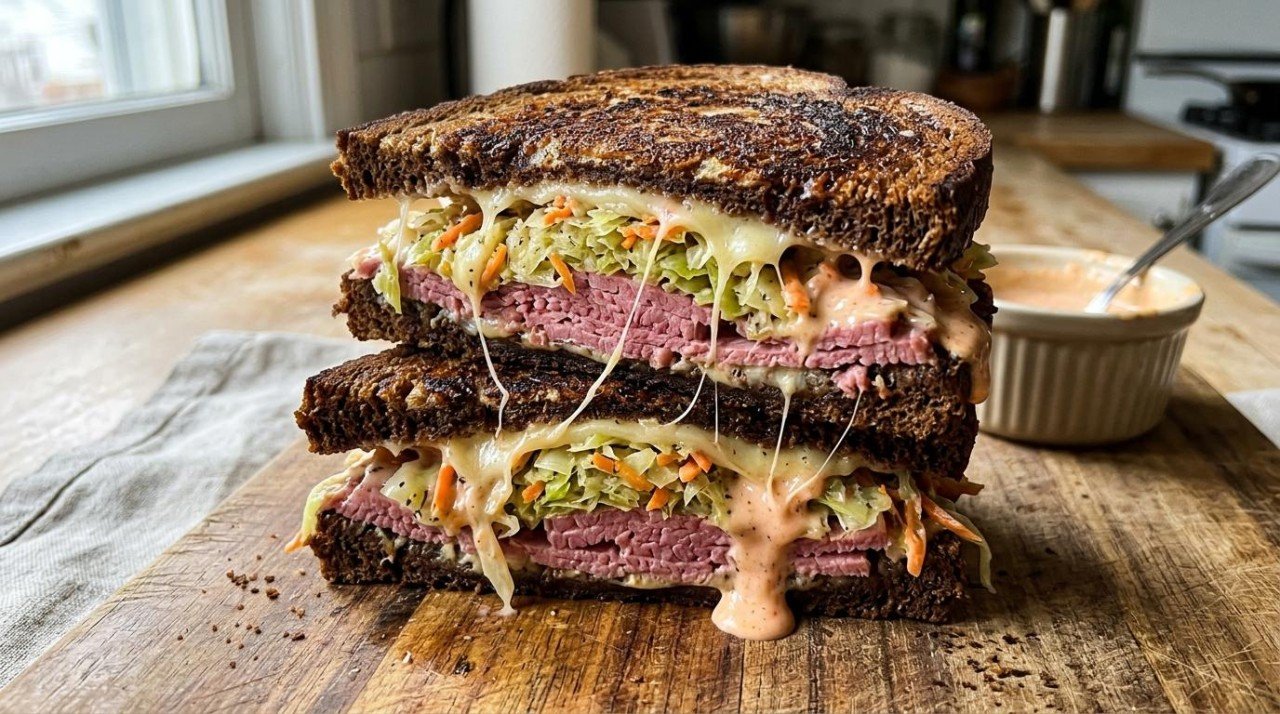
There is a specific moment a Reuben has to deliver. You press the sandwich into the pan, the rye goes deep brown, and when you cut it the Swiss stretches and the kraut leaks pink dressing onto the board. Nobody eats a Reuben absentmindedly. It is a two-handed, lean-over-the-plate sandwich, and it has been that way since somebody in either a New York delicatessen or an Omaha hotel poker room put corned beef, Swiss, sauerkraut and Russian dressing between two slices of rye.
So we built the deli standard - 4 oz of corned beef, two slices of Swiss, sauerkraut, a quarter cup of Russian dressing, buttered rye - and ran it through the Eat Well Planner Nutrition Score. It came back at 35 out of 100, with saturated fat at 115% of a day's allowance and sodium at 99%. One sandwich. Before the pickle spear.
Then we rebuilt it one swap at a time, re-scoring against live nutrition data after every change. The finished sandwich scores 56 - twenty-one points higher - with 60% less saturated fat, 690 mg less sodium, nearly double the fiber, and it still griddles and melts and drips. But the interesting part is the order. The swap everybody expects to matter, halving the corned beef, was worth 3 points. The swap nobody suggests, and which removes nothing at all, was worth 10. Here is every change and exactly what it bought.
The original: what's in it and how it scores
The version we scored is the deli plate: 4 slices of rye bread, 8 oz of corned beef split between two sandwiches, 4 oz of Swiss, about 2/3 cup of sauerkraut, a quarter cup of Russian dressing built the classic way from mayonnaise, ketchup and sweet relish, and 2 tablespoons of butter for the griddle. Here is one sandwich on the numbers:
- Nutrition Score: 35 / 100
- Calories: about 948
- Saturated fat: about 27.1 g (115% of the Daily Value)
- Sodium: about 2,270 mg (99% of the Daily Value)
- Fiber: about 5.5 g
- Protein: about 42 g
- Potassium: about 440 mg
- Plant points: 2
Sodium is the headline, and the number is almost comic: 2,270 mg is 99% of the 2,300 mg daily maximum in a single sandwich. What makes it hard to fix is that it is not coming from one place. The corned beef brings roughly half of it, the sauerkraut and the rye bread bring about 400 mg each, and the dressing and butter split the rest. Every component of a Reuben is a salt-preserved food. That is not an accident of the recipe - it is the definition of the dish. Corned beef is beef cured in brine, sauerkraut is cabbage cured in salt, and bread needs salt both for flavor and to control its rise.
Saturated fat is worse in percentage terms: about 27.1 g, or 115% of a day, from three sources stacked on each other - fatty brisket, two slices of Swiss, and butter on both outside faces of the bread.
What is already good deserves saying, because a Reuben is not junk food. One sandwich delivers about 42 g of protein and scores as an excellent source of vitamin B12 (130% DV), phosphorus, zinc, iron and calcium. Added sugar is a non-issue at 3.8 g, almost all of it from the ketchup and relish in the dressing. And the sauerkraut is doing real work, which we will come back to.
The genuine weak spot, the one that does not show up in any of the alarming numbers, is the plant points: 2. Cabbage and rye. That is the entire plant contribution of a sandwich the size of a paperback.
The upgrades
Six swaps, in the order we applied them. Every score below is cumulative - each change stacked on the last and re-scored against production nutrition data - so the number beside each swap is what it was worth at that point in the build. They are ordered by what they bought, so if you only make one change, make the first one.
1. Build a slaw layer around the sauerkraut
- Swap: Nothing removed. Add 3 cups shredded green cabbage, 1 shredded carrot, 1/4 cup sliced red onion and 3/4 tsp caraway seeds to the existing sauerkraut
- Score impact: +10 points (35 to 45)
- What it changes: Fiber from 5.5 g to 9.5 g, plant points from 2 to 5.25, and a much bigger sandwich
- What it costs you: Five minutes of shredding, and about 53 more calories a serving. Nothing on the plate gets smaller
This is the biggest single move in the post and it is purely additive, which is why it goes first. The 2/3 cup of sauerkraut in a standard Reuben is a condiment. Turn it into the base of a slaw - toss it with raw cabbage, carrot, red onion and caraway, and let it sit ten minutes so the kraut brine seasons and softens the raw cabbage - and it becomes the bulk of the sandwich instead of a garnish. You are not inventing anything: the Reuben's own sibling, the Rachel, swaps the kraut for coleslaw outright. We just kept both.
The score responded to the fiber and the plant points more than to anything we took away later. It is worth noticing that this swap made the sandwich more caloric, not less, and gained ten points anyway - those calories arrive with 4 g of fiber and a load of vitamin C from raw cabbage, which is why the slaw goes into the pan for three minutes and no longer.
One technique note that matters more than it sounds: squeeze the sauerkraut dry, and give the finished slaw three or four minutes in a dry skillet before it goes in the sandwich. Raw cabbage is mostly water, and water is what turns a griddled Reuben into a soggy one.
2. Rebuild the Russian dressing on yogurt
- Swap: 1/4 cup mayo-based Russian dressing to 3 tbsp plain whole-milk Greek yogurt, 1 tbsp ketchup, 2 tbsp chopped dill pickle and 1 tsp prepared horseradish
- Score impact: +4 points (45 to 49)
- What it changes: 125 fewer calories a sandwich, 2 g less saturated fat, added sugar from 3.8 g to 2.3 g, protein up slightly, plant points to 7.25
- What it costs you: Mayonnaise's fatty coating. The yogurt version is tangier and sharper - closer to the original dressing, honestly
Real Russian dressing is mayonnaise and ketchup with horseradish, pimentos, mustard and spice, and recipes have included horseradish since at least 1913. What most of us buy in a jar is closer to Thousand Island - sweeter, milder, and heavier on the relish. So swapping the sweet relish for chopped dill pickle and putting the horseradish back is not a health compromise; it is a restoration that happens to score better.
The rules for making it work: use full-fat Greek yogurt, not nonfat, or it goes thin and chalky. Whisk it thick enough that it holds a line when you drag a spoon through it. And do not heat it separately - it goes on the bread cold and only ever gets as hot as the inside of the sandwich. If you want the full rundown of what mayo can and cannot be traded for, our mayonnaise substitutes guide covers the rest.
3. Halve the corned beef
- Swap: 4 oz of corned beef per sandwich to 2 oz, sliced thin and spread edge to edge
- Score impact: +3 points (49 to 52)
- What it changes: Sodium from about 2,240 mg to 1,690 mg (98% to 74% DV), saturated fat from 25 g to 21.4 g, 141 fewer calories
- What it costs you: This is the one that costs you. Protein drops from about 46 g to 35 g, and the sandwich stops being a deli pile
Three points for the swap everyone assumes is the whole story. It moves the numbers hardest - 550 mg of sodium is more than any other single change in this post - and the score still valued it less than a bowl of shredded cabbage, because a Reuben has three other salt-cured components waiting behind the beef.
It is still worth doing, and not only for sodium. The WHO's cancer agency classifies processed meat as a Group 1 carcinogen and names corned beef specifically, with each additional 50 g a day associated with roughly an 18% higher risk of colorectal cancer. Two ounces instead of four is a meaningful move on a food most of us are not eating daily anyway. The same math applies to every cured meat in the deli case, which is why our deli ham substitutes guide exists.
To make 2 oz eat like 4: have it sliced as thin as the counter will go, warm it in the skillet for a minute a side, and pile it loosely in folded ribbons rather than pressing it into a flat slab. Loft is most of what makes a deli sandwich feel generous.
4. One slice of Swiss, shredded instead of sliced
- Swap: 2 oz of Swiss per sandwich to 1 oz, shredded
- Score impact: +1 point (52 to 53)
- What it changes: Saturated fat from 21.4 g to 16.3 g (91% to 70% DV), 110 fewer calories
- What it costs you: Almost nothing on the plate, and almost nothing on the score either
One point. We are including it because it is honest and because it sets up the swap after it - cutting the cheese alone barely registers, but it is what let the next change take saturated fat from a flagged number to an unflagged one.
Shred the Swiss rather than slicing it. An ounce of shreds covers roughly twice the bread surface a slice does, melts faster at a lower pan temperature, and reaches every corner of the sandwich instead of sitting in a square in the middle. If you would rather keep two slices, keep two slices. It is worth one point.
5. Griddle in olive oil instead of butter
- Swap: 2 tbsp butter to 1 tbsp olive oil, brushed on the outside faces
- Score impact: +2 points (53 to 55)
- What it changes: Saturated fat from 16.3 g to 11.0 g - from 70% of a day's allowance to 47%, and off the caution list
- What it costs you: Butter browns better and smells like breakfast. Olive oil does not
Halving the fat and changing its type at the same time is what finally moved saturated fat out of the danger zone. Note the interaction: this exact swap was worth 1 point when we tested it on the original sandwich, and 2 here, once the cheese and the beef had already come down. Nothing in a recipe is worth a fixed number of points - it depends on what else is in the pan.
To keep the crust: brush the oil on thin rather than melting it in the pan, and drop the heat to medium-low so the bread has four or five minutes a side to build color. Butter browns fast because of its milk solids; olive oil needs time instead. If you cannot give up the flavor, use a teaspoon of butter and the rest oil - our butter substitutes guide and olive oil guide both cover the blend.
6. Pumpernickel instead of deli rye
- Swap: 4 slices of deli rye to 4 slices of pumpernickel or 100% whole rye
- Score impact: +1 point (55 to 56)
- What it changes: Fiber from 9.65 g to 10.1 g
- What it costs you: Nothing. Pumpernickel is denser, faintly sweet, and arguably better here
The bread swap is the one we expected to be worth the most and it came in dead last, because deli rye was never really the problem. It already carries about 3.7 g of fiber in two slices, which is more than most sandwich bread manages.
The catch is what the label means. The Whole Grains Council notes that coarse whole-grain rye flour is what pumpernickel is named for, but that light rye is not a whole grain at all and dark rye may or may not be depending on the miller - so you have to look for the word "whole" on the bag rather than trusting the color, which is often just caramel or molasses. A genuinely dense German-style whole rye would do better than our +1, but we can only publish what we can score, and one point is what the data supports.
What we kept (on purpose), and where we stopped
Real corned beef, not turkey. Real Swiss, not a reduced-fat slice. Real sauerkraut, not rinsed into oblivion. And the sandwich still gets griddled in fat, because a Reuben toasted dry in a toaster oven is a sad object.
The sauerkraut earns its place twice over. It is the plant point, the acid that cuts the fat, and the reason the sandwich tastes like a Reuben instead of a corned beef melt. It is also a fermented food, and a Stanford randomized trial of 36 adults over ten weeks found that a diet high in fermented foods increased gut microbial diversity and lowered 19 inflammatory proteins, while a high-fiber diet did neither. Two honest caveats: buy it from the refrigerated section, because shelf-stable jars are typically pasteurized to make them shelf-stable, and ISAPP notes that for some fermented foods the live microorganisms are killed or removed before consumption; and a hot griddle is not kind to live cultures either. What survives regardless is the fiber, the vitamin C and the vitamin K.
Where we stopped is sodium: 1,580 mg a sandwich, still 69% of a day. We could not get it lower without dismantling the dish, and we tried - see below. A sandwich built on cured beef, fermented cabbage and bread has a salt floor, and pretending otherwise would mean serving you something that is not a Reuben. Eat it with a plain green salad rather than chips, and go easy on the salt everywhere else that day.
Take the Guesswork Out of Eating Well
Eat Well Planner helps you organize your favorite recipes, plan balanced meals, and automatically generate shopping lists — all in one place. Whether you're tracking macros, managing dietary restrictions, or just trying to stop asking "what's for dinner?", we've got you covered.
Our AI-powered tools can adapt any recipe to your dietary needs, help you discover new meals you'll love, and even log your nutrition effortlessly. It's meal planning made simple.
Start Organizing Your Meals — FreeSwaps we tested and skipped
Deli turkey instead of corned beef. The obvious suggestion, and it does score better - 61 against our 56. But look at why: saturated fat falls to 8.4 g, while sodium goes up, from 1,580 mg to 1,950 mg, because deli turkey is also a brine-cured meat. It scores five points higher by improving the sandwich's second-worst number and worsening its worst one. It is also no longer a Reuben: turkey in place of the corned beef, with slaw already in the sandwich, is the definition of a Rachel. If saturated fat is your priority rather than sodium, make it and enjoy it, but make it knowingly.
Doubling the sauerkraut. Sauerkraut is the hero of this sandwich, so more should be better. It is not: doubling it scored 56, exactly the same, while adding 400 mg of sodium. The kraut is the hero and the hero is salty. Keep it at 2/3 cup and let the raw cabbage carry the volume.
Pushing the sodium down harder. We cut the sauerkraut by a third, swapped the ketchup for tomato paste and dropped the dill pickle from the dressing. Sodium fell from 1,580 mg to 1,310 mg - 69% of a day to 57% - and the score did not move at all. Still 56. Two hundred and seventy milligrams of sodium for zero points, because everything we removed was also carrying fiber, potassium or a plant point. This is the clearest evidence in the post that the score is not simply counting salt.
Deleting the corned beef entirely. Worth 3 points (56 to 59), and it costs 10 g of protein, dropping the sandwich to 17.7 g. Three points is not a good trade for the entire point of the sandwich.
The healthier Reuben: full recipe
Scores 56 out of 100. Makes 2 sandwiches.
For the kraut slaw
- 2/3 cup (120 g) sauerkraut, drained and squeezed dry
- 3 cups (200 g) green cabbage, finely shredded
- 1 medium carrot (60 g), shredded
- 1/4 cup (30 g) red onion, thinly sliced
- 3/4 tsp caraway seeds
For the dressing
- 3 tbsp (45 g) plain whole-milk Greek yogurt
- 1 tbsp ketchup
- 2 tbsp (20 g) dill pickle, finely chopped
- 1 tsp prepared horseradish
- Black pepper
For the sandwiches
- 4 slices (128 g) pumpernickel or 100% whole rye bread
- 4 oz (113 g) corned beef, sliced thin
- 2 oz (56 g) Swiss cheese, shredded
- 1 tbsp olive oil
- Squeeze the sauerkraut dry over the sink, then toss it in a bowl with the shredded cabbage, carrot, red onion and caraway seeds. Let it sit for 10 minutes so the kraut brine seasons and softens the raw cabbage.
- Stir the yogurt, ketchup, chopped pickle, horseradish and several grinds of black pepper together in a small bowl. It should be thick enough to hold a line when you drag a spoon through it.
- Warm a dry skillet over medium heat and cook the slaw for 3 to 4 minutes, tossing, just until it wilts and stops giving off steam. This drives off the water that would otherwise soak the bread. Tip it back into its bowl.
- Warm the corned beef in the same skillet for about a minute a side, then pile it into loose folded ribbons rather than pressing it flat.
- Spread the dressing on all four slices of bread. Scatter the shredded Swiss over two of them, top with the corned beef, pack the slaw on, and close the sandwiches.
- Wipe the skillet and set it over medium-low. Brush the outside faces of each sandwich with olive oil, lay them in the pan, and cook for 4 to 5 minutes a side, pressing gently with a spatula, until the crust is deep brown and the cheese has melted.
- Rest for a minute, then cut on the diagonal.
Per sandwich, original versus improved:
- Nutrition Score: 35 to 56
- Calories: about 948 to about 578
- Saturated fat: about 27.1 g (115% DV) to about 10.9 g (46% DV)
- Sodium: about 2,270 mg (99% DV) to about 1,580 mg (69% DV)
- Fiber: about 5.5 g to about 10.1 g (34% DV)
- Protein: about 42 g to about 28 g
- Potassium: about 440 mg to about 750 mg
- Vitamin C: about 10 mg to about 50 mg (58% DV)
- Added sugar: about 3.8 g to about 1.7 g
- Plant points: 2 to 7.25
The potassium line is quieter than the others and worth a sentence. The original sandwich has a sodium-to-potassium ratio of about 5 to 1; the improved one is about 2 to 1. Harvard's Nutrition Source notes that high potassium intake helps relax blood vessels and excrete sodium, and that the sodium-to-potassium ratio matters significantly for cardiovascular health. Most of that shift came from the cabbage and the carrot, not from anything we took out.
Make it fit other diets
- Gluten-free: The only gluten here is the bread. A dense seeded gluten-free loaf griddles well; skip anything labeled soft white.
- Vegetarian: Replace the corned beef with thick-sliced roasted beets tossed in the same caraway and plenty of black pepper - the color, the earthiness and the sweetness all land in roughly the right place.
- Dairy-free: The Swiss and the yogurt both have to go, which is a real loss. Use a cashew-based cheese that actually melts, and swap the yogurt for unsweetened coconut yogurt with an extra teaspoon of horseradish to cover the sweetness.
You do not have to work these out by hand. In Eat Well Planner, Recipe Variations rewrites a saved recipe for a diet in one step - ask for the dairy-free version and you get a full recipe with the substitutions already worked in - and the AI recipe chat will argue the details with you if you want to know why a particular swap works.
Do this to your own recipes
Nothing about this process was specific to Reubens. We imported a recipe, read its score, looked at which two or three numbers were dragging it down, and then tested changes one at a time until the sandwich stopped being a Reuben - and published the ones that were worth nothing right alongside the ones that were worth ten points.
That is the Make It Healthier feature in Eat Well Planner, and it is free. Import any recipe from a URL, an Instagram reel or a YouTube video, and the app scores it and proposes swaps - with a calculator verifying the actual nutritional gain before a suggestion is ever shown to you, which is exactly how we caught the sauerkraut and sodium results above. The Recipe Playground lets you do what we did here: change one ingredient, watch the score move, and decide for yourself whether the point was worth the flavor.
Start with the dish you would be sad to give up. That is the one where twenty-one points actually changes what you eat.