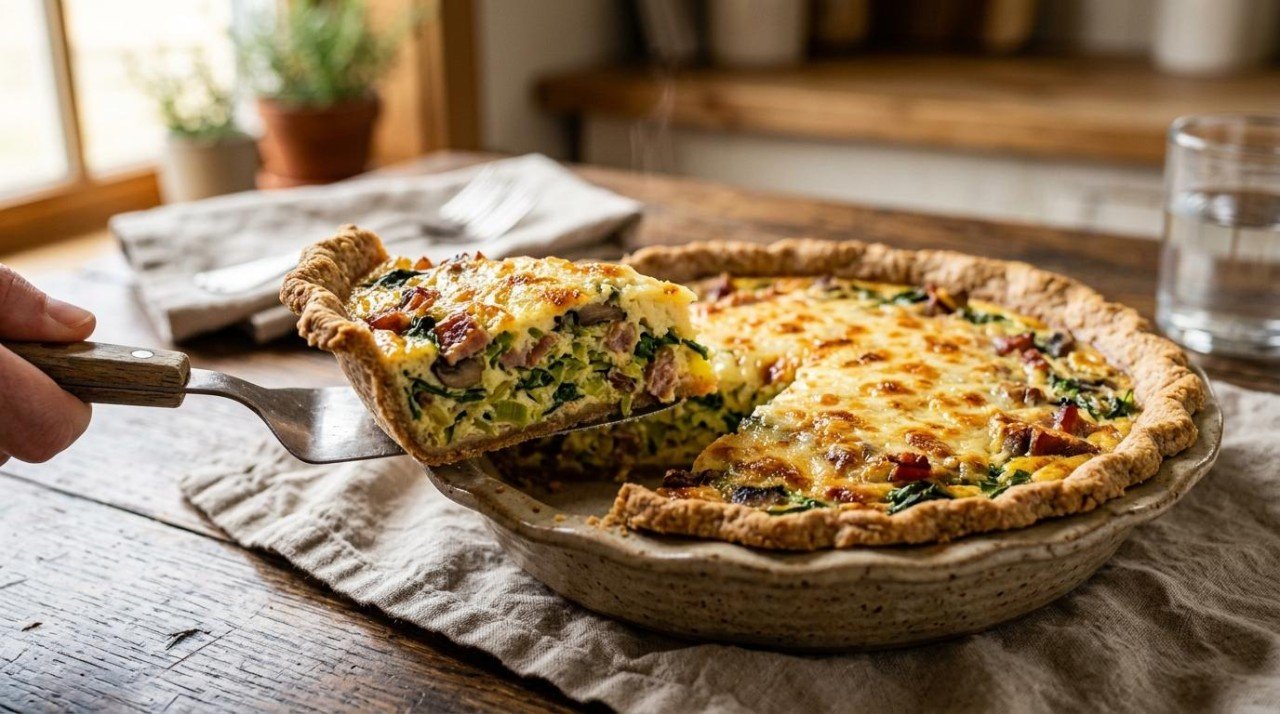
Quiche Lorraine comes from the Lorraine region of eastern France, and the word itself shows up in the Lorrain dialect as far back as 1605. The traditional version is three things — cream, eggs, and bacon — in a pastry shell. The cheese most of us consider mandatory was a later addition. Purists will tell you a real quiche Lorraine has no Gruyere in it at all. We are keeping the Gruyere.
What we are not keeping is the score. Built the standard American way — butter crust, a cup of heavy cream, six ounces of bacon, four ounces of cheese — and scored per serving against our default profile, it lands at 27 out of 100 on our Nutrition Score. That is one of the lowest openings we have had in this series.
Six changes took it to 53 — a 26-point jump — and it is still a quiche with a crust, real bacon, real Gruyere, and a custard that sets. Every number below is real: we scored the original, then applied each change on top of the last and measured what it was actually worth. The most famous "healthy quiche" move in the world made it worse. Two swaps that everybody recommends were worth nothing. That is all in here.
The original: what is in it and how it scores
The version we scored is a standard 9-inch quiche Lorraine cut into 6 slices:
- Butter pastry crust: 1 1/4 cups (150 g) all-purpose flour, 1 stick (113 g) butter
- 6 oz (170 g) bacon
- 1 cup heavy cream and 1/2 cup whole milk
- 4 large eggs
- 4 oz (113 g) Gruyere
- 3/4 teaspoon salt, black pepper, a pinch of nutmeg
That scores 27/100. Per slice:
- Calories: about 647
- Saturated fat: 25.4 g — flagged at 108% of a day's Daily Value, the app's most severe caution level
- Sodium: about 1,320 mg — 57% DV, also flagged
- Protein: 25.8 g
- Fiber: 0.7 g
- Plant points: 0.5
Start with what is already good, because there is more of it than you would expect. Quiche is eggs and dairy, and eggs and dairy are nutrient-dense food. The original clears the "excellent source" bar of 20% of the Daily Value for twelve separate nutrients: phosphorus (52%), vitamin A (44%), vitamin B12 (44%), thiamine (40%), riboflavin (37%), protein (32%), niacin (30%), iron (29%), choline (28%), calcium (27%), zinc (23%), and pantothenic acid (20%). Nearly 26 grams of protein a slice is real. The eggs are the best thing in this dish and they are not the problem.
The problem is that a whole stick of butter, a cup of heavy cream, six ounces of bacon, and four ounces of aged cheese are all in the same pie plate, and every one of them is mostly saturated fat. Twenty-five grams a slice is more than a full day's worth in one piece of quiche, and the Dietary Guidelines put the ceiling at under 10 percent of daily calories. The app flags exactly three weaknesses: high saturated fat, low vitamin C, and low plant diversity.
The plant problem is one of absence. Half a plant point. Under a gram of fiber, when we need 25 to 35 grams a day and most Americans get about 15. And the sodium is structural rather than shaken on: bacon, aged cheese, and salted butter are all salty before you season anything, which matters when Americans already average about 3,400 mg a day against a 2,300 mg ceiling.
Here is the thing that surprised us most, and it shapes the whole post. We tried the two obvious fixes first, on their own. Cutting the bacon from 6 oz to 3 oz took the score from 27 to 26. Cutting the Gruyere from 4 oz to 3 oz also took it to 26. Both went down. Shaving the toppings while a stick of butter and a cup of cream are still in the pan just removes protein from a dish that is still 108% DV saturated fat. You cannot fix this quiche by picking at the bacon. You have to fix the crust and the custard first.
The upgrades
Six changes, applied in this order, each scored on top of the last. They are ordered by how much they move the number for how little they cost you at the table, so if you only make the first two, you have captured two thirds of the gain.
1. Fill it with vegetables
- Swap: Add 1 large leek, 5 oz cremini mushrooms, and 3 1/2 oz baby spinach, all cooked down first
- Score impact: +8 points (27 → 35)
- What it changes: Plant points 0.5 → 3.5, fiber 0.7 → 2.3 g, vitamin K from under 10% DV to 81%, and it clears the low-plant-diversity flag
- What it costs you: Ten minutes at the stove. Nothing at the table — leeks and bacon are one of the great pairings in French cooking
Nothing was removed here. This is pure addition, and it is the single biggest lever in the recipe when tested on its own. It also solves a problem the original has quietly: a quiche Lorraine is a rich, one-note slice, and about three bites in, the richness stops being interesting. Sweet softened leeks and browned mushrooms give it somewhere to go.
The technique that matters, and it is not optional: cook the vegetables down completely before they go anywhere near the custard. Mushrooms are roughly 90% water and spinach collapses to almost nothing. Keep the pan on medium-high until the mushrooms have released their liquid and the skillet is dry again, wilt the spinach in at the end, then turn everything onto paper towels and press. Wet vegetables in an egg custard are the number one cause of a weeping, watery quiche. Done properly, 14 ounces of raw vegetables cooks down to about a cup and disappears into the filling.
2. Rebuild the crust with whole wheat and olive oil
- Swap: All-purpose flour and a stick of butter → 1 cup whole wheat flour and 1/4 cup olive oil, pressed into the pan
- Score impact: +9 points (35 → 44)
- What it changes: Saturated fat 25.6 → 18.4 g per slice, fiber 2.3 → 3.7 g, calories down about 80 a slice
- What it costs you: Flakiness. An oil crust is short and crumbly rather than layered and shattering. It is also five minutes of work instead of forty
This is the biggest single move in the post and the crust is where it comes from, which is why we did not throw the crust away (more on that below). Two things are happening at once. The flour goes from refined to whole grain — refining strips the bran and germ and with them more than half of wheat's B vitamins, 90 percent of its vitamin E, and virtually all of the fiber. And the fat goes from saturated to unsaturated, which is the swap with the best evidence behind it: replacing saturated fat with unsaturated fat lowers LDL cholesterol and improves the ratio of total to HDL cholesterol, where simply cutting fat and eating refined carbs instead does nothing for heart risk.
Be honest with yourself about the texture. You are not getting laminated pastry from olive oil, and anyone who tells you otherwise has not made one. What you get is a nutty, savory, slightly sandy crust closer to a shortbread base, which suits a savory custard better than you would think. It is a press-in dough — stir it in the pie plate with a fork, push it up the sides with your fingers, done. If you want to go deeper on either half of this swap, we have full guides to all-purpose flour substitutes and butter substitutes.
3. Heavy cream out, whole milk in
- Swap: 1 cup heavy cream + 1/2 cup whole milk → 1 1/2 cups whole milk
- Score impact: +4 points (44 → 48)
- What it changes: Saturated fat 18.4 → 11.0 g per slice, calories down another 113 a slice
- What it costs you: Some richness on the tongue. The custard is silkier and lighter rather than heavy — a real change, and the one swap here you might notice first
Heavy cream is about 36% fat and most of it saturated; whole milk is about 3.5%. Swapping the whole cup out is the largest single reduction in saturated fat in the entire makeover, and it costs four points less than the crust swap only because the crust swap already took the easy ground.
The custard still sets, and that is the part people worry about. A quiche is a savory custard held together by egg protein, not by fat, so milk-based quiches set perfectly well — they are simply less unctuous. If you want some of the richness back, canned evaporated milk in place of half the whole milk scored identically at 48 and brings more body and a faint caramelized note. We have a full breakdown of the options in our heavy cream substitutes guide.
4. Bacon becomes an accent, not the filling
- Swap: 6 oz bacon → 3 oz (about 3 slices of thick-cut)
- Score impact: +3 points (48 → 51)
- What it changes: Sodium 1,250 → 1,000 mg per slice, saturated fat 11.0 → 9.3 g, calories down 70
- What it costs you: Less bacon in some bites. With the leeks and mushrooms in there, you notice less than you expect
Now that the crust and the custard are fixed, the same cut that lowered the score at the start is worth three points. That is the whole lesson of this post: swaps are not worth a fixed amount, they are worth what the rest of the recipe leaves on the table.
Three ounces across six slices is still bacon in every bite — render it properly until it is genuinely crisp and crumble it rather than dicing it, and it distributes further. Keep about a teaspoon of the rendered fat to cook the leeks and mushrooms in and pour the rest off; that teaspoon is where most of the bacon flavor in the finished quiche actually comes from. Worth knowing while you are here: the WHO classifies processed meat as a Group 1 carcinogen, with each 50 g eaten daily associated with about an 18% higher risk of colorectal cancer. That is a statement about daily habits, not about Sunday brunch, and 3 oz split six ways is well inside "occasional." If you want to drop it entirely, see the diets section below. Our bacon substitutes guide covers what actually replaces its three jobs.
5. Less Gruyere, older Gruyere
- Swap: 4 oz Gruyere → 3 oz well-aged Gruyere
- Score impact: +2 points (51 → 53)
- What it changes: Saturated fat 9.3 → 8.4 g, sodium 1,000 → 970 mg, calories down 19
- What it costs you: An ounce of cheese, which the age of the cheese buys back
Cheese is the swap where the shopping matters more than the measuring. A well-aged Gruyere — look for 12 months or more, or reach for a proper Comte — is dramatically more assertive than a young one, so 3 ounces of it tastes like more cheese than 4 ounces of the supermarket default. Grate it coarsely rather than finely, hold back a third for the top so it browns in visible patches, and every slice reads as cheesy.
This is also the point where we stopped cutting, and we stopped for taste rather than for the number. Below 3 oz across a 9-inch quiche the cheese stops being something you taste in a slice and becomes something you can only identify on an ingredient list. That is the line where a makeover turns into a different dish.
6. A fifth egg and less salt (worth 0 points, do it anyway)
- Swap: 4 eggs → 5, and 3/4 teaspoon salt → 1/2
- Score impact: +0 points (53 → 53)
- What it changes: Sodium 970 → 800 mg per slice, protein back up from 20.2 to 21.2 g
- What it costs you: Nothing you will taste, once the bacon and the aged cheese are in
We are including these precisely because the score did not move, which is the sort of thing a post like this usually hides. The fifth egg is a technique fix, not a nutrition one: you have taken fat out of the custard and added vegetables that carry moisture, and more egg protein is what guarantees a clean set. That it also adds a gram of protein and more choline, biotin, lutein and zeaxanthin is a bonus.
The salt cut is worth 170 mg a slice and the score did not register it because sodium was already inside the same caution band. The Daily Value does not care about bands. Cut the salt.
Take the Guesswork Out of Eating Well
Eat Well Planner helps you organize your favorite recipes, plan balanced meals, and automatically generate shopping lists — all in one place. Whether you're tracking macros, managing dietary restrictions, or just trying to stop asking "what's for dinner?", we've got you covered.
Our AI-powered tools can adapt any recipe to your dietary needs, help you discover new meals you'll love, and even log your nutrition effortlessly. It's meal planning made simple.
Start Organizing Your Meals — FreeWhat we kept (on purpose)
The crust. Crustless quiche is the most-recommended healthy quiche advice on the internet, and we tested it properly — details below. It scored worse than keeping a whole wheat crust. Beyond the number, the crust is the structural reason a quiche is a quiche and not a frittata in a pie dish.
Real bacon and real Gruyere. Reduced, not replaced. Turkey bacon actually scored higher, and we still did not use it — the reasoning is below, and the numbers are there so you can overrule us.
All five yolks. Whole eggs, every time. Nearly everything interesting in an egg is in the yolk.
Whole milk, not skim. One point was not worth what skim does to a custard.
The healthier version: full recipe
This scores 53/100. One 9-inch quiche, 6 slices.
For the crust:
- 1 cup (120 g) whole wheat flour
- 1/4 cup (55 g) extra-virgin olive oil
- 1/4 teaspoon salt
- 3 to 4 tablespoons ice water
For the filling:
- 3 oz thick-cut bacon (about 3 slices)
- 1 large leek (about 5 oz trimmed), white and light green parts, halved and sliced
- 5 oz cremini mushrooms, sliced
- 3 1/2 oz baby spinach (about 3 packed cups)
- 5 large eggs
- 1 1/2 cups whole milk
- 3 oz well-aged Gruyere, coarsely grated (about 3/4 cup)
- 1/4 teaspoon salt
- 1/2 teaspoon freshly ground black pepper
- A pinch of grated nutmeg
- Heat the oven to 400F. In a 9-inch pie plate, whisk the whole wheat flour with 1/4 teaspoon salt. Add the olive oil and 3 tablespoons ice water and stir with a fork until the dough holds together, adding the last tablespoon if it looks dry. Press it evenly across the bottom and up the sides with your fingers, then prick all over with a fork.
- Bake the crust for 14 to 16 minutes, until dry and lightly colored at the rim. Reduce the oven to 350F.
- While the crust bakes, cook the bacon in a large skillet over medium heat until crisp, 6 to 8 minutes. Move it to paper towels and pour off all but about 1 teaspoon of the fat.
- Add the leek and mushrooms to the skillet and cook over medium-high heat, stirring, for 8 to 10 minutes, until the mushrooms have given up their liquid and the pan is dry again. Do not rush this.
- Add the spinach in handfuls and stir until wilted, about 2 minutes. Turn the vegetables onto a paper-towel-lined plate, press gently to drain, and let cool for 5 minutes.
- Whisk the eggs, milk, remaining 1/4 teaspoon salt, pepper, and nutmeg until completely smooth with no streaks of white.
- Scatter the vegetables, crumbled bacon, and two thirds of the Gruyere over the crust. Pour the custard over the top and finish with the remaining cheese.
- Bake for 35 to 45 minutes, until the edges are set and the center barely jiggles. A quiche custard is done anywhere between 165F and 185F depending on how soft you like it, and overcooking past that curdles the eggs; an instant-read thermometer in the middle at 170F to 175F is the sweet spot, allowing for a few degrees of carryover as it rests.
- Rest for at least 15 minutes before slicing. Good warm, better at room temperature.
Per slice, original vs. improved:
- Nutrition Score: 27 → 53
- Calories: 647 → 410
- Saturated fat: 25.4 g (108% DV) → 8.6 g (37% DV)
- Sodium: 1,320 mg (57% DV) → 800 mg (35% DV)
- Fiber: 0.7 g → 3.7 g
- Protein: 25.8 g → 21.2 g
- Plant points: 0.5 → 4.5
Protein is the one number that went down, and it went down because there is a third less bacon and a quarter less cheese in the dish. At 21 grams a slice it is still 26% of the Daily Value, and it is now coming mostly from eggs rather than from cured pork. Everything else moved the right way: the improved quiche is an excellent source of sixteen nutrients instead of twelve, adding vitamin K (81% DV, from the leeks and spinach), vitamin B6, vitamin E, and biotin to the list, and the app's gut health score more than doubles from 16 to 48.
One honest gap: vitamin C is still under 10% of the Daily Value, because a baked egg custard is never going to be a source of it. Serve a sliced tomato salad alongside and the plate is fixed, no changes to the quiche required. Four and a half plant points is also a strong start on 30 different plants a week for something you eat with a fork and a napkin.
Swaps we tested and skipped
Going crustless: 47, one point worse. Tested at the 48-point stage, dropping the crust entirely took the score down. Calories fell hard (487 to 337) but fiber fell with them, from 3.7 g to 1.5 g, and the whole grain took its B vitamins, vitamin E and minerals out of the dish on the way. The lesson is that the crust was never the enemy — the butter and white flour were. Fix those and the crust starts earning its place. This is the swap we most expected to win and it lost.
Skim milk instead of whole: 54, one point better. One point, in exchange for a thin custard with a real tendency to weep. Fat is doing structural work in a savory custard, not just adding calories. We took the honest 53.
Egg whites for two of the yolks: 53, no change at all. Saturated fat dropped to 7.8 g, so this one is not useless if that is your target. But the score did not move, the number of nutrients at "excellent source" level dropped from sixteen to fourteen, and you lose the yolks that make the custard taste like custard. No.
Turkey bacon: 57, four points better — and we still did not use it. This is the one place we overruled our own score, so here is the full disclosure. Turkey bacon took saturated fat to 7.5 g and sodium to 700 mg, and the app liked it. But protein fell from 21.2 g to 17.9 g, it dropped the dish from sixteen excellent-source nutrients to fourteen, there is no rendered fat to cook the leeks in, and it is a ground and re-formed product rather than a whole one — which cuts against the point of cooking a quiche from scratch. Those four points are on the table if you want them, and the score says taking them is defensible. We would rather have three ounces of the real thing.
Make it fit other diets
- Vegetarian: drop the bacon entirely and the quiche scores 60 — the highest number in this post. Protein does fall to 15.6 g, so add a sixth egg or a handful of toasted walnuts to the filling. Smoked paprika in the custard covers the missing smoke.
- Gluten-free: the press-in crust works with a 1:1 gluten-free baking blend, though you lose the fiber the whole wheat was bringing. Adding 2 tablespoons of ground flaxseed to the dough buys some of it back.
- Dairy-free: this is the hard one. The custard is milk, and unsweetened soy milk is the only plant milk with enough protein to set reliably alongside the eggs. Expect to lose the cheese and most of the browning.
If you would rather have the whole recipe rewritten than patched, Eat Well Planner's Recipe Variations does it in one step — ask for a vegetarian or gluten-free version and you get a full rewrite with the substitutions already worked in, scored.
Do this to your own recipes
None of this required a nutritionist. We scored a recipe, read the three weaknesses the app flagged underneath the number, and worked down the list — testing each change, keeping the ones that paid, and throwing out the most popular healthy-quiche advice on the internet because the math said it was wrong.
That is exactly what Make It Healthier does inside Eat Well Planner. Import any recipe from a website, an Instagram reel, or a YouTube video, and the app scores it, tells you what is dragging it down, and proposes concrete swaps — with a calculator verifying the real nutritional gain before a suggestion is ever shown to you. The Recipe Playground is where every delta in this post came from: change one ingredient, watch the score move, decide whether it was worth it. Want to keep all six ounces of bacon? Put it back and see what it costs, then make it up somewhere else.
Keep the quiche. Change six things. Start with a recipe you already love.