Pumpkin pie has a strange reputation. It is the dessert people call "the healthy one" at Thanksgiving, usually while going back for a second slice, and it is also the dessert people feel obliged to apologize for. Both instincts are half right, and the score says exactly which half.
We built a standard pumpkin pie in Eat Well Planner - a butter-and-white-flour crust, a can of pumpkin, a can of evaporated milk, three quarters of a cup of sugar, and a spoonful of tub whipped topping on each slice - and ran it through the app's Nutrition Score. It came back at 28 out of 100. Then we rebuilt it, one verified swap at a time, and got it to 45.
The interesting part is where the points were hiding. Almost nothing we did to improve this pie involved the pumpkin - the filling is genuinely one of the better desserts going. The crust was the problem, the sugar was the problem, and the ingredient every makeover article tells you to throw out first turned out to be worth exactly one point. Here is the whole thing, with receipts.
The original: what's in it and how it scores
We scored the version most people make, which is close to the recipe on the back of the can. The crust: 1 1/4 cups all-purpose flour, 1 stick (1/2 cup) butter, salt, ice water. The filling: one 15-ounce can of pumpkin puree, one 12-ounce can of evaporated milk, 3/4 cup granulated sugar, 2 large eggs, 1 teaspoon cinnamon, 1/2 teaspoon ginger, 1/4 teaspoon cloves. Eight slices, each served with about 2 tablespoons of tub whipped topping. Every number below is per slice.
Nutrition Score: 28/100. Per slice: about 376 calories, 8 g protein, 2.2 g fiber, 20.8 g of added sugar - which the app flags as very high, at 79% of a day's reference - and 10.4 g saturated fat, flagged high at 44%. The American Heart Association recommends no more than 24 g of added sugar a day for women and 36 g for men. One slice uses up most of that allowance before the table is even cleared.
Now the part nobody says out loud: a lot of this pie is fine. It is an excellent source of vitamin A at 63% of the daily value, because pumpkin is dense in the beta-carotene your body converts to retinol - Harvard lists pumpkin and other winter squash among the leading provitamin A sources. It is also an excellent source of iron, phosphorus, riboflavin and thiamine, and a good source of calcium, choline and protein, mostly from the evaporated milk and the eggs. Sodium is not flagged at all.
What holds it at 28 is narrower than the reputation suggests: three quarters of a cup of sugar, a crust that is refined starch and butter and nothing else, and only 2.2 g of fiber in a dessert built on a vegetable. It also scores just 1.75 plant points - the app's count of distinct plants eaten, against the 30-a-week target from gut microbiome research.
The upgrades
We applied these in order and re-scored after each one, so every delta is what that swap was worth at that point in the build. Notice how little of it touches the filling's core.
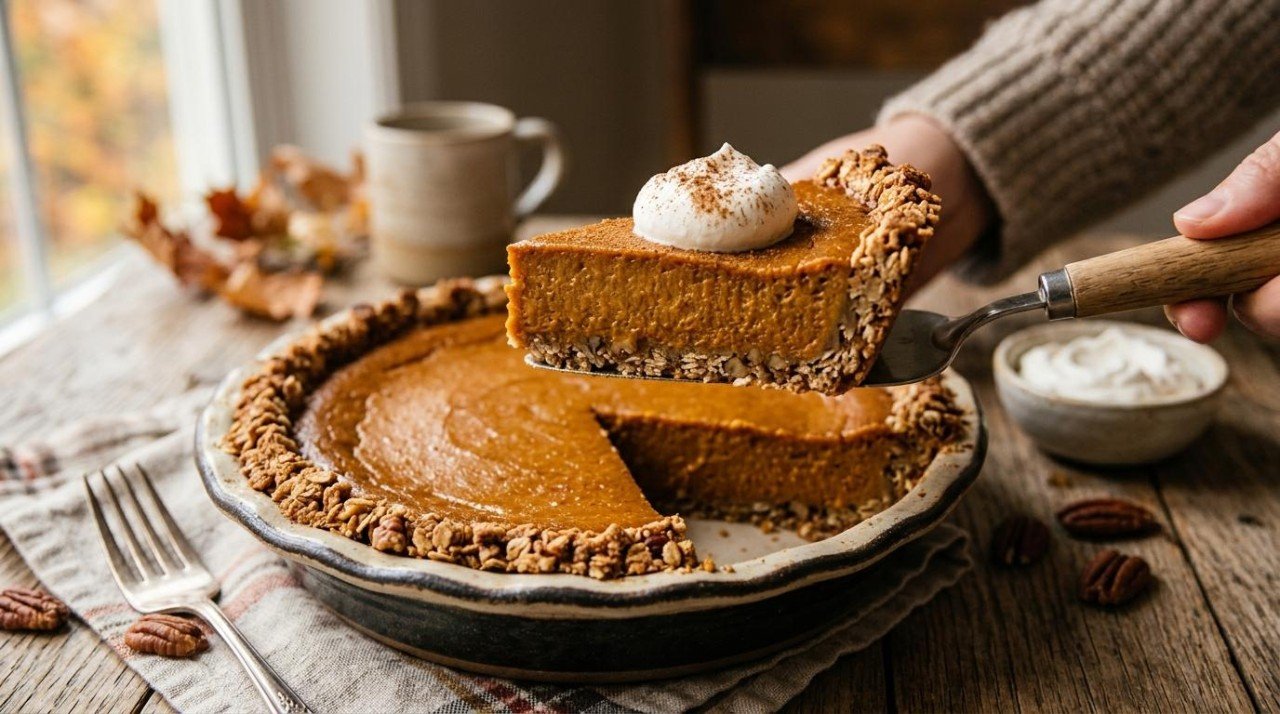
1. Replace the pastry crust with a pressed oat and nut crust
- Swap: 1 1/4 cups all-purpose flour + 1 stick butter → 1 1/4 cups rolled oats, 1 cup nuts, 3 tablespoons butter, 1 egg white
- Score impact: +7 points (28 to 35) - the biggest single move in the post
- What it changes: Saturated fat from 10.4 g to 7.3 g a slice; fiber from 2.2 g to 4.0 g, enough for the app to call it a good source; adds magnesium, zinc, biotin and phosphorus highlights
- What it costs you: Flake. This is a toasty, crumbly, cheesecake-style crust, not a shattering pastry one. A different pleasure, not a lesser one.
Seven points, and most of it is the butter. A single pastry crust carries a whole stick; a press-in crust needs three tablespoons, because the nuts bring their own fat. Meanwhile the flour, which contributes starch and little else, is replaced by two ingredients that contribute a great deal. Oats bring beta-glucan, the soluble fiber the FDA lets food makers link to reduced risk of coronary heart disease, with a meta-analysis putting 3 g a day at roughly a 12-point drop in blood cholesterol - and that fiber matters in a country where adults need 25 to 35 g a day and most get about 15. If you would rather keep a rolled crust and change the flour instead, our all-purpose flour substitutes guide covers that route.
The technique is easier than pastry, not harder. Pulse the oats, nuts and salt to coarse sand, add melted butter and an egg white, and pulse until a squeezed handful holds together. Press it up the sides first and then across the bottom - sides first is the trick that stops you running out of crust at the rim - and blind bake 12 minutes so it is set before the wet filling touches it.
2. Cut the sugar in half and raise the spice
- Swap: 3/4 cup granulated sugar → 6 tablespoons, with cinnamon doubled to 2 teaspoons, ginger to 1 teaspoon, cloves to 1/2 teaspoon, plus 1/2 teaspoon nutmeg and 2 teaspoons vanilla
- Score impact: +4 points (35 to 39)
- What it changes: Added sugar from 20.8 g to 11.5 g a slice, dropping it out of the very high band; 33 fewer calories
- What it costs you: Real sweetness, if you change nothing else. The extra spice is not decoration here - it is the compensation.
Halving the sugar here is far less brutal than halving it in a fruit pie, because the custard is not relying on sugar for structure - it is doing one job, and you can do part of that job with aroma instead. This is a real effect rather than a wellness talking point: cinnamaldehyde, the molecule that makes cinnamon smell like cinnamon, has been shown to activate the sweet taste receptor T1R2/T1R3 and amplify its response to other sweeteners - though the authors are careful to note that at everyday food doses the effect is probably mostly your nose telling your brain "sweet." Either way it runs in your favor. Double the cinnamon and the pie tastes sweeter than the sugar bill says it should.
Two practical notes. Buy pumpkin puree, not pumpkin pie filling - the second is puree with the sugar and spices already stirred in, which takes this swap out of your hands. And if your family recipe uses sweetened condensed milk rather than evaporated, know that you are pouring in milk and sugar pre-mixed; our guides to sweetened condensed milk and white sugar cover both.
3. Make half the nuts walnuts
- Swap: 1 cup pecans → 1/2 cup pecans + 1/2 cup walnuts
- Score impact: +4 points (39 to 43)
- What it changes: Omega-3 ALA moves from a listed weakness to an excellent source at 41% of the daily target
- What it costs you: Almost nothing. Walnuts are a shade more bitter than pecans; toasted and buried under cinnamon custard, you would struggle to call it.
This is the swap we would never have guessed was worth four points - twice what adding more pumpkin paid. ALA is a true essential fat, one the body cannot make, and walnuts are an unusually concentrated source: one ounce carries more than 2,500 mg. Splitting the nuts moved that nutrient off the app's weakness list and onto its strengths list in a single step, which is what crossing a threshold looks like. Harvard's review of the nut research also associates eating walnuts once a week or more with lower cardiovascular risk. Keeping the other half pecan is not sentimentality - pecan and pumpkin belong together, and the split costs nothing.
Take the Guesswork Out of Eating Well
Eat Well Planner helps you organize your favorite recipes, plan balanced meals, and automatically generate shopping lists — all in one place. Whether you're tracking macros, managing dietary restrictions, or just trying to stop asking "what's for dinner?", we've got you covered.
Our AI-powered tools can adapt any recipe to your dietary needs, help you discover new meals you'll love, and even log your nutrition effortlessly. It's meal planning made simple.
Start Organizing Your Meals — Free4. More pumpkin
- Swap: One 15-ounce can (about 1 3/4 cups) → 2 1/2 cups pumpkin puree
- Score impact: +2 points (43 to 45)
- What it changes: Vitamin A from 55% to 74% of the daily value; fiber up to 4.8 g a slice; iron to 30%
- What it costs you: A deeper, more squash-forward flavor, and you need a deep-dish pan. Some people prefer it - it tastes less like custard and more like pumpkin.
Adding more vegetable to the vegetable pie is the least surprising move here, and the honest report is that it only pays two points - the original was already excellent at the one thing pumpkin is excellent at. This is what a score is for: it stops you spending effort where there is nothing left to win.
5. A third egg
- Swap: 2 large eggs → 3
- Score impact: +1 point (45 to 46)
- What it changes: Protein from 9.7 g to 10.5 g a slice; adds choline and B12 highlights
- What it costs you: Nothing you would notice, beyond a slightly firmer set.
We would have added this egg regardless of the score. Two eggs set 1 3/4 cups of pumpkin; they do not reliably set 2 1/2 cups plus a can of milk, and a pie that will not slice cleanly is a failed pie whatever it scores. Sometimes an ingredient earns its place in the pan rather than on the scorecard.
6. Real whipped cream instead of tub topping
- Swap: 2 tablespoons tub whipped topping per slice → 1 tablespoon of unsweetened whipped heavy cream
- Score impact: -1 point (46 to 45)
- What it changes: Added sugar down to 9.4 g a slice; saturated fat up slightly, from 33% to 35% of the daily ceiling
- What it costs you: A point, and two minutes with a whisk. Make it anyway.
Here is the most useful number in this post, and it is a negative one. Tub topping is water, corn syrup, hydrogenated oil and emulsifiers - the most processed thing in the original pie by a distance, and the ingredient every makeover article tells you to bin first. Measured against real cream at a comparable serving, throwing it out is worth one point in the wrong direction. Removing it from the original pie entirely, changing nothing else, moved the score from 28 to 29.
We made the swap anyway, because a score is a model of nutrient density and it has no column for "made of four things instead of thirteen." What the numbers do settle is the portion. When we tested a generous dollop - a full tablespoon of liquid cream per slice, roughly double what we settled on - it scored three points below the tub topping. The cream is not the problem; the ladle is. Our heavy cream substitutes guide has the options if you want a lighter cloud.
What we kept, and where we stopped
The evaporated milk stays, and it does more work than it gets credit for: it is most of the reason the original counts as a good source of calcium and an excellent source of riboflavin, and its low water content is what makes a pumpkin custard silky instead of watery. Replacing it is the most commonly suggested "upgrade" to this pie and it is a mistake - see below. Our evaporated milk guide covers what to do if you have no can in the cupboard.
The butter stays too, three tablespoons in the crust, because the oats and nuts need fat to bind and because butter is what makes a toasted oat crust smell like a bakery. The eggs stay whole, yolks included. And we stopped one swap short of the obvious next one, for a reason worth its own section.
The healthier version: full recipe
Nutrition Score: 45/100 as served with a spoonful of whipped cream, and 47 for the pie on its own. Serves 8.
For the crust
- 1 1/4 cups (110 g) old-fashioned rolled oats
- 1/2 cup (55 g) pecan halves
- 1/2 cup (55 g) walnut halves
- 3 tablespoons (42 g) butter, melted
- 1 large egg white
- 1/4 teaspoon salt
For the filling
- 2 1/2 cups (600 g) pumpkin puree - one 15-ounce can plus about 3/4 cup from a second
- 1 can (12 fluid ounces) evaporated milk
- 6 tablespoons (75 g) granulated sugar
- 3 large eggs
- 2 teaspoons ground cinnamon
- 1 teaspoon ground ginger
- 1/2 teaspoon ground nutmeg
- 1/2 teaspoon ground cloves
- 2 teaspoons vanilla extract
- 3/4 teaspoon salt
To serve
- 1/4 cup (60 mL) heavy cream, whipped unsweetened - about 1 tablespoon of whipped cream per slice
- Heat the oven to 350°F and lightly butter a 9 or 9 1/2-inch deep-dish pie pan. This filling is generous; a shallow pan will overflow.
- Pulse the oats, pecans, walnuts and 1/4 teaspoon salt in a food processor until the mixture looks like coarse sand with a little nut texture left in it.
- Add the melted butter and egg white and pulse until a squeezed handful holds its shape.
- Press the crust firmly up the sides of the pan first, then across the bottom, keeping it as even as you can. Bake for 12 minutes, until it smells toasted and looks dry. Leave the oven on.
- Whisk the pumpkin, sugar, spices, vanilla and 3/4 teaspoon salt together until smooth. Whisk in the eggs one at a time, then the evaporated milk.
- Pour the filling into the warm crust. If the rim of the crust is already dark, cover it with a ring of foil.
- Bake for 50 to 60 minutes, until the outer 2 inches are set and a circle about 2 inches across still wobbles in the center. Illinois Extension advises that a pumpkin pie reach 180°F at its coolest point, so a thermometer in the middle is the reliable check. Take it out there - much past that and the custard tightens and cracks.
- Cool on a rack for at least 2 hours, then refrigerate for at least 2 more. Homemade pumpkin pie has to be refrigerated, and custard pies should not sit out for more than two hours.
- Whip the cream to soft peaks with no sugar in it and serve about a tablespoon per slice.
Per slice, original vs. improved:
- Nutrition Score: 28 → 45
- Calories: 376 → 390
- Protein: 8.0 g → 10.4 g
- Fiber: 2.2 g → 4.8 g
- Added sugar: 20.8 g (79% DV) → 9.4 g (35% DV)
- Saturated fat: 10.4 g (44% DV) → 8.2 g (35% DV)
- Vitamin A: 63% DV → 78% DV
- Omega-3 ALA: flagged low → 41% DV, an excellent source
- Plant points: 1.75 → 5
The calories went up by 14, and we are not going to pretend otherwise. A cup of nuts is a cup of nuts. This makeover trades a little energy for a much better set of nutrients around it, which is the trade the score is built to reward and the one a calorie count cannot see.
Swaps we tested and skipped
Going crustless. The obvious next swap, and the one every low-carb pumpkin recipe makes: bake the custard in a buttered dish and skip the crust entirely. It scored 48 against our 46 at the equivalent stage of the build. Two points, for giving up the whole crust. Two points is not a pie. It is worth knowing about if you are feeding someone avoiding grains, though - it is a genuinely good dish, and at 193 calories a serving it is the lightest thing on this page.
Maple syrup instead of sugar. Swapping the 6 tablespoons of granulated sugar for 1/3 cup of maple syrup moved the score from 46 to 47. One point. Maple brings a trace of minerals and a flavor that suits pumpkin beautifully, so make the swap if you like it - but make it for the taste, because nutritionally it is still sugar and the app counts it as added sugar in exactly the same way.
Coconut milk instead of evaporated milk. This is the standard dairy-free rewrite, and it is the worst thing you can do to this pie's numbers. The score fell from 46 to 41, and saturated fat per slice jumped from 7.7 g to 15.0 g - 64% of the daily ceiling, straight into the very high band. If you need it dairy-free, canned coconut milk is not the route.
Make it fit other diets
For dairy-free, the swap that actually works is an unsweetened evaporated oat or soy milk, or ordinary soy milk reduced by a third on the stove - what you want from that can is the low water content, not coconut fat. For gluten-free, use certified gluten-free oats and the pie is already there; nothing else in it contains wheat. Vegan is a real rebuild rather than a substitution, since three eggs are the structure - a silken tofu and cornstarch custard is the usual route.
Rather than guessing at ratios, drop the finished recipe into Eat Well Planner and ask its Recipe Variations for the version you need. It rewrites the whole recipe with the swaps worked in, and you can score the result before you commit a can of pumpkin to it.
Do this to your own recipes
Everything above came out of the app's Make It Healthier feature and its Recipe Playground. You import a recipe - from a URL, an Instagram reel, a YouTube video, or a photo of a handwritten card - and the app scores it, then proposes ingredient swaps with the nutritional gain verified by a calculator before the suggestion ever reaches you. In the playground you change one thing and watch the number move, which is the only way we would have found out that walnuts were worth four points and the whipped topping was worth minus one.
Do it with your grandmother's pie. You will probably find, as we did, that most of it was already fine and the real fix is smaller and more specific than the internet led you to expect. If the rest of the table needs the same treatment, we have already been through the stuffing and the sweet potato casserole.