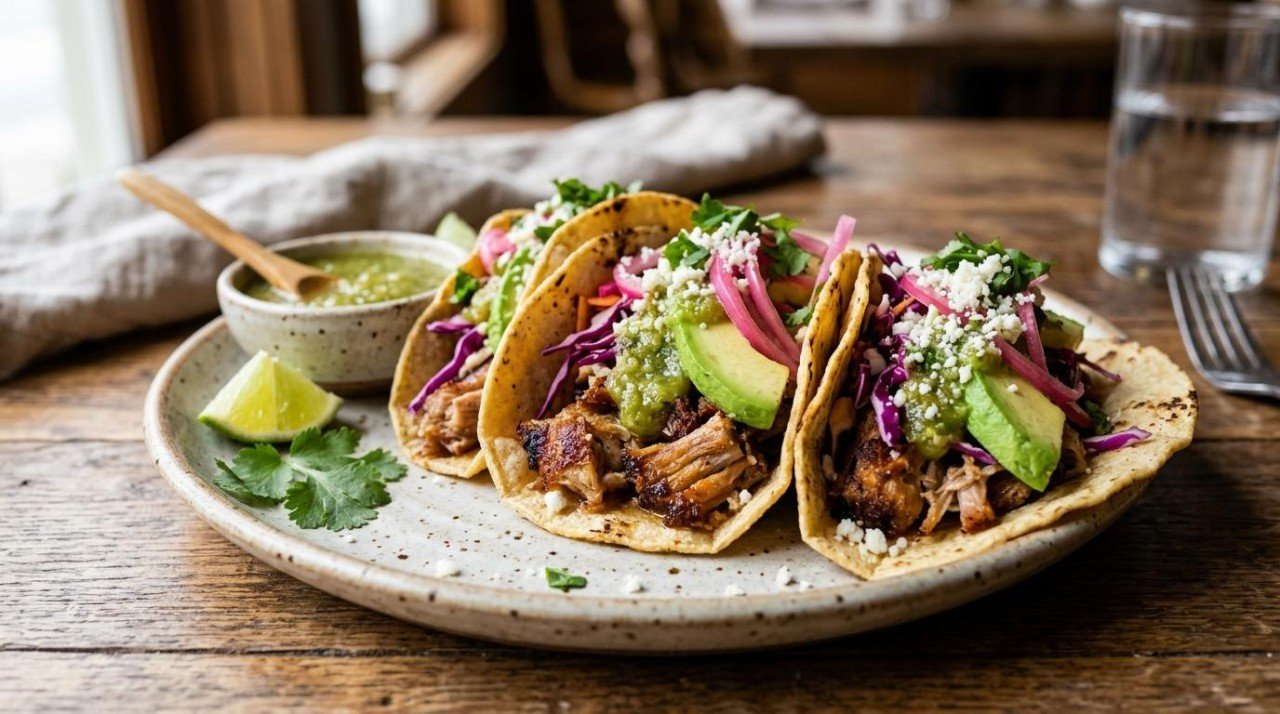
Carnitas are proof that patience beats technique. You season a cheap pork shoulder, let it go soft for a few hours in citrus and garlic, shred it, and then crisp it until the edges shatter. In Michoacán, where the dish comes from, the pork is simmered in lard and then crisped over higher heat. In American kitchens it usually turns into a slow-cooker braise finished in a skillet of lard, then piled onto flour tortillas under a blanket of cheese and sour cream.
We built that home version - three tacos to a plate - and ran it through the Eat Well Planner Nutrition Score. It came back at 35 out of 100. Then we rebuilt it one swap at a time, scoring every step, until the plate reached 75. The braise stays the same. The edges still crisp. The difference is mostly in what goes on the tortilla, and which tortilla you use.
One lesson came up again here: some swaps that barely registered early in the build turned out to be worth 5 to 7 points at the end. We will show both numbers.
The original: what's in it and how it scores
Our baseline uses Salt & Lavender's carnitas, a typical home recipe: 4 pounds of boneless pork shoulder rubbed with chili powder, oregano, cumin, 2 teaspoons of salt and black pepper, then braised with onion, jalapeño, garlic, half a cup of chicken broth, and orange and lime juice. We finished it the taqueria way, crisped in 1/4 cup of lard, and served it the way most American kitchens do:
- 24 six-inch flour tortillas (3 tacos per plate, 8 plates)
- 8 oz shredded Monterey Jack
- 1 1/2 cups sour cream
- Chopped white onion and cilantro
Per plate: 1,090 calories, 29.4 g saturated fat, 1,650 mg sodium, 4.3 g fiber, and 3.5 plant points. The score flags saturated fat at 125% of the app's daily reference and sodium at 72%. The heart health sub-score is 29 and gut health is 26.
Saturated fat is the main problem, and it comes from several places at once. The untrimmed shoulder accounts for about 14 g per plate. The cheese adds 5.4 g, the sour cream 4.6 g, the flour tortillas 2.6 g and the lard 2.5 g. No single fix clears the flag, which matters later.
Sodium comes from two places that are easy to miss. The flour tortillas carry about 630 mg per plate, more than the salt in the rub (about 580 mg). Most of the fiber comes from the tortillas, and three tacos come to just 4.3 g.
The good news: this is not a junk plate. It delivers 55 g of protein, nearly two days of thiamine, and excellent amounts of B12, zinc and niacin. The citrus-garlic-oregano braise is close to fat-free and has almost no added sugar. We are not changing the braise. We are changing everything around it.
The upgrades
Eleven swaps, scored cumulatively against production nutrition data. Each one was applied on top of the last, so the number beside it is what it was worth at that point in the build. For the swaps where order mattered, we also put the original ingredient back into the finished recipe and report what that cost.
1. Corn tortillas instead of flour
- Swap: 24 six-inch flour tortillas → 24 six-inch corn tortillas
- Score impact: +6 (35 to 41). Putting flour back into the finished recipe costs 15.
- What it changes: Sodium drops about 590 mg per plate (1,650 to 1,060), fiber rises, and 105 calories come off
- What it costs you: Nothing, if you warm them properly. This is how carnitas are served in Mexico.
This is the swap we would make if you only made one. The difference is sodium. Flour tortillas are made with salt and leavening, while corn tortillas are mostly masa, water and a little lime. In the app's data, flour tortillas carry about 700 mg of sodium per 100 g and corn about 50. Corn tortillas are also made from nixtamalized whole corn, and that alkaline cooking makes the corn's protein more usable and can add a lot of calcium.
Warm them in a dry skillet until they puff and get a few brown spots, then stack them in a towel. Cold corn tortillas crack, which is why many people give up on them. For more options, our tortilla substitutes guide compares the rest.
2. A cabbage-lime slaw on every taco
- Swap: Add 1/2 small head green cabbage, shredded and tossed with 2 tbsp lime juice
- Score impact: +5 (41 to 46)
- What it changes: More fiber, vitamin C and vitamin K, plus one more plant point
- What it costs you: Nothing - crunch and acid are exactly what rich pork needs
Fish tacos come with cabbage and carnitas usually don't, but they should. A handful of cold, lime-dressed cabbage against hot crisp pork is the best texture contrast you can add. Toss it at the last minute so it stays crunchy. No mayo and no salt: the pork and the salsa supply both.
3. Homemade salsa verde and quick-pickled red onions
- Swap: Add a broiled tomatillo-jalapeño salsa verde and red onions pickled in apple cider vinegar
- Score impact: Salsa +3 (46 to 49), onions +1 (49 to 50)
- What it changes: Two more plant points, more vitamin C and fiber, and a lot of brightness
- What it costs you: 15 minutes, and both keep for a week in the fridge
We made the salsa because it beat jarred. The app's jarred salsa verde carries 910 mg of sodium per 100 g. Ours has a quarter teaspoon of salt for the whole pound of tomatillos. Broil the tomatillos and jalapeños until blistered, then blend them with cilantro and lime. The pickled onions are just sliced red onion covered with vinegar and hot water. They turn bright pink in 30 minutes and add the sharp bite that sour cream used to cover up. (Out of cider vinegar? Here is what works instead.)
4. Trim the shoulder, skim the juices, and lose the lard
- Swap: Trim the exterior fat cap to about 1/4 inch, skim the braising liquid, and crisp the shredded pork under the broiler with its own defatted juices instead of frying it in 1/4 cup lard
- Score impact: Trimming +1 (50 to 51), broiler instead of lard +1 (51 to 52). In the finished recipe, an untrimmed shoulder costs 6 points and the lard costs 5.
- What it changes: Saturated fat per plate from 27.2 g to 20.4 g, and about 170 calories off
- What it costs you: Very little. The broiler gives you crisp, caramelized edges. Lard gives a slightly richer, more even crunch.
This swap explains the whole score. Taking about 7 g of saturated fat out of the pork moved the score only two points, because the cheese and sour cream still held the plate over the saturated-fat line. Once they were fixed, putting the same fat back cost 5 to 6 points each. When the score barely reacts to a swap, it does not always mean the swap is pointless. Sometimes it means a bigger problem has to be fixed first. We saw the same thing on our pulled pork makeover.
Don't trim the shoulder down to bare meat. As Texas A&M's meat science guide notes, the cut is made of "many locomotion muscles in the shoulder that vary in tenderness and contain substantial connective tissue." That collagen, not the fat cap, is what keeps carnitas juicy. For the broiler finish, used by both Kristine's Kitchen and Salt & Lavender: spread the shredded pork on a sheet pan, toss it with some of the defatted cooking liquid, and broil on the top rack. The juices reduce onto the meat and the edges caramelize in the pork's own fat. Use enough liquid to coat the pork without pooling, or it steams instead of crisping.
5. Greek yogurt-lime crema instead of sour cream
- Swap: 1 1/2 cups sour cream → 1 1/2 cups plain Greek yogurt, thinned with water to drizzling consistency
- Score impact: +3 (52 to 55). Sour cream back in the finished recipe: -10.
- What it changes: 4.5 g less saturated fat and 3 g more protein per plate
- What it costs you: Slightly tangier. Thinned out and drizzled, most people won't notice.
Thinning it matters. A dollop of thick Greek yogurt tastes like yogurt, but a thin drizzle tastes like crema. Stir in water a tablespoon at a time until it falls off a spoon in a ribbon. Our sour cream substitutes guide covers the other options if yogurt isn't your thing.
6. Two ounces of cotija instead of eight ounces of Jack
- Swap: 8 oz shredded Monterey Jack → 2 oz crumbled cotija
- Score impact: +7 (55 to 62). Putting the Jack back costs 7.
- What it changes: Saturated fat from 15.9 g to 11.6 g per plate and 86 calories off. This is where the saturated-fat warning finally clears.
- What it costs you: No melty cheese. You get a salty, crumbly finish instead, and you need far less.
This was the biggest single jump in the build, because it is the swap that clears the warning. Cotija is aged, dry and salty, so a light sprinkle does what a handful of melted Jack did. Per gram it is actually saltier, but at a quarter of the amount the plate still loses sodium.
7. Halve the salt in the rub
- Swap: 2 tsp salt → 1 tsp (6 g)
- Score impact: +6 (62 to 68). The full 2 teaspoons in the finished recipe: -7.
- What it changes: Sodium from 1,060 mg to 770 mg per plate
- What it costs you: Nothing you'll taste on the finished taco, with salsa, cotija, pickled onions and lime already on it
The rub was salted for meat eaten on its own. On a taco, the pork is one of several salty, sour and bright toppings, and the full amount was more than it needed. The FDA puts the daily limit at under 2,300 mg and notes that Americans average about 3,400 mg. This plate now uses about a third of the limit instead of nearly three-quarters.
8. Three pounds of pork instead of four
- Swap: The same 24 tacos from a 3 lb shoulder instead of 4 lb
- Score impact: +3 (68 to 71). Going back to 4 lb costs 3.
- What it changes: About 105 calories and 2.5 g saturated fat off each plate, with 42 g of protein still on it
- What it costs you: Slightly less meat per taco, which the slaw and salsa now make up for
Making the meat portion smaller doesn't move the score by itself. Changing the ratio does, because with more toppings per bite, each bite has more nutrients. Three pounds raw for 8 plates is about 170 g of raw pork per person, which matches the yield Salt & Lavender gives for their own recipe (12 servings from 4 to 5 pounds).
9. Sliced avocado
- Swap: Add 3 medium avocados, sliced, across the 24 tacos
- Score impact: +4 (71 to 75)
- What it changes: Fiber from 8.9 g to 12.3 g per plate, plus potassium and unsaturated fat
- What it costs you: About 80 calories per plate
This is the only swap that added calories, and it was worth it. Avocado also helps you absorb the carotenoids in the salsa. In a 2005 study in the Journal of Nutrition, adding avocado to salsa increased lycopene absorption 4.4 times and beta-carotene absorption 2.6 times compared with salsa alone. Avocado is also a standard carnitas topping, and Maricruz Avalos suggests guacamole with her Michoacán-style version.
What we kept (on purpose)
The whole braise is unchanged: shoulder, not loin; the chili powder, oregano and cumin rub; orange, lime, garlic and jalapeño; the half cup of broth. The crisping step stays too, with the broiler taking over from the lard. We also kept a little cheese, because cotija is a classic carnitas taco topping and a light sprinkle costs little. We stopped at 75 because the remaining options either changed the dish or added calories for a small gain (see below).
Take the Guesswork Out of Eating Well
Eat Well Planner helps you organize your favorite recipes, plan balanced meals, and automatically generate shopping lists — all in one place. Whether you're tracking macros, managing dietary restrictions, or just trying to stop asking "what's for dinner?", we've got you covered.
Our AI-powered tools can adapt any recipe to your dietary needs, help you discover new meals you'll love, and even log your nutrition effortlessly. It's meal planning made simple.
Start Organizing Your Meals — FreeEvery score in this post came from the same engine behind the app's Make It Healthier feature. Import a carnitas recipe from a website or a TikTok and the app scores it, proposes swaps like these, and checks each gain with a calculator before showing it to you. If you'd rather keep the Jack cheese, try it in the Recipe Playground. It shows what the cheese costs, and you can see whether adding more slaw makes up for it.
The healthier version: full recipe
Nutrition Score: 75 (up from 35). Makes 24 tacos, 8 servings of 3. Prep 30 minutes; cook about 3 hours 45 minutes, mostly hands-off.
For the carnitas
- 3 lb boneless pork shoulder (Boston butt), exterior fat cap trimmed to about 1/4 inch
- 1 tablespoon chili powder
- 2 teaspoons dried oregano
- 2 teaspoons ground cumin
- 1 teaspoon fine salt (6 g)
- 1/2 teaspoon black pepper
- 1 medium onion, chopped
- 1 jalapeño, finely chopped
- 6 garlic cloves, minced
- 1/2 cup chicken broth
- Juice of 1 large orange (about 1/3 to 1/2 cup)
- 2 tablespoons lime juice
For the salsa verde
- 1 lb tomatillos, husked and rinsed
- 2 jalapeños
- 1 cup loosely packed cilantro leaves and tender stems
- 1 tablespoon lime juice
- 1/4 teaspoon salt
For the toppings
- 1 large red onion, thinly sliced
- 1/2 cup apple cider vinegar plus 1/2 cup hot water
- 1/2 small head green cabbage, thinly sliced (about 5 cups)
- 2 tablespoons lime juice
- 1 1/2 cups plain Greek yogurt (nonfat or 2%)
- 3 medium avocados, sliced
- 2 oz cotija, crumbled (about 1/2 cup)
- 1/2 cup finely diced white onion and 1/2 cup chopped cilantro
- 24 six-inch corn tortillas
- Lime wedges, for serving
- Pickle the onions first: pack the sliced red onion into a jar, pour the vinegar and hot water over it, and refrigerate at least 30 minutes.
- Heat the oven to 300°F. Cut the pork into 4 large pieces. Mix the chili powder, oregano, cumin, salt and pepper and rub it over every side.
- Put the pork in a Dutch oven with the onion, jalapeño, garlic, broth, orange juice and lime juice. Cover and bake 2 hours, then uncover and bake about 1 1/2 hours more, until the pork shreds easily. (Or cook on low in a slow cooker for 8 to 10 hours.)
- While the pork cooks, make the salsa: broil the tomatillos and jalapeños on a sheet pan 6 to 8 minutes, turning once, until blistered and soft. Stem the jalapeños (seed them for less heat) and blend everything with the cilantro, lime juice and salt.
- Lift the pork out and pour the cooking liquid into a fat separator, or chill it in the freezer for 15 minutes and spoon off the fat that rises to the top.
- Shred the pork with two forks, pulling out and discarding any large pieces of fat. Spread it on a rimmed sheet pan and toss with about 1 cup of the defatted liquid.
- Broil on the top rack 5 to 8 minutes, until the edges are browned and crisp. Toss, drizzle on a little more liquid, and broil 3 to 5 minutes more.
- Toss the cabbage with the lime juice. Stir water into the yogurt a tablespoon at a time until it drizzles.
- Warm the tortillas in a dry skillet until they puff and spot, then wrap them in a towel.
- Build each taco: carnitas, slaw, salsa verde, pickled onions, avocado, a drizzle of crema, a pinch of cotija, and diced onion and cilantro. Serve with lime wedges.
Per plate (3 tacos), original → healthier:
- Nutrition Score: 35 → 75
- Calories: 1,090 → 691
- Saturated fat: 29.4 g → 10.2 g
- Sodium: 1,650 mg → 730 mg
- Fiber: 4.3 g → 12.3 g
- Protein: 55 g → 43 g
- Plant points: 3.5 → 8.5
Fiber goes from 14% to 42% of the Daily Value, vitamin C from 13% to 55%, and vitamin K from 12% to 50%. The heart health sub-score goes from 29 to 72 and gut health from 26 to 76.
Swaps we tested and skipped
Half pork loin. Replacing half the shoulder with loin scored 79, four points higher. But loin has little of the connective tissue that turns into gelatin, so it tends to cook up dry and stringy in a long braise. Carnitas need to be juicy, so we kept all shoulder.
No cheese at all. Dropping the cotija completely scored 3 points higher. A note on how we measured it: in the app's data, cheese carries a trace of omega-3 EPA and DHA. The score ignores a nutrient at exactly zero but rates a trace amount as low, so removing the cheese can look better than it really is. We added a matched trace to both versions before comparing them. Plenty of taquerias serve carnitas with no cheese at all, so leave it off if you like.
Doubled corn tortillas. Two tortillas per taco, the way many taquerias serve them, scored 78. That's 3 points more, but it adds 170 calories per plate, so we left it as your choice.
Unsalted stock and ancho powder. Tested earlier in the build, unsalted chicken stock instead of broth scored +0, since half a cup split across 8 plates is only about 50 mg of sodium each. Swapping the chili powder blend for pure ancho chile powder scored -1. Neither change was worth making.
Make it fit other diets
- Gluten-free: It already is, as long as your corn tortillas are 100% corn and your chili powder and broth are labeled gluten-free.
- Dairy-free: Skip the cotija and replace the yogurt crema with avocado blended with lime juice and a splash of water.
- Vegetarian: Use torn oyster mushrooms with the same rub and citrus, roasted and then broiled until crisp. It's a different dish, but it uses the same build.
For a full rewrite, the app's Recipe Variations does it in one step: ask for a dairy-free or vegetarian version and the whole recipe comes back with the swaps already worked in.
Do this to any recipe
The pork was only part of the story here. The biggest gains came from the tortilla, the toppings and the order of the fixes. Corn tortillas and slaw were worth 11 points together, cotija and the salt cut were worth 13, and the fat cuts on the pork only paid off fully once the cheese and sour cream were fixed. If you'd like more taco nights like this one, see our birria tacos, fish tacos and Chipotle burrito bowl makeovers.
Import your own favorite recipe, score it, and let Make It Healthier find which swaps matter most for that dish. Eat Well Planner is free to use.